

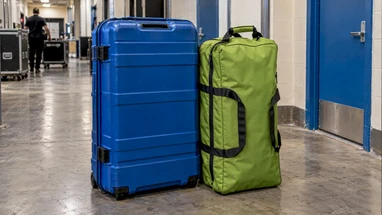
Hard vs. Soft Cases for Trade Show Displays: How to Choose
Posted by Deeder Dandenhorf on Oct 22nd 2026
Hard vs. Soft Cases for Trade Show Displays: How to Choose

Choose a hard case when your display ships by freight or parcel, gets handled by strangers, or contains graphics and hardware you can’t afford to replace before show day. Choose a soft case when you carry the display yourself, load it in your own vehicle, and want something light that folds away at the office. Most small exhibitors who fly or ship end up with a hard case. Most who drive to local expos do fine with soft.
That’s the short version. The rest of this guide covers where each type earns its price, where it doesn’t, and how to match a case to the display you own, whether that’s a retractable banner stand, a tension fabric display or a pop up.
TL;DR
- Hard cases protect better against crushing, drops and rough freight handling, and they stack and ship cleanly. They cost more and take up fixed space.
- Soft cases are lighter, cheaper and easier to carry and store, which suits local events where you control the transport.
- If a carrier or show contractor will touch your display, a hard case is the safer default. If it rides in your own SUV, a padded soft bag is usually enough.
- Weight drives cost at large shows, so a case that adds pounds can add handling fees. Check the numbers before you buy.
- Arrowhead Sign Company sells hard cases in several sizes, plus accessories and travel bags, and most products ship within two business days.
Table of Contents
- What the difference really means for a display
- Hard case vs. soft case at a glance
- Where hard cases win
- Where soft cases win
- The costs that decide it: weight and handling
- Match the case to the display
- The clamshell trap
- How to tell a good case from a marketing label
- Our perspective: protect the thing you paid for
- Ready to pair a case with your display?
- A quick decision guide
- FAQ
- Sources
What the difference really means for a display
The search results for this topic are mostly about suitcases and phone cases, and the logic carries over more than you’d expect. A case is a trade-off between protection, weight, capacity and convenience. Trade show gear just raises the stakes, because the thing inside is a printed graphic you ordered for a specific date.
Hard cases are rigid shells, usually molded plastic or similar, often with wheels, a latching lid and a foam or open interior. They resist crushing and keep sharp corners from poking through.
Soft cases are fabric bags, typically padded or lined, with handles or shoulder straps. They flex, compress and weigh less, but they only protect as well as the padding and what’s stacked on top of them.

The luggage world has landed on the same split. Wirecutter’s comparison of soft-sided and hard-sided suitcases notes that a quality bag of either type beats a cheap bag of the other, so build quality matters more than category. Consumer Reports adds that hard-shell luggage may offer the most security, while soft-sided bags fit more easily into tight spaces. Both points apply to a banner stand case.
Hard case vs. soft case at a glance
| Factor | Hard case | Soft case |
|---|---|---|
| Crush and impact protection | Strongest | Depends on padding |
| Best for | Freight, parcel, air travel, repeat shows | Local events, your own vehicle |
| Weight | Heavier | Lighter |
| Storage at the office | Fixed footprint | Folds or compresses |
| Wheels | Common on larger sizes | Less common |
| Security | Latches and locks | Zippers |
| Upfront cost | Higher | Lower |
| Lifespan | Long, if latches and wheels hold | Long if fabric and seams are good |
Treat the table as a starting point. A cheap hard case with weak latches can lose to a well-padded soft bag, which is exactly the point Wirecutter makes about build quality.
Where hard cases win
Shipping by carrier or freight
Once a box leaves your hands, you can’t control how it’s stacked, dropped or strapped down. A rigid shell spreads load across the whole case instead of letting a heavy box crush a fabric bag onto a pole or a cartridge. If your display is shipped to a convention center or advance warehouse, a hard case is the layer that decides whether the graphic arrives flat and clean.
We cover the shipping side in more detail in our guide to trade show shipping cases.
Protecting a graphic you can’t replace overnight
A creased or scuffed print is a problem you notice at 7 a.m. on setup day. Hard cases keep retractable banner cassettes and rigid components from shifting. If you’ve ever had a banner edge curl or a stand end snap, you know the cost of a bad trip is bigger than the price difference between case types. Our post on carrying cases and banner lifespan goes through how storage habits affect how long a banner stays presentable.
Security and reuse
Industry experts quoted by Consumer Reports point out that a hard-sided bag cannot be intentionally ripped open with a blade, which matters if your display travels through airports or sits in a loading dock. Latches that accept a lock also give you a little peace of mind.
Capacity can surprise you
It’s common to assume soft bags hold more. Wirecutter’s testing found that a hard-sided carry-on can hold roughly 25% more volume than a soft-sided one of similar exterior size, around 48L against 38L, because soft bags use internal framing. For display cases the effect is smaller, since many are built around one item, but it’s a reminder to compare internal dimensions, not the outside.
Where soft cases win
Local events and your own vehicle
If you drive a banner stand to a farmers market, a chamber of commerce mixer or a regional expo, a padded bag does the job. It slides behind a seat, goes in a trunk and doesn’t take a cart to move. Consumer Reports’ buying advice for road trips is to look for bags pliable enough to maximize your trunk space, and the same applies to a loaded SUV.
Storage between shows
A hard case needs a permanent spot in your office, closet or garage. Wirecutter points out that hard shells are rigid and need larger fixed footprints at home or in a vehicle, something people tend to underestimate until the empty case is in the way. A soft bag gets tucked into a corner.
Weight and carrying comfort
Soft cases generally weigh less, and a shoulder strap frees a hand for the door. For a single exhibitor setting up alone, that matters more than a spec sheet suggests.
Price
Soft bags usually cost less up front. If you run one or two local events per year, that savings is real. If you ship to eight shows a year, it can be false economy.
The costs that decide it: weight and handling
At large shows, the case is part of your freight bill. Drayage, the service that moves your freight from the dock to your booth and back, is charged per hundredweight, with typical US rates cited at $60 to $180 per CWT for round-trip handling. One CWT is 100 pounds, and each shipment is rounded up. A heavier case can push you into the next 100-pound increment.

Here’s a simple worked example using that source’s range. Say your display and case together weigh 95 pounds. That bills as 1 CWT. At $60 per CWT, you pay $60. At $180, you pay $180. Add 10 pounds with a heavier case and you bill as 2 CWT, so the bill doubles to $120 to $360. The same logic applies to minimums at some venues, so read the exhibitor kit before you ship.
Two practical takeaways:
- If you’re shipping a lightweight display to a show with drayage, weigh the packed case before you choose.
- If you can hand-carry the display into the hall, many shows let you skip drayage entirely. Ask the show organizer about its policy before you decide. In that case, a rolling hard case or a light soft bag may both work, and weight matters less than carrying ease.
Match the case to the display
Retractable banner stands
These are the simplest to protect. A cassette base with a rolled graphic is compact, and many stands arrive with a basic bag. For local events, that bag may be enough. For shipping, a hard travel case keeps the cassette from being crushed. Our accessories and cases page shows what’s available for banner stands and larger displays.
Tension fabric and stretch displays
Frames come apart into tubes and connectors, and the graphic is a separate fabric piece. The tubes are tough, but the fabric needs to stay clean and unpinched. A hard case with room for both is ideal for shipped shows. A padded soft bag works for the fabric if you’re driving.
Large wheeled transporters
Longer displays call for a case you can roll. Our La Caja hard case with wheels at 64 inches and the La Cajita at 53 inches are built for that kind of display transport.
Smaller kits and table-top setups
For a table cover, a few small signs and a tabletop banner, the Half Sized Hard Case or Medium Sized Hard Case can be a tidy match, and either one stacks easily in a vehicle.
The clamshell trap
Many hard cases open as two halves. Consumer Reports notes that this 50/50 style needs more floor space to open fully than a lid-style bag. In a cramped hotel room or a narrow booth, that’s a hindrance. When you compare hard cases, ask how the lid opens and whether you can unpack with the case standing or lying against a wall.
How to tell a good case from a marketing label
Be skeptical of vague durability claims. This is well documented in phone cases: Android Police explains that “military-grade” ratings are mostly self-reported by manufacturers using non-standardized methods. Independent testing backs up the idea that price and labels don’t guarantee results: in a 2025 Rossen Reports drop test, a $46 case protected a phone from a 20-foot drop while a $99.99 model failed.
Those are phone cases, not display cases, but the lesson transfers. Inspect these details instead:
- Latches and hinges: Do they feel solid and close without force? These fail first.
- Wheels: Spin them and check they’re firmly attached. Consumer Reports suggests testing wheels, a common weak spot, on any rolling bag.
- Interior fit: Measure your folded display, including the base. Leave a little room for the graphic.
- Handles: A handle that digs in when the case is full will annoy you for years.
- Soft-bag fabric and seams: Look for dense, abrasion-resistant fabric, such as high-denier nylon, and reinforced stitching at strap points.
Kit Dillon, quoted by Wirecutter, says the durability gap between quality soft and hard luggage has narrowed, and that hard shells can show scratches more easily. Appearance matters if the case sits in your booth, so factor that in.
Our perspective: protect the thing you paid for
We sell displays to small businesses that have a date on the calendar, so we think about cases from the point of view of someone with a deadline. Here’s how we’d approach it.
First, think about the route, not the product. A display that rides in your own vehicle faces different risks than one that goes through a carrier. The case should match the riskiest leg of the trip.
Second, buy the case when you buy the display. Many exhibitors treat the case as an afterthought and then scramble for a box the week before an event. Our products ship quickly, with most leaving within two business days, so the case can arrive with the display rather than after it.
Third, if you’re in Arizona, ask about delivery. We offer direct delivery to clients’ venues in the state, which takes one more handoff out of the chain for local expos. For events elsewhere, we ship nationwide.
Finally, don’t over-buy. If you exhibit twice a year in the Phoenix area and load the display yourself, a hard wheeled transporter may be more case than you need. If you ship to shows out of state, it’s usually the cheaper choice once you count one ruined graphic.
— Dan
Ready to pair a case with your display?
If you’re choosing a display and a case together, start with our Trade Show Products & Displays range, or browse Quick Ship Displays if your event is close. For a banner stand that needs a protective travel case, our retractable hard shell travel case is one place to look, and the Lucid molded plastic travel case and its large version cover bigger kits. Ordering a banner? Our printed banners page lists a standard banner layout at 35 USD, and Next Day Air at 10 USD when your timeline is tight.
A quick decision guide
Answer these four questions in order:
- Will anyone else handle the display? If a carrier, show contractor or airline will, pick a hard case.
- How often will it travel? More than a few trips a year favors hard. One or two local events favors soft.
- Where will it live between shows? If space is tight, a soft bag or a stackable hard case is easier to live with.
- What happens if the graphic is damaged? If you can’t reprint before the show, protect it with a hard case.
If you land on a mix, that’s fine. Many exhibitors use a hard case for shipped events and a soft bag for local drives.
FAQ
Is a hard case or a soft case better for a trade show display?
For shipping, a hard case is better because it resists crushing and rough handling. For local events where you load the display yourself, a padded soft case is usually enough and is lighter to carry. The route and number of trips matter more than the case category.
Do hard cases cost more in shipping?
They can, since they weigh more, and freight at large shows is billed by weight. Drayage is charged per hundredweight and rounded up, so weigh your packed case and check the show’s exhibitor kit. If you can hand-carry into the hall, you may avoid drayage entirely.
Can a soft case hold more than a hard case?
Not always. Wirecutter’s testing on carry-on luggage found that soft-sided bags lose internal space to framing. Compare inside dimensions against your folded display rather than assuming.
How do I know a case is truly durable?
Check latches, hinges, wheels and handles in person or through independent reviews. Ignore broad claims such as military-grade ratings, which are often self-reported by manufacturers.
What case do I need for a retractable banner stand?
A basic padded bag works for local events. If the stand will ship, a hard travel case protects the cassette and the graphic better. See our banner stands and accessories and cases pages for options.
Sources
- Soft-Sided vs. Hard-Sided Suitcases: The Final Showdown, Wirecutter
- A Soft-Sided Suitcase Lover Tries Away’s Softside Carry-on, Wirecutter
- Choosing Between Hard-Shell and Soft-Sided Luggage, Consumer Reports
- How to Buy Luggage, Consumer Reports
- Best Luggage Buying Guide, Consumer Reports
- 7 Common Luggage Problems and How to Fix Them, Consumer Reports
- Why most military-grade cases need to go back to basic training, Android Police
- Rossen Reports: affordable phone cases that protect from drops, KCRA
- Trade Show Shipping Costs: Freight, Drayage & Budget, Freightzy