

Avoid 35–55% Drayage Premiums, Exhibitors' Trade Show Shipping Cases
Posted by Deeder Dandenhorf on Sep 3rd 2026
Avoid 35–55% Drayage Premiums, Exhibitors’ Trade Show Shipping Cases
For exhibitors who hit the same regional or national circuit repeatedly, ATA/road cases are worth the investment for core AV and hardware, while lighter molded cases handle graphics and collateral. One-off or occasional shippers do better with wood crates built for a single heavy haul. The tradeoff is simple: heavier, tougher cases protect your gear but raise drayage costs, so match the case to the trip, not just the item. Several products are available; the Signicade Deluxe A-Frame Sidewalk Sign, the 10 ft stretch fabric display, and the Outdoor Banner Frame are engineered to fit these lighter, lower-cost shipping profiles.
TL;DR:
- Using ATA/road cases for repeated, fragile equipment ensures durability over many trips, while lightweight molded cases are suitable for signage and smaller electronics.
- Properly sizing, labeling, and weighing your cases after packing prevents drayage billing disputes and reduces handling surcharges, especially for uncrated or odd-shaped freight.
- Foam interior setups with at least 2 inches of clearance and labeled compartments greatly reduce damage risk and streamline setup, saving time and expense.
- Shipping via advance warehouse 10 to 14 days prior to the show provides buffer time and reduces the risk of delays affecting move-in, especially for complex exhibits.
- Accurately tracking shipments, confirming delivery, and timely booking outbound freight are critical to avoiding stranded freight and costly last-minute charges.
Table of Contents
- What Types of Trade Show Shipping Cases Should You Use?
- How Do You Choose Case Size and Labeling to Avoid Drayage Penalties?
- What Packing and Foam Setup Protects Fragile Exhibit Materials?
- Should You Ship to the Advance Warehouse or Direct to the Show?
- Why Case Selection and Fulfillment Speed Actually Matter
- What Actually Drives Your Drayage Bill?
- How Do You Avoid Scheduling Failures at Move-In and Move-Out?
- What Insurance Coverage Do You Need for Trade Show Shipments?
- How Do You Track Your Shipment Once It’s on the Road?
- The Case Decision Nobody Talks About Until It Costs Them Money
- Which Arrowhead Products Fit Your Shipping Profile
- Sources
- FAQ
What Types of Trade Show Shipping Cases Should You Use?
Not every piece of your booth needs the same level of protection, and buying max-durability cases for everything wastes money on drayage you don’t need to spend.
ATA/road cases are the industrial standard for anything fragile, expensive, or shipped repeatedly. ATA 300 certification means a case has passed testing for repeated handling, high-impact drops, vibration, and environmental exposure like moisture and dust, which is why touring AV crews and frequent exhibitors rely on them for monitors, control boards, and lighting rigs. Expect these to handle well over 100 round trips before they need retiring.
Molded and rotomolded plastic cases sit a step down in toughness but weigh less, making them a solid fit for signage hardware, tablet stands, and smaller electronics that still need real protection. Most hold up for 50 to 100 trips depending on how roughly they’re handled.
Wood crates make sense for one-off or infrequent heavy shipments, like a single large structural element headed to a single show. They cost less upfront but don’t have the reusable lifespan of a road case.
Soft bags work fine for banner stands, table covers, and literature that can tolerate a little compression.
A practical mix looks like this:
- ATA cases for AV, monitors, and anything with circuit boards
- Molded plastic for hardware, tools, and mid-weight fixtures
- Wood crates for oversized one-time structural pieces
- Soft bags for graphics, linens, and printed collateral
Reusable cases with foam interiors also tend to lower long-term costs by cutting down on damage claims compared to relying on one-way wood crates for every shipment, which is a real consideration if you’re doing more than two or three shows a year, as noted by Trade Show Advisor.
How Do You Choose Case Size and Labeling to Avoid Drayage Penalties?
Drayage contractors don’t charge based on how careful you were packing. They charge based on how your freight looks on paper and how easily a forklift operator can move it. Get the specs wrong and you’ll pay for it, sometimes literally in high minimum fees.
- Match forklift clearance. Most venues run forklift clearance between 72 and 80 inches, so keep crate height inside that window and, where possible, size the footprint to fit a standard 48x40 pallet.
- Build for stacking. Reinforce lids so cases can be stacked two or three high. Freightzy’s crating guide notes that stackable, forklift-ready crates routinely avoid the special handling surcharges that hit awkward, one-off shapes.
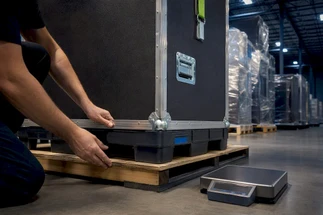
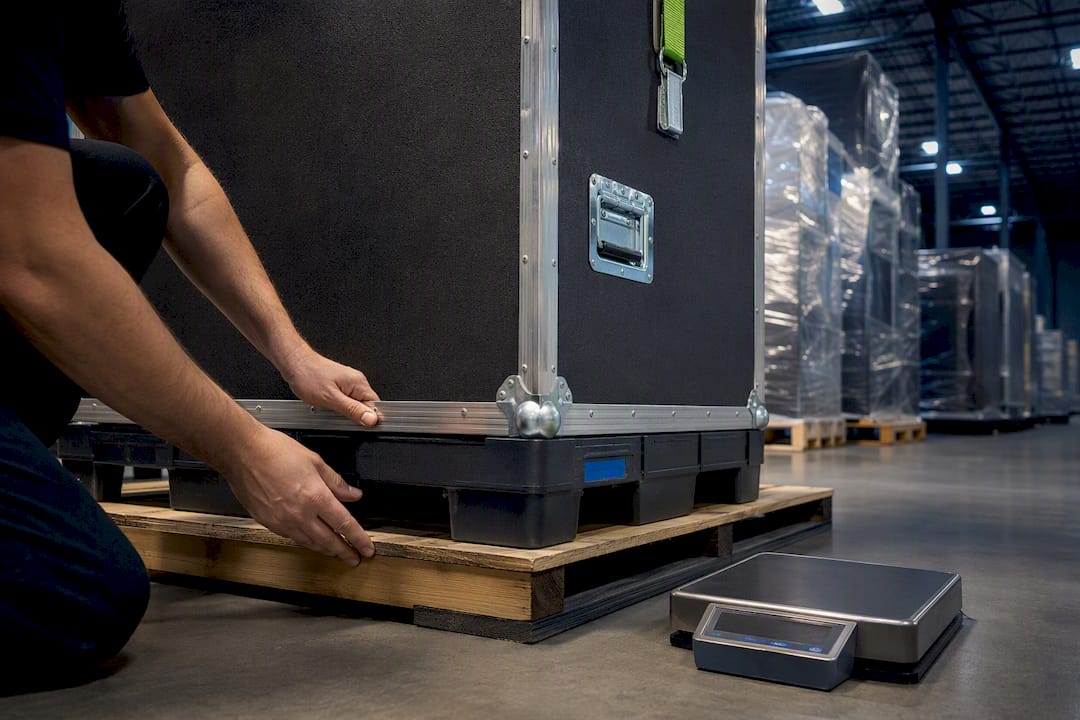
- Weigh after full pack-out, not before. A crate weighed empty and then loaded with 200 pounds of gear will get flagged the moment the contractor puts it on a scale, and that mismatch triggers disputes and rebills.
- Print actual weights on the bill of lading. This single step prevents the most common billing argument at move-in.
- Label all four sides. Every case should show the show name, booth number, hall, exhibitor name, an arrow indicating “up,” and a phone number for whoever’s managing logistics on-site.
Statistic to know: crated freight consistently gets the lowest drayage rate per hundredweight, while blanket-wrapped or uncrated freight can run 35 to 55 percent higher on that same charge. That gap alone often justifies the cost of a proper case.
What Packing and Foam Setup Protects Fragile Exhibit Materials?
Good exterior protection means nothing if the inside of the case lets equipment slide around during transit. Interior planning is where most damage claims actually originate.
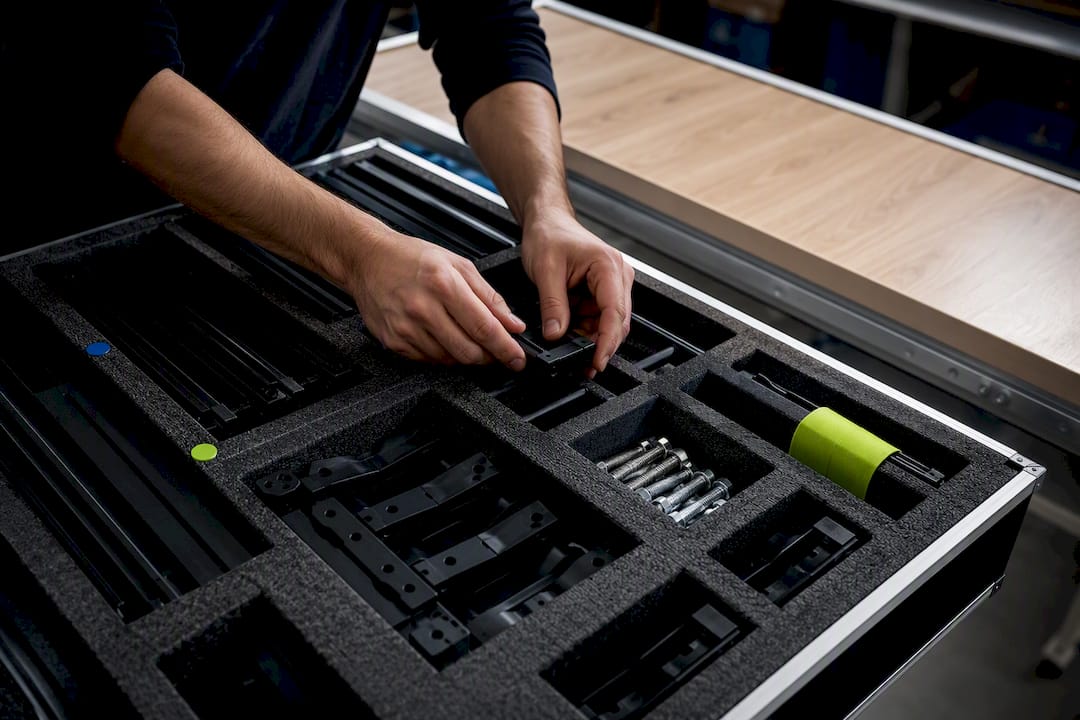
Foam liners need at least 2 inches of clearance around every item, front, back, and sides, to absorb shock from drops or rough handling. You’ve got two main foam options: pick-and-pluck foam, which you customize by pulling out perforated cubes to match your gear’s shape, and die-cut foam, which is pre-cut to an exact template and holds up better over repeated shows but costs more upfront and locks you into that layout.
- Use pick-and-pluck for gear that changes shot to shot, like rotating product samples
- Use die-cut for a fixed AV kit you ship the same way every time
- Build a packing map taped inside the lid so anyone on your team can repack correctly without guessing
- Secure casters and skids according to venue rules, since some halls restrict rolling equipment on show floors
- Strap or bolt heavier components in place rather than relying on foam friction alone
- Store cables, connectors, and small hardware in labeled zip pouches inside the case
Pro Tip: Photograph the packed interior before your first shipment and tape a printed copy inside the lid. It turns “where does this go” into a 30-second job for whoever’s on setup duty, even if it’s not you.
Packing maps and labeled compartments don’t just prevent damage. They shave real time off setup, since crews aren’t hunting for a missing bracket twenty minutes before doors open.
Should You Ship to the Advance Warehouse or Direct to the Show?
Your timeline decision matters as much as your case choice, and getting it wrong is one of the most common ways exhibitors end up scrambling on move-in day.
- Advance warehouse shipping is the safer default for most exhibitors, especially first-timers or anyone running a complex, multi-piece exhibit. Ship 10 to 14 days before show open, which gives the warehouse time to receive, sort, and hold your freight, and gives you a buffer if a carrier runs late.
- Direct-to-show shipping carries more risk since there’s no cushion if a truck is delayed, but it can work for reliable, short lanes with a smaller footprint. Plan for 7 to 10 days if you go this route.
- Choose your carrier by load size. LTL (less than truckload) works fine for a single case or two. FTL (full truckload) is worth the premium for large, high-value exhibits since your freight isn’t handled or transferred as many times.
- Book outbound freight before the show even opens. Waiting until teardown means competing for trucks at premium last-minute rates, and it’s one of the most preventable costs in the entire process.
Weight and packing choices still drive your drayage bill either way, which is exactly why the case decisions above come first.
Why Case Selection and Fulfillment Speed Actually Matter
Most shipping mistakes trace back to decisions made weeks before a truck ever shows up, not the day of. Most products ship within two business days, which gives exhibitors real breathing room when a show date moves up or a case needs replacing fast.
Several product lines, retractable banners, banner stands, and stretch fabric displays, are built lighter by design, which directly reduces the weight and volume driving your drayage bill. For a deeper look at timing your shipment correctly, read about exhibit planning timelines, and for packing guidance specific to smaller teams, see how exhibitors prepare display materials.
What Actually Drives Your Drayage Bill?
Drayage is billed by the show’s general contractor per hundredweight (CWT), and it’s often the single largest line item on a show services invoice that exhibitors don’t budget for correctly. Weight is the obvious driver, but it’s not the only one.
Packaging condition changes the rate tier you fall into. Crated, palletized freight gets billed at the standard rate, while loose, uncrated, or blanket-wrapped pieces get flagged for special handling and billed at a markup, sometimes the 35 to 55 percent premium mentioned earlier. Odd shapes that can’t stack or can’t be forklifted cleanly get the same treatment, even if they don’t weigh much.
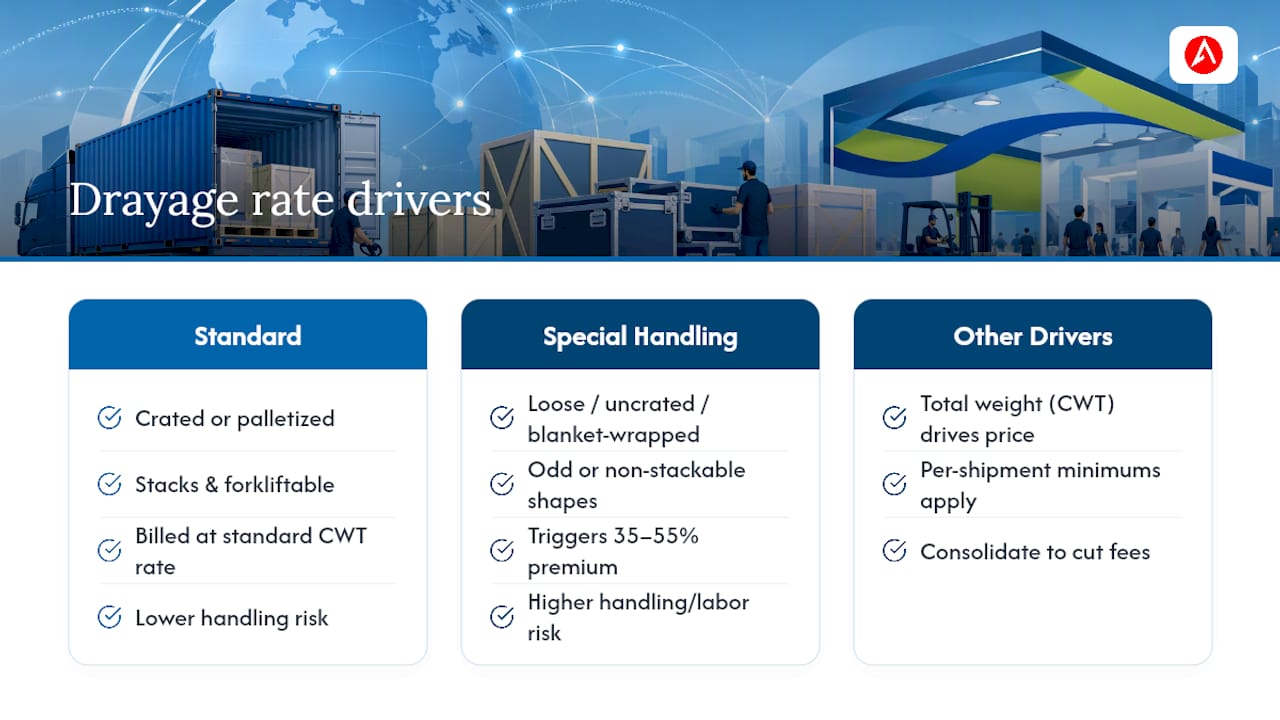
Consolidation matters too. Five small boxes shipped separately often cost more in aggregate than the same materials packed into two well-built cases, because minimum weight charges apply per shipment, not per pound. A “small” crate billed at the wrong weight tier can trigger a four-figure minimum you weren’t expecting, which is why weighing after full pack-out and consolidating pieces before they leave your warehouse are two of the cheapest insurance policies available to any exhibitor.
None of this is arbitrary. Contractors are pricing labor and handling risk, and a case built to stack cleanly and move on a forklift is objectively less labor for their crew. That’s the entire logic behind every surcharge on the invoice.
How Do You Avoid Scheduling Failures at Move-In and Move-Out?
Two operational failures cause more stranded freight and storage penalties than anything related to the case itself.
The first is a missing or late Material Handling Agreement (MHA). This is the document authorizing the show’s contractor to handle your freight, and without a signed copy on file, your shipment can sit unclaimed even after it arrives on-site. Team Phoenix Logistics flags this as one of the most common and most avoidable mistakes exhibitors make, usually because nobody assigned ownership of the paperwork.
The second is failing to book outbound freight before the show closes. Teardown is chaotic, everyone’s exhausted, and the trucking market at that exact moment is flooded with exhibitors who also forgot to book ahead. That’s precisely when carriers charge the most. Confirming your outbound carrier and pickup window before doors even open removes that entire problem.
A simple rule covers both: assign one person on your team to own the MHA and the outbound booking, separate from whoever’s managing the booth itself. Confirm both items are done at least 48 hours before show open, not the morning of. If you’re tracking multiple shipments across a season, a system for monitoring delivery status removes a lot of the guesswork around when freight actually lands versus when it’s supposed to.
What Insurance Coverage Do You Need for Trade Show Shipments?
Standard carrier liability rarely covers what your booth is actually worth. Most freight carriers cap liability at a set rate per pound, which might cover a wood crate full of literature but falls far short of replacing a damaged LED video wall or custom fabric structure.
Exhibitors generally have three coverage paths. Carrier liability is the default and cheapest, but the payout ceiling is low and rarely matches replacement cost. Third-party cargo insurance, purchased separately for a specific shipment or show season, covers actual value rather than a per-pound formula, and it’s the option most logistics providers recommend for anything with real replacement cost. A rider on an existing business property policy is the third route, and it’s worth a call to your insurance agent if you already carry general liability coverage, since some policies extend partial coverage to property in transit.
Filing a claim after damage occurs requires documentation you should be collecting anyway: photos of the packed case before shipping, the signed bill of lading noting the actual weight, and photos of the case and contents immediately upon arrival, before you open it fully. Note visible exterior damage on the delivery receipt at the time of delivery, not after the fact. Carriers and contractors both push back hard on claims filed without a delivery-time damage note, so this single habit matters more than the coverage type you choose.
How Do You Track Your Shipment Once It’s on the Road?
A case sitting in a warehouse three states away with no tracking update is one of the most stressful parts of exhibiting, and it’s largely preventable with a few habits.
Request tracking numbers and carrier contact information for every leg of the shipment, not just the initial pickup. Advance warehouse shipments often change hands between your original carrier and the warehouse’s local delivery service, and that handoff is exactly where shipments go quiet.
Confirm delivery to the advance warehouse in writing, then confirm again that your freight was received at the show site itself, since those are two separate checkpoints that don’t always get communicated automatically. Keep a single point of contact on your team checking status daily during the week before move-in, rather than leaving it to whoever has time. For teams juggling several product shipments alongside booth freight, a consistent way of tracking delivery status across orders cuts down on the last-minute phone tag that eats up move-in morning.
The Case Decision Nobody Talks About Until It Costs Them Money
Most advice on trade show logistics treats case selection and drayage cost as separate problems. They aren’t. Every dimension, weight, and stacking decision you make when you buy a case shows up again as a line item on the drayage invoice months later, and by then it’s too late to change anything.
The conventional wisdom oversells “buy the toughest case you can afford” as universal advice. It’s right for AV and anything irreplaceable, wrong for graphics and collateral that don’t need road-case durability and just add unnecessary weight to your bill. The better rule is to size your protection to what you’re actually protecting, not to a blanket standard.
If there’s one habit worth adopting before anything else, it’s weighing every case after full pack-out and writing that number down before it ever reaches a contractor’s scale. It’s unglamorous, but it prevents more billing disputes than any case upgrade will. Get that right first, then worry about foam density and case materials.
— Dan
Which Arrowhead Products Fit Your Shipping Profile
Once you know how you’re shipping, matching the right display to that plan gets a lot easier, and it’s usually where a little product knowledge saves real money.
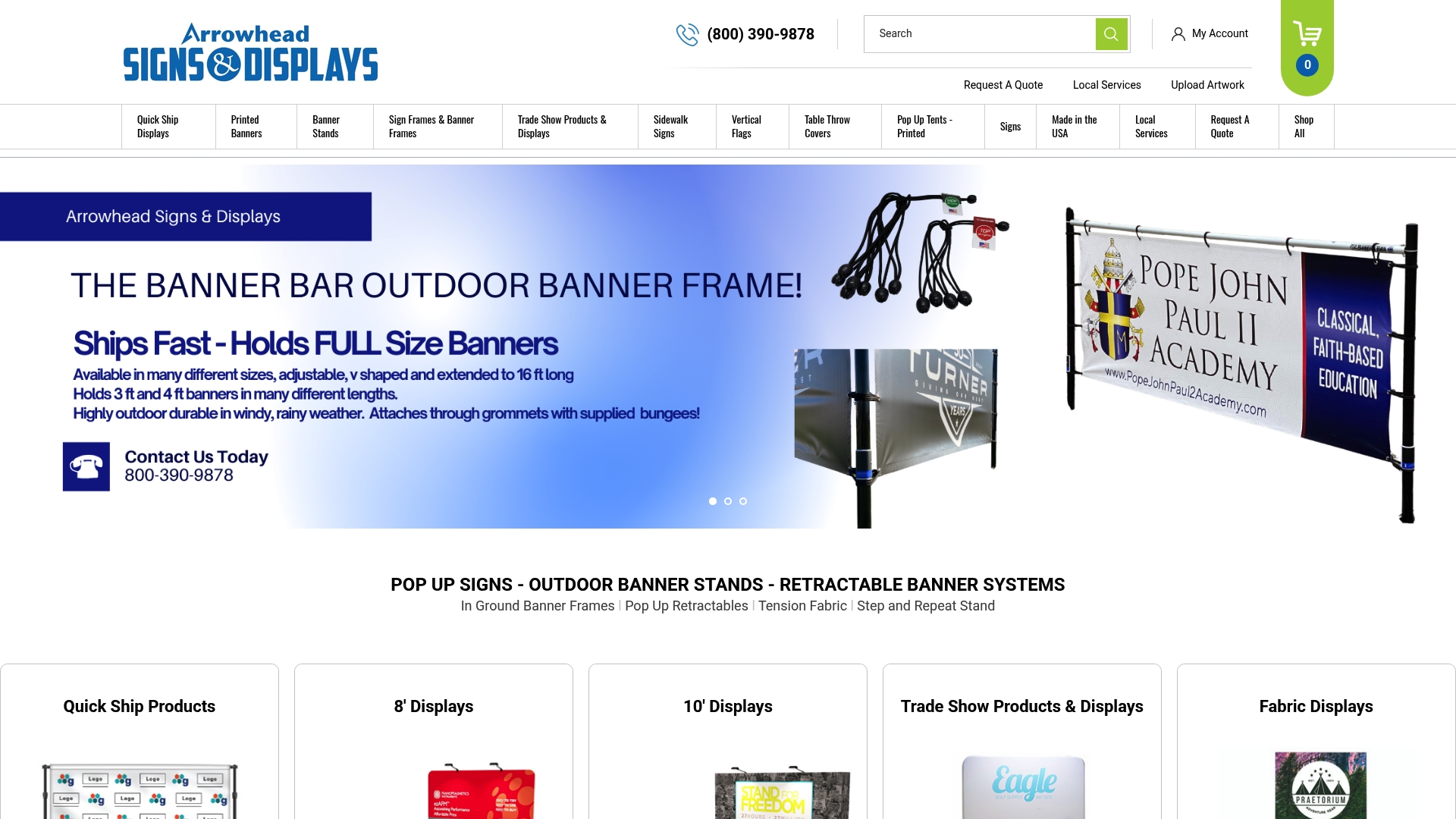
If you’re running local pop-ups or regional events, the Signicade Deluxe A-Frame Sidewalk Sign is built for exactly that kind of quick, low-risk setup where you’re not paying advance warehouse fees at all. If you’re on the national circuit and trying to keep every pound off your drayage bill, the 10 ft stretch fabric display packs down light enough to shift you into a cheaper freight tier without sacrificing booth presence. And if your events have an outdoor component, wind, rain, foot traffic, the Outdoor Banner Frame is built to hold up trip after trip without the wood-crate weight penalty.
Most orders ship within two business days, and some customers receive direct venue delivery. Browse the full product lineup on the Arrowhead Sign Company site and get a quote built around your next show date.
Sources
- How to Pack and Crate Trade Show Exhibits for Freight Shipping
- What Are ATA Cases? An Expert Overview Of Their Design, Features, And Uses
- Exhibit Shipping: How to Get Your Booth There and Back Safely
FAQ
What Are the Best Travel Cases for Trade Shows?
ATA/road cases are the best choice for AV and fragile hardware you ship repeatedly, molded plastic cases work well for mid-weight equipment, and soft bags suit graphics and literature that don’t need rigid protection.
How Much Does a 20x20 Trade Show Booth Cost?
Costs vary widely by show contractor, drayage rates, and display materials, so there’s no single figure that applies everywhere. Packing choices alone can shift your drayage bill by 35 to 55 percent, which is often a bigger swing than the booth space rental itself.
How Do I Ship to a Trade Show?
Choose between advance warehouse delivery, recommended 10 to 14 days before show open, or direct-to-show shipping, which carries more risk and needs 7 to 10 days of buffer. Submit your signed Material Handling Agreement early and book outbound freight before the show closes to avoid stranded freight or premium last-minute rates.
What Is the Biggest Trade Show in the USA?
Show size varies by industry and changes year to year, so there isn’t one fixed answer. What stays consistent across large national shows is that heavier drayage volume and stricter forklift and dock rules make case design and labeling even more important than at smaller regional events.