

Signs Every Small Business Needs for Trade Shows
Posted by Deeder Dandenhorf on May 26th 2026
Signs Every Small Business Needs for Trade Shows
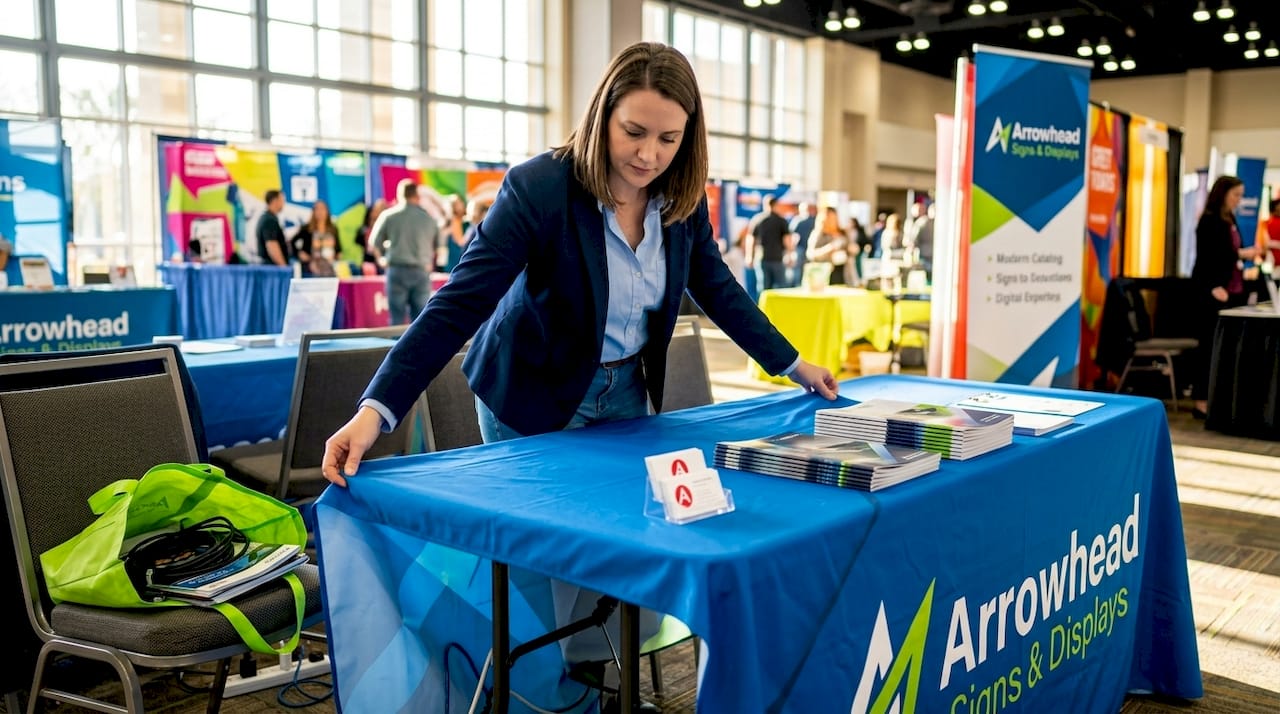
You walk into a trade show floor and immediately, your eyes go to the booths with bold, clear, professional displays. The businesses without strong signage become part of the background. For small business owners, this reality makes understanding the signs every small business needs not just useful but critical to event success. The right signage communicates your brand identity before you say a word, draws foot traffic from across a crowded hall, and leaves attendees with something tangible to take home. This guide gives you a practical checklist to make every show count.
Table of Contents
- Key takeaways
- 1. How to choose signs for your business events
- 2. Retractable banner stands
- 3. Booth backdrop or step-and-repeat banner
- 4. Branded table throws
- 5. Business cards
- 6. Brochures and product catalogs
- 7. Flyers and one-sheets
- 8. Foam board displays and tabletop signage
- 9. Design and material choices that maximize impact
- 10. Compliance and accessibility requirements
- 11. Budgeting and signage investment strategies
- My honest take on small business signage
- Get your trade show signage ready with Arrowheadsigncompany
- FAQ
Key takeaways
| Point | Details |
|---|---|
| Signage works as a system | Combining backdrops, banners, and table throws creates a cohesive brand story that individual signs cannot. |
| Quantity planning prevents lost leads | Bring 200 to 300 business cards per team member per day and a 30% buffer on brochures to avoid mid-event shortages. |
| Budget shapes your options early | Setting a clear budget first determines your material choices, sign sizes, and overall display complexity. |
| ADA compliance is non-negotiable | Accessible signage design protects your business legally and opens your booth to every potential customer. |
| Fast fulfillment saves your event | Partnering with a reliable printer who ships within two business days removes a major source of pre-show stress. |
1. How to choose signs for your business events
Before you order anything, you need a plan. Setting a budget early directly shapes every other decision, from the materials you select to the physical size of your displays. A modest budget might steer you toward retractable banners and table throws. A larger investment opens the door to full booth backdrops and illuminated displays.
Think through these factors before placing a single print order:
- Brand consistency: Every sign should share the same color palette, fonts, and logo treatment. Inconsistent visuals make your booth feel disorganized, even when the individual pieces look fine on their own.
- Visibility distance: Will attendees see your sign from 10 feet away or 50 feet away? Larger text and high-contrast colors are necessary for signs meant to attract attention from across a hall.
- Placement type: Mounted signs, ground-level displays, and hanging banners each serve different visibility goals. Plan your placement before you finalize sizes.
- Material durability: If you exhibit multiple times a year, invest in materials that travel well. Cheap banners wrinkle and tear after one or two shows.
- ADA requirements: Accessible signage is a legal requirement for most public-facing businesses under Title III, so factor compliance into your design from the start.
- Order timeline: Rush printing fees are avoidable. Build in at least two weeks for standard orders and confirm your printer’s turnaround before committing.
Pro Tip: Request a physical proof or high-resolution digital mockup before approving your final print files. Color calibration differences between your screen and the printer can shift your brand colors noticeably.
2. Retractable banner stands
Retractable banner stands are the workhorse of trade show signage. They set up in minutes, pack down into a compact carry bag, and deliver a professional visual impact that is hard to match at the price point. For a standard 10x10 booth, plan on two to four retractable banners to create depth and surround attendees with your brand messaging.
Position one banner at each open side of your booth to catch foot traffic from multiple angles. Use one to highlight a specific product or promotion and another to communicate your core brand message. Varying the content across your banners gives visitors more information without requiring them to stop and read a single wall of text.
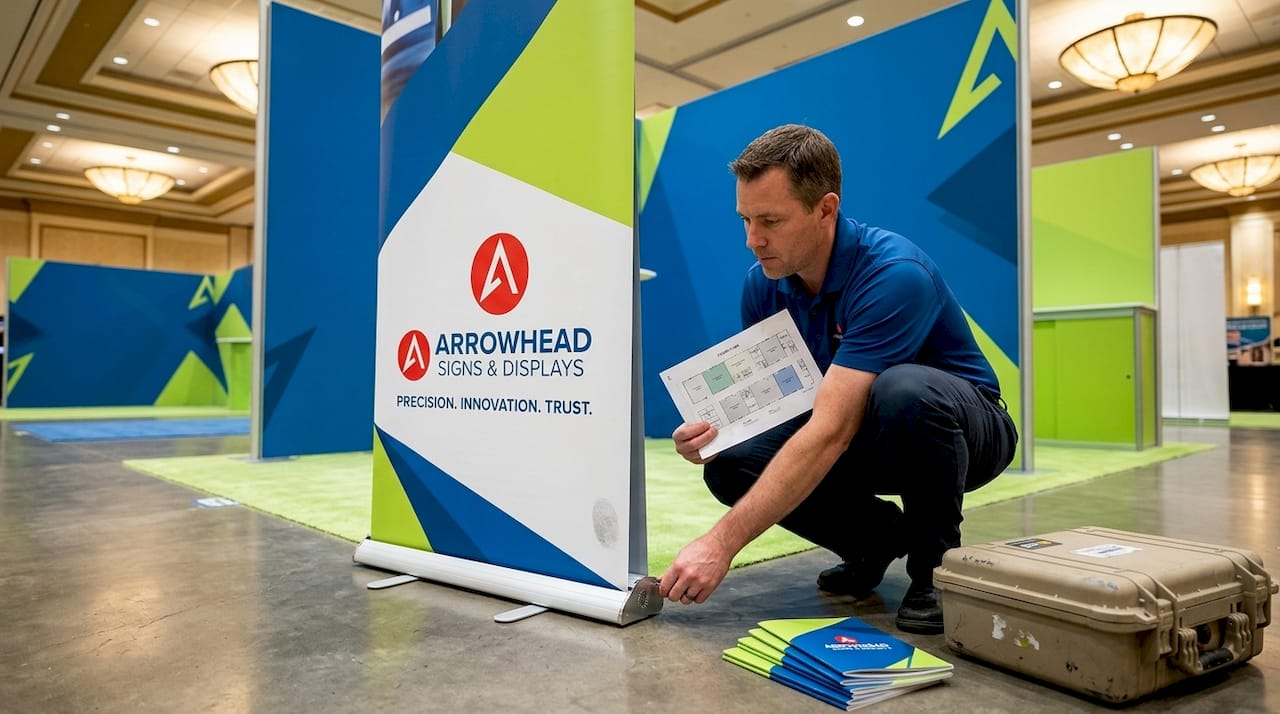
Pro Tip: Design your retractable banners with a simple visual hierarchy: brand name at the top third, core message in the middle, and contact or call-to-action information at the bottom. This mirrors the natural eye path of someone walking past your booth.
3. Booth backdrop or step-and-repeat banner
A full booth backdrop is your single most visible asset at any trade show. It fills the rear wall of your booth space and acts as the visual anchor that everything else builds around. Consistent branding across multiple booth visuals creates a professional and memorable impression, and the backdrop is where that consistency starts.
Step-and-repeat banners, traditionally associated with red carpets, serve double duty at trade shows. They work as a photo backdrop that encourages attendees to take and share photos at your booth, which extends your brand reach onto social media at no additional cost. One well-designed backdrop per 10x10 booth space is the standard recommendation.
4. Branded table throws
A bare table with a folding tablecloth looks like a clearance sale, not a professional business. A branded table throw transforms the same space into a polished, intentional display. Full-color table covers with your logo, business name, and brand colors signal that you take your business seriously.
Table throws also hide the clutter underneath your table. Extra inventory, bags, personal items, and charging cables all disappear behind a clean branded surface. Choose a fitted style over a loose drape for a sharper appearance, especially if your booth includes multiple tables.
5. Business cards
Business cards seem obvious, but most small businesses dramatically underestimate how many to bring. The proven standard is 200 to 300 business cards per team member per day. At a two-day show with two team members, that means 800 to 1,200 cards minimum.
Running out of business cards mid-event damages your credibility. It signals disorganization to the exact people you most want to impress. Print more than you think you need. Cards that come home unused can go to the next show, making them a zero-waste investment.
6. Brochures and product catalogs
Business cards open the door, but brochures close it. A well-designed brochure gives potential customers the detailed information they need to make a decision after they leave your booth. For two-day shows, plan on 250 to 500 brochures, and add a 30% buffer on top of that estimate to account for high-traffic moments you cannot predict.
Product catalogs work especially well for businesses with multiple offerings. A catalog lets a prospect review your full range at their own pace, long after the show ends. Keep the design clean and make sure your contact information and website appear prominently on the back cover.
7. Flyers and one-sheets
Flyers are your highest-volume distribution tool at any event. They work for show specials, giveaways, product launches, or simply directing people to your website or social channels. For high-traffic events, plan on 500 to 1,000 flyers to avoid running dry.
One-sheets deserve their own mention. A single, well-designed page that summarizes your business, your offer, and your contact details performs better than a multi-page packet for casual attendees. People who pick up a flyer in passing are far more likely to keep a single page than a stapled packet they have to sort through later.
8. Foam board displays and tabletop signage
Foam board displays give you a lightweight, affordable way to showcase products, pricing, testimonials, or case studies directly on your table. They require no stand or hardware and can be propped up, framed, or laid flat depending on your table configuration.
Tabletop signage fills the gap between your table surface and your banner displays. Small signs with QR codes linking to your website, pricing cards, or product spotlights keep visitors engaged while your team is occupied with other conversations. Think of tabletop signage as your silent sales team.
9. Design and material choices that maximize impact
The material your sign is printed on affects how it looks, how long it lasts, and how it photographs for your marketing content after the show. Here is a quick comparison of the most common options:
| Material | Best for | Durability | Relative cost |
|---|---|---|---|
| Vinyl | Banners, backdrops | High | Low to moderate |
| Acrylic | Rigid tabletop displays | Very high | Moderate to high |
| Aluminum | Outdoor and semi-permanent signs | Excellent | Moderate to high |
| Foam board | Lightweight indoor displays | Low | Very low |
| Fabric | Backdrops, table throws | High | Moderate |
High-contrast colors and easy fonts are the two design decisions that most affect whether your signage actually does its job. Dark text on a light background or light text on a dark background reads clearly from a distance. Decorative or script fonts may look beautiful up close but become illegible at ten feet.
For businesses that exhibit at evening events, LED illuminated signs improve visibility significantly and maintain your brand presence after dark. Outdoor signs for any small business should always be made from weather-resistant materials, even if you only plan to use them occasionally outside.
Pro Tip: When designing for print and graphic production, set up your files at 150 DPI at full size minimum. Files designed at 72 DPI look sharp on screen but print blurry at large formats.
10. Compliance and accessibility requirements
Accessible signage is not optional. ADA Title III requirements apply to most businesses that are open to the public, and they cover both the physical accessibility of your space and how effectively you communicate with all visitors.
For signage specifically, this means considering:
- Tactile and Braille elements on permanent room identification signs within venues you control
- Font size and contrast that allows people with low vision to read your materials independently
- Auxiliary communication tools such as written materials, accessible digital documents, or real-time captioning for presentations at your booth
- Permit and zoning compliance for any outdoor or semi-permanent signage you install at a fixed location
Effective communication aids such as accessible printed materials and electronic documents are required under ADA guidelines to give people with disabilities equally effective access to your business information. Incorporating these standards into your booth design from the beginning is far easier than retrofitting them later.
Check with your venue, landlord, or shopping center management for any additional design standards or permit requirements before your show. Some venues have strict rules about sign materials, mounting methods, and display heights.
11. Budgeting and signage investment strategies
Small business signage costs average between $2,000 and $3,000, though trade show specific budgets vary widely depending on how many pieces you need and what materials you choose. Here is how to allocate your budget effectively:
| Sign type | Approximate cost range | Priority level |
|---|---|---|
| Retractable banner stands | $80 to $250 each | High |
| Full booth backdrop | $200 to $600 | High |
| Branded table throw | $60 to $150 | High |
| Business cards (500 qty) | $30 to $80 | High |
| Brochures (500 qty) | $100 to $300 | Medium |
| Foam board displays | $20 to $60 each | Medium |
| LED tabletop sign | $50 to $200 | Low to medium |
Prioritize your high-visibility items first. Retractable banners and a booth backdrop will deliver more brand impact per dollar than any other item on this list. Once those are covered, work down through the collateral items.
Working with a reliable printing partner who understands event signage helps you avoid costly last-minute reprints. Evergreen branding, meaning designs that are not tied to a specific date, promotion, or event, lets you reuse banners and backdrops across multiple shows and maximize your investment.
Pro Tip: Order your full signage package at least three weeks before your first show. This gives you time for revisions, shipping delays, and quality checks without paying rush fees.
My honest take on small business signage
I’ve seen booths that spent thousands on a single massive display and still got outperformed by a neighbor with three well-designed retractable banners and a clean table throw. The insight most businesses miss is that signage works as a system. Isolated great pieces surrounded by visual inconsistency still leave a scattered impression.
What I’ve found works consistently is treating every touchpoint from your backdrop to your business cards as one connected brand experience. The colors match. The fonts are the same. The logo is placed consistently. When that cohesion is present, visitors perceive your business as professional and trustworthy before you’ve spoken a word.
The quantity mistake is also far more common than people admit. I’ve watched businesses run out of business cards by noon on day one and spend the rest of the show apologizing and scratching email addresses on sticky notes. Print more than feels comfortable. Leftover materials carry to the next show and cost you nothing extra.
For businesses with tight budgets, my practical advice is to get the three highest-impact items right first: the booth backdrop, at least two retractable banners, and a branded table throw. Those three items alone will put you ahead of the majority of small business booths at most regional trade shows. Build from there as your budget allows. Incremental improvements across multiple shows compound into a genuinely impressive presence over time.
— Dan
Get your trade show signage ready with Arrowheadsigncompany
When you’re ready to put a professional signage system together for your next event, Arrowheadsigncompany makes the process straightforward and fast. Their product range covers everything on this checklist, from retractable banner stands and backdrops to custom table throws and outdoor banner displays.
What sets Arrowheadsigncompany apart is their two-business-day fulfillment on most products, which means you don’t need to plan months ahead to get quality signage. For businesses in Arizona, they offer direct delivery to your venue so you aren’t managing logistics on top of everything else that comes with event preparation. Their team brings real expertise in trade show and event signage, which means you get guidance on materials, sizing, and design that actually fits your space and budget. Explore their full catalog and request a quote at Arrowheadsigncompany to get your next show ready.
FAQ
How many retractable banners does a small booth need?
For a standard 10x10 trade show booth, plan on two to four retractable banners positioned at open sides to capture attention from multiple directions.
What is the most cost-effective sign for trade shows?
Retractable banner stands offer the best combination of visual impact, portability, and price, typically ranging from $80 to $250 per unit and reusable across multiple events.
Do small businesses need ADA-compliant signage at trade shows?
Yes. ADA Title III requirements apply to most public-facing businesses, covering accessible sign design and effective communication materials for people with disabilities.
How far in advance should you order trade show signs?
Order at least three weeks before your event to allow time for proofing, any revisions, standard shipping, and a quality check before the show date.
How many business cards should you bring to a trade show?
Bring 200 to 300 business cards per team member per day. For a two-day show with two people, that means a minimum of 800 to 1,200 cards total.
Recommended
- How Trade Show Printing Works: A Planner’s Guide - Arrowhead Sign Company
- Custom Pop Up Signs | Outdoor Banner Stands | Retractable Banner Stands | Arrowhead Signs and Displays
- Pop Up Display Comparison Guide for Event Marketers - Arrowhead Sign Company
- Types of Promotional Backdrop Displays: 2026 Guide - Arrowhead Sign Company