

Temporary Sign Rules in Arizona: What to Check Before You Post
Posted by Deeder Dandenhorf on Nov 26th 2026
Temporary Sign Rules in Arizona: What to Check Before You Post
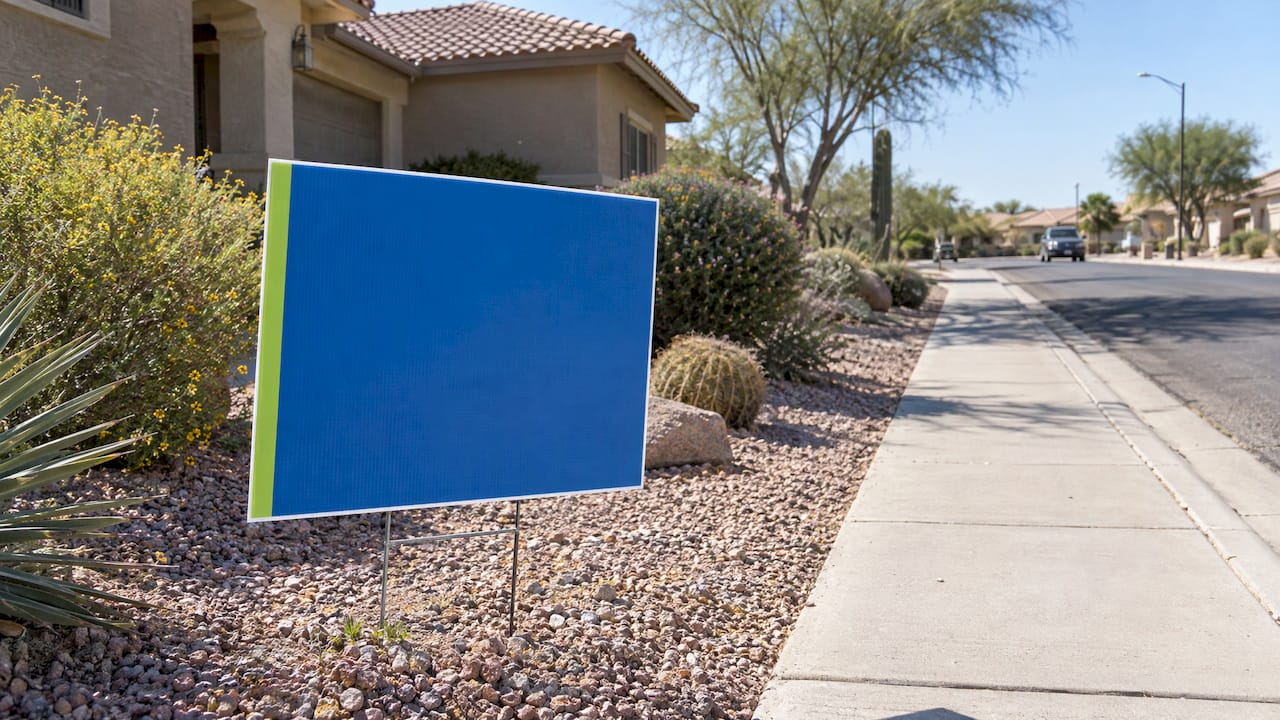
Arizona has one state law that governs temporary political signs and a patchwork of city rules for everything else, including business banners, festival signs and church event signs. The practical answer: know your sign type, check the city where it will hang, and order the sign once you know the size and placement. We print and ship banners, yard signs, sidewalk signs and displays, and most products ship within two business days, so the rules should be settled before you order, not after the sign arrives.
TL;DR
- Arizona’s only statewide temporary sign statute is A.R.S. § 16-1019, which covers political and campaign signs: size caps, contact information and removal protection.
- Business banners, event signs and A-frames are regulated city by city. Scottsdale requires a banner permit, and Phoenix limits what counts as a temporary sign.
- Political signs in a city or county right-of-way can be up to 16 square feet in residential zones and 32 square feet elsewhere, and must show a contact name and phone number or website.
- Always get property owner permission, stay out of traffic sight lines and away from power lines, and confirm details with the city’s planning or zoning office.
- Know your size, placement and dates first, then order. Rush options help when the schedule is tight.
Table of Contents
- What counts as a temporary sign in Arizona
- The state rule: political and campaign signs
- Business banners and event signs: city rules decide
- Rules by who you are
- A pre-order checklist
- How to turn the rules into the right sign
- Order your Arizona event signs with us
- FAQ
- Sources
What counts as a temporary sign in Arizona
A temporary sign is one meant to stay up for a limited time and then come down: a grand opening banner, a festival directional sign, a church fundraiser banner, a seasonal sale sign or a campaign yard sign. Arizona has no single rulebook for all of them. The state sets rules for political signs, and cities and counties write their own sign codes for the rest.
That split explains why two neighbors a few miles apart can get different answers. Scottsdale, for example, defines a banner as a temporary sign made of flexible material such as vinyl or fabric that is not enclosed in a rigid frame, and its code regulates duration, size and placement but not the message, according to the City of Scottsdale banner page. The City of Maricopa, in its temporary signs guide, defines a political sign as a temporary sign that supports a candidate or urges a vote on a ballot measure in a primary, general or special election.
So the first question is always: what kind of sign is this, and which city or county will it stand in?
The state rule: political and campaign signs
If your sign supports a candidate or a ballot measure, A.R.S. § 16-1019 applies. Here is what it means in plain terms.
Where it can go and how big it can be
A political sign may stand in a public right-of-way owned or controlled by a city, town or county when it meets these conditions, all from the statute:
- It is not hazardous to public safety.
- It does not block clear vision or ADA (Americans with Disabilities Act) accessibility requirements.
- It is no larger than 16 square feet in residential-zoned areas, or 32 square feet elsewhere.
- It carries the name and phone number or website address of the candidate or campaign committee contact person.
A municipality may also designate up to two commercial tourism, resort and hotel sign-free zones, with a combined area no larger than three square miles. State highways, routes and overpasses fall outside this statute. Yavapai County’s candidate sign guide points to A.R.S. § 28-7903 for signs next to state roadways and interstates, and requires property owner permission for private property.
Worked example. A 4 by 8 foot sign is 32 square feet. That fits the commercial and non-residential limit but is double the residential limit. A standard 24 by 18 inch yard sign is 3 square feet and fits anywhere the statute allows signs, as long as the contact information is printed on it.
Tampering and removal
The same statute makes it a class 2 misdemeanor to knowingly remove, alter, deface or cover a political sign during the protected window. That window starts 71 days before an election and ends 15 days after it, with a longer tail to 15 days after the general election for candidates who advance from a primary. Exceptions cover the candidate or authorized agent, the committee that supplied the sign, and the owner or authorized agent of the private property where it stands. The window was set at 71 days by 2024’s Senate Bill 1063, which replaced an earlier 45-day period.
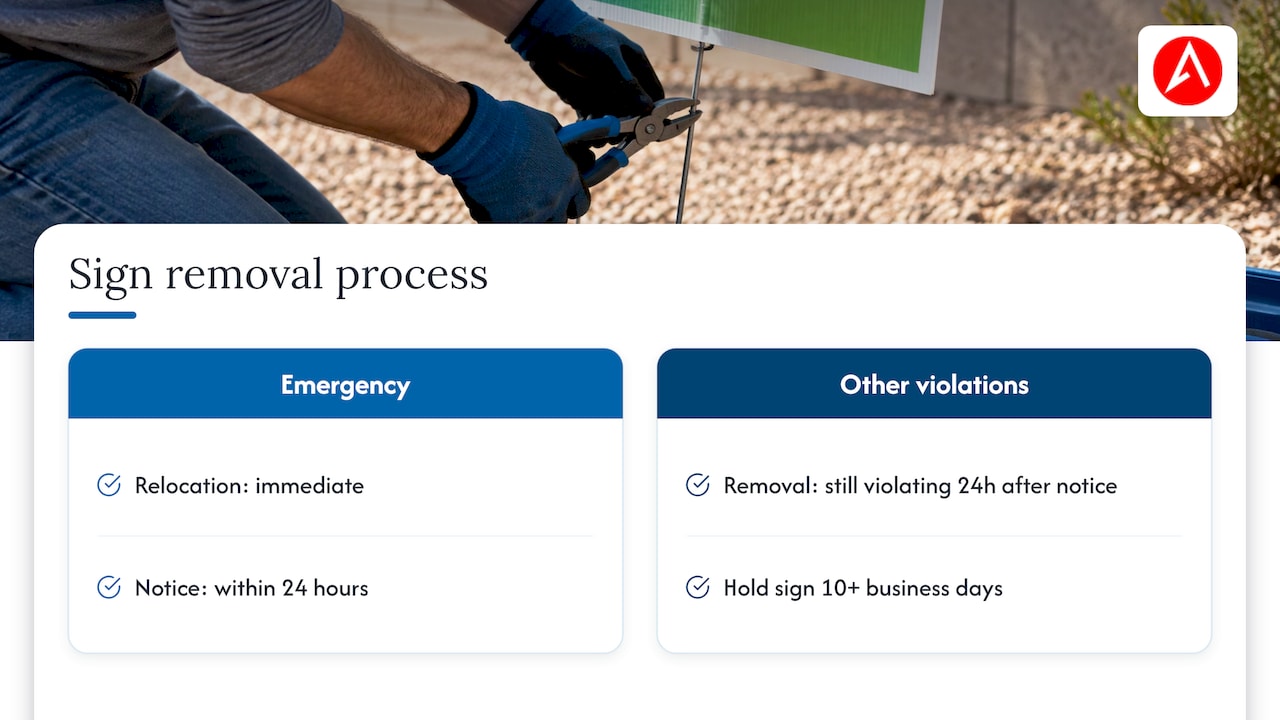
Cities can act on signs that break the rules, but with a process. A jurisdiction may immediately relocate a sign it considers an emergency and must notify the candidate or committee within 24 hours. For other violations it may remove the sign only if it is still in violation 24 hours after notice, and it must hold the sign at least 10 business days so it can be retrieved without penalty.
The practical lesson: put your contact information on the sign from the start, and keep the size within the limit, so no one has a reason to pull it.
Local add-ons
Cities layer their own details on top. Glendale’s campaign sign brochure states that no permit or registration is required for campaign signs. Yavapai County tells candidates it is their responsibility to check with county, city and town planning, zoning and public works departments, and to follow the Arizona Blue Stake Law before placing any sign. Blue Stake is the underground utility marking service, and it matters when a stake goes into the ground.
Business banners and event signs: city rules decide
The state statute does not cover a grand opening banner or a craft fair sign. Those fall under your city’s sign code, and the differences are real.
| Topic | Scottsdale | Phoenix |
|---|---|---|
| Permit | All banners require a permit before installation | Temporary signs under the code section require a permit from Development Services |
| Allowed content | On-site business or development only, off-site banners prohibited | Banners and balloons may be used; portable A-frame signs, pennants and streamers are not permitted under that section |
| Duration | 35 consecutive days, no extensions | Confirm on the city sheet |
| Placement | Commercial districts only, not residential | No encroachment into the public right-of-way or corner and driveway visibility zones |
| Size | One square foot per linear foot of building wall, up to 250 square feet | Confirm on the city sheet |
These details come from the Scottsdale banner page and the Phoenix temporary signage information sheet. Phoenix also sets banner safety standards: banners must be attached securely to a solid structure, have at least eight feet of clearance above grade over areas open to the public, be vented to handle wind pressure and not project above the roofline. They should never go near power lines.
Two takeaways for a business owner:
- A banner you can hang in one city may need a permit in the next. Scottsdale’s 35-day clock starts one day after approval, so build the permit into your timeline.
- Sign type matters. In Phoenix, the temporary sign section does not allow portable A-frames. Sidewalk signs may be governed by a different part of the code, so ask before you put one on a public sidewalk.
Smaller cities and counties publish their own sheets, usually on the planning, zoning or development services page. Search the city name plus “temporary sign” and read the official page, or call the office. They answer this question daily.
Rules by who you are
Festivals and craft fairs
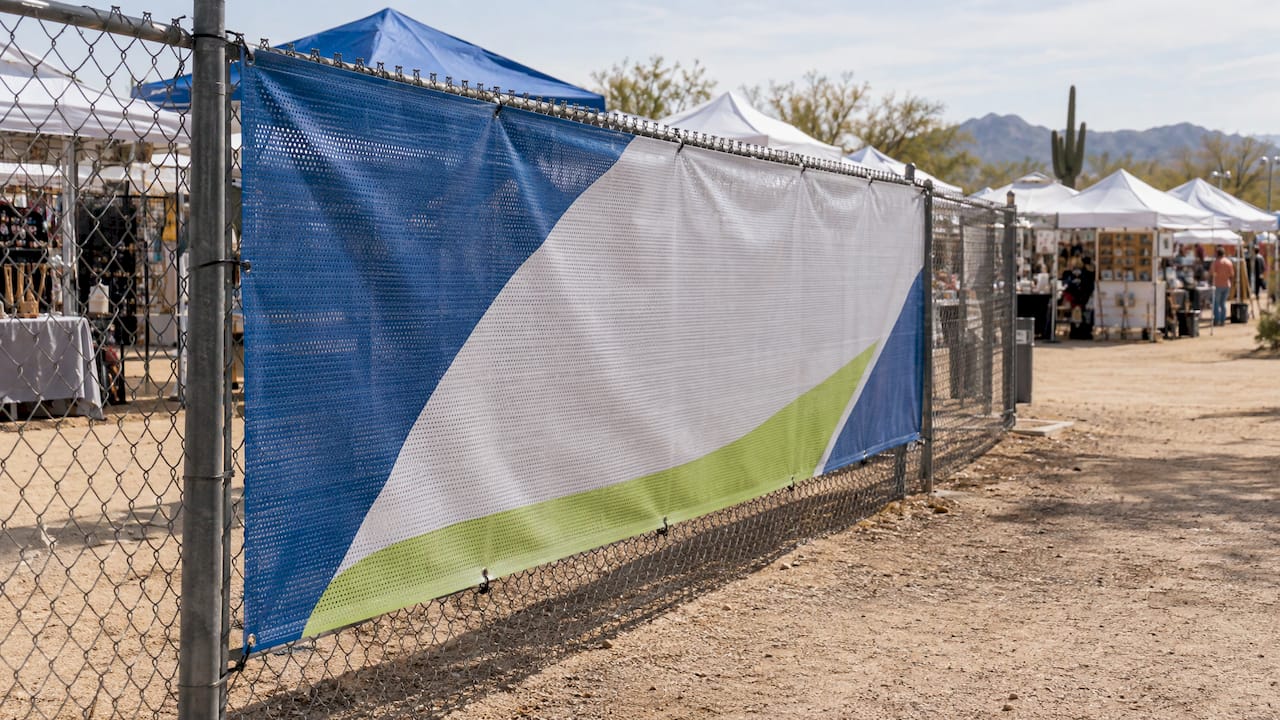
Organizers usually work inside a special event permit, and signs are part of that review. Put banner and directional sign plans in the application. Vendors should ask the organizer what sizes and mounting are accepted at the venue. Fence banners and directional signs are common, and wind is a constant in Arizona, so vented or mesh material and secure grommets or ties are worth planning for.
Churches and community groups
Phoenix’s sheet lists temporary signs for places of worship among the categories its temporary sign section covers, so a church event banner is a recognized use there. Other cities handle it differently. Check the city’s rules for religious institutions, and confirm any private property or landlord permission in writing.
Exhibitors and trade show participants
Indoor venue rules are different from city sign codes. They are set by the convention center or show organizer: booth height limits, hanging sign rules, flame-retardant fabric and freight deadlines. Read the exhibitor manual before you finalize artwork or choose a display size. Our trade show displays range from banner stands to tension fabric displays and pop-up tents, and the manual tells you what fits your space.
Campaigns and ballot measure committees
Use the state rules above. Keep signs at or under the size limit for the zone, print the contact name and phone number or website, and get permission before using private property.
HOA neighborhoods
Homeowners associations add their own restrictions on signs and flags. Read your declaration (the CC&Rs) and ask your board before you stake a sign in a front yard.
A pre-order checklist
Before you design or order, collect these answers.
- Which jurisdiction? City, town, county or unincorporated land. The address decides which code applies.
- What type of sign? Banner, yard sign, A-frame, flag or tent. Codes treat each differently.
- How big? Convert to square feet. Compare to the limit for the zone.
- How long? Note any maximum duration and whether a permit sets a start date.
- Where exactly? Private property needs owner permission. Stay out of the public right-of-way unless the code allows it, and keep clear of driveway and corner sight lines.
- How will it be mounted? Solid structure, secure fastening, wind venting, no power lines nearby. Call Blue Stake before any ground stakes.
- What must it say? Political signs need contact information. Business banners in some cities may only promote the on-site business.
- Who do I call? The city’s planning, zoning or development services office confirms anything a web page leaves unclear.
If you are planning signage for a larger event, this event wayfinding signage planning guide shows how to think through the visitor’s route from parking to the front door, which helps you decide how many signs you need and where.
How to turn the rules into the right sign
Once you know the size and placement, the order itself should be quick. Here is how the rules translate into product choices.
- Fence, building and festival banners. Our printed banners come with a standard banner layout for $35, and Next Day Air is available for $10 when the permit is in hand and the event is close.
- Campaign and event yard signs. Coroplast yard signs suit small-format limits and are easy to stake and remove after the event.
- Storefront sidewalk signs. A-frame sidewalk signs are for locations where the code allows them. Our guide to A-frame sidewalk signs covers where they work best.
- Outdoor changeable graphics. The outdoor flex sign kit uses a snap frame so you can swap graphics between events.
- Event tents. Printed pop-up tents give vendors a branded booth at festivals and fairs.
For more on layout, contrast and readability from a distance, see our outdoor event signage best practices.
Our take
We talk with business owners, organizers and church volunteers who have a date on the calendar and a sign that is not ready. The rules in Arizona are not hard once you know which ones apply, but they are local, so the smartest first move is a quick look at the city’s temporary sign page. After that, the sign should be the easy part.
That is why we built our process around speed. Most of our products ship within two business days nationwide, and we offer direct venue delivery in Arizona, so the sign can arrive where the event is. Pair a clear size and placement plan with a banner that is designed once and printed right, and your event looks professional without a scramble.
Our advice: write down the size, location and dates before you open the design file. Every question we can answer on the order page gets easier when you have those three facts.
Dan
Order your Arizona event signs with us
Whether you need banners for a festival, a printed tent for a craft fair or a display for an expo, we can print and ship quickly. Browse printed banners, banner stands and custom signs, or start at Arrowhead Sign Company. Most products ship within two business days, and Arizona customers can have orders delivered directly to the venue.
FAQ
Do I need a permit for a temporary banner in Arizona?
That depends on the city. Scottsdale requires a permit for all banners before installation, and Phoenix requires a permit from Development Services for temporary signs under its code section. Glendale states that campaign signs need no permit or registration. Check your city’s page before you hang anything.
How big can a political sign be in Arizona?
Under A.R.S. § 16-1019, a political sign in a public right-of-way controlled by a city, town or county can be up to 16 square feet in residential zones and 32 square feet elsewhere. It must also show the contact person’s name and phone number or website address.
Is it illegal to remove someone’s political sign?
It can be. Knowingly removing, altering, defacing or covering a political sign during the protected period is a class 2 misdemeanor under the same statute. Exceptions include the candidate or agent, the committee that supplied the sign, and the property owner or authorized agent where it was placed.
Can I put a sign on private property without asking?
No. Get the owner’s permission first. Yavapai County’s guide requires it for private property, and landlords, HOAs and business centers may have their own rules.
Where do I find my city’s rules?
Search the city or county name with “temporary sign” or “sign code,” and look for the planning, zoning or development services page. If anything is unclear, call that office to confirm before you order.
Sources
- A.R.S. § 16-1019, Political signs
- Arizona SB 1063 (2024), Chapter 170
- City of Maricopa Temporary Signs Guide
- City of Glendale Campaign Sign Regulations
- Yavapai County Posting of Candidate Signs
- City of Scottsdale Banners
- City of Phoenix Temporary Signage Information Sheet