

Banner Material Types: How to Choose the Right One
Posted by Deeder Dandenhorf on Oct 19th 2026
Banner Material Types: How to Choose the Right One

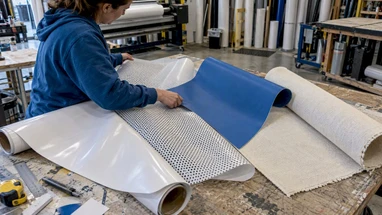
Most banners are made from one of four materials: vinyl, mesh, polyester fabric or canvas. The right one depends on where the banner hangs, how long it stays up and how often you will pack it. Vinyl suits most outdoor and general-purpose jobs. Mesh suits wind. Fabric suits indoor trade show booths where finish and portability matter.
This guide walks through each material, what it does well, where it falls short and how to match it to your event. We also cover the fire-safety paperwork many venues ask for, which catches plenty of first-time exhibitors off guard.
TL;DR
- Vinyl is the all-rounder: waterproof, sturdy and affordable. Choose it for most indoor and outdoor banners.
- Mesh lets air through, so it is the safer pick for windy fences, scaffolding and open-air events.
- Polyester fabric gives a matte, premium look that photographs well. It is best for indoor booths and backwalls.
- Canvas has a textured, artisan feel and suits short-run decor rather than weather exposure.
- Check your venue’s flame-retardancy rules (NFPA 701 for hanging fabrics) before you order, not after.
Table of Contents
- Banner material types at a glance
- Vinyl banners: the dependable default
- Mesh banners: built for wind
- Polyester fabric banners: the trade show favorite
- Canvas and other specialty materials
- How to choose: five questions to ask
- Fire ratings: the step many exhibitors miss
- Our perspective: match the material to the job, then to the logistics
- Order your banner with fast turnaround
- Banner material FAQs
- Sources
Banner material types at a glance
| Material | Best for | Weather | Finish | Portability |
|---|---|---|---|---|
| Vinyl | Storefronts, events, general signage | Strong outdoors | Smooth, can be glossy or matte | Good, but can crease if folded |
| Mesh vinyl | Fences, windy sites, large outdoor spans | Very good in wind | Perforated, slightly muted color | Good |
| Polyester fabric | Trade show backwalls, tension displays | Mainly indoor | Matte, premium | Excellent, resists wrinkles |
| Canvas | Decor, galleries, short-term indoor use | Limited | Textured | Heavier, less convenient |
| Paper or film | One-time indoor use | Poor | Varies | Light, but fragile |
The five common names in this table line up with what most printers list. Vistaprint’s overview names vinyl, polyester, mesh and canvas as the most common banner materials, which matches what we see in daily orders.
Vinyl banners: the dependable default
Vinyl is a coated, flexible material that shrugs off rain, handles sun and takes bold, saturated color. That combination is why it is the first material most small businesses reach for. You can hang it with grommets, pole pockets or hems, and it works as a one-day event sign or a months-long storefront banner.
Weight matters as much as the material name. Heavier vinyl lasts longer and hangs flatter, which is why we offer heavy duty 18 oz vinyl banners for outdoor jobs that need to survive repeated use. For a deeper look at how vinyl behaves in the elements, see our post on whether vinyl banners are durable enough for outdoor use, or browse our custom vinyl banners.
Where vinyl is a weaker choice:
- Under professional lighting. Gloss vinyl throws glare. A research note from a university media lab says high-gloss vinyl can wash out graphics in photos and video under professional lighting. If your booth will be photographed, ask for a matte finish.
- In very high wind. A solid sheet acts like a sail. See the mesh section below.
- For frequent travelers. Vinyl that is folded tightly can arrive creased. Rolling it in a tube avoids most of that.
If you exhibit often, our guide to choosing vinyl banners for trade shows covers sizing, finishing and hanging choices in more detail.
Mesh banners: built for wind
Mesh banners are vinyl with tiny perforations. Air passes through, so the banner pulls on its ties and fasteners far less than a solid sheet. That makes mesh the practical choice for chain-link fences, construction barriers, building fronts and any spot where gusts are common.
The tradeoff is image sharpness. Because part of the surface is open, colors look slightly softer and fine text needs to be larger than you would use on solid vinyl. Mesh also lets some light through, so it is not the best option when you need a crisp, opaque message from close range.

Our comparison, mesh banners vs. vinyl banners, lays out the decision using real business scenarios. If you mainly want an outdoor answer, our post on the best outdoor banner material for wind, rain and weekend events helps you avoid reprinting.
Polyester fabric banners: the trade show favorite
Fabric banners are printed with dye-sublimation, which puts the ink into the material instead of on top of it. The result is a soft, matte surface with rich color and no glare. The Wayne State note mentioned earlier adds that fabric is almost always preferred for trade show backwalls because of its premium, matte look, as long as you can steam or tension out wrinkles on-site.
Tension systems solve the wrinkle problem. The fabric slides over a frame or stretches across a tube structure, so it sits taut with no steaming. Our EZ Tube tension fabric displays work this way, and the 10 ft stretch fabric display is a good example of a backwall that packs small and sets up fast. If you need a display on a short timeline, our Quick Ship displays are built for that.
Fabric is light, which helps when you pay for freight or carry the booth yourself. Its main limit is weather: it is a better fit for indoor halls than for a rainy parking lot.
Canvas and other specialty materials
Canvas gives banners a woven, textured look. That suits galleries, boutiques, wedding decor and brand stories that lean handmade. It is heavier than polyester and absorbs moisture more readily, so it is a poor choice for long outdoor runs. Paper and thin film banners exist too, and they work for a single indoor event, but they tear and curl easily.
Adhesive vinyl and window perforated film are different products for different jobs. They go on glass, trucks and walls instead of hanging from grommets. If that is what you need, we also handle window lettering and logos and truck lettering.
How to choose: five questions to ask
- Where will it hang? Indoors favors fabric or smooth vinyl. Outdoors favors vinyl, and mesh if it is windy.
- How long will it stay up? A single weekend can use a lighter material. Months of exposure justify a heavier one.
- How often will you travel with it? Frequent exhibitors should lean toward lightweight, wrinkle-resistant fabric and a case that protects it.
- Will it be photographed or lit? Choose matte over gloss.
- What does the venue require? Ask about flame-retardant certification before you order.
ExhibitionsVoice makes a point we agree with: consider the total life cycle of the signage. A cheap banner that arrives creased, or a heavy material that raises your freight bill, can cost more than it saves. The same guide notes that being able to replace only the graphic, and not the entire display, lowers long-term costs. That is why many of our stands let you swap the print and keep the hardware.
If you are weighing how banner spend fits the rest of your budget, a broader read on digital marketing trends for small businesses can help you decide where physical signage earns its place.
Fire ratings: the step many exhibitors miss
Many U.S. venues ask for proof that hanging fabric is flame-resistant. The relevant test for banners, drapes and backdrops is NFPA 701, which SBI Finishing explains is separate from ASTM E84, a test for surface-mounted building materials. People mix the two up, so it is worth being precise.
What to do about it:
- Ask the venue or show organizer which standard they require. The fire marshal or local authority having jurisdiction makes the final call.
- Ask your printer whether the material you want carries a current flame-retardancy certificate.
- Keep the paperwork with the display, so you can show it at load-in.
Canopies have their own certification quirks. Our post, fire retardant canopy certification, explains the wrong-test trap and the permit risk that follows. If you are planning a tent, see our printed pop up tents.
Our perspective: match the material to the job, then to the logistics
We talk to small business owners every week who are about to order the wrong banner. Usually the issue is not quality. It is fit. Someone orders glossy vinyl for a lit indoor booth, or a solid sheet for a windy fence line, and the banner underperforms through no fault of the print.
Our rule of thumb is simple. For outdoor use, start with vinyl and step up to mesh in wind. For indoor booths you will reuse, start with fabric on a tension frame or a retractable stand. For everything else, ask what the venue needs and how you will carry it.
Speed matters just as much as material. Most of our products ship within two business days, and in Arizona we can deliver straight to your venue. That means you can make a materials decision close to the event and still have the display in hand when the doors open.
— Dan
Order your banner with fast turnaround
Ready to put this into practice? Our printed banners page lets you choose your size and material. A standard banner layout is $35, and Next Day Air shipping is $10 if you are short on time. For portable setups, browse banner stands, or see our full range of trade show products and displays. We ship nationwide.
Banner material FAQs
What is the best material for banners?
For most people it is vinyl, because it handles both indoor and outdoor use at a reasonable cost. Choose mesh if wind is a concern, and polyester fabric if the banner will live in a trade show booth.
Is vinyl or polyester better for a banner?
It depends on the setting. Vinyl wins outdoors and for rugged, general-purpose use. Polyester fabric wins indoors, where its matte finish avoids glare and it packs without creasing.
What is the best material to hang a banner?
Vinyl with reinforced hems and grommets is the usual choice for hanging, and mesh works well on fences and open frames. Heavier vinyl holds its shape better over time. Use ties or hardware spaced along the edges so the load is shared.
Do I need a fire-rated banner?
Often you do, especially at indoor commercial venues and convention halls. Ask the venue which standard applies, most commonly NFPA 701 for hanging fabrics, and request the certificate from your printer before you order.
Sources
- Trade Show Booth Banner Guide 2026, ExhibitionsVoice
- NFPA 701 vs. ASTM E84: Which Fire Code Test Do You Need?, SBI Finishing
- Large format substrates, Wayne State University Medical Communications
- The most common promotional banner materials, Vistaprint