
Best Custom Canopy Tents for Trade Shows and Events
Posted by Deeder Dandenhorf on Nov 2nd 2026
Best Custom Canopy Tents for Trade Shows and Events

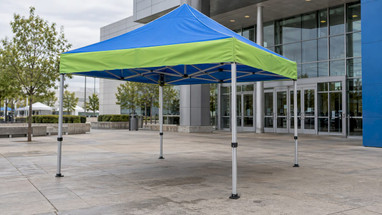
The best custom canopy tent is one that pairs a commercial-grade frame with a fully printed top, ships on a timeline that fits your event, and packs down small enough that you will actually use it. For most small businesses that means a 10x10 pop up with a steel or hexagonal aluminum frame, a printed canopy with your logo, and a rolling bag. We build printed pop up tents with fast fulfillment, and below we show you how to compare any option, ours included.
TL;DR
- Start with the frame. Commercial-grade steel or hexagonal aluminum frames are built for daily use and unpredictable weather, and a pretty print on a weak frame will not last.
- A 10x10 is the standard size for markets, festivals and trade show aisles. Decide on walls, half walls and weights before you compare prices.
- Compare the whole package: frame, printed top, bag, stakes or weights, and the shipping terms. Printed 10x10 canopies and replacement tops are sold from roughly $146 to $370 on marketplaces, so the headline price tells you little.
- Ask about production time before you pay. If your event is close, a quick ship option matters more than a small discount.
- Arrowhead Sign Company ships most products within two business days and delivers directly to your venue in Arizona.
Table of Contents
- What makes a custom canopy tent “the best”
- Frames: where durability comes from
- Fabric and printing options
- Sizes and package contents
- The brands buyers compare
- Production time and shipping
- Accessories that earn their place
- How to compare options side by side
- Which tent for which buyer
- Our perspective
- Get a printed tent from Arrowhead
- FAQ
- Sources
What makes a custom canopy tent “the best”
There is no single best tent, because a farmers market vendor, a trade show exhibitor and a school booster club need different things. What separates good tents from disappointing ones is the same in every case: the frame, the fabric, the print quality, and how much hassle the tent causes on setup day.
Before you open a single product page, answer four questions:
- How often will you use it? Weekly use calls for a commercial frame. One event a year can justify a lighter one.
- Where will it stand? Grass, asphalt and convention hall floors all need different anchoring.
- How windy or sunny is your typical event? Open-air events in the Southwest punish thin fabric and light frames.
- Who is carrying it? If one person sets up alone, weight and bag design matter as much as print.
Write those answers down. They decide almost everything in the sections below.
Frames: where durability comes from

The frame is the part of a canopy that fails first when the tent is cheap, and it is the hardest part to judge from a photo. According to a professional review roundup, ABCCANOPY, MasterCanopy and Eurmax offer 40mm hexagonal aluminum, reinforced steel and commercial-grade steel frames respectively. That range shows how different the construction can be even among brands sold for the same purpose.
Here is how the common frame types compare in practice:
| Frame type | Best for | What to know |
|---|---|---|
| Steel (commercial-grade) | Frequent use, windy sites | Strong and rigid, heavier to carry |
| Hexagonal aluminum | Traveling exhibitors, solo setup | Lighter and corrosion resistant, usually priced higher |
| Light-duty steel | Occasional backyard or one-off events | Lowest cost, not meant for daily use |
Commercial-grade equipment is aimed at professional vendors, event organizers and businesses that need shelter for daily use and unpredictable weather. If your tent is going to represent your brand at a dozen events a year, that is the category you belong in.
When you compare frames, look for:
- Leg profile and thickness stated in millimeters, not just “heavy duty”
- Slider and truss construction, since joints take the most stress
- Whether replacement parts are sold separately
- A stated warranty, and what it covers (frame, top or both)
Fabric and printing options
The printed top is your billboard, so it needs to look good from 30 feet away and survive sun, rain and repeated folding. The factors that matter:
- Fabric weight and coating. Look for water-resistant, UV-resistant polyester. Heavier denier numbers generally mean a sturdier top.
- Print method. Full-color dye sublimation prints into the fabric, so graphics stay vivid and do not crack at the folds. Screen printed or heat transfer graphics can fade or flake sooner, depending on the process.
- Print coverage. Some tents print only a logo on a solid color. Others print the full top and valance. Full coverage reads better from a distance and in photos.
- Stitching and seams. Reinforced seams matter in wind, where the top pulls hard on every corner.
- Color matching. If your brand has a specific color, ask whether the printer works from Pantone references and whether you receive a proof.
A good design is simple. Put your company name big and high, keep the contrast strong, and avoid tiny text on the valance. For more on how print turns a tent into a marketing tool, see our guide on how a printed pop up tent can boost your brand visibility.
Sizes and package contents
The 10x10 is the default for good reason: it fits most event booth spaces, and most accessories are made for it. Larger sizes like 10x15 or 10x20 give you room for demos and seating but need more people to set up and a larger vehicle to haul.
Packages are where prices get confusing. Two tents at the same price can include very different things. Check each listing for:
- Frame and printed top (some sellers sell the top alone, as a replacement for an existing frame)
- Carry bag, ideally a roller bag, since Eurmax is noted for L-shaped roller bags with oversized wheels that help on uneven surfaces
- Stakes, ropes and weight bags
- Side walls, half walls or a back wall
- Printed flags, banners or hanging signs
Price ranges are wide. A quick look at marketplace listings shows printed 10x10 canopies and replacement tops from about $146 to about $370, and that spread is before walls, upgraded frames or rush production. Treat any single price as a starting point and add up what you would need to buy on top.
The brands buyers compare
When business buyers shop for a custom canopy, the names that come up are E-Z UP, KD Kanopy, Extreme Canopy, TentCraft and a long tail of online print shops. Each sells custom printed canopies for businesses and events, and each has its own strengths in frame lines and print options. Review sites such as CanopyTentLab compare brands on frame construction, weather resistance and accessories, which is a good way to shortlist.
How to use that shortlist:
- Pick two or three options at the frame level you need.
- Ask each for the total with your design, walls and bag included.
- Ask for the production time and the shipping cost in writing.
- Check what happens if the print comes out wrong.
The last two steps are where small-business buyers get burned. A tent that arrives after your event does not help your brand.
Production time and shipping
Lead time is the most underrated part of the comparison. Some custom tents are sewn to order and take weeks. Others use a standard frame with a quick print and ship in days. Ask:
- How many business days from approved proof to shipment?
- Is rush production available, and what does it cost?
- Is shipping included, or calculated at checkout?
- Can the order be delivered to your event venue?
That last one matters more than people expect. Freight deliveries to a convention center or event site have their own rules, and having the tent arrive where you need it removes a day of risk. In Arizona, we deliver directly to client venues, and nationwide we ship most products within two business days.
If timing is tight, look at our quick ship event tent before anything else.
Accessories that earn their place
A tent alone is not a booth. These add-ons make the difference between a booth that looks professional and one that looks improvised:
- Weights. Most events require them. Many outdoor venues and festivals ask exhibitors to secure tents so they cannot lift in a gust, so buy weights before you need them.
- Half walls and back walls. They give you privacy, branding space and shade on low-angle sun.
- Printed table cover. A fitted throw in your colors ties the booth together.
- Retractable banner or sign stand. Put your offer or QR code at eye level, where the tent top cannot reach. Our banner stands work well beside a tent.
- Flags and sidewalk signs. These pull foot traffic from the aisle or the parking lot. Our festival tent banner guide shows how they work with a tent.
- A roller bag. If you set up alone, this is not optional.
For a full setup walkthrough, read our custom printed tent setup guide for outdoor events.
How to compare options side by side
Use a simple scorecard. Rate each tent from 1 to 5 on these points, then total them.
| Criterion | What to look for |
|---|---|
| Frame | Commercial-grade steel or hexagonal aluminum, stated leg size |
| Full-color, fade-resistant, full coverage option | |
| Top fabric | Water-resistant, UV-resistant, reinforced seams |
| Package | Bag, weights, stakes and walls clearly listed |
| Turnaround | Written production and shipping time |
| Support | Real person to talk to, clear remake policy |
| Total cost | Everything you need, not just the base tent |
A tent that scores well across the board is better than one that wins on a single feature. If you are comparing brands, put the numbers in a spreadsheet. It takes ten minutes and it prevents the most common mistake: buying on the lowest base price and then paying for walls, bags and rush shipping.
Which tent for which buyer
- Weekend market vendor: a 10x10 with a steel frame, a full-color top and weights. Keep it simple.
- Trade show exhibitor: a 10x10 or larger with walls, a printed table cover and a banner stand, so the booth matches your other displays.
- Event planner: several matching tents, ordered together so colors line up, with a clear delivery date for each venue.
- Marketer or promoter: a tent plus flags and signs for a visible street-level presence. If you also run digital campaigns around events, an event geofencing strategy can help turn booth traffic into captured leads.
Our perspective
We have watched a lot of small businesses spend weeks on a tent design and ten minutes on the delivery date. Then the event arrives and the tent does not.
That is why we built our process around speed. Most of our products ship within two business days, and in Arizona we deliver straight to your venue. For a small business with one shot at a show, that is worth more than a few dollars off the base price.
Our advice: choose a sturdy frame, print the whole top, keep the design bold and simple, and match your tent to your banner stands and table cover so the whole booth reads as one brand. A printed tent works hardest when everything around it looks like it belongs.
We would rather you order once and use it for years than order twice.
Dan
Get a printed tent from Arrowhead
If you want a printed pop up tent that arrives on time, start with our printed pop up tents. Upload your logo, choose the setup that fits your event, and we handle the print and the shipping, with direct venue delivery in Arizona.
Need the rest of the booth? Our trade show displays, quick ship displays and printed banners are made to match. A standard banner layout is $35, and Next Day Air is available for $10 on banner orders.
FAQ
How much do custom canopy tents cost?
Prices vary with frame, print coverage and what is in the package. Marketplace listings for printed 10x10 canopies and replacement tops run from about $146 to about $370. Commercial-grade frames, walls and rush production add to that, so compare the total with everything you need.
What is the best frame for a custom canopy tent?
For frequent use, choose a commercial-grade steel or hexagonal aluminum frame. Steel is rigid and strong, while aluminum is lighter to carry and resists corrosion. Light-duty frames suit occasional events only.
How long does it take to get a custom printed tent?
It depends on the seller. Made-to-order sewn tops can take weeks, while quick ship options are designed to go out in days. Ask for production and shipping times in writing before you pay, and send your design early.
Do I need walls and weights?
In most cases, yes. Weights keep the tent grounded in wind and are often required by event organizers, while walls add branding space and block low sun. Check your event’s rules before you order.
Sources
- Best Custom Canopies 2026: Tested & Reviewed, CanopyTentLab
- Canopy Tent Brands: Reviews & Comparisons, CanopyTentLab
- Ez up Tent listings, Etsy