

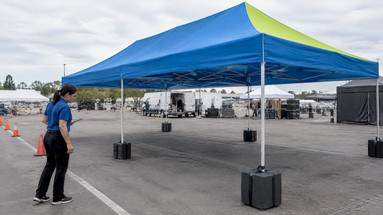
20x30 Often Needs a Permit: Trade-Show Canopy Tent Sizes & Capacity
Posted by Deeder Dandenhorf on Oct 5th 2026
20x30 Often Needs a Permit: Trade-Show Canopy Tent Sizes & Capacity

For most trade-show booths, a 10x10 pop-up canopy is the default choice because it matches standard booth footprints while balancing branding, staffing, and easy transport. Larger footprints like 10x20, 20x20, and 20x30 trade that portability for more display space and higher people capacity, but they also bring stricter permit and sight-line rules you need to check before you order.
TL;DR:
- Canopies larger than 10x10 often require permits and must meet strict height and sight-line regulations to avoid organizer adjustments.
- A 10x10 canopy comfortably fits approximately 10 to 14 people standing and is ideal for standard trade-show booths with minimal staffing.
- Custom-sized canopies are recommended if your booth space is irregular or if your event requires special branding or layout considerations.
- Proper anchoring, especially for outdoor events, depends on canopy size, venue surface, and wind exposure, with larger structures needing more or specialized ballast.
- Confirm permitted footprint and height with show management early to avoid costly setup delays or rule violations on move-in day.
Table of Contents
- Common Canopy Footprints and Where Each One Fits
- How Many People Actually Fit Under Each Size
- Booth Standards, Sight Lines, and Height Limits
- Permits, Flame Certification, and Egress Requirements
- A Five-Step Checklist for Choosing Your Canopy Size
- How We Help You Move Fast and Stay Compliant
- Weight and Anchoring Needs Scale With Canopy Size
- What the Size Guides Usually Get Wrong
- Matching Your Booth Size to the Right Display Products
- FAQ
- Sources
Common Canopy Footprints and Where Each One Fits
Picking the right custom canopy tent size starts with matching the footprint to what you are actually doing at the event. An 8x8 canopy is the compact option, good for a single demo table or a product sample station where floor space is tight. The 10x10 is the workhorse: it covers 100 square feet and lines up with the standard inline booth almost every show uses.
Step up to a 10x15 or 10x20 when you need room for a sit-down consultation area alongside your display, or when two staff members need to work the booth without bumping elbows. A 15x15 suits corner booths that want a little more presence without jumping to a full double unit. The 20x20 and 20x30 sizes belong to experiential activations, sponsor lounges, or outdoor festival setups where you are hosting groups rather than greeting foot traffic one at a time.
- 8x8: best for single-table demos or sample stations with minimal staffing.
- 10x10: the standard inline booth size, easy to transport and set up solo.
- 10x15 or 10x20: fits a consultation area or two-person staffing without crowding.
- 15x15: a corner-booth upgrade with modest extra branding room.
- 20x20 or 20x30: suited to activations, lounges, or outdoor group gatherings.
Storage and transport scale with footprint. A 10x10 pop-up frame and its canopy typically pack into a rolling bag one person can handle, while a 20x30 setup usually needs a small crew and a larger vehicle. When your event calls for something between these standard sizes, a custom footprint is worth ordering, particularly if you have an irregular booth space or want a canopy that matches an unusual backwall width.
How Many People Actually Fit Under Each Size
Square footage only tells half the story. What matters for planning is how many visitors, staff, and demo stations a given canopy can hold without feeling cramped or violating a venue’s occupancy rules. The tent capacity chart from the University of Kentucky breaks this down using standard density rules: 5 square feet per person for standing room, 7 square feet for concentrated seating, and 15 square feet for banquet-style seating.
- 10x10 (100 square feet): holds up to roughly 14 people standing, around 10 in concentrated seating, or 6 at banquet-style tables. A single demo table along the back wall with an open front leaves comfortable visitor flow.
- 10x20 (200 square feet): fits up to about 28 standing, 20 seated, or 13 at banquet tables. This size supports a demo station plus a small seating nook, with storage tucked behind a pipe-and-drape divider.
- 20x30 (600 square feet): accommodates up to roughly 85 standing, 60 seated, or 40 at banquet seating. At this scale you can run a product display zone, a hospitality area, and a back-of-house storage section as distinct zones under one canopy.
Once your expected headcount climbs toward 50 or more, many venues start requiring a licensed attendant, additional exits, or a fire-watch presence, so it is worth checking local occupancy rules before you commit to a layout.
Booth Standards, Sight Lines, and Height Limits
Trade shows run on 10-foot increments, which is why canopy sizing almost always maps to 10x10, 10x20, or larger multiples rather than odd dimensions. The IAEE guidelines for display describe the standard booth types: linear (inline) booths typically cap rear-wall height at 8 feet with a 4-foot limit on anything within 10 feet of a neighboring booth, while peninsula and island booths allow taller structures since they are not boxed in by neighbors on three sides.
A canopy peak that exceeds these limits, or signage that blocks a neighbor’s sight line, is one of the most common reasons organizers request changes at move-in. If your canopy’s peak or branding tower pushes past the standard height, plan a setback from the aisle, choose a lower-profile frame, or submit drawings to show management in advance for a variance. Confirming your show’s specific height and sight-line rules weeks before the event, and getting written approval for anything non-standard, avoids a scramble on setup day.
Permits, Flame Certification, and Egress Requirements
Size thresholds trigger permit requirements in most jurisdictions, and missing the paperwork can mean your canopy gets flagged or removed on-site. Guidance from Derby, Kansas and the City of Chicago both point to similar tiers: structures over 400 square feet commonly need a permit, with open canopies sometimes allowed up to 700 square feet before the same rule applies.

A 20x30 canopy reaches a size where many cities start requiring a plan submittal or express permit, according to Chicago’s temporary tent procedures, so confirm this before you finalize your size.
Before setup, confirm you have:
- A flame-retardancy certificate matching the tent’s serial number, on-site and ready to show.
- A floor plan showing exits, aisles, and fire extinguisher placement.
- Exit signage and extinguishers sized to your occupant count.
Apply for permits as soon as your booth footprint is locked in, ideally several weeks out, and contact the venue’s fire marshal or facilities office directly rather than relying on show-guide assumptions.
A Five-Step Checklist for Choosing Your Canopy Size
Turning all of this into a decision is simpler than it sounds once you work through it in order.
- Confirm your booth footprint and allowed height with show management before you shop for a canopy.
- Estimate visitor flow and staffing so you know whether you need standing room, seating, or both.
- Choose a size that balances branding space against interaction room, since a bigger canopy means less walk-up traffic per square foot.
- Verify permit thresholds and flame certification apply to your chosen footprint and venue.
- Lock in accessories and fulfillment timing so sidewalls, signage, and lighting arrive with time to spare.
When you talk to a vendor or the show manager, ask about lead time for production, whether a flame certificate ships with the product, the recommended anchoring method for your venue’s surface, and whether onsite liability insurance is required for your booth type.
Pro Tip: Keep a quick-ship backup banner or sign in reserve. Last-minute booth changes happen more often than exhibitors expect, and a fast-turnaround option saves a show from a bare backwall.
How We Help You Move Fast and Stay Compliant
Many products ship within two business days, which matters most when a permit question or a late booth-size change leaves you scrambling before move-in. Direct delivery to event venues in some areas may be available, cutting out a shipping step entirely for local exhibitors.
Our product range maps directly to the sizes covered above: the Outdoor Banner Frame suits a standard 10x10 inline booth, while a 10 ft stretch fabric display fits well against a 10x20 backwall. Check flame-certification and lead times on each product page before you order.
Weight and Anchoring Needs Scale With Canopy Size
A canopy is only as good as what keeps it on the ground, and anchoring requirements grow fast as footprint increases. A 10x10 frame typically needs four corner weights, often in the 25 to 40 pound range per leg depending on the manufacturer’s specifications, or stakes driven into soft ground where staking is allowed. Move up to a 10x20 or 20x20, and you are often doubling the number of anchor points, since the extra frame span creates more surface area for wind to catch.

Indoor venues almost always prohibit stakes, which means weight bags or water-filled ballast are the standard choice regardless of canopy size. Outdoor setups give you more flexibility, but concrete, asphalt, or pavers rule out stakes too, pushing you back toward weighted options. Larger structures like a 20x30 canopy may require engineered ballast calculations, particularly if local code treats the structure as a temporary membrane building rather than a simple pop-up frame.
Wind is the real driver here, not just size. A canopy with sidewalls attached catches far more wind load than an open-frame version of the same footprint, which is why adding sidewalls often pushes anchoring requirements up a full category. If you are unsure what your specific frame needs, check the manufacturer’s weight chart rather than guessing, and always confirm the anchoring method with the venue before move-in, since some facilities restrict both stakes and certain ballast types on finished flooring.
What the Size Guides Usually Get Wrong
Most sizing guides treat canopy footprint as a branding decision first and a logistics decision second. We would flip that. Branding looks good on a 20x30 canopy, but if your booth space, your permit threshold, and your crew size are all built around a 10x10 footprint, that bigger canopy becomes a liability rather than an asset on show day.
The thing we see overlooked most often is the sight-line and height rule, not the square footage. Exhibitors size up for presence, then get a move-in day request to lower a tower or rework a backwall because nobody checked the show’s specific height allowance in advance. That single phone call to show management, made weeks early, prevents more wasted setup time than any amount of careful square-footage math.
Prioritize confirming your allowed footprint and height first, then build staffing and branding decisions around that confirmed number, not the other way around.
— Dan
Matching Your Booth Size to the Right Display Products
Once you know your footprint, matching it to the right product is straightforward. A 10x10 booth pairs well with an Outdoor Banner Frame for clean, portable branding, while a 10x20 layout gets more visual weight from a 10 ft stretch fabric display or one of our Quick Ship Displays.
- 10x10 booths: Pop Up Tents - Printed or the Outdoor Banner Frame.
- 10x20 booths: 10 ft stretch fabric display or a quick-ship backwall.
- Any size, last-minute changes: our two-business-day fulfillment and direct Arizona venue delivery keep you covered.
Browse our full trade show products and displays to find the right match for your booth before your next show.
FAQ
What are custom canopy sizes?
Custom canopy sizes are footprints built outside the standard increments like 10x10 or 10x20, tailored to an irregular booth space or a specific branding need. Vendors typically build these around your exact booth dimensions rather than a stock size.
What sizes do canopy tents come in?
Standard canopy tent sizes run from 8x8 up through 10x10, 10x15, 10x20, 15x15, 20x20, and 20x30, with 10-foot increments matching standard trade-show booth footprints. Custom dimensions are available when your space does not fit these standard options.
How many people fit in a 20x30 canopy?
A 20x30 canopy covers 600 square feet and can hold a large group of people, with approximate capacities for standing or seated arrangements based on standard occupancy density rules.(https://events.uky.edu/sites/default/files/2022-04/TENT CAPACITY CHART v2.pdf). The right number for your event depends on whether you need open floor space or seated areas.
How many people can fit in a 10x20 canopy tent?
A 10x20 canopy tent covers 200 square feet and fits up to about 28 people standing, 20 in seated rows, or 13 at banquet tables, according to the same capacity chart. This size works well for a demo station paired with a small seating area.
Sources
- Tent capacity chart (University of Kentucky)
- Temporary membrane structure permit guidance (Derby, KS)
- IAEE guidelines for display
- City of Chicago temporary tent permitting procedures