
Press Conference Backdrop: Size and Order Guide for Events
Posted by Deeder Dandenhorf on Aug 15th 2026
Press Conference Backdrop: Size and Order Guide for Events
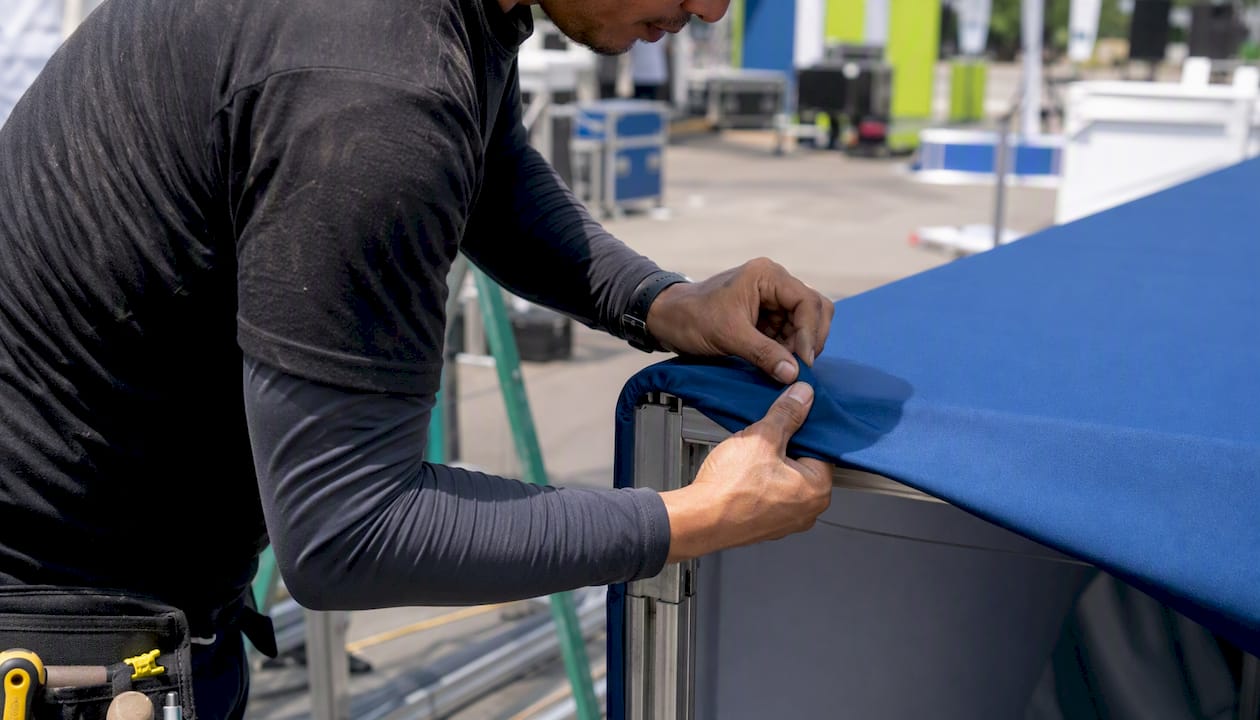
For most indoor press conferences, a tensioned 10’ × 8’ stretch-fabric step-and-repeat is the right call. It fills the camera frame cleanly for solo speakers and small press rows, photographs without glare or wrinkles, and sets up quickly.
- Camera visibility: A 10’ width gives TV cameras and still photographers enough branded real estate without cropping logos at the edges.
- Wrinkle-free finish: Stretch fabric pulls taut over an aluminum frame, so there are no ripples or creases to distract from your brand on screen.
- Fast fulfillment: The right vendor ships a print-ready fabric display quickly enough to meet tight event deadlines.
Pro Tip: Order at least 6 inches of extra width beyond your podium or speaker table. That buffer keeps logos fully visible even when cameras shift angle during a live broadcast.
Ready to order? The 10 ft stretch fabric display from Arrowhead Sign Company - Signs, Banners and Trade Show Displays ships fast and is sized for exactly this use.
Key Takeaways
A tensioned 10’ × 8’ stretch-fabric display is the most practical press conference backdrop for indoor events: it photographs cleanly, sets up fast, and ships within two business days from Arrowhead Sign Company - Signs, Banners and Trade Show Displays.
| Point | Details |
|---|---|
| Standard size for most press events | A 10’ × 8’ or 8’ × 10’ stretch-fabric backdrop covers solo speakers through small press rows. |
| Fabric beats vinyl on camera | Matte stretch fabric eliminates glare and wrinkles that vinyl shows under studio lighting. |
| File specs before you order | Submit CMYK PDF/X-1a at 100 ppi with 1–2 inches of bleed and a 3–4 inch safe zone. |
| Build in proof time | Request a digital proof and a fabric swatch before approving the full production run. |
| Arrowhead Sign Company fulfillment | Most stock displays ship within two business days, with direct venue delivery in Arizona. |
Table of Contents
- What size press conference backdrop do you actually need?
- Which material photographs best for press and broadcast?
- How are press backdrops supported and mounted?
- What design specs does your print file need?
- What do press backdrops cost, and how long does production take?
- How do you choose the right vendor and avoid ordering mistakes?
- Why Arrowhead recommends stretch fabric for indoor press events
- What I’ve learned from press backdrop installs
- Order your press backdrop from Arrowhead Sign Company
- Sources
- FAQ
What size press conference backdrop do you actually need?
Matching your backdrop to the shot type is the single decision that determines whether your branding reads on camera or gets cropped out. Standard step-and-repeat dimensions run from 8’ × 5’ for tight tabletop setups all the way to 10’ × 20’ for full-stage sponsor walls.
| Size | Typical Occupants | Best Use |
|---|---|---|
| 8’ × 5’ | 1–2 people | Tabletop, video interview, small briefing |
| 8’ × 8’ | 1–4 people | Single podium, solo speaker, small group |
| 8’ × 10’ | 3–8 people | Multi-person press row, film premieres |
| 10’ × 8’ | 1–5 people | Standard press conference, podium with flanking officials |
| 8’ × 12’ | 4–10 people | Red carpet arrivals, group sponsor shots |
| 10’ × 20’ | Full stage | Sponsor walls, large-stage press events |
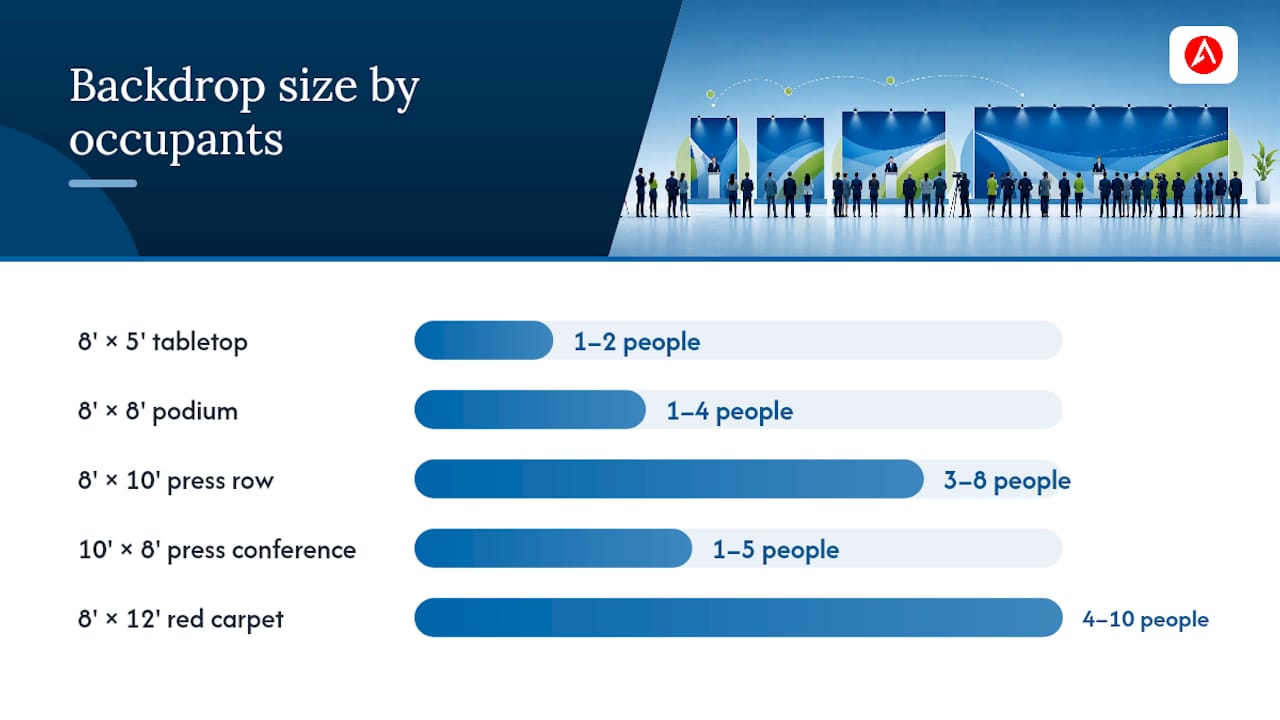
According to Event Fab’s sizing guide, an 8’ × 8’ wall handles singles, couples, and small trios comfortably, while an 8’ × 10’ is the go-to for red-carpet arrivals where photographers need extra width for group compositions.
Before you finalize a size, measure your venue’s available floor depth and ceiling height. A 10’ × 20’ wall needs at minimum 12’ of ceiling clearance and significant floor depth for the frame footprint. For most hotel ballrooms and conference centers, a 10’ × 8’ or 8’ × 10’ hits the sweet spot between coverage and portability.
Pro Tip: If your press conference includes a roped aisle or multiple camera positions at different angles, add 12–18 inches of extra width so logos stay in frame from every shooting position.
Which material photographs best for press and broadcast?
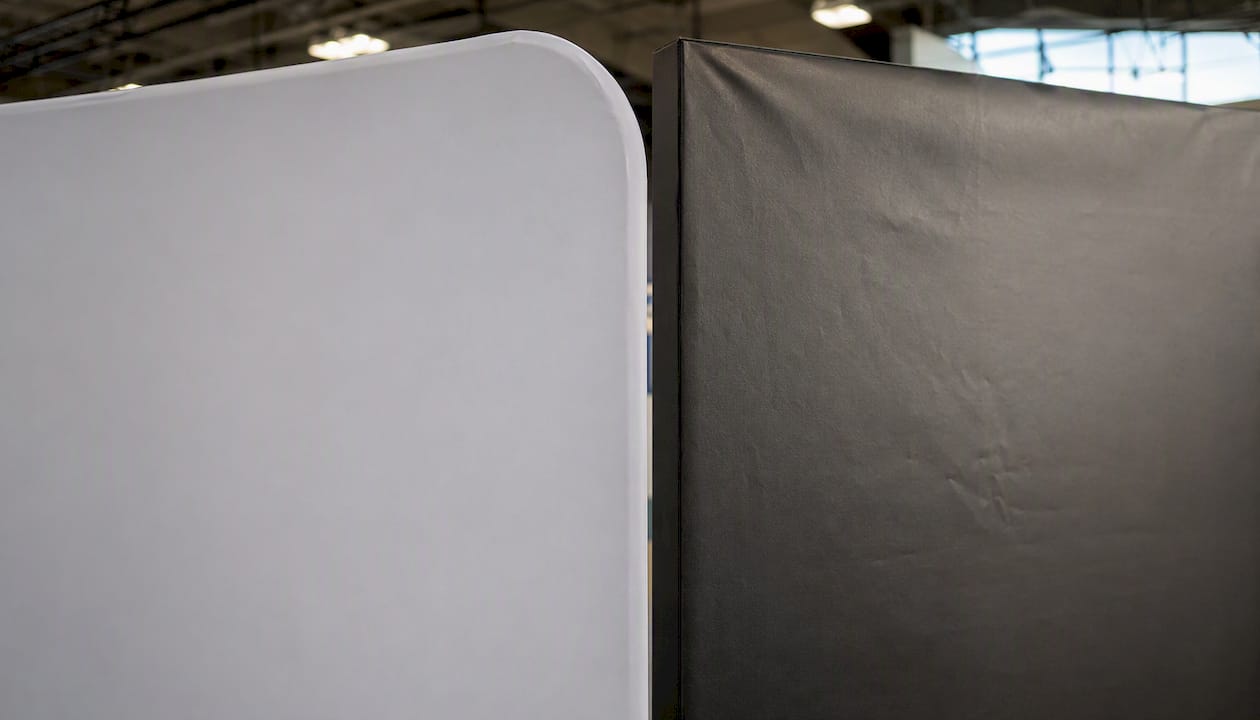
The material you choose determines how your backdrop looks on a broadcast feed, in wire-service photos, and in social clips. Vinyl is cheaper upfront, but tensioned fabric systems consistently outperform it for indoor media walls because they eliminate glare and resist wrinkling on camera.
| Material | Camera/Lighting Performance | Best Use | Notes |
|---|---|---|---|
| Stretch/tension fabric (SEG) | Excellent — matte, wrinkle-free | Indoor press, broadcast, repeat use | Requires aluminum SEG frame; fast swap |
| Straight stretch fabric | Excellent — matte finish | Indoor press, portable setups | Pillow-case style over frame; no tools |
| Matte vinyl | Good — low glare if matte | Budget indoor events | Heavier, can crease in transit |
| Gloss vinyl | Poor — reflects studio lights | Outdoor signage only | Avoid for any camera-facing use |
| Rigid panels | Very good — flat surface | Permanent or semi-permanent installs | Heavy freight; longer lead time |
| LED/video wall | Excellent — dynamic content | High-budget broadcast events | Requires power, AV crew, and rigging |
SEG and straight-stretch fabric systems deliver a smooth, photogenic surface that holds color saturation without hot spots under studio lighting. For any event where TV cameras or professional photographers are present, matte fabric is the practical standard.
Pro Tip: Request a fabric swatch or small sample print before approving a full order. Color shifts between a monitor proof and a printed fabric panel are common, and a swatch lets you catch them before the full run.
How are press backdrops supported and mounted?
Your mounting system determines setup time, venue compatibility, and how the wall holds up under event conditions. Each system has a different footprint, weight, and skill requirement.
Common mounting systems:
- Telescopic stands: Adjustable poles with crossbars; the most portable option for fabric banners. No tools required. Best for 8’ × 8’ or smaller.
- Pop-up/tension frames: Accordion-style frames that expand and lock; fabric attaches with hook-and-loop or pillow-case sleeves. Setup in under 10 minutes for most sizes.
- SEG aluminum frames: Silicone-edge graphics slot into a channel frame. Produces the flattest surface of any fabric system. Requires basic assembly but no special tools.
- Pipe-and-drape: Venue-standard system using uprights, crossbars, and drape. Flexible for wide spans; common in hotel ballrooms. Fabric banners attach with grommets or clips.
- Retractable/roll-up stands: Cassette-style base that retracts the graphic for transport. Best for smaller formats (under 6’ wide) or auxiliary branding near the press area.
- Outdoor banner frames: For outdoor press events, a weighted outdoor banner frame with ballast bags handles wind loads that would topple a standard telescopic stand.
For wayfinding and secondary branding near the press area, a Signicade Deluxe A-Frame works well at venue entrances or media check-in points.
Installation steps for a standard pop-up or SEG frame:
- Confirm ceiling height and floor depth at the venue before delivery.
- Lay out the frame components and identify the base feet, uprights, and crossbar.
- Assemble the frame flat on the floor, then raise it upright with a second person.
- Attach the fabric graphic (pillow-case sleeve or SEG channel) starting from the top center.
- Tension the fabric evenly from center to edges to remove any slack.
- Place the frame at least 10 feet behind the speaker to reduce shadows and give photographers clean sightlines.
- Check the backdrop from the camera position before the event begins.
For very large walls (10’ × 20’ or modular rigid panels), plan for longer install access windows and, in some venues, a scissor lift for upper-frame assembly.
What design specs does your print file need?
Getting the artwork right before you send files to print saves you from a reprint. Here are the non-negotiable specs for a production-ready press backdrop file.
File and color requirements:
- File format: PDF/X-1a is the safest choice for large-format print. High-resolution TIFF or layered PSD files are accepted by most vendors.
- Color mode: Submit in CMYK. RGB files will be converted by the printer, and that conversion can shift brand colors noticeably on fabric.
- Resolution: 100–150 ppi at final print size is standard for large-format fabric. A 10’ × 8’ file at 100 ppi equals 12,000 × 9,600 pixels.
- Bleed: Add 1–2 inches of bleed on all sides so the graphic wraps cleanly around the frame edge.
- Safe zone: Keep all logos and text at least 3–4 inches from the edge to avoid cropping during finishing.
For a step-and-repeat logo grid, space logos so that any 3’ × 3’ crop of the backdrop contains at least one complete logo. A brick-offset pattern (each row shifted by half a logo width) keeps logos visible from every camera angle and at every crop. For multi-sponsor walls, assign logo sizes by tier and maintain consistent clear space (at least one logo-width) between each mark.
Pro Tip: Always request a digital proof at full scale before approving production. For fabric displays, also ask for a color-match swatch printed on the actual substrate — monitor proofs and fabric output can differ by a visible margin.
What do press backdrops cost, and how long does production take?
Budget and lead time are usually the two constraints that drive the final decision. Here are realistic ranges by product type.
Typical price ranges:
- Fabric tension displays (8’–10’ wide): entry-level to mid-range, depending on frame quality and graphic complexity.
- Vinyl step-and-repeat banners: generally lower cost than fabric, but heavier and less camera-friendly.
- Rigid panel walls: significantly higher cost, plus freight and installation fees.
- LED/video walls: highest cost tier; typically rented rather than purchased for single events.
| Product Type | Typical Production Time | Rush Available? | Shipping Notes |
|---|---|---|---|
| Fabric stretch display (stock frame) | 2–5 business days | Yes, often 1–2 days | Ships folded; lightweight parcel |
| Custom fabric graphic only | 3–5 business days | Yes | Folded or rolled; no crating |
| Vinyl banner | 2–4 business days | Yes | Rolled; standard freight |
| Rigid panel wall | 5–7 day production queues | Limited | Crated; freight carrier required |
| LED/video wall | 2–4 weeks (rental setup) | No | Requires AV crew and truck |
Arrowhead Sign Company - Signs, Banners and Trade Show Displays ships most stock display products within two business days, with local venue delivery available in Arizona. For events with tight deadlines, that fulfillment window is a real advantage over vendors with standard 5–7 day production queues.
Signage deadlines affect the entire event timeline — ordering a backdrop late can cascade into setup delays on the day. Build in at least one extra business day as a buffer for proof review.
How do you choose the right vendor and avoid ordering mistakes?
Work through this checklist in order before placing any order.
- Confirm your shot types. Will cameras be at a fixed position or moving? Is this a podium-only setup or a multi-person press row? Your answer determines the minimum width you need.
- Measure the venue. Get ceiling height, available floor depth, and the exact wall or stage width where the backdrop will sit.
- Pick material and size. For indoor press use, stretch fabric in a 10’ × 8’ or 8’ × 10’ format covers most scenarios. Outdoor events need a weather-rated frame and vinyl or outdoor-rated fabric.
- Select your mounting system. Match the system to your venue’s floor type, ceiling height, and setup crew size.
- Prepare your print file. CMYK PDF/X-1a at 100 ppi, with bleed and safe zone, and a step-and-repeat logo grid if needed.
- Request a proof. Digital proof first; fabric swatch if color accuracy is critical.
- Confirm lead time and delivery. Get the ship date and delivery date in writing before you pay.
Vendor questions worth asking before you commit:
- What file formats do you accept, and do you handle RGB-to-CMYK conversion?
- What fabric finishing is included (hemming, grommets, SEG silicone edge)?
- Do you offer a warranty or reprint policy for color or print defects?
- Can you deliver directly to the venue, and do you offer installation support?
- What is your rush production policy and fee structure?
Red flags to watch for:
- No digital proof offered before production.
- Vague material descriptions (“high-quality fabric” with no substrate name).
- No mention of finishing method (how the graphic attaches to the frame).
- Hidden freight or crating fees disclosed only at checkout.
Why Arrowhead recommends stretch fabric for indoor press events
Stretch fabric wins for press and broadcast use because it is wrinkle-resistant, matte, and fast to set up. Those three qualities are not marketing language — they are the practical reasons wire-service photographers and broadcast crews prefer fabric media walls over vinyl at professional events.
Tensioned fabric systems reduce glare and resist wrinkling in ways that vinyl simply cannot match under studio lighting. A vinyl banner that ships rolled or folded arrives with visible crease lines that catch light on camera. A stretch-fabric graphic ships folded in a carry bag, then pulls smooth over the frame in minutes.
Arrowhead Sign Company - Signs, Banners and Trade Show Displays backs that recommendation with real fulfillment capability: most stock displays ship within two business days, and Arizona-based clients can arrange direct venue delivery. For event teams coordinating a press conference on a short timeline, that combination of product quality and speed matters.
Arrowhead Sign Company - Signs, Banners and Trade Show Displays ships most stock display products within two business days, with local venue delivery available in Arizona — so your backdrop arrives ready to set up, not just ready to unbox.
What I’ve learned from press backdrop installs
The problems that show up on install day are almost never about the backdrop itself. They are about the room.
A venue floor plan that looks generous on paper can shrink fast once you account for the AV cart, the podium, the camera riser, and the press table. The backdrop frame needs floor space behind it as well as in front, and that rear clearance is where AV cables and lighting stands tend to live. Scheduling a 15-minute walkthrough with the AV crew before the media arrives catches those conflicts before they become problems.
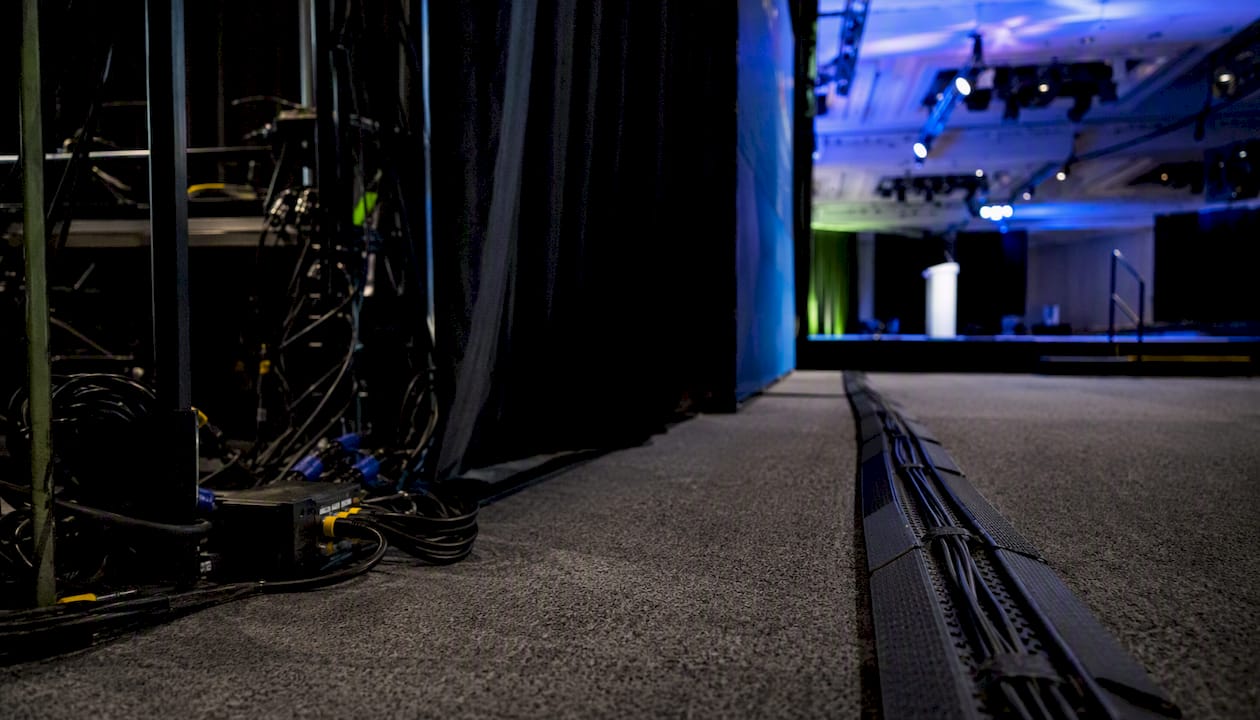
The other thing worth building into your schedule: a short camera-position check. Stand at the camera riser, look through the viewfinder or monitor, and confirm that logos are centered and fully in frame. A backdrop that looks perfect from the front of the room can sit two feet off-center from the camera’s perspective.
For last-minute artwork changes, the fastest fix is a replacement graphic on the same frame. If your vendor ships the graphic separately from the hardware, a new print can arrive overnight without touching the stand already set up at the venue.
Order your press backdrop from Arrowhead Sign Company
The Shasta 10 ft straight stretch fabric display is the product that matches everything this guide recommends: a 10’ wide stretch-fabric graphic on an aluminum frame, matte finish, wrinkle-free, and sized for solo speakers through small press rows. It ships folded to avoid creasing and is designed for quick artwork swaps when your event schedule changes.
Your ordering checklist: confirm your venue dimensions and shot type, prepare a CMYK PDF/X-1a file at 100 ppi with 1–2 inches of bleed, request a digital proof before approving production, and specify your delivery date and whether you need Arizona venue delivery. For outdoor press areas, pair the main display with an outdoor banner frame rated for wind loads.
Contact Arrowhead Sign Company - Signs, Banners and Trade Show Displays directly to request a quote, ask about rush production, or arrange local delivery to your Arizona venue.
Sources
- Guide to Step-and-Repeat Banner Sizes | PrintPlace
- Step-and-Repeat Banner Sizes: A Complete Guide for Branded Photo Walls – Event Fab
- Step and Repeat Banners: The Complete 2026 Guide – C17media
FAQ
What is the standard size for a press conference backdrop?
The most common sizes are 8’ × 8’ for single speakers and small groups, and 8’ × 10’ or 10’ × 8’ for multi-person press rows. Larger events use 8’ × 12’ or 10’ × 20’ for full-stage sponsor walls.
What material works best for a media event backdrop?
Tensioned stretch fabric is the preferred material for indoor press and broadcast use because it is matte, wrinkle-free, and eliminates the glare that vinyl shows under studio lighting.
How far behind the speaker should a press backdrop be placed?
Place the backdrop at least 10 feet behind the speaker. That distance reduces shadows and gives photographers enough room for clean shots without blocking the branded background.
What file format should I send to print a custom press background?
Submit a CMYK PDF/X-1a file at 100 ppi at final print size, with 1–2 inches of bleed on all sides and a 3–4 inch safe zone to protect logos from edge cropping.
How quickly can a press conference backdrop be produced and shipped?
Fabric stretch displays typically produce in 2–5 business days, with rush options often available in 1–2 days. Arrowhead Sign Company - Signs, Banners and Trade Show Displays ships most stock displays within two business days, with local venue delivery available in Arizona.
Recommended
- Types of Promotional Backdrop Displays: 2026 Guide - Arrowhead Sign Company
- Pop Up Display Comparison Guide for Event Marketers - Arrowhead Sign Company
- How Exhibitors Choose Banner Heights: Quick Sizing Guide - Arrowhead Sign Company
- Portable Display Options for Marketing Events: 2026 Guide - Arrowhead Sign Company