

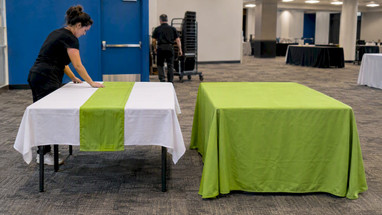
Table Runner vs. Table Throw: Which One Fits Your Table?
Posted by Deeder Dandenhorf on Oct 23rd 2026
Table Runner vs. Table Throw: Which One Fits Your Table?

A table runner is a narrow strip of fabric that runs down the center of a table. A table throw is a full cover that drapes over the top and sides, usually to the floor in a trade show or event setting. The runner decorates. The throw covers, hides and brands.
That difference decides almost every purchase. If you want to add color to a dining table or layer texture over a cloth, buy a runner. If you are setting up a 6 ft or 8 ft table at an expo, a fundraiser or a farmers market and want it to look finished, buy a throw.
TL;DR
- A runner is a decorative strip. It never replaces the main cover, and it leaves the table edges visible.
- A throw is a full drape that covers the top and hangs down the sides. It is the standard choice for booths because it hides storage and carries your logo.
- For a 6 ft (72 in) table, a runner usually runs about 84 in long, so it overhangs each end by roughly 6 in. Measure your actual table first.
- Runners can sit on top of a throw. The two work well together when you want a branded look plus a color accent.
- For events, ask the organizer about table sizes and fabric rules before you order.
Table of Contents
- What each one actually is
- Side-by-side comparison
- When to use a table runner
- When to use a table throw
- Sizing for 6 ft and 8 ft tables
- Fabric, printing and care
- Our view: why exhibitors end up with throws
- Building a booth around the table
- Where Arrowhead fits
- How to choose in five minutes
- FAQ
- Sources
What each one actually is
The table runner
A runner is a long, narrow piece of fabric, typically 12 to 16 inches wide, laid lengthwise along the middle of the table. It protects a small part of the surface, adds color and texture, and gives place settings or centerpieces a visual anchor. One commercial linen buyer’s guide describes it as a decorative layer that does not replace the main cloth, which is the clearest way to think of it.
Because it covers so little, a runner does not hide anything. Boxes, cords and spare stock under the table stay in view.
The table throw
A throw is a loose cover cut larger than the tabletop. It lays over the top and falls down the front, back and sides. Unlike a fitted cover with sewn corners, a throw simply drapes, so it tolerates small differences in table size from one venue to the next. On a 6 ft table, the front panel is the largest visible surface at a booth, which is why printed throws are popular for logos and taglines.
A throw is also what many people mean when they search for a tablecloth in an event context. For everyday home use, tablecloth and throw overlap. For exhibitors, a throw is a tablecloth built for display.
Side-by-side comparison
| Criteria | Table runner | Table throw |
|---|---|---|
| Coverage | Center strip only | Top and sides, often to the floor |
| Main job | Decoration, accent, protection of the center | Full cover, branding, concealment |
| Hides storage under the table | No | Yes |
| Logo and message space | Small | Large front panel |
| Works alone | Yes, on a finished wood or stone surface | Yes |
| Works layered | On top of a cloth or throw | As the base layer |
| Tolerates different table sizes | Very easy | Fairly easy, depending on cut |
| Best for | Dining rooms, buffets, weddings, console tables | Trade shows, expos, craft fairs, sponsor tables |
When to use a table runner
A runner earns its place in a few situations:
- Dinner tables with an attractive surface. If the wood or stone is the star, a runner frames it without hiding it.
- Layered looks. Place a runner across a solid cloth to add a second color or pattern. This is common at banquets and weddings, and it is simple to swap for a new season or theme.
- Buffets and console tables. A runner gives serving dishes a defined zone.
- Protecting the center. Hot dishes still need trivets, but a runner takes the everyday scuffs where centerpieces sit.
- Sponsor or welcome tables. A narrow branded runner over a plain cover adds a hint of identity at low cost.
Skip the runner when your table is rented, scratched or mismatched. A runner will not hide any of that.
When to use a table throw
Choose a throw when appearance and practicality both matter:
- Trade show booths. The cover turns a rented folding table into a branded display and keeps boxes, bags and brochures out of sight.
- Product demos and sampling tables. A clean floor-length drape keeps attention on what you are showing.
- Registration and check-in desks. A single color throw looks organized and consistent.
- Outdoor events. A heavier fabric helps with wind, although you will still want clips or weights.
If you want the brand look and an accent, layer them. Put the throw down first, then lay a contrasting runner across the top for a product display or a stack of handouts.
Sizing for 6 ft and 8 ft tables
Sizing is where most buyers get stuck, so measure before you buy. A standard 6 ft rectangular table is 72 in long. Event inventories commonly list both 6 ft and 8 ft rectangular tables, so confirm which one your venue is providing.
Runner size for a 6 ft table
Our rule of thumb: let the runner hang about 6 in past each end of the table. On a 72 in table that gives you roughly 84 in of runner length. For an 8 ft (96 in) table, aim near 108 in. If you are layering over a cloth, make sure the runner never hangs lower than the cloth beneath it. Width is a style choice; 12 to 16 in suits most settings, and wider reads as more formal.

Throw size for event tables
The height of the table matters as much as the length. Tablecloth length guides sort drops into categories such as lap, calf, floor and puddle lengths, and a trade show throw is almost always the floor-length version. A standard event table is 30 in high, so you want a drop that reaches the floor without pooling.
One event fabric guide notes that for a standard 8 ft banquet table, full floor-length coverage calls for a 90 by 156 in cloth, while a 90 by 108 in size leaves the ends short. That is a banquet cloth for a table 30 in wide. Trade show tables are often 24 or 30 in wide, and a throw made for a three-sided drape covers the front and sides while leaving the back open for you to work, so match the product spec to your table rather than assuming.
A quick method:
- Measure the tabletop length and width, and the height from floor to tabletop.
- Decide the drop you want: to the floor for booths, shorter for casual tables.
- Add the drop on every side you plan to cover to the tabletop dimensions.
- Compare the result to the product’s listed dimensions, and call the seller if you are between sizes.
Fabric, printing and care
For home use, cotton and linen are popular and easy to iron. Hospitality operations lean on polyester blends; one university linen program describes a polyester-based line as the most used restaurant table linen fabric in the U.S.. Polyester also takes dye-sublimation printing well, which is how most custom event throws get their full-color graphics.
Check the fabric label before you buy for an event. Wrinkles are the enemy at a booth, so look for a fabric that holds up after being folded in a carry bag. A tip from a university textile handout: rub the cloth between your fingers, and if firmness changes, the cloth carries heavy sizing that will wash out and leave it limp. Wash and test a sample if you can.
Fire rules at shows
Some venues and show organizers require flame-retardant fabrics for booth draping, and requirements vary by building and local fire marshal. Read your exhibitor manual or ask your show contact before you order printed fabric, and keep the product’s flame-retardant documentation handy if it has any.
Our view: why exhibitors end up with throws
We work with small businesses getting ready for expos, and the table is the part many forget until the week before. Here is what we see over and over.
First, a rented table looks rented. A runner will not fix that. A throw will, and a printed throw also does a second job as a sign at hip height, right where visitors’ eyes land when they walk the aisle.
Second, the floor space under the table is useful. Spare banners, shipping boxes and personal items need somewhere to go. A throw gives you that without anyone noticing.
Third, the strongest booths look consistent. A throw that repeats your logo and colors from the banner stand behind it ties the booth together. If your budget is tight, start with one printed front panel and a solid-color cover, and add the runner as a seasonal accent later.

And a practical tip: order for the table you will most likely get, but pick a cut that forgives a slightly different size. Shows change table sizes, and a throw is more forgiving than a rigid fitted cover.
Our trade show display types guide goes through how tables, banners and backdrops work together, and our brand visibility checklist helps you catch gaps before the show.
— Dan
Building a booth around the table
A covered table is only one piece. Visitors read a booth from several steps away, so the message should sit above table height too. A retractable banner or a tension fabric display behind the table carries your headline, and the throw in front repeats your brand color.
If you are choosing what goes behind your table, see our guide to portable display options for marketing events and our list of signs every small business needs. For a broader look at event signage, read how to choose promotional signage.
Once the show is over, the real work is turning booth traffic into searches for your name. Small businesses that follow up with steady content, such as an automated SEO content approach, tend to keep that attention after the banners come down.
Where Arrowhead fits
We are a Arizona-based sign and display company, and we sell table throw covers alongside the banners, stands and tents that sit around them. Most products ship within two business days, we ship nationwide, and in Arizona we can deliver directly to your venue. Printed banners start with a $35 standard banner layout, and Next Day Air is available for $10 on the printed banners page. Table throws are listed on our home page with the rest of the line, and you can see the matching banner stands, Quick Ship displays and trade show displays to coordinate the whole booth.
How to choose in five minutes
- Where is it going? A dining table at home points to a runner. A booth or event table points to a throw.
- Do you need to hide anything? If yes, throw.
- Do you want your logo on it? A throw gives you the panel. A runner gives you a strip.
- Is the table surface worth showing? If yes, runner. If it is a plain rental, throw.
- Do you want both? Throw first, runner on top, runner never longer than the drop.
FAQ
Can I use a table runner instead of a tablecloth?
Yes, if the table surface looks good and you are comfortable with it being partly exposed. A runner leaves the sides and edges uncovered. For a rented or worn table, or any table you are branding, a full cover is the better choice.
What size table runner do I need for a 6 ft table?
A 6 ft table is 72 in long, so a runner around 84 in gives about 6 in of overhang at each end. If you are layering over a cloth, keep the runner shorter than the cloth’s drop. Measure your own table, since 6 ft tables vary slightly.
Should a table runner be the same length as the tablecloth?
No. The runner is usually shorter than the cloth. It should hang over the table ends, but not as far as the cloth drops, so the cloth stays visible beneath it.
Is a table throw the same as a tablecloth?
For event tables, they do the same job: both cover the top and hang down the sides. The word throw is common in the trade show world and often means a loose drape with a printed front panel. Tablecloth tends to describe dining and banquet linens.
Can I put a runner on top of a table throw at a booth?
Yes. It is a good way to add an accent color or display a product on a defined zone. Keep it plain or lightly patterned so it does not compete with your logo on the throw.
Sources
- Event Linens for Commercial Use: A Practical Buyer’s Guide
- Events Equipment Inventory, UTD Event Planning Guide
- Linen length guide, SIU Student Center
- How to Choose Event Tablecloth Fabric, New Creations Fabric & Foam
- Table Linen Selection, Spartan Linen Services
- Tips on Table Linens, University of Hawaii ScholarSpace