

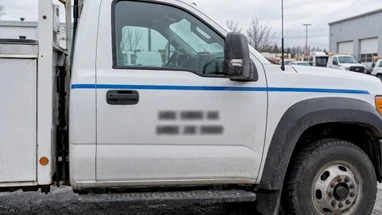
USDOT Door Lettering Size: What the Rule Says
Posted by Deeder Dandenhorf on Oct 18th 2026
USDOT Door Lettering Size: What the Rule Says

The federal rule does not give a letter height for USDOT door lettering. 49 CFR 390.21 sets a performance test instead. The marking must be readily legible in daylight from 50 feet (15.24 meters) while the vehicle is stationary. It must also appear on both sides of the vehicle and contrast sharply with the color behind it. Most sign shops and many state agencies treat 2-inch letters as the practical minimum. Think of 2 inches as a safe starting point, not as the number in the regulation.
This guide covers what to put on the door, how to size it, which mistakes cost carriers a failed inspection, and how to order lettering you won’t have to redo.
TL;DR
- No federal letter height exists. The test is legibility from 50 feet in daylight, on both sides of the power unit.
- Two inches is a common vendor spec and a conservative choice. Texas DPS describes it as an enforcement expectation, so check your operating states.
- The marking needs your legal name or single trade name as filed with FMCSA, plus “USDOT” followed by your number. Digits alone are not enough.
- A removable vinyl decal is allowed if it stays legible, high-contrast and maintained.
- Confirm you need a USDOT number before you order. Weight, passenger count and cargo decide it.
Table of Contents
- What the regulation actually requires
- Why you keep hearing “2 inches”
- How to size lettering so it passes at 50 feet
- Do you need USDOT lettering at all?
- What goes on the door: name, prefix and number
- Printed, painted or removable: what material works
- Don’t confuse the marking with an inspection sticker
- Our perspective: design for the inspector, not the template
- A practical ordering checklist
- Managing the rest of your fleet
- Need lettering for your trucks or your next event?
- FAQ
- Sources
What the regulation actually requires
The rule reads like a checklist. The FMCSA Motor Carrier Safety Planner says vehicles in interstate commerce need two items on both sides of the self-propelled vehicle:
- The motor carrier’s legal name or a single trade name, as listed with FMCSA.
- The identification number, preceded by “USDOT.”
The lettering itself has to meet the conditions in 390.21©. It appears on both sides, contrasts sharply with the background, is readily legible in daylight from 50 feet while the vehicle is stationary, and is kept legible. FMCSA frames the marking as an identification and safety measure. Its summary of the marking final rule says it helps enforcement officials and the public identify the responsible carrier.
That last point shapes how you design the door. The name and the number work as one identification block. They are not decoration to be tucked beside a logo.
Why you keep hearing “2 inches”
Search this topic and nearly every decal vendor says the same thing: letters at least 2 inches tall, readable from 50 feet. That advice is sensible, but it is not the federal wording.
Texas shows the gap well. The Texas DPS markings page lists clearly legible letters and numbers at least two inches high. The same page quotes the federal 50-foot test. So 2 inches can be a state-level expectation, a vendor convention, or both, but it is not a universal federal minimum.
What that means for you:
- Treat 2 inches as the floor. If your design can’t hold 2-inch letters, rethink the layout.
- Go bigger when the door allows. Larger letters make the 50-foot test easier to pass. Some vendors suggest 3 to 4 inches where individual states ask for it, so verify before you assume.
- Check your states. Intrastate carriers can face extra rules. Arizona, for example, requires certain intrastate CMVs to carry a USDOT number, and its Commercial Vehicle Enforcement division enforces the markings.
How to size lettering so it passes at 50 feet
Because the test is about what an inspector can read, size the lettering as a whole system. Letter height is only one factor.
Letter height and stroke weight
Start at 2 inches. Choose a bold, plain typeface. Thin or decorative fonts blur at distance, even at the right height. Clean sans-serif styles read fastest on a moving or parked truck.
Contrast
The rule says the letters must contrast sharply with the background. White on a dark door and black on a white or light door are the safest pairings. Avoid mid-tones on mid-tones, such as gray on silver or red on dark blue. Metallic or glossy vinyl can also wash out in direct sun.
Spacing and line count
Give each character room. Crowded numerals, especially 3, 8 and 0, merge at range. Stack the name above “USDOT 1234567” in two or three lines rather than shrinking everything onto one line. A longer legal name may need a wider door panel or a second line.
Surface and obstructions
“Door lettering” is shorthand, not a federal placement term. The rule says both sides of the vehicle. It does not say the door. Put the complete marking where it sits flat, unobstructed and clean. Avoid door handles, mirrors, window edges, deep body creases and rivet lines.
Quick sizing reference
| Element | Practical spec | Why |
|---|---|---|
| Letter height | 2 inches minimum, larger if space allows | Common vendor and state-level expectation |
| Typeface | Bold sans-serif | Easier to read at distance |
| Color | Sharp contrast with the door | Required by 390.21 |
| Content | Legal name or single trade name, plus “USDOT” and number | Required by FMCSA |
| Placement | Both sides, unobstructed | Required by 390.21 |
| Test | Read from 50 feet in daylight, vehicle stationary | The actual federal standard |
A simple field check: set the finished lettering up, or park the truck, and walk back 50 feet in daylight. If you have to squint at any character, increase the size or the contrast before you finalize.
Do you need USDOT lettering at all?
Don’t order a decal just because your truck carries a company logo. A business decal and a USDOT marking are different things. FMCSA’s registration guidance says a USDOT number is generally required for interstate operations when a vehicle has:
- A gross vehicle weight rating, combination rating, or actual weight of 10,001 pounds or more, or
- Seating for more than 8 passengers including the driver, when carrying them for compensation, or
- Seating for more than 15 passengers including the driver, compensated or not, or
- A load of hazardous materials that qualifies for the rule.
Some states also require a number for intrastate carriers. A sign company can produce the lettering, but you are the one responsible for determining your regulatory status. If you aren’t sure, ask your state’s commercial vehicle enforcement office or your FMCSA registration contact before you buy anything.
What goes on the door: name, prefix and number
The two required elements are easy to get wrong in production.
Use the name exactly as filed. FMCSA says the name should be your legal name or a single trade name as it appears on your registration. A catchy brand name that isn’t on file doesn’t satisfy the rule. If your filed name and your logo differ, put the filed name in the USDOT block and keep the logo separate.
Include the prefix. The number must be preceded by “USDOT.” A decal with only digits is incomplete.
Keep the block together. Don’t split the name onto one door panel and the number onto another. Both items belong on each side.

Check the digits twice. A single transposed number is the most expensive typo in this business, because the decal has to be reprinted. Copy the number straight from your registration record and have a second person read it back.
Printed, painted or removable: what material works
The regulation allows the marking to be painted or made with a removable device, provided it meets the same identification, legibility, contrast and maintenance conditions. The published CFR text permits it, and it does not establish a mandated decal dimension.
Removable vinyl suits several situations:
- Leased or rented trucks you will return.
- Fleets that change units or carriers often.
- Trucks that will be resold, where clean removal protects the paint.
- New operations that want branding while the registration settles.
The obligation to keep the marking legible doesn’t end at installation. Walk the truck before trips and look for peeling edges, fading, cracks, dirt buildup or damage. A decal that has curled at the corner can fail the legibility test as quickly as a missing one. For a sense of lifespan, see our overview of how long vinyl signage lasts. When it is time to take a decal off, our guide to removing truck vinyl without harming the paint walks through the aftercare.
Don’t confuse the marking with an inspection sticker
These are separate items. FMCSA says the inspection sticker, decal or documentation has no federally specified location on the vehicle. The driver must know where it is, produce it on request, and keep it legible and current. That guidance doesn’t replace the USDOT marking requirements on both sides. Plan the door layout for the USDOT block and keep inspection paperwork separate.
Our perspective: design for the inspector, not the template
We make a lot of vehicle and window lettering, and the pattern is consistent. Most failed or redone jobs don’t come from someone ignoring the rule. They come from a design that looked fine on a screen and didn’t hold up on a real door.
Here is how we’d approach it for a small fleet:
- Start from the 50-foot test. If a customer asks for a number, we say 2 inches is a sound starting point and explain that the regulation sets a legibility standard. Then we look at the door and see whether we can go larger.
- Treat the name as filed. Before layout, we ask for the name and number exactly as they appear on the registration, so the proof matches the paperwork.
- Proof before print. A digital proof catches spacing and contrast problems early. Read it aloud, digit by digit.
- Match material to the truck’s future. A leased unit or a short contract calls for removable vinyl. A long-term owned truck may justify something more permanent. Our piece on compliant, paint-safe temporary truck lettering covers that choice in more detail.
- Keep the carrier in charge of compliance. We produce the lettering you specify. You confirm whether your operation needs a USDOT number and what your states expect.
We ship most products within two business days and serve Arizona customers with direct local service, which helps when a truck is waiting on its decals.
— Dan
A practical ordering checklist
- Confirm your vehicle and operation need a USDOT number, using FMCSA’s guidance above.
- List every state you operate in and look up any intrastate marking rules.
- Pull your legal name or single trade name and number from your registration record.
- Measure the usable flat area on each door, clear of handles, seams and windows.
- Pick a bold sans-serif font, a 2-inch minimum height, and a color pair with strong contrast.
- Approve a proof, and have a second person check every character.
- Apply to a clean, dry surface, then do the 50-foot walk-back in daylight.
- Schedule regular inspections for peeling, fading and dirt.
If you want an idea of budget before you start, our truck lettering cost breakdown covers typical ranges and a quote checklist.
Managing the rest of your fleet
Once the markings are right, the next job is keeping track of the trucks wearing them. If you run more than a couple of units, a practical guide to exporting fleet tracking data can help you tie mileage and trip records to each vehicle. That makes it easier to see which units are on the road and which need their lettering inspected.
Need lettering for your trucks or your next event?
Arrowhead Sign Company offers truck lettering and window lettering, along with banners, banner stands and trade show displays. If you’re branding vehicles, start from our homepage to see the lettering options. If you’re heading to an expo, our Quick Ship Displays are made for short timelines, with most products shipping within two business days. We have no published price for truck lettering, so request a quote with your name, number and door measurements.
FAQ
How tall do USDOT numbers need to be?
The federal regulation does not state a number. It requires the marking to be readily legible in daylight from 50 feet while the vehicle is stationary. Many vendors and some states point to 2 inches as the working minimum, so use that as your floor and go larger if the door allows.
Does USDOT lettering have to go on the door?
No. The rule requires the marking on both sides of the self-propelled vehicle, not on the door specifically. The door is simply the most common flat, visible spot. Choose an unobstructed area and check any state-specific rules for intrastate operations.
Can I use a removable decal instead of paint?
Yes. The regulation allows a painted or removable marking as long as it meets the same identification, legibility, contrast and maintenance requirements. Replace any decal that peels, fades or is damaged enough to hurt legibility.
Is the USDOT number alone enough on the door?
No. FMCSA says the marking needs your legal name or single trade name as filed, plus the number preceded by “USDOT.” Order the full block, not just the digits.
Do all trucks with a company decal need a USDOT number?
No. Need depends on your operation, vehicle ratings, passenger use, hazardous materials and sometimes state law. Check FMCSA’s guidance or ask your state enforcement agency before you order.
Sources
- eCFR: 49 CFR 390.21, Marking of self-propelled CMVs
- FMCSA Motor Carrier Safety Planner: Marking of CMVs
- FMCSA: Highlights of the CMV Marking Final Rule
- Texas DPS: Markings
- Arizona DPS: Commercial Vehicle Enforcement
- FMCSA: Do I Need a USDOT Number?
- GovInfo: 49 CFR 390.21 (2021)
- FMCSA: Does the sticker have to be located in a specific location?