

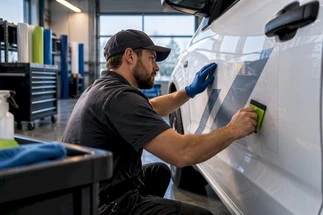
Compliant, Paint Safe Temporary Truck Lettering for Small Business
Posted by Deeder Dandenhorf on Sep 25th 2026
Compliant, Paint Safe Temporary Truck Lettering for Small Business

The easiest, paint-safe temporary lettering options are ultra-removable adhesive film for flat panels, magnetic signs for steel body panels, and reusable stickers when magnets or full adhesion won’t work. All balances paint safety, ease of installation, and cost differently. Whichever you pick, test a small area first and confirm your design doesn’t cover required carrier markings before you commit to the full install.
TL;DR:
- Ultra-removable films are ideal for flat panels and short-term use, but testing a small area first can prevent paint damage during removal.
- Magnets work only on steel surfaces and leave no residue, making them the fastest option for easy swapping without adhesives.
- Adhesive vinyl requires careful surface preparation and installation in controlled temperatures to avoid bubbles and ensure paint safety.
- Federal regulations mandate that temporary graphics do not obscure required markings like the USDOT number, especially on regulated vehicles.
- Larger or more complex installations benefit from professional application to avoid mistakes crossing seams or contoured panels, saving time and materials.
Table of Contents
- What Are Your Temporary Truck Lettering Options?
- Designing Truck Lettering That’s Legible and Compliant
- How to Install Temporary Truck Decals Yourself
- Removing Truck Lettering Without Damaging the Paint
- Compliance Checklist Before You Cover Any Markings
- What Does Temporary Truck Lettering Cost?
- How Arrowhead Sign Company Handles Temporary Vehicle Graphics
- When DIY Makes Sense and When It Doesn’t
- Get Your Temporary Truck Lettering Shipped Fast
- Sources
- FAQ
What Are Your Temporary Truck Lettering Options?
Not every removable material behaves the same way once it’s on your truck, and picking the wrong one for your panel type or timeline can mean peeling paint or a decal that won’t survive a rainstorm.
Ultra-removable film is built for shorter-term jobs. 3M classifies its IJ180mC-10UR film as removable without heat or chemicals on properly prepped substrates, which makes it a strong fit for flat door panels or tailgates you plan to change out within weeks or months.
Removable vinyl sits a step up in durability and works well for graphics you’ll keep for a season rather than a single event, though it typically needs more careful removal than ultra-removable film.
Magnetic signs are the fastest to swap. They work only on steel panels (aluminum and most fiberglass won’t hold a magnet), and they leave zero adhesive residue since there’s no adhesive at all.
Reusable stickers cover the gap when magnets won’t stick and full adhesive coverage feels too permanent. They’re a practical choice for aluminum trailers, rental fleets, or leased vehicles where your contract restricts what you can apply.
Before you order, walk through this checklist:
- Is the panel flat or contoured? Curves and seams change your material choice and installation difficulty.
- Is the surface steel, aluminum, or fiberglass? This determines whether magnets are even an option.
- Is the vehicle owned, leased, or rented? Lease agreements often restrict adhesive-based graphics.
- How long do you need the branding? Days call for magnets or stickers; weeks or months support film or vinyl.
Designing Truck Lettering That’s Legible and Compliant
Good temporary lettering has to work at 45 miles per hour, not just on your laptop screen. Aim for letter heights of at least 3 inches for anything meant to be read from a moving vehicle, and go larger, closer to 5 to 6 inches, for your business name and phone number if you want them read at a glance.
High-contrast color combinations (dark text on light backgrounds or vice versa) outperform subtle palettes every time. Bold, simple sans-serif fonts hold up better than script or thin-stroke lettering, and single-color designs are generally easier to read at distance than busy multicolor layouts.
- Choose flat panels first. Doors and tailgates are more forgiving than panels crossing seams or wheel wells.
- Leave required markings untouched. Your legal name and USDOT number, where required, need to stay fully visible.
- Avoid placard-like shapes. Steer clear of diamond outlines or color schemes that could be mistaken for hazardous-material placards under PHMSA’s interpretation guidance.
- Proof before you print. Check scale, cut lines, and confirm the substrate on your proof matches what you’re actually applying.
Pro Tip: Print a full-size paper mockup and tape it to the panel before you approve final artwork. It catches sizing mistakes that look fine on a screen but crowd the panel in person.
How to Install Temporary Truck Decals Yourself
Installation success comes down to environment and prep more than skill. 3M’s vehicle preparation guidance recommends a controlled, clean workspace and a working temperature range of roughly 50°F to 100.4°F. Installing in direct sun or near-freezing temperatures are some of the fastest ways to end up with bubbles or poor adhesion.
- Inspect the surface. Look for rust, chips, or old wax buildup. Document any existing paint damage before you start.
- Clean thoroughly. Wash with soap and water, then wipe down with isopropyl alcohol to remove wax and residue.
- Stage your tools. You’ll want a squeegee, low-tack application tape, a needle or air-release tool, a tape measure, and ideally a second set of hands for anything larger than a door panel.
- Position before you commit. Use tape hinges to hold the decal in place and confirm alignment before removing the backing.
- Apply from the center out. Squeegee outward in overlapping passes to push out air, working slowly across flat panels.
- Handle contours carefully. Deep recesses, rivets, or strong curves may need relief cuts or adhesion promoter. If your design crosses seams or wheel arches, this is where amateur installs usually go wrong.
The most common mistake is rushing the squeegee pass, which traps air bubbles that are hard to fix later. The second is skipping the alcohol wipe, which leaves wax behind and shortens how long your graphic actually stays down.
Pro Tip: If your design has to cross a seam or panel gap, ask your sign shop about relief cuts before you order. It’s far easier to build that into the artwork than to improvise with a razor blade in a parking lot.

Removing Truck Lettering Without Damaging the Paint
Not all “removable” claims are equal, and this is where a lot of small business owners get burned. 3M’s removal instructions break films into distinct categories: some peel off unaided at room temperature, others need heat in the 160°F to 200°F range to release cleanly, and older or heavily weathered installations sometimes require chemical or mechanical assistance.
- Ultra-removable films typically peel by hand, pulling back at a low angle and steady speed.
- Heat-assisted films need a heat gun or hair dryer to soften the adhesive before peeling.
- Older or sun-exposed graphics may leave adhesive residue that needs a dedicated adhesive remover.
Testing a small, inconspicuous patch before you commit to full removal is the only reliable way to predict how a given film will behave, since exposure history and substrate prep both affect adhesion. Once the graphic is off, clean any residue, and consider a clay-bar treatment to lift embedded contaminants before waxing. Our guide to removing vinyl lettering safely walks through the full aftercare process step by step. Skipping aftercare is how a clean removal turns into a dull patch of paint that never quite matches the rest of the panel.
Compliance Checklist Before You Cover Any Markings
Temporary branding has to work around federal requirements, not over them. FMCSA rules require qualifying interstate commercial motor vehicles to display the carrier’s legal name and USDOT number legibly on both sides. Your temporary lettering can sit next to those markings, but it can’t obscure or replace them.
Design also needs to steer clear of anything resembling a hazardous-material placard. PHMSA has specifically flagged diamond-shaped logos or graphics using placard-style color schemes as potentially prohibited, since they risk confusion with required hazmat placards.
Run through this before you apply anything:
- Confirm which markings, if any, are legally required on your specific vehicle.
- Keep temporary graphics clear of those markings entirely, not just technically visible.
- Avoid diamond outlines, red/orange/yellow placard color combinations, and anything that reads as an official warning symbol.
- When in doubt, check FMCSA and PHMSA guidance directly rather than relying on a sign vendor’s assumption.
What Does Temporary Truck Lettering Cost?
Pricing depends heavily on size, material, and design complexity, but small lettering jobs (a business name and phone number on two doors) tend to fall at the lower end of the range, while full magnetic sign sets or larger ultra-removable panels cost more. Our truck lettering cost breakdown walks through sample budgets between $150 and $5,500 depending on scope.
Turnaround also varies by product type. Custom jobs with unique artwork typically need proof approval before production starts, which adds a day or two versus quick-ship products that ship in standard sizes. Vehicle-based advertising remains one of the more cost-effective, high-recall marketing channels available to a small business, which is part of why sign shops frequently bundle it with event and trade-show signage orders.
Before you order, gather:
- Panel material (steel, aluminum, fiberglass) and whether the surface is flat or contoured.
- Preferred removal category (ultra-removable, heat-assisted, or standard vinyl).
- Final artwork proof, approved and scaled to the actual panel dimensions.
- Installation preference: DIY kit or professional application.
How Arrowhead Sign Company Handles Temporary Vehicle Graphics
A sign company specializes in customizable signage and trade show displays, with many products shipping quickly. That matters when you’re prepping for an event next week, not next quarter. Product categories include window and truck lettering, printed banners, and quick-ship trade show displays, so you can order your vehicle graphics and your booth signage from the same source. Customers have pointed to fast turnaround and responsive service as consistent strengths.
To request a quote, share your panel material, dimensions, and desired removal category, along with your artwork or a description of what you need designed. If you’re also gearing up for an event, our guide on signs every small business needs for trade shows covers what else to bring.

When DIY Makes Sense and When It Doesn’t
Simple lettering on a flat door panel is a genuinely good DIY project. Once your design crosses seams, wraps a contour, or you’re outfitting more than two or three vehicles at once, professional installation earns its cost back in avoided do-overs. Weigh your own risk tolerance against how much a botched install would actually cost you in materials and time.
— Dan
Get Your Temporary Truck Lettering Shipped Fast
A sign company offers fast shipping for temporary vehicle graphics, avoiding the longer wait times quoted by some local shops for custom work.
Beyond truck and window lettering, the same rapid fulfillment applies across our event signage lineup: the Signicade Deluxe A-Frame Sidewalk Sign for sidewalk visibility, a 10 ft stretch fabric display for booth backdrops, and the Outdoor Banner Frame for outdoor events. If your artwork needs proofing before it goes to print, our proofing guide for small business signage walks through what to check first.
If your job involves wrapping curves, crossing seams, or outfitting a full fleet, a local installer with hands-on experience is worth the extra cost. For flat-panel lettering, single vehicles, or standard event signage, request a quote through our printed banners and signage page and get a proof back before you commit to production.
Sources
- 3M Print Wrap Film IJ180mC-10UR product bulletin
- FMCSA commercial motor vehicle marking final rule
- PHMSA interpretation on logo confusion with placards (2002)
FAQ
What are some removable signs for aluminum trucks?
Magnets won’t hold on aluminum panels, so reusable stickers or ultra-removable adhesive film are your best options. 3M’s ultra-removable film is designed to come off without heat or chemicals when the aluminum surface is properly cleaned first.
Is vinyl lettering durable on a truck?
Removable vinyl holds up well for weeks to months of daily driving, though durability depends on sun exposure, washing frequency, and how well the panel was prepped before installation. It’s less durable long-term than a permanent wrap but more weather-resistant than a basic sticker.
Can I install truck decals myself?
Yes, flat panels like doors and tailgates are genuinely DIY-friendly with basic tools like a squeegee and application tape. Panels with seams, curves, or rivets are trickier and benefit from professional installation to avoid lifting or wrinkling.
Where can I get truck decals made?
Custom window and truck lettering is available with many products shipping within two business days, and current pricing is available on the printed banners and signage page. You can also check local sign shops for same-day installation if your timeline is tight.