

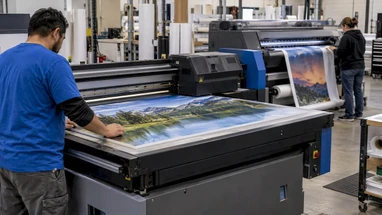
UV vs. Latex Printing: Which Is Right for Your Signs?
Posted by Deeder Dandenhorf on Oct 21st 2026
UV vs. Latex Printing: Which Is Right for Your Signs?

Latex printing is usually the better fit for flexible, roll-fed graphics such as banners, fabric and vinyl, and it is ready to finish the moment it leaves the printer. UV printing is usually the better fit for rigid, flat materials such as acrylic, aluminum, wood and glass, and for effects like white ink and raised varnish. Most small businesses buying trade show and event graphics will land on the first, but the right answer depends on what you are printing on and how soon you need it.
Below, we compare the two on the points that change your results: materials, durability, finish, speed, safety and cost. We also say when each one is worth choosing.
TL;DR
- Choose latex for banners, vinyl, fabric, wall graphics and posters. The prints can be laminated and finished right away instead of waiting out a long outgassing period.
- Choose UV for rigid, flat substrates (acrylic, metal, wood, glass), for white ink, and for textured or glossy varnish effects.
- Durability is close for most outdoor banners. Material, lamination and how long the sign stays in the sun matter more than the ink name.
- Turnaround matters more than technology when your show date is fixed. Ask any printer how long prints rest before finishing and shipping.
Table of Contents
- How the two technologies work
- UV vs. latex at a glance
- Materials: the deciding question
- Durability outdoors and indoors
- Finish and image quality
- Speed: curing, outgassing and your show date
- Safety, odor and environment
- Cost: what really drives the price
- Which should you choose? A decision guide
- Our perspective: ask about turnaround, not technology
- Where to start with your order
- FAQ
- Sources
How the two technologies work
Both are inkjet processes. They differ in how the ink becomes a solid, durable image.
UV printing uses ink that stays liquid until it passes under an ultraviolet light on the print carriage. The light cures it almost instantly. According to Mimaki’s comparison of the two technologies, UV systems use LED lamps to cure ink on the spot, which lets them print on a wider range of rigid, flat surfaces than typical roll-to-roll latex setups.
Latex printing uses water-based ink with polymer particles. Heat and airflow inside the printer dry and cure it. HP states that its Latex inks contain up to 65% water, and that no hazardous air pollutants were detected under EPA Method 311. Prints are essentially odorless.
So one process cures with light, the other with heat. That single difference drives most of what follows.
UV vs. latex at a glance
| Factor | Latex | UV |
|---|---|---|
| Best substrates | Vinyl, banner material, fabric, paper, wall graphics | Rigid boards, acrylic, metal, wood, glass, plus flexible media on hybrid machines |
| Curing | Heat and airflow inside the printer | UV LED light, instant |
| Ready to laminate | Immediately | Typically quick, but thicker ink layer |
| Ink layer | Thin, flexible | Thicker, can build texture |
| Special effects | Limited | White ink, clear varnish, gloss and texture |
| Odor | Essentially odorless | Low odor, but operators need protective gear |
| Typical sweet spot | Banners, tents, flags, posters | Signs on rigid boards, promotional items, short runs on odd shapes |
Materials: the deciding question
Start here, because it often settles the debate before anything else does.
If your graphic is a roll of vinyl, mesh or fabric, latex is built for it. A thin, flexible ink film handles the folding, rolling and tugging that banners go through. Benchmark Imaging notes that latex prints thinner ink layers than UV and accepts overlaminates well when you want a special finish.
If your graphic is a rigid sign, UV pulls ahead. The Epson SureColor V7000 UV flatbed is a good example: it carries white ink and varnish and detects media thickness up to 3.14 inches. That means you can print directly on a board, a panel or a thick object without mounting a printed sheet to it.

The same logic explains why UV shows up in promotional products. Pens, bottles and other branded items cannot go through a roll-fed machine. If you are also weighing merchandise for your booth, this Italian-language guide to UV printing on promotional gadgets explains when UV makes sense for small objects.
Durability outdoors and indoors
Both technologies make prints that survive real use. The honest answer is that the gap is smaller than sales pages suggest.
UV prints are widely described as scratch-resistant and weather-resistant because the cured ink forms a hard layer. Latex prints are tough too. Novatech reports that HP Latex prints can last up to 4 years outdoors without lamination and up to 6 years with lamination. Those figures are manufacturer-rated outcomes under defined conditions, so treat them as upper bounds, not promises.
What actually shortens a banner’s life:
- Sun exposure. A banner facing south in Phoenix ages faster than one in a convention hall. Intense sun is the biggest variable for any ink.
- Wind. Flapping flexes the ink film and stresses grommets and hems. Mesh banners help; our guide to mesh vs. vinyl banners covers when.
- Handling. Banners that ship in tubes and get rolled twice a month need flexible ink more than rock-hard ink.
- Lamination. A laminate adds scratch and fade protection to either technology. Our laminated vs. unlaminated banner test walks through when the extra step pays off.
For a banner you will use at a handful of events a year, the ink choice will almost never be what wears it out.
Finish and image quality
Both produce sharp, vibrant images at normal viewing distances. Differences show up in the details.
UV keeps ink on the surface because it cures before it can spread, which helps fine detail on coated and uncoated rigid stock. Mimaki says UV is often favored for cost-efficiency in high-volume production and for tactile effects such as gloss and texture from varnish inks. If you want a logo that is slightly raised, or a spot gloss that catches the light, UV is the tool.

Latex gives smooth, flat color with a soft, flexible feel. It works well for photographic backdrops, large gradients and full-bleed graphics on banner material, where a tactile effect would add nothing.
One caution on white ink: if your design relies on opaque white on clear or colored media, UV with a white channel is the more dependable route. Do not assume every machine offers it.
Speed: curing, outgassing and your show date
This is where many small exhibitors get burned. A print that looks dry may not be ready to laminate, roll or ship.
With latex, the print is ready for lamination and finishing as soon as it exits the printer. That contrasts with technologies that need an outgassing period of 6 to 24 hours before finishing. For a printer working on a tight deadline, hours matter. We explain the same issue for solvent inks in Avoid Overnight Outgassing: Latex vs. Solvent Printing for Trade Shows.
UV also cures instantly at the lamp. Where it can slow down is not the ink but the workflow: rigid substrates need cutting, mounting and often a second pass. A flat sign printed on a flatbed is one job. A banner is a print, a hem and grommets.
For you as a buyer, the useful question is not “UV or latex?” It is:
- When will my file be approved?
- When does printing start, and when does it ship?
- Is there a rush option if my show date moves?
If you want the full path from artwork to booth, our planner’s guide to how trade show printing works and how booth graphics get printed cover each stage.
Safety, odor and environment
If you or your team ever run a printer in-house, this section matters. If you only buy prints, it still tells you how clean the shop is behind your order.
Latex. Water-based inks mean a cleaner working environment. Printing Services supervisor Jake McDonald told In-plant Impressions that latex’s appeal lies in versatility and a cleaner, safer workspace that avoids the ventilation needs often associated with UV and solvent systems. HP also describes odorless prints and UL ECOLOGO-certified water-based inks.
UV. Operators need protective equipment. Epson’s guidance says operators should wear UV protective goggles during prolonged exposure to the LED lights, along with gloves and long sleeves to prevent skin sensitization. UV printers are also sensitive to their surroundings: Epson warns that a printer left in direct sunlight can cure ink prematurely, which may ruin production and damage the ink system.
A note on eco-solvent. You will see it in competing guides. According to SGIA technical documentation, the “eco” in eco-solvent historically referred to economical pricing, not an ecological benefit, and some of these inks may emit hazardous compounds, with VOC classification varying by state. Water-based latex is the more clearly sustainable of the two.
Cost: what really drives the price
Machine price does not reach your invoice directly, but it shapes what shops offer.
- High-volume rigid signs tend to favor UV, because printing straight onto the board removes mounting steps and cuts per-piece cost at scale.
- Banners, fabric and tents tend to favor latex because roll-fed speed and immediate finishing keep labor down.
- Setup and design often cost more than ink. At Arrowhead, for instance, our standard banner layout is $35 and Next Day Air shipping is $10, both published on the printed banners page. Price the whole job, not just the print.
Be wary of any comparison that gives a single cost-per-square-foot winner. Substrate, quantity, finishing and shipping all move the total.
Which should you choose? A decision guide
Pick latex when:
- You need banners, vinyl, tent graphics, flags, window graphics or wall graphics.
- Your show is close and you cannot wait on finishing.
- The graphics will be rolled, folded or shipped repeatedly.
Pick UV when:
- You are printing on acrylic, aluminum, wood, glass or other rigid stock.
- You need white ink, spot gloss or a raised texture.
- You are producing a larger quantity of identical flat signs.
Do not worry about the difference when:
- You are buying a standard retractable banner or a pop-up display and just need it printed well and delivered on time. The product format sets the process, and a good print provider will choose accordingly.
Our perspective: ask about turnaround, not technology
We work with small businesses, event planners and exhibitors, and the same pattern repeats: a buyer spends days comparing ink technologies and then discovers the real risk was the calendar. Our customers tell us what they value most is service and fast turnaround, and that matches how we run things. Most of our products ship within two business days, and in Arizona we can deliver straight to your venue.
That is why we pay close attention to the topics above, especially curing and outgassing. A print that cannot be finished and boxed promptly is a print that misses your booth setup.
Our advice to a first-time exhibitor is simple. Decide what you are printing on, decide your ship-by date, and then ask your provider three things: what is the production time, what finishing is included, and what happens if I need it sooner? Technology labels come second. A well-made banner on the right material, delivered before load-in, beats a perfect spec sheet that arrives late.
— Dan
Where to start with your order
If your project is a banner, a retractable stand or a tent, you are in the right place. Browse printed banners, banner stands and printed pop-up tents, or look at Quick Ship displays when your show is around the corner. We ship nationwide and deliver directly to venues in Arizona.
FAQ
Is UV printing better than latex printing?
Neither is better across the board. UV is stronger on rigid materials and special effects such as white ink and varnish. Latex is stronger on flexible media such as banners and fabric, and its prints can be finished immediately.
Which lasts longer outdoors, UV or latex?
Both can last for years outdoors, and the difference is usually smaller than sun exposure, wind and handling. HP Latex prints are rated up to 4 years unlaminated and up to 6 years laminated in outdoor display conditions. Lamination and the right material do more for lifespan than the ink name.
Can latex print on rigid signs?
Latex is designed mainly for roll-fed flexible media, so rigid boards are usually a UV job. A latex print can be mounted to a rigid board, which works well for many indoor signs. For direct printing on thick or textured items, UV is the more natural tool.
Is latex printing safer than UV printing?
Latex inks are water-based and prints are essentially odorless, so shops avoid some ventilation needs. UV operators should wear protective goggles, gloves and long sleeves per Epson’s guidance. Anyone running either system should follow the manufacturer’s safety instructions.
Sources
- UV vs. Latex Printing, Mimaki USA
- HP Official Site
- HP Latex sustainability, HP
- Evaluating Latex Printers on the Expo Show Floor, In-plant Impressions
- In-plant Impressions
- Choosing a Grand-Format Digital Printer, SGIA
- Epson SureColor V1070 support FAQ
- Epson SureColor V7000 UV flatbed printer
- UV & Latex Printing, Benchmark Imaging
- HP Latex Inks and Print Durability, Novatech