


What Is a Promotional Standing Sign for Marketing
Posted by Deeder Dandenhorf on May 24th 2026
What Is a Promotional Standing Sign for Marketing

Promotional standing signs are one of the most misunderstood tools in a marketer’s kit. Most people assume any sign will do the job, but there is a meaningful difference between a message taped to a wall and one positioned directly in your customer’s path. A promotional standing sign is a freestanding display unit designed to hold printed or digital graphics at eye level, without needing a wall, bracket, or permanent fixture. Whether you are preparing for a trade show, outfitting a retail store, or promoting an event, understanding how these signs work and what makes them effective will change how you approach your next campaign.
Table of Contents
- Key Takeaways
- What is a promotional standing sign
- Types of promotional signs and build options
- Benefits of standing signs for your campaign
- Choosing and designing your standing sign
- How businesses apply standing signs in real settings
- My take on what most people get wrong
- Ready to find the right standing sign for your next event
- FAQ
Key Takeaways
| Point | Details |
|---|---|
| Standing sign definition | A promotional standing sign is a freestanding display that holds graphics at eye level without wall mounting. |
| Multiple build types available | Options range from printed poster stands to digital totem displays, each suited for different environments. |
| Changeability drives ROI | Snap-open and slot-in loading systems let you swap graphics without replacing the entire stand. |
| Double-sided signs outperform in busy spaces | Two-sided configurations capture attention from multiple directions in corridors and entrances. |
| Material choice affects outdoor durability | Weather-tolerant substrates like corrugated plastic outperform paper in outdoor or damp settings. |
What is a promotional standing sign
A promotional standing sign is a freestanding signage unit designed to display marketing or informational graphics in high-traffic areas without being attached to a wall or ceiling. The standing sign definition covers a wide range of products, but the core concept is always the same: a stable base, a vertical support, and a frame or holder that presents your message at a visible height.
What separates a promotional standing sign from a standard sign is its purpose and placement. These signs are built to be positioned in the path of foot traffic, not mounted in a corner where they compete with dozens of other visual elements. Freestanding placement is specifically marketed as a way to increase the odds of attention compared to wall-mounted graphics, because the sign meets the customer where they already are.
A standing sign display can take several forms depending on the application:
- Poster stands that hold a single printed graphic in a frame
- A-frame or sandwich board signs that open like a book and display content on both sides
- Retractable banner stands that pull a printed graphic up from a base cassette
- Menu or entrance stands with a slot or pocket for inserting printed cards or sheets
- Digital totem displays that show video or rotating content on a freestanding screen
The defining characteristic across all of these is mobility and independence. You can move them, reposition them, and update them without a contractor or a facilities team.
Types of promotional signs and build options
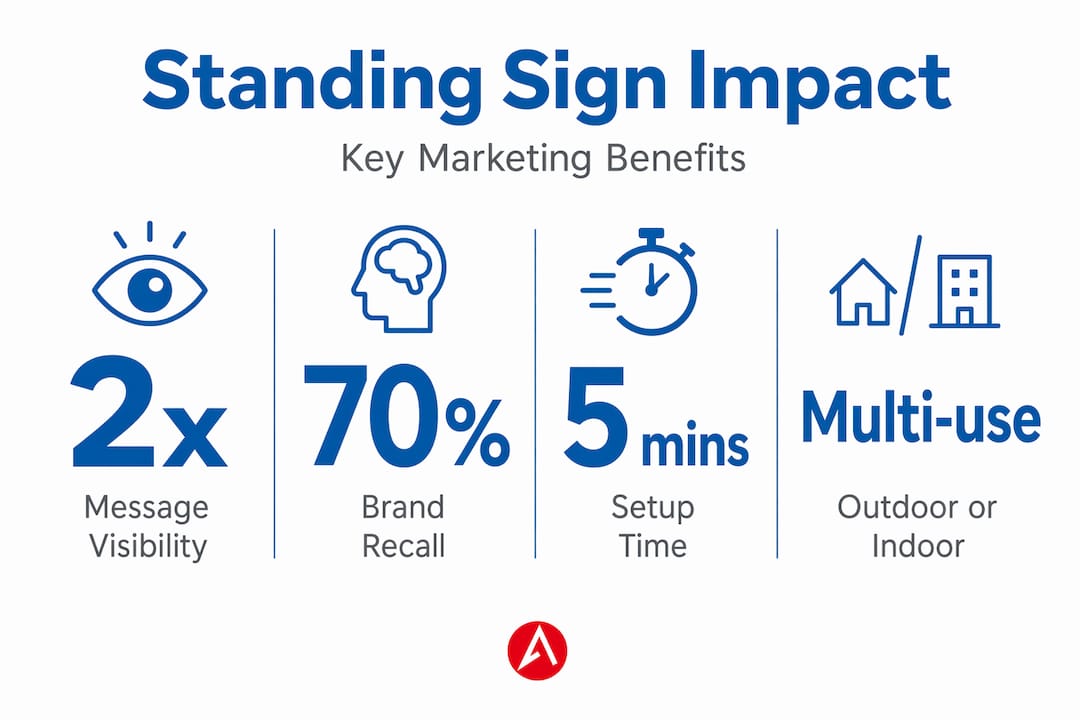
Understanding the types of promotional signs available helps you match the right product to your specific environment and campaign goals.
| Sign Type | Best For | Key Feature |
|---|---|---|
| Printed poster stand | Retail, lobbies, events | Snap-open or front-loading frame |
| A-frame / sandwich board | Entrances, sidewalks | Double-sided visibility |
| Retractable banner stand | Trade shows, exhibitions | Compact, portable cassette base |
| Digital totem display | High-traffic venues, retail | Video content, USB updates |
| Menu standing holder | Restaurants, hotels | A4 or A5 insert slot |
Printed poster stands are the most common format. They use a floor-standing pole or frame system to hold a printed graphic, and many use snap-open frames that allow you to change graphics in under a minute without tools. This makes them ideal for businesses that rotate promotions frequently.
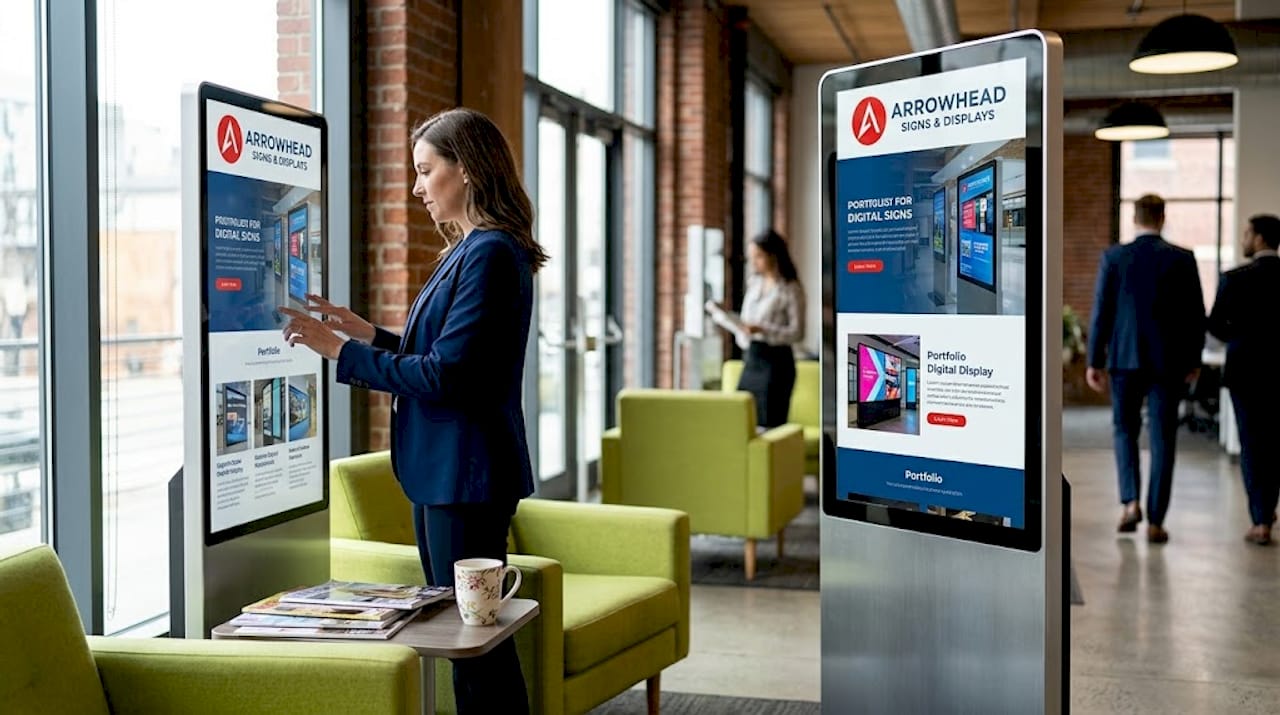
Digital freestanding totems represent the high-end option. These plug-and-play displays require no wall fixings or IT infrastructure, making them genuinely portable. Content updates happen via USB, so a single staff member can refresh messaging across multiple units quickly.
For outdoor use, material selection becomes critical. Some standing sign holders are not waterproof and require printing on weather-resistant substrates like coreflute or corrugated plastic rather than standard paper. If you plan to use a sign outside, confirm both the frame’s weather rating and your graphic material before ordering.
Height and base design also matter more than most buyers expect. Sign towers are available in heights like 72 inches and 92 inches, with base weights up to 30 pounds specifically designed to keep the unit stable in busy environments. A lightweight stand that tips over in a crowded venue is not just a safety concern. It is a wasted marketing opportunity.
Pro Tip: If your sign will be used in a high-traffic venue like an airport, stadium, or convention hall, choose a stand with both a heavy base and mobility wheels. You get stability when it is stationary and easy repositioning when the floor plan changes.
Benefits of standing signs for your campaign
The benefits of standing signs go well beyond aesthetics. These products solve a specific problem: getting your message in front of people who are already moving through a space.
Eye-level placement along a customer’s natural path is more effective than wall-mounted graphics because it creates a direct encounter rather than a peripheral one. A sign positioned at the entrance of a store or the entrance to a trade show booth does not require the viewer to look for it. It is simply there, in their way, in the best possible sense.
Here are the core benefits that make standing signs worth the investment:
- Mobility. You can reposition a standing sign in seconds, which means you can test different placements and respond to how foot traffic actually flows in your space.
- Campaign adaptability. Quick-change graphic systems mean you do not need to buy a new stand every time your promotion changes. The hardware outlasts dozens of campaigns.
- Double-sided visibility. Double-sided configurations dramatically increase exposure in corridors and entrances where people approach from multiple directions.
- No installation required. Unlike wall signage, standing signs require no drilling, permits, or landlord approval, making them ideal for leased retail spaces and temporary event setups.
- Scalability. You can deploy one sign or fifty across a venue with the same product line, maintaining visual consistency without significant added cost per unit.
The adaptability factor deserves extra attention. Businesses that run seasonal promotions or rotate product features regularly will find that stands with front-loading access pay for themselves quickly. The cost of reprinting a graphic is a fraction of buying new hardware each cycle.
Choosing and designing your standing sign
Selecting the right standing sign comes down to four practical decisions: environment, graphic loading method, size and stability, and design quality.
-
Define your environment first. Indoor signs can use standard printed graphics on paper or foam board. Outdoor or semi-outdoor signs need weather-tolerant substrates like corrugated plastic to survive moisture and wind. Do not assume a sign rated for indoor use will hold up under a canopy or near an entrance door that opens frequently.
-
Choose your graphic loading method based on update frequency. Snap-open frames are fastest for frequent swaps. Slot-in or pocket systems work well for menus or single-use promotions. If you plan to create a marketing sign that changes weekly, front-loading frames save significant time over the life of the stand.
-
Match height and base weight to your venue. A 72-inch sign tower with a 30-pound base is appropriate for a busy convention floor. A lighter tabletop or 48-inch stand works fine in a quiet lobby. Oversizing is rarely a problem. Undersizing, especially in terms of base stability, creates real issues in crowded spaces.
-
Design your graphic for the medium. Standing signs are typically viewed from 5 to 15 feet away, which means your headline needs to be large, your color contrast needs to be strong, and your call to action needs to be singular. Avoid crowding the graphic with too much text. One clear message outperforms three competing ones every time.
Pro Tip: When you create a marketing sign for a trade show or event, design the graphic so the top third carries the key message. Viewers often see the upper portion of a sign before the rest, especially in crowded rooms where other people partially block the lower section.
For guidance on outdoor signage materials and design choices that hold up across different event environments, the Arrowheadsigncompany blog offers practical comparisons worth reviewing before you finalize your order.
How businesses apply standing signs in real settings
Knowing how to use signage for promotions effectively means understanding where these signs actually perform. The most common and productive applications span several industries.
Retail stores use standing signs at entry points to announce sales, new arrivals, or loyalty program offers. The sign intercepts the customer before they form a shopping plan, which increases the chance of influencing their behavior. Hotels place standing menu holders and directional signs in lobbies, elevators, and conference corridors to guide guests and promote on-site amenities. Restaurants use A-frame signs on sidewalks to attract foot traffic with daily specials or happy hour promotions.
At trade shows and exhibitions, standing signs serve multiple functions simultaneously:
- Brand identification at the front of a booth so attendees can spot you from across the hall
- Product feature highlights positioned near specific display items
- Wayfinding within a large multi-booth setup
- Brochure and literature holders built into the stand frame for added functionality
Offices and corporate lobbies use standing signs for visitor directions, safety messaging, and event announcements. These environments benefit especially from the no-installation advantage, since signage needs change frequently and permanent fixtures are impractical.
The multi-functional aspect of some standing sign models adds real value. Certain frames include built-in brochure pockets or literature shelves, turning a single unit into both a graphic display and a lead-generation tool. For event marketers comparing display options, the pop-up display comparison guide from Arrowheadsigncompany breaks down how standing signs fit alongside other booth elements.
My take on what most people get wrong
I’ve worked with enough businesses preparing for trade shows and events to notice a consistent pattern. Most people treat the sign as an afterthought. They get the booth, the tablecloth, the giveaways, and then order a sign two days before the event without thinking about placement, height, or how often they will need to update the graphic.
What I’ve learned is that the mobility and quick-change features are not nice-to-have extras. They are the entire point. A sign you cannot reposition is just an expensive wall decoration. A sign that requires a vendor to update the graphic is a sign you will stop updating after the first campaign. The businesses I’ve seen get the most out of their standing signs are the ones that treat the stand as a long-term asset and plan their graphic rotation from day one.
The double-sided visibility factor is genuinely underestimated. I’ve watched exhibitors set up single-sided signs at the entrance to a corridor and miss half their audience entirely. If people approach your sign from two directions, you need two faces on that sign. It sounds obvious, but it gets overlooked constantly.
My honest advice: spend more time selecting the right loading mechanism than you spend picking the frame color. The operational side of your sign will determine whether it actually gets used or sits in a storage closet after the first event.
— Dan
Ready to find the right standing sign for your next event
If you are ready to put these ideas into practice, Arrowheadsigncompany offers a full range of custom standing sign products including retractable banner stands, outdoor banner stands, and custom pop-up signs built for trade shows, expos, and retail environments. Most products ship within two business days, and the team provides direct delivery to venues across Arizona. Whether you need a single sign for a local event or a full set of coordinated displays for a trade show booth, Arrowheadsigncompany has the products and the expertise to help you make an impression that lasts beyond the event itself.
FAQ
What is a promotional standing sign?
A promotional standing sign is a freestanding display unit that holds printed or digital marketing graphics at eye level without requiring wall mounting. It is designed to be placed in high-traffic areas to intercept and engage viewers along their natural path.
What is a standing sign display used for?
Standing sign displays are used in retail stores, trade shows, hotels, restaurants, offices, and events to promote products, provide directions, announce offers, and reinforce brand identity. Their mobility makes them adaptable across many environments.
What types of promotional signs are available?
Common types include printed poster stands, retractable banner stands, A-frame sandwich boards, digital totem displays, and menu standing holders. Each type suits different environments, budgets, and update frequency needs.
How do I choose the right standing sign for outdoor use?
For outdoor use, select a stand rated for weather exposure and print your graphics on weather-resistant substrates like corrugated plastic rather than paper. Confirm both the frame’s durability and the graphic material before ordering.
How often can I update the graphics on a standing sign?
Stands with snap-open or front-loading frames allow graphic updates in under a minute without tools, making them practical for weekly or even daily campaign rotations. This changeability is one of the primary cost advantages over permanent signage.
Recommended
- Types of Promotional Backdrop Displays: 2026 Guide - Arrowhead Sign Company
- Custom Pop Up Signs | Outdoor Banner Stands | Retractable Banner Stands | Arrowhead Signs and Displays
- Pop Up Display Comparison Guide for Event Marketers - Arrowhead Sign Company
- Assembling Retractable Banner Stands Correctly - Arrowhead Sign Company