

3-Sided Table Covers: A Trade Show Buyer's Guide
Posted by Deeder Dandenhorf on Aug 16th 2026
3-Sided Table Covers: A Trade Show Buyer’s Guide
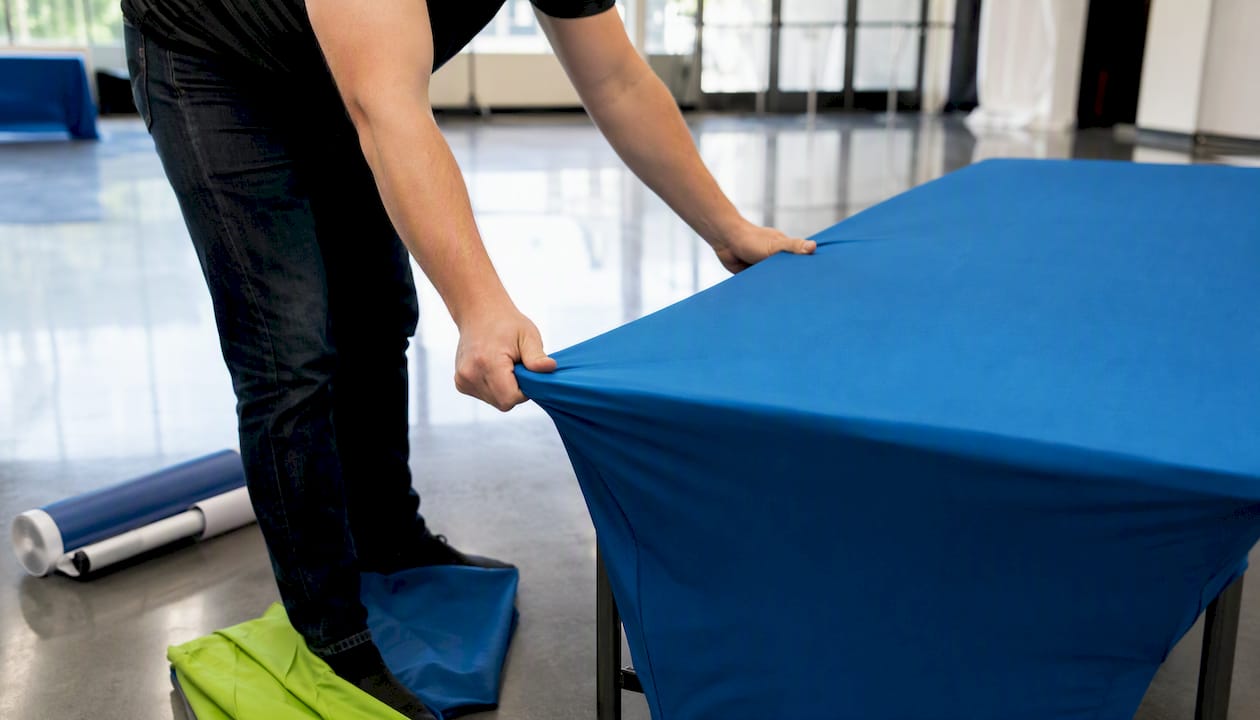
A 3-sided table cover, also called an open-back tablecloth or 3-sided tablecloth, drapes the front and two side panels of a display table while leaving the back open. It’s the right call when your staff needs to sit or stand behind the table, when you need quick access to stored inventory or supplies underneath, or when your booth sits in a row where nobody sees the back anyway. If your table backs up to a wall or an aisle where the rear is fully visible, a 4-sided closed-back cover makes more sense.
The upside:
- Easy access to boxes, literature, and giveaways stashed under the table during the show.
- More legroom for seated staff, plus a lower price point than most fitted 4-sided styles.
The trade-off:
- Storage and cords stay visible from behind, so it looks less polished if your booth is viewed from multiple angles.
- It reads as slightly less formal than a full wrap, which matters at higher-end trade shows.
Most exhibitors are working with a 6-foot or 8-foot folding table, the two sizes that dominate convention centers nationwide. Whatever style you pick, confirm the fabric carries a flame-retardant rating, since many venues require certification under standards like 16 CFR 1610 before they’ll let you set up. Measure twice: length, depth, and height all affect fit, and a good 3-sided open-back cover balances accessibility against how much of the table it needs to hide.
Key Takeaways
Choosing the right 3-sided table cover comes down to matching table size, fabric, and print method to your booth layout, then leaving enough lead time to get a proof approved before your event date.
| Point | Details |
|---|---|
| Measure before you order | Confirm table length, depth, height, and desired drop to avoid returns. |
| Match material to print method | Choose 300D polyester for dye-sublimation and flame-retardant compliance. |
| Order with lead time to spare | Build in production time plus shipping buffer ahead of your event date. |
| Confirm flame-retardant certification | Ask vendors for certification documentation and a written proof policy before production. |
| Consider Arrowhead for fast turnaround | Arrowhead Sign Company ships most orders within two business days, with local delivery available in Arizona. |
Table of Contents
- Sizes and Fit: How to Choose the Right Size for Folding Tables
- Materials and Finishes: Polyester, Stretch, and Flame-Retardant Options
- Styles and Fit: Fitted, Throw, and Open-Back vs. Closed-Back
- Branding and Imprint Options: Getting Your Logo Right
- Lead Times, Pricing, and How Many Covers to Order
- A Step-by-Step Checklist for Choosing a Table Cover
- Event Setup and Maintenance: Keeping Your Cover Looking Sharp
- Why Fast Fulfillment and Local Delivery Change the Math for Planners
- How Arrowhead Sign Company Can Help You Get Show-Ready
- Sources
- FAQ
Sizes and Fit: How to Choose the Right Size for Folding Tables
Table covers are sized to match three folding table lengths that show up at almost every convention center and hotel ballroom: 4-foot, 6-foot, and 8-foot. A 3-sided throw for a 6-foot table typically measures around 90 inches wide by 30 inches deep, with drop length added on top depending on how far down you want the fabric to hang. An 8-foot table calls for a wider panel, usually in the 114-inch range, to properly cover the front and both sides without leaving gaps at the corners.
Before ordering, run through this measurement checklist:
- Length: measure the tabletop from end to end, not the frame underneath.
- Depth (width): measure front to back across the top.
- Height: measure from the floor to the tabletop surface, since this determines your drop.
- Desired drop: decide between floor-length (fully to the ground), mid-length (roughly to the seat of a chair), or short (a few inches past the table edge).
Getting the drop wrong is the single most common return reason event planners run into, and it’s avoidable with a tape measure and five minutes before you check out. As one measuring guide for custom table cover buyers points out, you also need to confirm whether the product you’re buying is a standard throw, a fitted stretch cover, or an open-back style, because each category calculates sizing differently.
Materials and Finishes: Polyester, Stretch, and Flame-Retardant Options
The fabric you choose shapes everything from print vibrancy to how the cover survives a three-day trade show cycle. Woven polyester is the industry workhorse: durable, budget-friendly, and available in both matte and satin finishes. It handles screen printing well but shows more visible weave texture on large graphics than tighter-weave alternatives.
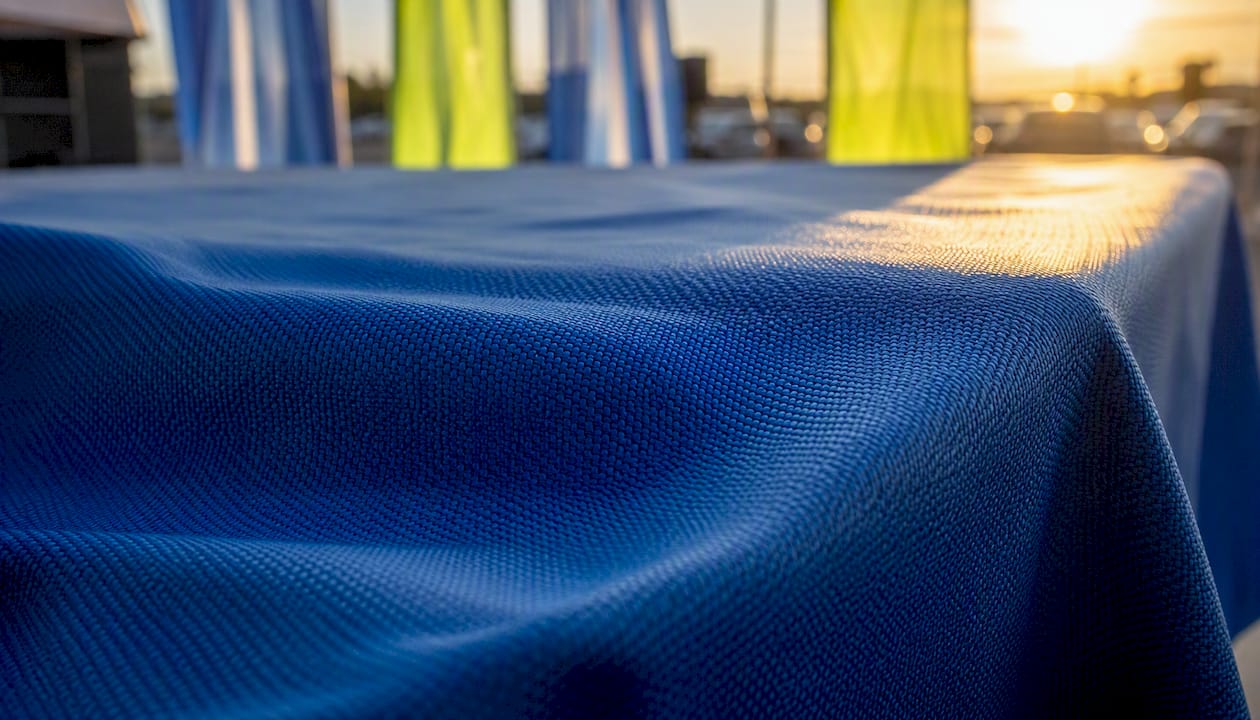
300D polyester is a heavier, denser weave that resists wrinkling and holds color better across repeated use. It’s also the fabric most commonly certified flame-retardant, which matters because 3-sided throws built in 300D polyester can be wrinkle-resistant, waterproof, stain-resistant, and printable in full color across every visible panel.
Spandex or stretch fabric wraps tight to the table frame for a sleek, tailored look, but it doesn’t hold up as well for open-back styles since the stretch relies on full-perimeter tension. Stretch covers shine on fitted, closed applications rather than 3-sided throws.
- Woven polyester: affordable, good for screen printing, moderate wrinkle resistance.
- 300D polyester: heavier, more durable, best flame-retardant compliance, ideal for dye-sublimation.
- Spandex/stretch: form-fitting, best for 4-sided fitted covers rather than open-back throws.
- Canvas-weight fabric: heavier hand, premium feel, higher cost, less common for full-color printing.
Dye-sublimation printing infuses ink directly into the fabric fibers, producing edge-to-edge, full-bleed graphics with no visible print lines or fading over repeated washes. Screen printing works fine for one or two colors and simpler logos, but it can’t match dye-sublimation for photorealistic images or gradients. If your booth graphic includes a photo background or a complex color gradient, dye-sublimation on 300D polyester is the better route. Event planners increasingly ask vendors to confirm flame-retardant certification upfront, since many convention centers and fire marshals won’t approve booth setups without it on file.
Styles and Fit: Fitted, Throw, and Open-Back vs. Closed-Back
Fitted and stretch covers wrap the table like a tailored jacket, snapping tight at the corners for a crisp, professional silhouette. They work best when your booth needs a polished, seamless look and you’re not swapping graphics between events. Avoid them if you plan to reuse the same cover across different table sizes, since a fitted cover for a 6-foot table simply won’t stretch to fit an 8-foot one.
Loose drape or throw-style covers lay over the table without shaping to its exact dimensions. They’re easier to store flat, quicker to swap between events, and generally cheaper to produce, which makes them the more practical pick for exhibitors running multiple shows a year with different table configurations.
The real decision point, though, is open-back versus closed-back. A feature comparison of full-back, open-back, and hybrid zipper-back styles lays out the trade-off clearly: full-back covers hide storage completely but limit legroom and access, open-back covers give staff full legroom and instant access to what’s underneath, and zipper-back styles split the difference by combining both in one product.
- Row booth: open-back is almost always the right call, since neighboring booths block any view of the rear.
- Island booth: closed-back or a hybrid zipper style makes more sense, because all four sides are visible to passing traffic.
Branding and Imprint Options: Getting Your Logo Right
Your logo placement and print method decide how much impact the cover has from ten feet away, and how much it costs. Silk screen printing works well for one or two-color logos on woven polyester, and it’s the most economical choice for simple branding. Heat transfer applies vinyl-cut graphics for small runs or single logos but doesn’t scale well for full-panel coverage. Dye-sublimation, paired with 300D polyester, is the only method that delivers true full-bleed graphics across the entire front and side panels without seams or color banding.
For maximum visibility on a 3-sided cover, center your primary logo on the front panel where it’s seen head-on by every passing attendee. Reserve the side panels for secondary branding, like a tagline, website URL, or social handles, since they’re seen more often by people approaching from an angle. A checklist for booth signage design can help you think through visual hierarchy before you send artwork to print.
Before you approve any order, ask your vendor to confirm:
- Accepted file formats (vector files like AI or EPS print sharper than raster JPEGs).
- Color profile (CMYK for print, not RGB) to avoid color shifts between screen and fabric.
- Bleed requirements, typically a quarter to half inch beyond the trim line.
- A written proof or digital mockup policy before production starts.
Pro Tip: Ask for a physical fabric swatch with your color proof, not just a digital rendering. Screens display color differently than fabric absorbs it, and a swatch catches mismatches before a full production run ships.
Lead Times, Pricing, and How Many Covers to Order
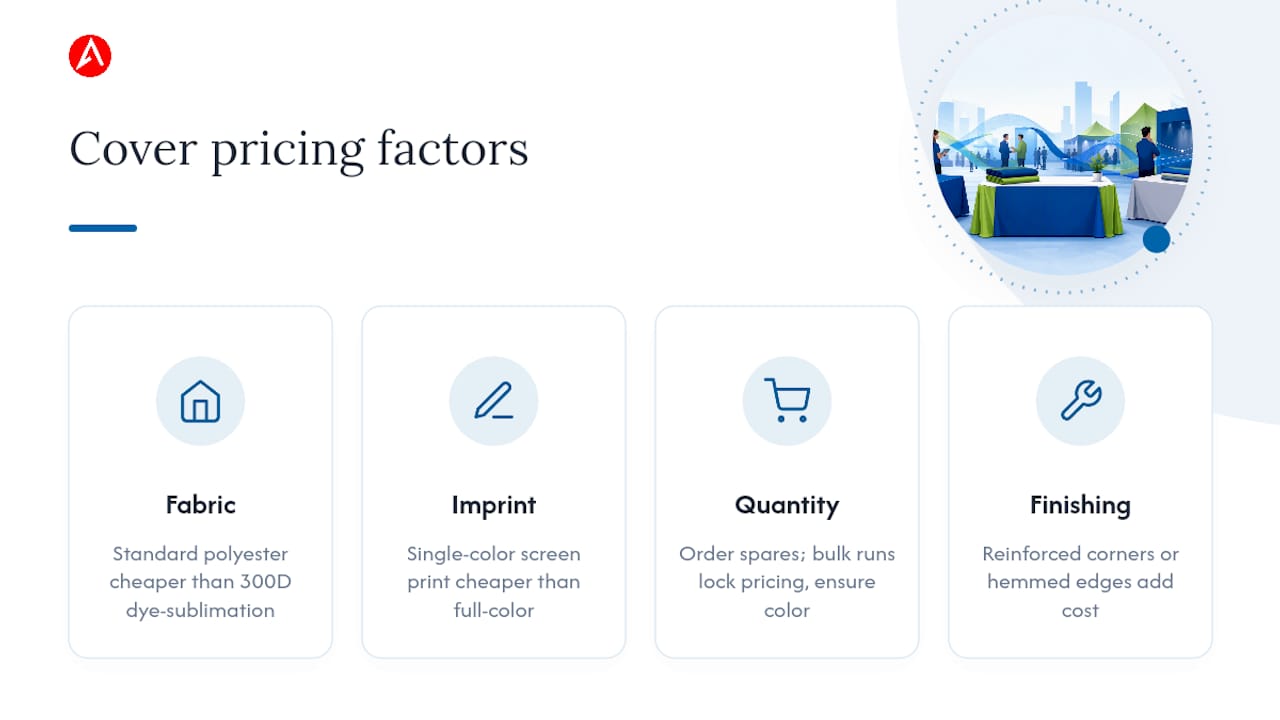
Four variables move the price on a custom cover: fabric type, imprint complexity, order quantity, and finishing details like reinforced corners or hemmed edges. A single-color screen-printed throw on standard polyester costs less than a full-color dye-sublimated 300D cover, and pricing per unit typically drops as quantity tiers increase, so ordering three or four at once often costs less per piece than ordering one.
Lead time depends on production complexity. Standard fulfillment for custom-printed covers commonly runs one to two weeks depending on artwork approval speed, while rush production can compress that timeline for planners working against a tight show date. Building in buffer time for shipping, on top of production, protects against the one delay nobody can control: freight carriers.
On quantity, think beyond a single event. If you’re running a multi-day show, order at least one spare cover in case of spills, tears, or an unexpected second table. Exhibitors running a full season of trade shows often order a small fleet of covers in one production run to lock in bulk pricing and guarantee color consistency across events rather than ordering piecemeal each time.
A Step-by-Step Checklist for Choosing a Table Cover
- Confirm your table size (4’, 6’, or 8’) and measure length, depth, and height yourself rather than trusting a venue’s stated dimensions.
- Choose your style: 3-sided open-back for row booths and seated staff, 4-sided closed-back for island booths and full concealment.
- Pick your material: 300D polyester for flame-retardant compliance and dye-sublimation printing, standard polyester for simpler one-color budgets.
- Select your imprint method based on logo complexity and how much of the panel you need covered in graphics.
- Confirm lead time against your event date, including shipping buffer.
- Place your order with a written proof approval built into the timeline.
Before you commit to a vendor, ask a few pointed questions: What’s your standard turnaround versus rush turnaround? Do you provide a physical or digital proof before production? What’s your return or exchange policy if the fit is wrong? Can you provide flame-retardant certification documentation for venue compliance?
Watch for these red flags when shopping online:
- No listed dimensions or vague sizing language like “fits most tables.”
- No proof or mockup step before your order goes to print.
- An unclear or missing return and exchange policy.
- No mention of flame-retardant certification anywhere on the product page.
Event Setup and Maintenance: Keeping Your Cover Looking Sharp
Most polyester and 300D covers are machine washable on a cold or warm cycle, and they should air dry or tumble dry on low heat, since high heat can warp dye-sublimated graphics over time. Fold covers along their existing seams for transport rather than crumpling them into a bag, which cuts down dramatically on wrinkle set-in during transit.
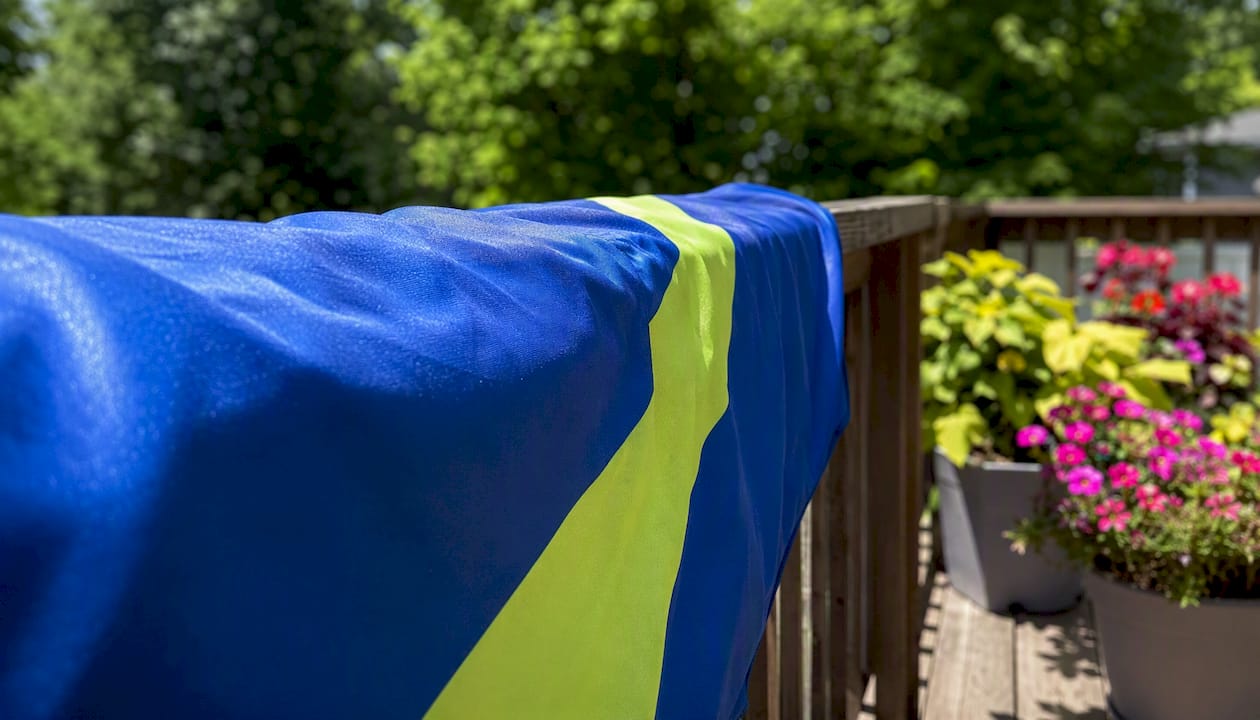
At the venue, a handheld garment steamer is the fastest fix for wrinkles that show up after a table cover has been folded in a case for weeks between shows. Choosing a wrinkle-resistant fabric like 300D polyester from the start reduces how often you need one in the first place.
Common on-site issues and quick fixes:
- Snags: trim loose threads carefully with small scissors rather than pulling, which can widen the tear.
- Color bleed: keep covers away from damp cardboard boxes or wet floors during setup and breakdown.
- Hem fraying: a small dab of clear fabric glue holds a fraying edge together for the rest of the show.
Pro Tip: Pack a mini sewing kit and a roll of fabric tape in your booth supply case. A five-minute fix on-site beats scrambling for a replacement cover an hour before doors open.
Why Fast Fulfillment and Local Delivery Change the Math for Planners
Every event planner has lived through the nightmare scenario: a vendor promises a table cover, the proof gets stuck in email limbo, and the show date arrives with nothing to put on the table. That risk is exactly why fulfillment speed matters as much as fabric choice or print quality. Arrowhead Sign Company - Signs, Banners and Trade Show Displays ships most products within two business days, which gives planners a real buffer against the artwork delays and last-minute changes that are simply part of running events.
For Arizona-based exhibitors, local delivery direct to the venue removes another point of failure. Instead of tracking a freight shipment and hoping it clears customs checkpoints or delivery windows on time, you get a straightforward drop-off, which is one less thing to worry about the night before a show. During ordering, planners can expect a proof review before anything goes to press and a fulfillment timeline that’s communicated upfront rather than discovered after the fact.
How Arrowhead Sign Company Can Help You Get Show-Ready
Arrowhead Sign Company - Signs, Banners and Trade Show Displays fills the gap between generic online table cover shops and full-service agencies: you get custom-printed, flame-retardant-compliant covers with a two-business-day fulfillment window, without the markup or slow proofing cycles that come with larger display companies.
When you order, expect a straightforward proof step before production starts, a standard fulfillment window that keeps most orders moving within two business days, and local delivery direct to your venue if you’re setting up in Arizona. Beyond table covers, Arrowhead’s catalog covers the rest of your booth footprint too, including the 10 ft stretch fabric display for larger branded backdrops, the Signicade Deluxe A-Frame Sidewalk Sign for directing foot traffic outside your booth, and the Outdoor Banner Frame for larger outdoor visibility. If you’re ready to start a custom order, visit the Arrowhead Signs and Displays landing page and get your table cover proof moving today.
Sources
- Table Covers: Styles, Fit & Function
- 3 Sided Throw Table Cloth 4ft | Promotional Shop NZ
- How to Measure a Table for a Custom Table Cover? | Promotional Products Blog
FAQ
Are Tablecloths Out of Style for Trade Shows in 2026?
No. Custom-printed table covers remain a standard trade show tool because they turn a plain folding table into branded floor space, and demand for custom dye-sublimated designs has only grown as printing technology improves.
What Are My Options for Table Covers?
Your main choices are fitted/stretch covers, loose throw-style covers, and open-back (3-sided) versus closed-back (4-sided) styles, each suited to different booth layouts and budgets.
What Is the “Tablecloth Trick” for Trade Show Setups?
It typically refers to using a properly sized drop length, floor-length for a polished, fully concealed look, or mid-length for easier movement, to control how formal or functional your booth appears without changing the table itself.
How Many Inches Should a Table Cover Hang Over the Table?
It depends on your goal: a floor-length drop reaches nearly to the ground for full concealment, while a mid-length drop typically stops a few inches above the floor for easier staff movement around the table.
Does Arrowhead Sign Company Offer Custom 3-Sided Table Covers?
Yes, Arrowhead Sign Company - Signs, Banners and Trade Show Displays offers custom-printed table covers with fast fulfillment, typically shipping within two business days, plus local delivery for Arizona-based events.
Recommended
- Venue Signage Placement Checklist for Trade Shows - Arrowhead Sign Company
- How Trade Show Printing Works: A Planner’s Guide - Arrowhead Sign Company
- Trade Show Booth Setup Fast: Your 2026 Buyer’s Guide - Arrowhead Sign Company
- Trade Show Display Types Explained for Marketers - Arrowhead Sign Company