

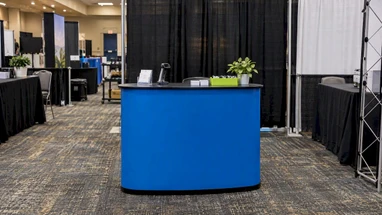
Best Trade Show Counters: How to Choose for Your Booth
Posted by Deeder Dandenhorf on Oct 28th 2026
Best Trade Show Counters: How to Choose for Your Booth

The best trade show counter is the one that fits your booth footprint, packs into a case one person can carry, and carries your branding at eye level for the people walking past. For most small exhibitors in a 10x10 booth, that means a portable counter with a printed fabric or panel front, either a pop-up frame or a fold-flat unit. This guide compares the main styles, what they cost, and what to check before you order.
TL;DR
- Portable counters come in four main builds: fabric tension frame, pop-up frame, fold-flat panel and lightweight podium. Each trades off graphic quality, setup time and weight.
- Prices run from about $208 for a simple carry-bag podium to well over $1,000 for backlit or custom units, and rental can cost more than that per show.
- In a 10x10 booth, keep the counter to the side or front corner so visitors can still walk in.
- Check carrying case, top load rating, graphic replacement cost and lead time before you buy, not after.
- We print table throws, banners and fabric displays that match your counter, and ship most products within two business days.
Table of Contents
- What a trade show counter does for your booth
- The main counter styles compared
- What trade show counters cost
- Size and footprint: what fits in a 10x10 booth
- Materials and graphics to compare
- Portability: setup, teardown and reuse
- Matching the counter to the way you exhibit
- Shipping time and what affects it
- Warranty, durability and support
- Our perspective: build the booth around the visitor, not the counter
- Match your counter with Arrowhead displays
- FAQ
- Sources
What a trade show counter does for your booth
A counter is the working surface of a booth. It is where you scan badges, hand out samples, demo a product on a laptop or take an order. It also gives your booth a front, a place where visitors know to stop and talk.
That is different from a table. A table is flat and low, usually covered with a throw. A counter is taller, usually around standing hand height, with a printed face that works as a sign in its own right. If you want the longer definition and the custom options, our guide to a custom trade show counter for exhibitors covers it in detail, and our piece on demo counters for trade shows explains the version built around product demonstrations.
A good counter does three jobs at once:
- Holds what you need. Tablet, lead scanner, brochures, a monitor or product samples.
- Carries your brand. The front panel is often the largest graphic at waist height, where the eye lands when people approach.
- Packs down. If it does not fit in a case you can check, ship or load into a car, it will not be used show after show.
The main counter styles compared
Most listings you will see fall into the same few builds. The differences matter more than the brand names.
| Style | Typical build | Setup | Graphic quality | Best for |
|---|---|---|---|---|
| Fabric tension counter | Aluminum frame with a stretched fabric skin | 5 to 15 minutes, no tools | Seamless, edge to edge, dye-sublimation print | Brand-forward booths, repeat shows |
| Pop-up frame counter | Folding scissor frame with magnetic or fabric panels | Under 5 minutes | Good, with visible seams on some models | Quick setups, tight budgets |
| Fold-flat panel counter | Hinged or interlocking panels, often with a shelf | 5 to 10 minutes | Printed panels, easy to swap | Reception desks, demos |
| Lightweight podium or promo table | Folding wood-look or metal top with a carry bag | Under 2 minutes | Usually plain, add a throw or banner | Simple check-in, giveaways |
| Backlit counter | Tension frame with LED lighting | 10 to 20 minutes | Illuminated, highest visibility | Dim halls, premium booths |
These are the build types sold across the category, and the setup times are typical ranges rather than promises. Always check the specific model’s instructions.
Fabric tension counters
A fabric tension counter uses a lightweight aluminum frame wrapped in a printed stretch fabric. The graphic has no seams, wrinkles shake out in the case, and the frame is light. The same construction is behind most tension fabric backwalls, so a counter in this style matches a backwall almost perfectly. Our EZ Tube tension fabric displays use that approach for backdrops, and a 10 ft stretch fabric display shows how well the seamless look carries across a full 10-foot wall.

Pop-up frame counters
A pop-up counter opens like an accordion and usually locks in place. It is the fastest to set up. Many use printed panels that attach to the frame with magnets or hook-and-loop strips. The tradeoff is that seams can show between panels, and the top surface is often a separate piece you need to keep track of.
Fold-flat and panel counters
Panel counters are sturdier. They often have an internal shelf, a lockable cabinet or a thicker top, so they take heavier items such as a monitor or product samples. They weigh more, which usually means a hard case or a shipping crate.
Lightweight podiums and promo tables
These are the value tier. A Vispronet 3 ft portable counter listed at Walmart sells for $207.99 with a carry bag included, which shows where the entry point sits. You then brand it with a table cover, a banner stand or a printed sign.
Backlit counters
Backlit counters add LEDs behind the fabric so the graphic glows. They help in halls where booths are dim or where your booth sits at the end of a long aisle. They also add power needs, extra parts and weight. Make sure your show allows the power you need before you order one.
What trade show counters cost
Counter pricing swings widely, and the sticker price often leaves things out. A rough range from the market:
- Entry level: around $200 for a simple portable podium with a carry bag, such as the Vispronet unit above.
- Mid range: custom printed pop-up or fabric counters, commonly several hundred to roughly $1,000, depending on size and graphics.
- Premium: backlit or oval custom counters, which can run well past $1,000 once you add lighting and a case.
Rental is another route, though it is rarely the cheap one. At the 2026 Global Produce and Floral Show, rental exhibit counters with custom graphics were priced at $1,114.36 for the 1M size and $1,655.68 for the 2M size, shipping and handling included. If you exhibit more than once or twice, owning usually pays back quickly.
When you compare prices, ask what the price includes:
- Is the printed graphic included, or only the frame?
- Is a carrying case or bag included?
- Is the top surface included?
- Is shipping included, and how fast?
- What does a replacement graphic cost when you change your message?
That last one matters most for repeat exhibitors. A frame lasts for years, but your tagline and offer may change every season.
Size and footprint: what fits in a 10x10 booth
A standard inline booth is 10 feet wide and 10 feet deep. A counter that is too large will block the entrance and push visitors away, which defeats the point.
A few practical rules:
- Keep it to the side or front corner. Leave at least half of the front open so people can step in without feeling they are entering a checkout lane.
- Angle it if you can. A counter set at a slight angle invites people over the way a straight barrier does not.
- Match width to purpose. A check-in or lead-scan counter can be 2 to 3 feet wide. A demo counter needs more surface, since you may be showing a monitor and a product.
- Think about height. Most portable counters sit around 36 to 42 inches, which suits standing conversations. If you want to sit for part of the day, plan a stool and check that the counter is comfortable at that height.
Thinking about how you and your staff will move behind the counter is worth the time. A walkthrough of counter layout and workflow is written for a different kind of counter, but the questions it raises about reach, working zones and clearance apply to a booth where two people share a few square feet.
Also confirm your show’s rules. Exhibitor manuals often set height limits for structures in inline booths, so check yours before you commit to a tall counter or a backlit tower.
Materials and graphics to compare
Frame. Aluminum is the standard for portable counters because it is light and does not rust. Look for tool-free connections and a locking mechanism that does not feel loose.
Top surface. Ask about the load rating. A laptop and a few brochures are fine on nearly anything. A monitor, a product sample or a heavy demo unit needs a sturdier top.
Graphics. Three methods are common:
- Dye-sublimation fabric. The ink is part of the fabric. Colors are rich, creases fall out and the fabric can be washed or steamed.
- Direct-print panels. Good for sharp text and logos, but panels can scratch if they rub in transit.
- Vinyl or adhesive wraps. Cost-effective for flat fronts, though harder to change.
Whatever you choose, design the front panel for a quick read. Visitors passing at a walking pace give you a couple of seconds. A logo, a short line about what you do, and one clear offer do more than a full paragraph.
Print the rest of the booth in the same colors and finish. A counter in one shade of blue with a banner in another looks like two different companies. If your supplier prints everything, color matching is easier.
Portability: setup, teardown and reuse
A counter is only worth the money if you use it again and again, so look hard at how it travels.
- Weight. Choose something one person can lift. If you often fly to shows, check airline baggage limits for the case.
- Case. Soft bags are light and cheap but offer less protection. Hard cases protect better and can double as shipping cases. We stock trade show display travel cases for banner stands and displays, including expandable options.
- Setup time. Pop-up and fold-flat units set up fastest. Fabric tension counters take longer but give a cleaner look.
- Graphic care. Fold fabric loosely, keep it dry and store it flat or rolled. Panels need padding between them.
- Reuse. Choose a model where the graphic is replaceable, so a new campaign does not mean a new counter.
Run a trial setup at home or at the office before the show. Time it. If it takes 30 minutes when the listing says 5, you want to know that before load-in day.
Matching the counter to the way you exhibit
| If you are… | Look for | Why |
|---|---|---|
| A small business at a few regional shows | Fabric tension or pop-up counter with soft case | Light, quick, affordable |
| Running product demos | Fold-flat panel counter with sturdy top and shelf | Holds a monitor and samples |
| At a dimly lit hall or end-cap | Backlit counter | Visibility from a distance |
| Collecting leads all day | 2 to 3 ft counter with a tablet-friendly top | Light footprint, open booth |
| Tight on budget | Portable podium plus a printed table throw or banner | Low cost, easy to brand |
| Exhibiting once | Rental or low-cost podium | No storage or reuse cost |
The counter is only one part of the booth. A common combination is a backwall or banner stand behind you, a counter at the front corner, and a printed table throw on any extra table. Our guide to trade show display types shows how these pieces work together.
Shipping time and what affects it
Timing is where many exhibitors get caught. Custom printed counters require artwork approval, printing and assembly, and each step adds days. Delays most often come from:
- Late or low-resolution artwork. A file that needs rework restarts the clock.
- Custom construction. Standard sizes ship quicker than made-to-order shapes.
- Freight versus parcel. Heavier units may ship by freight, which takes longer and may need a delivery appointment.
- Distance to the show. Ground shipping across the country takes days, so build in a buffer.
Ask for a date in writing and work backward from your show’s advance warehouse deadline, not from the opening day.
At Arrowhead, most products ship within two business days. For banners, the standard banner layout service is $35 and Next Day Air is $10, which gives you a fast route for last-minute graphics that match a counter. Quick Ship Displays are built for exhibitors who are short on time. In Arizona, we can deliver directly to your venue.
Warranty, durability and support
Before you buy, ask:
- What does the warranty cover? Frames, hardware and graphics are often covered differently, and graphics are often excluded.
- Can you buy parts? A broken connector should not mean a new counter.
- Who do you call? Talk to a person before you order. A supplier who answers questions in advance is more likely to help with a problem on show week.
- What do reviews say about the graphic after several shows? Fabric fading and frame wear are the issues to look for.
A warranty is only as good as the company behind it. Local support helps too: if you can reach someone by phone and, in Arizona, have a delivery to the hall, small problems do not turn into missed shows.
Our perspective: build the booth around the visitor, not the counter
We see the same pattern with first-time exhibitors. They pick a counter first, then fit everything else around it. The better approach is to start with the visitor. Where do they come from? What do they see first? What do you want them to do?

In our experience serving small businesses and event planners, the counter works best as one piece of a matched set. The banner behind it states what you do, the counter front gives a name and an offer, and the table throw or tent continues the same colors. When everything shares one look, even a modest booth reads as organized and credible.
We also push exhibitors to think about turnaround. Shows move on fixed dates, and a printed piece that arrives a week late is worth nothing. That is why we built our process around quick fulfillment, with most products shipping within two business days, and why we offer hand delivery to venues in Arizona. If your budget is limited, spend it on the front graphic and a good case, not on extras.
— Dan
Match your counter with Arrowhead displays
If you are building out a booth, start with the pieces we print and ship quickly: banner stands, tension fabric backwalls, printed pop-up tents and table throw covers, all in the same colors so your counter looks like part of one booth.
Browse our full range of trade show products and displays, upload your artwork, and we will ship most products within two business days. In Arizona, we can deliver straight to your venue.
FAQ
What is the best trade show counter for a 10x10 booth?
A portable fabric tension or pop-up counter between 2 and 3 feet wide works for most 10x10 booths. It leaves room for visitors to enter and still gives you a branded front. Choose a fold-flat panel model if you need to hold a monitor or product samples.
How much does a portable trade show counter cost?
A basic portable podium with a carry bag lists at about $208. Custom printed counters cost more, and backlit or specialty shapes cost the most. Rental can run over $1,100 for a single show, so owning is usually cheaper if you exhibit more than once.
Should I buy or rent a trade show counter?
Rent if you are exhibiting once and do not have storage. Buy if you attend several shows a year, because the cost of a rental can equal or exceed a portable counter. Buying also lets you keep your colors and branding consistent.
How long does it take to get a custom counter?
It depends on the supplier, the artwork and whether the model is standard or made to order. Ask for a written delivery date and work back from your show’s advance warehouse deadline. Approve your artwork early, since file problems are the most common delay.
Sources
- 2026 Global Produce and Floral Show cost estimates
- Vispronet 3 ft portable trade show counter, Walmart listing
- Counter layout and workflow guide