

Best Truck Lettering Kits: How to Choose for Your Business
Posted by Deeder Dandenhorf on Nov 8th 2026
Best Truck Lettering Kits: How to Choose for Your Business

The best truck lettering kit is the one that matches your truck, your legal needs and how long you plan to keep the lettering on. For most small businesses that means a custom-sized set in quality vinyl, with the company name and USDOT number laid out for your doors. You get a clean look, you stay compliant, and you avoid reordering. Below we compare the kit types you will see online, explain what separates a good one from a poor one, and show how to measure and apply it.
TL;DR
- Decide first whether you need compliance lettering only (company name and USDOT number) or full branding with logo, phone number and website.
- Vinyl type matters: cast film is built for curves and longer outdoor life, while calendered film suits flat surfaces and shorter-term use.
- Federal rules require the name and USDOT number on both sides, readable from 50 feet in daylight, in colors that contrast sharply with the background.
- Generic pre-made kits are quick for one truck. Custom sets are the better fit for fleets and for trucks with ribs, curves or unusual door shapes.
- We design and print truck lettering for small businesses and deliver directly to venues and job sites in Arizona.
Table of Contents
- The main kinds of truck lettering kits
- What the law requires on a commercial truck
- How kits differ: material, size, customization and design
- Our pick by situation
- What to check before you order
- How to measure and apply a truck lettering kit
- Our perspective
- Lettering as part of your marketing
- Get your truck lettered
- FAQ
- Sources
The main kinds of truck lettering kits
Search results for this keyword show four types of product, and they solve different problems. Knowing which one you need saves more money than any coupon.
| Kit type | Best for | What you usually get | Watch out for |
|---|---|---|---|
| Pre-made USDOT door kit (pair) | One work truck that only needs compliance lettering | Company name, USDOT and sometimes MC number, one set per door | Fixed layouts, limited logo options |
| Marketplace custom decals | Owner-operators on a tight budget | Personalized text decals, often sold as a pair | Film quality and lettering height vary by seller |
| Pickup lettering kits with application tools | Do-it-yourself installs on a pickup | Individual vinyl letters plus a squeegee or transfer tape | Fewer options for logos and tailgate art |
| Fleet decal kits | Several trucks that must match | Identical sets, often with bulk pricing | Minimum quantities, less flexibility per vehicle |
| Custom lettering and graphics | Branding plus compliance, curved or ribbed doors | Designed to your measurements, logo and colors | Longer proofing and a higher price than a stock pair |
Pre-made door kits are the fastest path for a single truck. Several sellers advertise USDOT and MC door sets starting under $100 per pair, and marketplace listings for custom USDOT pairs run in a similar range. Custom lettering costs more, but it is sized to your truck and carries your actual logo instead of a template. Our own guide to truck lettering costs walks through how pricing builds up, from a simple door set to a fully wrapped fleet.
What the law requires on a commercial truck
If your truck is a commercial motor vehicle that falls under federal safety rules, compliance drives the kit choice. Under 49 CFR 390.21, the vehicle must display the legal name or a single trade name of the motor carrier and the FMCSA-issued number preceded by the letters USDOT on both sides. The lettering must contrast sharply with the background, be readable in daylight from 50 feet while the vehicle is stationary, and be maintained so it stays that way.
Two details matter when you shop for a kit:
- Removable lettering is allowed. The same regulation says the marking may be painted on or may be a removable device, as long as it meets the legibility requirements and is maintained. That makes vinyl a legitimate choice for most fleets.
- Height is not set federally. The 50-foot legibility test is the federal standard, and the Colorado State Patrol notes that most companies go with at least 2-inch lettering. Some states add their own wording. Texas, for example, lists letters and numbers at least two inches high for covered vehicles.
For most trucks, taller letters are an easy way to stay comfortably readable. We cover this in more depth in our article on USDOT door lettering size. Whether your truck needs a USDOT number at all depends on its weight, use and state, so confirm with the FMCSA or your state commercial vehicle enforcement office before you order.
How kits differ: material, size, customization and design
Material: cast versus calendered vinyl
The film is the single biggest quality factor. A Signwarehouse comparison advises calendered vinyl for flat surfaces with moderate exposure and cast vinyl when the film has to conform to curves or last longer. The same comparison lists ORACAL 951 cast film at a rated outdoor life of 10 years for black and white, 8 years for colors and 6 years for metallics, against 3 years for ORACAL 631 calendered film. These ratings are for vertical, unprinted exposure in a mild climate zone, so real life on a truck in desert sun or road salt can be shorter.

A truck door is mostly flat, but many have body lines, door handles and rivets. If your door has any of those, ask for cast film. If the kit does not name its vinyl at all, treat that as a signal to ask before you buy.
Size and layout
Stock kits come in a few preset sizes. That works on a standard pickup door and can fail on a box truck, a dump truck or a cab with a narrow door window frame. Measure the flat, unobstructed area first, then compare it to the kit’s stated dimensions, not just the letter height.
Customization
A basic kit lets you change text. A better one lets you place a logo, match a brand color and add phone number, website or service area. Brand consistency matters more with every truck you add, so a fleet should work from one approved artwork file.
Design and legibility
The winning design is simple. Use one or two typefaces, strong contrast (white on dark doors, black on light) and generous spacing. Avoid thin script fonts and busy backgrounds, which fail the 50-foot test long before they fail on a screen.
Our pick by situation
No single kit wins for every buyer, so here is how we would match them.
| Your situation | Best choice |
|---|---|
| One truck, compliance only, tight timeline | A pre-made USDOT door pair, with cast film if offered |
| Owner-operator who wants a logo and a clean look | Custom door lettering sized to your measurements |
| Three or more trucks that must match | Custom lettering from one approved file, ordered together |
| Leased or financed truck, or a short-term contract | Temporary, paint-safe lettering |
| Arizona business that wants it delivered | Local custom lettering with direct delivery |
The Arizona option is where we come in. Our truck lettering service covers vehicle graphics and fleet markings, and our local delivery means we can bring finished pieces straight to your venue or job site. Most of our products ship within two business days.
What to check before you order
Use this list for any kit, from any seller.
- Which vehicle and which rule applies. Confirm you need USDOT lettering and whether your state adds requirements.
- The film. Look for a named cast or calendered film and its outdoor rating.
- Actual dimensions. Compare the kit size to your measured door area.
- Proofing. A proof before production lets you check spelling, spacing and the number itself. A wrong digit in a USDOT number means a reorder.
- Shipping and total cost. Add shipping, proof fees and any application tools to the sticker price.
- Installation method. Pre-spaced letters on transfer tape are far easier than individual letters.
- Removal. Quality vinyl should come off cleanly. See our guide to removing truck vinyl without harming paint.
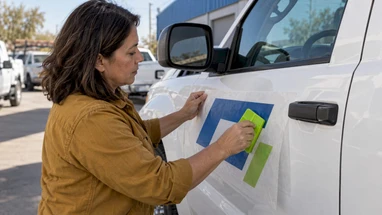
How to measure and apply a truck lettering kit
A careful install makes an average kit look professional and a great kit last longer.
- Measure the door. Record the flat area’s height and width, and note handles, seams and window edges.
- Pick the temperature window. Most vinyl applies best in moderate temperatures, out of direct sun. Follow the film maker’s range on your kit’s instructions.
- Clean the surface. Wash with soap and water, then wipe with isopropyl alcohol so no wax or grease is left. Let it dry fully.
- Position with tape. Hold the kit in place and make a tape hinge across the top. Step back and check that it is level and centered.
- Apply from the center out. Peel the backing back from the hinge, then squeegee with overlapping strokes so no air gets trapped.
- Remove the transfer tape slowly. Pull at a sharp angle back along the surface. If a letter lifts, lay the tape back down and press again.
- Let it cure. Skip pressure washing for a few days, as the adhesive needs time to bond.
To keep it legible, wash the truck by hand or with a soft touch-free system, and replace any panel that fades or peels, since the federal rule requires the marking to be maintained. Our guide to how long vinyl signage lasts explains what shortens or extends its life.
Our perspective
Most of the lettering problems we see start the same way: a kit that looked fine online but was never sized to the truck. A stock pair is fine for a simple pickup, but small businesses usually get more from a set designed around their own door, logo and colors.
That is why we focus on custom work with quick turnaround. You send your measurements and artwork, we help you lay it out, and most products ship within two business days. In Arizona, we can deliver straight to your location.
Lettering also does a second job. Every trip is an ad for your company, so clear contrast and simple layouts are worth more than clever ones. And if you lease your truck or only need lettering for a season, our temporary, paint-safe approach is built for that. We explain it in our temporary truck lettering guide.
Dan
Lettering as part of your marketing
Truck lettering works hardest when it matches your website, business cards and event displays. If you are building a broader plan, small business marketing services can help you tie vehicle branding to the rest of your presence. Then carry the same logo and colors across your trade show banners and signs.
Get your truck lettered
If you want lettering sized to your truck instead of a one-size-fits-all pair, start with our truck lettering page and tell us about your vehicle and your timeline. We can also build matching pieces for events, such as printed banners and pop-up tents, so your trucks and your booth look like one brand.
See our truck lettering and fleet markings, or browse custom signs and printed banners to match your brand across every surface.
FAQ
How much do truck lettering kits cost?
Stock USDOT door pairs from online sellers often start under $100, while custom lettering costs more because it is designed to your truck. Price depends on size, film, number of vehicles and artwork. Our truck lettering cost guide breaks down what drives the total.
Can I use removable vinyl for USDOT numbers?
Yes. Federal regulation allows the marking to be a removable device if it meets the same legibility requirements and is maintained. Choose high-contrast colors and replace any piece that fades or peels.
How long will truck lettering last?
It depends on the film and your climate. Manufacturer ratings for cast vinyl run several years longer than for calendered vinyl, but sun, heat and frequent washing can shorten that. Washing gently and replacing worn pieces keeps the lettering compliant.
Should I apply a kit myself or have it done?
A single flat door is a reasonable do-it-yourself job if you clean the surface and use a hinge method. Curved panels, large logos and fleets go faster and look cleaner with a trained installer.
Sources
- 49 CFR 390.21, Marking of self-propelled CMVs
- Markings, Texas Department of Public Safety
- FAQ’s MCSAP, Colorado State Patrol
- Cast vs. Calendered Vinyl, Signwarehouse