

Outdoor Sign Materials: How to Choose What Lasts
Posted by Deeder Dandenhorf on Oct 20th 2026
Outdoor Sign Materials: How to Choose What Lasts

The best material for an outdoor sign depends on how long the sign has to stay up, how much wind and sun it will face, and whether it is a permanent fixture or a temporary push. Aluminum and aluminum composite panels suit permanent storefront and property signs. Corrugated plastic suits short campaigns and yard signs. Vinyl and mesh banners suit events, fences and fast promotions. Below we compare each option honestly, so you can match the material to the job before you spend a dollar.
TL;DR
- Permanent signs: aluminum or aluminum composite panel (ACM) gives you a rigid, flat, weather-tolerant face that holds up for years.
- Short-term signs: corrugated plastic is cheap and light, but it is a campaign material, not a long-term one.
- Banners: solid vinyl suits most storefronts and events. Mesh lets wind through, so it is the safer pick for exposed fences and open sites.
- Real cost: count installation, permits and replacement, not only the price of the panel.
- Need it fast? We ship most products within two business days and deliver directly to venues in Arizona.
Table of Contents
- Start with three questions, not a material
- Outdoor sign materials compared
- Aluminum: the permanent-sign standard
- Aluminum composite panel: flat, light and sharp
- Corrugated plastic: great for short runs
- PVC and foam PVC: a budget step up
- Vinyl banners: the flexible workhorse
- Fabric displays for outdoor events
- Match the material to the job
- Count the whole cost, not just the panel
- Lighting changes the maintenance equation
- Safety and work-zone signs follow rules
- Our perspective: durability is a design choice too
- Order outdoor signs and displays from Arrowhead
- A few more practical tips
- FAQ
- Sources
Start with three questions, not a material
Most bad outdoor sign purchases come from choosing a material first and a use second. Before you compare substrates, answer these:
- How long does it need to last? A weekend festival, a three-month promotion and a ten-year storefront need three different materials.
- What will it face? Direct desert sun, coastal salt air, high gusts and freezing temperatures each punish materials differently.
- How will it be mounted? Stakes in the ground, a frame, a wall, a pole or a stand each favor a different weight and rigidity.
If you can answer those, the choice usually narrows to two options. The sections below walk through each material, what it does well and where it lets you down.
Outdoor sign materials compared
This table is a quick orientation. Lifespan always depends on sun exposure, mounting and print quality, so treat the ranges as relative, not as guarantees.
| Material | Best for | Strengths | Watch out for | Relative lifespan |
|---|---|---|---|---|
| Aluminum | Permanent business, property and wayfinding signs | Rigid, rust resistant, easy to cut and finish | Higher upfront cost, needs a good finish in harsh climates | Long |
| Aluminum composite panel (ACM) | Storefronts, large flat panels, real estate signs | Very flat, light for its size, smooth print surface | Edges need sealing and the core is plastic | Long |
| Corrugated plastic | Yard signs, event directions, short promotions | Low cost, very light, weather resistant | Can crack and fade, bends under wind load | Short |
| PVC / foam PVC | Budget signs in moderate climates | Smooth surface, inexpensive | Can warp under extreme heat | Short to medium |
| Vinyl banner | Grand openings, storefronts, event fences | Large format, low cost, easy to hang | Edges and grommets are the weak points in wind | Short to medium |
| Mesh banner | Fences, scaffolding, windy sites | Air passes through, so less sail effect | Slightly softer image than solid vinyl | Short to medium |
| Fabric (tension and SEG) | Trade shows, covered outdoor events | Rich color, packs small, wrinkle resistant | Best kept out of heavy rain and strong wind | Medium |
Aluminum: the permanent-sign standard
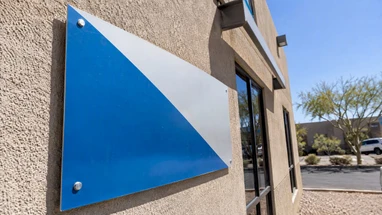
If a sign is going to be on your building or property for years, aluminum is where most sign professionals start. It does not rust the way steel can, it is light enough to mount without heavy hardware, and it can be cut into almost any shape. A flat aluminum face takes vinyl graphics or direct print cleanly and stays rigid in a breeze.
Two caveats are worth knowing. First, thicker gauges resist denting and flexing better, and they cost more. Second, aluminum is not immune to the environment. Near the coast, salt air can attack bare or poorly finished metal, so ask for a quality coating if your location is anywhere near the ocean. In a dry inland climate like much of Arizona, that is less of a concern, and sun fade becomes the bigger enemy, which is why a UV-resistant print or laminate matters.
We cover this category on our aluminum signs page, and our custom signs range is the place to start if you want a sign built to your size and artwork.
Aluminum composite panel: flat, light and sharp
ACM is two thin aluminum skins bonded to a plastic core. The result is a panel that stays much flatter than a single thin sheet of aluminum and weighs less than a solid metal panel of the same size. That makes it popular for large storefront faces, real estate markers and any sign where a crisp, warp-free surface matters.
The trade-off is the edge. Because the core is plastic, water that reaches a cut edge can cause trouble over time, so installers seal or frame the edges on signs that will see rain. ACM is also not the right answer for a sign that will take regular physical abuse, such as a low sign beside a parking lane. A solid aluminum sheet handles dents better.

Corrugated plastic: great for short runs
Corrugated plastic, often called by the brand name Coroplast, is the material behind most yard signs, open-house signs and election-season placards. It is hollow, so it is extremely light, and it shrugs off rain. It is also cheap enough to order in quantity.
What it does not do is last. In constant sun it fades and can turn brittle, and the flat face flexes in strong wind. Treat it as a campaign material measured in weeks or months. Two practical tips:
- Check the flute direction. The hollow channels should run vertically so an H-stake slides in cleanly without tearing the board or letting the sign sag.
- Plan for replacement. If a sign must look good for a year or more, spend a little more on a rigid panel.
For temporary, high-traffic sidewalk placement, a frame often beats a stake. Our A-frame sidewalk signs guide explains when that makes sense, and the Signicade Deluxe A-Frame Sidewalk Sign is a sturdy, reusable option with two prints included.
PVC and foam PVC: a budget step up
PVC sheet has a smoother, more finished surface than corrugated plastic and costs less than metal. It is a common choice for signs that need to look tidy on a budget in moderate climates. Its weakness is heat. Under strong, sustained sun it can warp, which is a real consideration in a hot, sunny region. If your sign will sit in direct summer sun all afternoon, metal is the safer long-term choice, and PVC is better kept for sheltered or shaded spots.
Vinyl banners: the flexible workhorse
For a grand opening, a seasonal sale, a fence line or an outdoor event, a printed vinyl banner is hard to beat. It covers a large area for relatively little money, it is easy to hang with grommets, and you can swap it out when the promotion changes. Heavier vinyl generally lasts longer outdoors than lightweight material, and finishing details matter: reinforced hems and well-set grommets are what keep a banner from tearing in wind.
Banners are only as good as how they are hung. Pull them taut, use every grommet, and do not leave them flapping like a flag. For poles along streets and campuses, our light pole banners are built for that use. For general orders, see our printed banners. A standard banner layout is $35, and Next Day Air shipping is an extra $10 for when your deadline is tight.
When to choose mesh instead
A solid banner acts like a sail. On an open site, a construction fence or a windy overpass, that force goes straight into the grommets. Mesh vinyl has small openings that let air pass through, which lowers the load on the banner and the fence. The image is slightly less crisp than on solid vinyl, so keep the artwork bold and simple: big logo, short message, high contrast. If your location is sheltered, solid vinyl gives the best print quality.

Fabric displays for outdoor events
Trade show and festival exhibitors often ask whether fabric can work outside. It can, with limits. Dye-sublimated fabric gives you saturated color and a premium look, and tension fabric frames pack down small and set up quickly. They are best for covered patios, tented areas and mild days, and they are not the right choice for a sign that has to ride out a storm.
For outdoor events, the sturdier pieces of the kit are usually the tent, the frame and the base. Our printed pop up tents put your brand overhead where it is seen from across a field, and a durable outdoor retractable banner stand works when you need a vertical message with a weighted, stable base. If you prefer a banner on a frame, the Banner Bar outdoor banner frame adjusts between 6 ft and 8 ft.
For lighter indoor and covered displays, see our EZ Tube tension fabric displays and Quick Ship displays.
Match the material to the job
Here is how the choice plays out in common situations.
| Your situation | Material to consider | Why |
|---|---|---|
| Storefront sign you want for years | Aluminum or ACM | Rigid, flat, durable, takes graphics well |
| Three-month sale or seasonal promo | Vinyl banner | Large, quick to produce, easy to replace |
| Open-house or election-style yard signs | Corrugated plastic | Cheapest per piece, stakes in quickly |
| Banner on a windy fence or scaffold | Mesh | Air passes through, less strain on grommets |
| Outdoor festival booth | Printed tent plus weighted stand | Visibility from a distance and stability |
| Vehicle or window branding | Cut or printed vinyl lettering | Applied directly to the surface |
| Hot, sunny location with long exposure | Metal over PVC | PVC can warp under extreme heat |
Count the whole cost, not just the panel
The sticker price of a sign is only part of what you will pay. For permanent signs, installation can outweigh the sign itself, especially if you need lifts, mounting hardware or a licensed electrician for lighting. Safety Decals makes the same point in its guide to outdoor business signs: balance upfront cost against maintenance, installation labor and permitting.
Permits deserve their own line in your budget. Many cities and counties regulate size, height, placement and lighting for permanent signs, and some require engineering drawings that account for wind load. Call your local planning or building department before you finalize a design, not after the sign arrives. Temporary banners and yard signs often have their own local rules, so check those too.
A useful way to compare options is cost per year of use. A cheap sign you replace every season can cost more over three years than a better panel you install once. A better panel you do not need is wasted money, though, so be honest about how long the message will stay relevant.
Lighting changes the maintenance equation
If your sign is illuminated, the light source matters almost as much as the face. Federal energy guidance notes that LED signs can reduce energy use and maintenance, with lamp lives reaching up to 100,000 hours compared with about 1,000 hours for incandescent bulbs, according to a U.S. Department of Energy guide. Fewer bulb changes means fewer ladder visits, which matters on a tall pole or wall sign.
If you are planning signage for an event as well as a storefront, it is worth reading this agency perspective on visual rules for corporate event signage, which touches on lighting and readability at events.
For non-illuminated signs, reflective vinyl or high-contrast color choices can help visibility at dusk without any wiring at all.
Safety and work-zone signs follow rules
If the sign is a safety sign on a construction site, color and design are not optional. Under OSHA’s construction standard 29 CFR 1926.200, danger and caution signs follow set color schemes, and signs must have rounded or blunt corners. For general industry workplaces, 29 CFR 1910.145 covers the specifications. If your sign is a regulatory safety sign, confirm the requirements with your safety officer or OSHA before you order. A marketing sign is a different thing and does not carry those rules.
Our perspective: durability is a design choice too
We sell to small businesses and exhibitors who usually have one thing in common: a date. A grand opening, an expo, a festival weekend. That shapes how we think about materials.
First, the best material is the one that survives your timeline. We would rather talk a customer out of an expensive panel they will take down in six weeks than sell it to them. Second, finishing and hanging matter as much as the substrate. A well-hemmed banner hung taut outlasts a premium banner left loose. Third, speed counts. Most of our products ship within two business days, and in Arizona we can deliver directly to your venue, so you are not gambling on a courier the week of your show.
Our advice for most small businesses is simple: use a rigid aluminum sign for anything permanent, a vinyl or mesh banner for anything seasonal, and a weighted stand or tent for anything at an event. If you are unsure, send us the location, the dates and a photo of where it will go. For more on how weather affects the choice, see why weather resistant signs matter for outdoor brands.
— Dan
Order outdoor signs and displays from Arrowhead
Whether you need printed banners, banner stands, printed pop up tents, sidewalk signs or custom signs, you can order online and we handle the production. Most products ship within two business days, we ship nationwide, and Arizona customers can have their order delivered straight to the venue. Browse our trade show products and displays, start a banner order, or visit arrowheadsigncompany.com to see the full range.
A few more practical tips
- Think about the sun. Dark, saturated colors and photos can fade faster in direct sun than simple, bold artwork. UV-resistant inks or laminates help.
- Keep the message short. Drivers read a sign in seconds. A logo, a few words and a contact detail beat a paragraph.
- Size for distance. Bigger letters for roads, smaller for walkways.
- Plan the mounting first. Wall, post, frame, stake or stand: choose it before you finalize the size and weight.
- Order a little early. Weather, permits and approvals can slip, so build in buffer days.
For more on what changes between inside and outside use, our indoor vs outdoor sign options guide is a good next read, and outdoor event signage best practices covers layout and placement at events.
FAQ
What is the most durable material for outdoor signs?
For most business uses, aluminum is the most practical durable choice, because it resists rust, stays rigid and takes graphics well. Aluminum composite panel is a close second for large, flat faces. Stainless steel can last longer but costs considerably more, so it is usually reserved for special architectural uses.
What is the cheapest material for outdoor signs?
Corrugated plastic is typically the lowest-cost rigid option, which is why it is used for yard signs. Vinyl banners are also inexpensive per square foot for large formats. Both are best for short to medium timelines, so compare the cost per year of use, not only the purchase price.
Can a vinyl banner stay outside in the wind?
Yes, if it is hemmed and grommeted well and hung taut using every grommet. On very exposed sites, switch to mesh so air can pass through. Remove any banner before severe weather, because no material is built for a storm.
Do I need a permit for an outdoor sign?
Often you do for permanent signs, and sometimes for temporary ones too. Rules on size, height, lighting and placement vary by city and county, so contact your local planning or building department before you order. If your sign needs structural review, ask what documents they require.
Sources
- Outdoor Signs for Business: Types, Materials, Costs & Tips, Safety Decals
- Federal Energy Management Program guide on LED signs, U.S. Department of Energy
- 29 CFR 1926.200, Accident prevention signs and tags, eCFR
- 29 CFR 1910.145, Specifications for accident prevention signs and tags, eCFR
- Event Planners: 5 Visual Rules for Agency Led Corporate Event Signage