

Two Day Spot UV Business Cards for Exhibitors
Posted by Deeder Dandenhorf on Sep 9th 2026
Two Day Spot UV Business Cards for Exhibitors
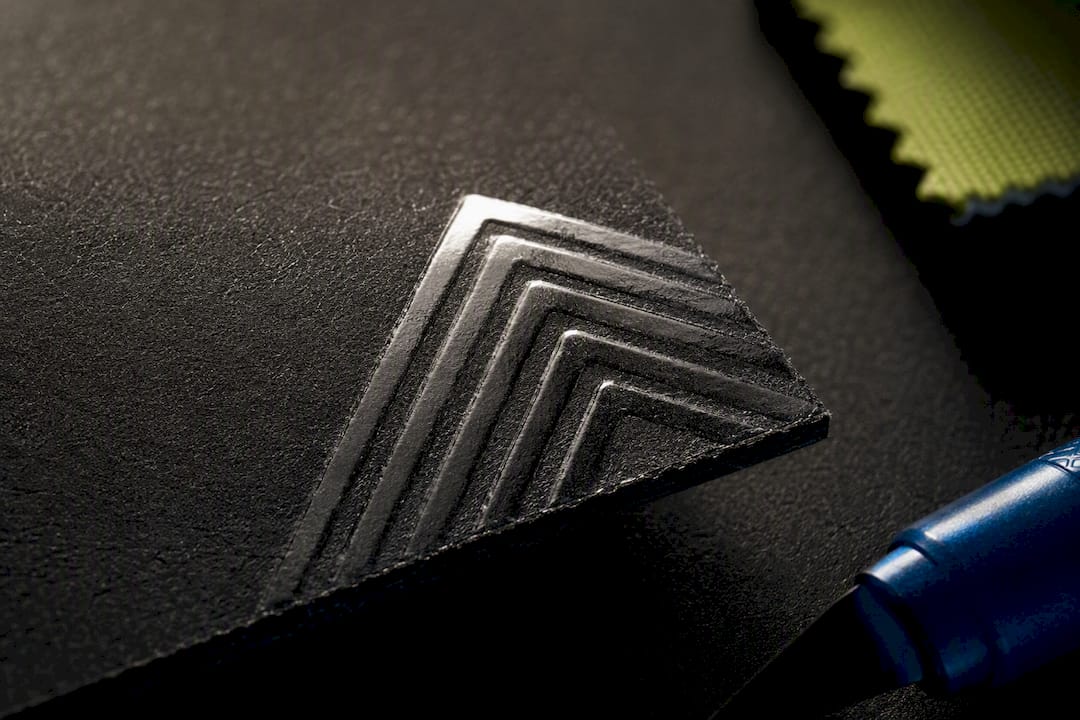
Spot UV is a premium finish that adds glossy contrast or a raised, tactile texture to specific parts of your card, and for most professionals who hand off cards face to face, it’s worth the upgrade. The catch is real: expect a higher per-card cost, some artwork prep on your end, and a finish that performs best on matte or soft-touch stock rather than an already glossy base. If you want a card that gets noticed and kept, spot UV earns its price. If you’re ordering high-volume giveaways, it probably doesn’t; consider elevating your brand image with professional visuals as explained in Business Photography – MYBMC.
TL;DR:
- Spot UV coating requires a separate, clearly defined spot layer in your design and is most effective on matte or soft-touch stocks for contrast.
- Raised spot UV creates a tactile bump that is highly memorable, but it is more expensive and may cause warping on heavy or thin stock if applied extensively.
- The total cost increases with the number of coated areas, raised elements, and thicker card stock, and production time is longer due to additional curing steps.
- Spot UV is ideal for premium, purpose-driven cards like executive, portfolio, or invitation cards, rather than high-volume, disposable handouts.
- Confirm the type of proof, color compatibility, and registration tolerances with your printer before approving the order to avoid delays and misapplication.
Table of Contents
- What Is Spot UV on a Business Card?
- How Do You Prep Artwork for Spot UV Printing?
- When Is Spot UV Worth the Extra Cost?
- What Should You Confirm Before Ordering Spot UV Cards?
- Arrowhead Sign Company’s Approach to Fast Spot UV Fulfillment
- What Are the Limitations of Spot UV Printing?
- How Does Spot UV Compare to Embossing and Foil Stamping?
- Are Spot UV Coatings Environmentally Friendly?
- Ready to Order? Here’s How Arrowhead Sign Company Handles Spot UV Cards
- A Printer’s Perspective on Ordering Spot UV Under a Deadline
- Sources
- FAQ
What Is Spot UV on a Business Card?
Spot UV is a clear, glossy coating applied only to selected areas of your design rather than the whole card. That contrast between the coated section and the uncoated paper is the entire point. Where full UV coats the whole surface (making everything shiny but adding no contrast) and foil stamping presses a metallic film into the paper, spot UV printing works by highlighting a logo, headline, or icon against a duller background.
There are two versions worth knowing before you order:
- Flat spot UV sits nearly level with the card surface and produces a subtle gloss highlight with almost no texture change.
- Raised (thick) spot UV builds up a noticeable bump you can feel under your fingertip, and it’s often the version buyers remember most because touch increases how memorable a printed piece is.
Your base finish decides how well either version reads. Spot UV over a matte or soft-touch stock creates strong visual separation because the eye immediately catches the shift from flat to glossy. Applied over a card that’s already gloss-coated, the effect nearly disappears; contrast is what makes spot UV work, and a glossy base removes that contrast entirely. Soft-touch (a velvety laminate) tends to produce the most dramatic raised-UV effect of the three common base options, followed by matte, with gloss trailing well behind.
How Do You Prep Artwork for Spot UV Printing?
Getting a proofable file right on the first try saves you a reprint cycle, and most delays on spot UV orders trace back to a missing or malformed spot layer.
- Build your design in two layers. One is your standard four-color artwork (CMYK). The other is your spot layer, which tells the printer exactly where the UV coating goes.
- Name the spot layer correctly. Most printers want it supplied as a named spot color (something like “Spot UV” set to 100% tint) or as a solid black mask on its own layer in the PDF, since that separate layer is how the press knows where to apply varnish.
- Respect minimum line widths. Raised spot UV in particular has a floor. Hairline text or thin serif fonts under roughly 6 to 8 point often won’t hold a clean raised edge; bold sans-serif logos and icons register far better.
- Keep detail out of the safe area. Standard business card safe zones (typically an eighth of an inch from the trim edge) apply to your spot layer too. Don’t place fine spot detail closer to the edge than that.
- Watch alignment on double-sided cards. If you’re running spot UV on both sides, confirm registration tolerances with your printer. Misalignment is more visible on a raised effect than a flat one.
- Request a physical proof, not just a digital one. A PDF proof can’t show you raised texture. Ask for a printed or tactile sample before you approve a run of any real size.
Pro Tip: Send your spot layer as its own separate PDF page alongside your full-color artwork instead of flattening everything into one file. It’s the single easiest way to prevent a printer from misreading which elements should carry the coating.
When Is Spot UV Worth the Extra Cost?
Spot UV pays off when the card itself is doing sales work, not when it’s a disposable handout. Executive cards, portfolio and creative-agency cards, invitations, and any card meant to function as a small keepsake are the clearest fits, since premium finishes reward the closer, tactile inspection that these use cases actually get.
Design matters as much as use case. Spot UV tends to land harder on minimalist layouts than on busy, colorful ones, because a glossy highlight needs open space to “read” as a highlight rather than get lost in competing detail. If your card design is already dense with color blocks or photography, strip it back before adding spot UV, not after.
A few situations call for a different finish entirely:
- Choose foil stamping if you want maximum shine and a metallic look rather than a clear gloss accent.
- Choose soft-touch alone (no spot UV) if your priority is a premium feel in the hand rather than a visual highlight.
- Combine foil and raised spot UV only for small, high-impact runs, since stacking finishes adds cost and production complexity that rarely makes sense at volume.
What Should You Confirm Before Ordering Spot UV Cards?
Four factors drive most of the price difference between a basic spot UV card and an expensive one: how many separate spot areas your design uses, whether you’re running flat or raised coating, your card stock thickness in points (pt), and your total order quantity. Raised UV on heavy stock, applied across multiple design elements, costs meaningfully more per card than a single flat highlight on a standard 16pt card.
Turnaround varies by printer, but spot UV almost always adds production time compared to a standard printed card, since it’s a separate curing step after the base printing runs. Rush options exist at most shops, though rush plus a raised finish plus a large quantity is the combination most likely to strain a tight deadline. Build in buffer time if your cards need to be ready for a specific show date.
One physical quirk worth flagging before you approve a large run: heavy spot UV coverage, especially raised coating, can cause card stock to warp slightly. That’s a material interaction between the coating and the paper fibers as they cure, not a defect, but it’s more likely to show up as your coverage area and stock weight increase. Request a sample before committing to a big order if your design uses raised UV across a large portion of the card.
Before you sign off on any proof, ask your printer these questions directly:
- What type of proof will I see before production, digital or physical?
- If recipients need to write on this card, will the coated area still take pen ink?
- Can I get a small sample swatch of the raised effect before ordering the full quantity?
- What are your edge-trimming tolerances, and how close can spot detail sit to the trim line?
Getting straight answers to those four questions before approval is what actually prevents reprints, far more than any amount of file prep on your side. For guidance on ordering the right quantity for an upcoming show, our breakdown of card volumes for exhibitors covers how many cards most booths actually go through in a day.
Arrowhead Sign Company’s Approach to Fast Spot UV Fulfillment
Arrowhead Sign Company - Signs, Banners and Trade Show Displays built its business around one recurring problem: small businesses need trade show and event materials fast, and most printers aren’t set up to move that quickly. We specialize in customizable trade show displays and signage for exhibitors and event marketers, and that same fulfillment mindset carries over to premium card orders.
- Most products ship within two business days, which matters when a spot UV order needs to land before a show date.
- We offer dedicated local service across Arizona, including direct delivery to your event venue rather than a generic shipping drop.
If your timeline is the tightest constraint in your card order, that’s the conversation to have with us before you finalize artwork.
What Are the Limitations of Spot UV Printing?
Spot UV isn’t a fix for a weak design, and it has real technical boundaries you should plan around before you commit to it.
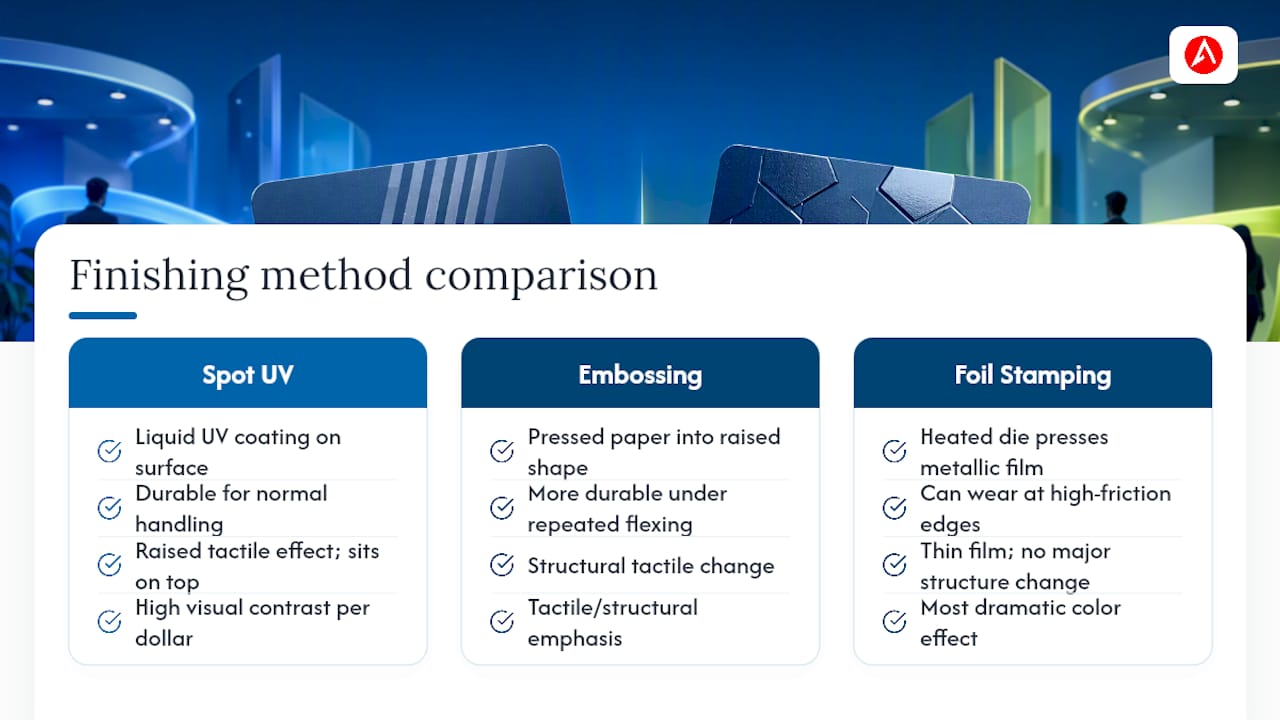
Fine detail is the biggest constraint. Small text, thin outlines, and intricate patterns don’t hold a clean raised edge, and even flat spot UV can look muddy on very fine linework because the coating tends to spread slightly at its edges during curing. If your logo relies on delicate detail, simplify it for the spot layer or reserve the coating for a bolder secondary element.
Color underneath the coating shifts slightly. Spot UV over printed color deepens and saturates that color somewhat, which is usually a benefit but can throw off exact color matching if your brand guidelines require a precise Pantone match.
Writability is another practical limit. A raised or flat UV-coated area won’t reliably take pen ink, so keep any area where someone might write (a note field on the back of the card, for instance) free of coating.
Cost scales with complexity. Every additional spot area, every increase in raised height, and every added color underneath the coating adds production steps. A design with five separate spot elements costs more to produce correctly than one bold spot highlight, even at the same card quantity.
Finally, spot UV doesn’t travel well across every stock. Extremely thin card stock can struggle to support raised coating without curling, which loops back to why stock thickness and coverage area need to be decided together, not separately.
How Does Spot UV Compare to Embossing and Foil Stamping?
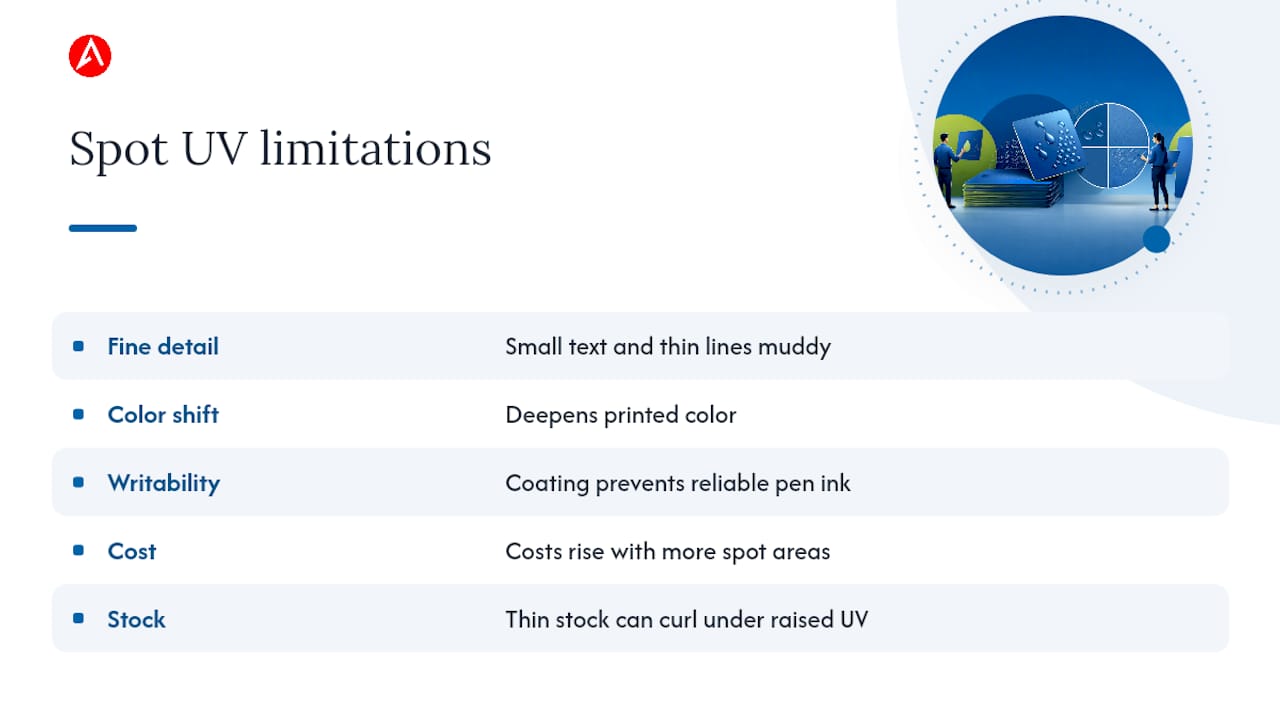
Each of these three finishing techniques creates impact through a different physical mechanism, and that difference determines both durability and the impression each one leaves.
Spot UV is a liquid coating cured with ultraviolet light onto the paper surface. It’s durable against normal handling but sits on top of the stock rather than reshaping it, so its effect is primarily visual and tactile through height, not through a change in the paper’s structure. Embossing physically presses the paper into a raised (or, with debossing, recessed) shape using heat and pressure. That structural change makes embossing arguably more durable against repeated flexing since there’s no coating layer that can eventually crack or peel at the edges over years of handling. Foil stamping presses a thin metallic or pigmented film into the paper using a heated die, delivering the most dramatic color impact of the three, particularly in gold, silver, or bold color foils, but foil can show wear at high-friction edges over long-term handling faster than either spot UV or embossing.
For pure visual contrast per dollar spent, spot UV usually wins. For structural, long-lasting tactile impact, embossing holds up best. For maximum color drama on a low-quantity run, foil stamping is hard to beat. Many premium cards actually combine two of the three, most often embossing with foil or raised spot UV with a foil accent, though that combination pushes both cost and production complexity higher.
Are Spot UV Coatings Environmentally Friendly?
UV-cured coatings have one genuine environmental advantage over older varnish types: curing happens almost instantly under ultraviolet light rather than through slow solvent evaporation, which means UV coatings typically release fewer volatile organic compounds (VOCs) into the air during production compared to solvent-based varnishes.
That said, spot UV coating is still a petroleum-derived polymer layer bonded to the paper stock, and that bonded layer can complicate recycling. A card with heavy spot UV coverage is harder for standard paper recycling processes to break down cleanly than an uncoated card, since the cured coating doesn’t dissolve the way plain paper fibers do. If sustainability is a priority for your brand, ask your printer whether their base card stock carries any recycled content or forestry certification, and consider limiting spot UV to smaller accent areas rather than large coated fields. A small raised logo has a much lighter material footprint than a card with a full-bleed gloss treatment.
None of this makes spot UV a poor environmental choice compared to foil stamping, which involves a separate metallic film layer, or to lamination-heavy soft-touch finishes. It simply means “premium finish” and “lowest environmental footprint” are usually in tension, and the honest move is picking your battles: coat the logo, not the whole card.
Ready to Order? Here’s How Arrowhead Sign Company Handles Spot UV Cards
Getting a spot UV order right comes down to four steps: pick your stock weight and base finish, supply a clean spot layer with your artwork, request a proof or tactile sample, and approve the run once you’re confident in how it’ll feel in hand. Arrowhead Sign Company - Signs, Banners and Trade Show Displays walks Arizona-based clients through each step directly, including venue delivery timed to your event date, and ships most orders nationwide within two business days of approval.
Cards rarely travel alone at a trade show booth. If you’re upgrading your printed collateral for an upcoming event, pair your premium cards with signage that gets people to your table in the first place. Our 10 ft stretch fabric display works as a bold backdrop for booths that want a polished, professional look to match a premium card hand-off. For outdoor events or parking-lot activations, the adjustable outdoor banner frame holds up in wind and weather, and a Signicade A-frame sidewalk sign directs foot traffic straight to your booth.
Whatever finish you land on, get your artwork spec questions answered before you place the order. Reach out to Arrowhead Sign Company - Signs, Banners and Trade Show Displays through our full product lineup to request a quote or start your spot UV card order today.
A Printer’s Perspective on Ordering Spot UV Under a Deadline
Most spot UV headaches aren’t about the finish itself. They’re about timeline math done wrong. Raised spot UV adds a curing step, and if you’re also rushing a large quantity, something usually has to give: either your deadline slips, or you drop down to flat UV to hit the date. Decide which tradeoff you’re willing to make before you’re two days out from a show.
The buyers who get the best results treat spot UV cards as one piece of a matched set, not a standalone item. A raised logo on your card means little if your banner finishes at the booth look flat and generic beside it. Match your finish choices across your printed materials when you can.
And request a physical sample. Every time. A screen render of raised UV tells you almost nothing about how it’ll actually feel or catch light in someone’s hand.
— Dan
Sources
- What Is Spot UV Printing? Benefits, Uses & When It’s Worth It | Overnight Prints
- Small detail, big impact: how spot UV elevates print - Neyenesch
- How to Design & Create Spot UV Files | WTTB
- Spot UV vs Foil Business Cards: Which Finish Suits You | YAYA Prints
FAQ
What Is Spot UV on a Business Card?
Spot UV is a clear glossy coating applied to specific parts of a card design, creating visual contrast between the shiny coated area and the surrounding uncoated stock rather than coating the whole surface.
Is Spot UV Worth It on Business Cards?
It’s worth it for executive cards, portfolios, and other cards meant to be kept and handled repeatedly, since the tactile contrast makes them more memorable, but it adds less value on high-volume disposable handouts.
What Does a Spot UV Finish Mean in Practice?
In practice, it means part of your card carries a raised or flat glossy layer while the rest stays matte or soft-touch, and the printer needs a separate spot layer in your artwork file to know exactly where that coating goes.
What’s the Difference Between Hot Stamping and Spot UV?
Hot stamping (foil stamping) presses a metallic or pigmented film into the paper using a heated die for maximum color drama, while spot UV cures a clear liquid coating with ultraviolet light to create gloss contrast rather than metallic color.