

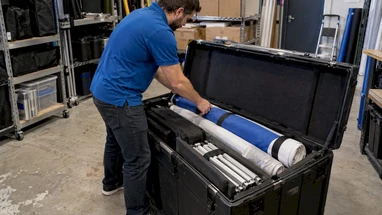
Trade Show Graphics Storage: Protect Fabric, Crate Displays for Travel
Posted by Deeder Dandenhorf on Oct 14th 2026
Trade Show Graphics Storage: Protect Fabric, Crate Displays for Travel

Store fabric and printed graphics in a cool, dry, stable space and transport them in padded reusable crates or hard cases. Get this right and your graphics can stay sharp from one show to the next.
TL;DR:
- Keep storage near 60 to 70°F and 50% relative humidity; avoid attics, basements, windows, and unconditioned units where conditions fluctuate.
- Roll fabric and stretch displays printed side out on wide tubes with tissue or washed muslin; fold vinyl only, varying fold locations over time.
- Use reusable wood crates with foam for repeated shows, ATA road cases for valuable electronics, and lightweight inserts to reduce venue charges tied to weight.
- Inspect every graphic after each show and regularly during extended storage for mildew, hardware wear, fading, and damage that may appear only when unrolled.
- Choose remote storage only after confirming climate control, and compare rental fees with ownership costs if you exhibit infrequently.
Table of Contents
- Why temperature, humidity, and light control matter for banners and fabric displays
- Material-specific packing: rolling, folding, flat storage, and inner wraps
- Labeling, inventory, and container choices that save time and prevent damage
- On-site vs off-site storage vs managed/rental exhibit programs
- Choosing and designing crates and cases for venue logistics and repeated handling
- A short inspection and upkeep checklist to keep graphics show-ready
- Seller perspective: what exhibitors typically get wrong and quick fixes
- How Arrowhead Sign Company products help store and transport graphics
- FAQ
- Sources
Why temperature, humidity, and light control matter for banners and fabric displays
Fabric and vinyl graphics react to their environment more than most exhibitors expect. Textile preservation guidance recommends keeping fabric displays between about 60 and 70°F with relative humidity near 50%, since fluctuation outside that range causes distortion, mold, and mildew. The Smithsonian Institution points to a similar band, around 65 to 70°F and 40 to 50% RH, in a clean, dark space.
High humidity can encourage mildew on fabric backdrops. Direct light fades printed colors unevenly, so a banner that spent a season near a window will look washed out next to a fresh print. Temperature swings, the kind you get in an uninsulated garage or storage unit, stress the fibers and printed inks every time the material expands and contracts.
- Store graphics on interior shelving, away from exterior walls and windows.
- Skip attics, basements, and un-climate-controlled storage units.
- Use breathable fabric or paper covers, never sealed plastic, for long-term storage.
- Add a small dehumidifier or desiccant packs when full climate control isn’t practical.
Pro Tip: A hygrometer in your storage closet helps you check whether the storage closet is near 50% RH.
Material-specific packing: rolling, folding, flat storage, and inner wraps
How you pack a graphic determines whether it unrolls smooth or creased at your next show. Conservation guidance on textile care recommends rolling fragile fabric pieces onto archival tubes rather than folding them, since folds create permanent stress lines over time.
- Roll most fabric and stretch displays onto a wide archival tube, printed side out, with a layer of unbuffered tissue or washed muslin between layers.
- Reserve folding for vinyl banners that tolerate it better, and avoid tight, repeated folds in the same spots.
- Store rigid signs and sidewalk sign inserts flat, separated by acid-free interleaving so printed faces never touch bare wood or cardboard.
- Choose foam inserts by job: polyethylene foam resists moisture for frequent travel, polyurethane cushions better for one-time shipping, and ESD-safe foam matters only for sensitive electronics riding alongside your graphics.
CNC-cut foam is suited to repeated use, while pluck foam works for occasional use or mixed-size inventory. Avoid sealing any fabric piece in airtight plastic for storage, since trapped moisture does more damage than open air ever would. Our guide to choosing vinyl banners covers material choices that hold up best to this kind of repeated handling.
Pro Tip: Refold or re-roll fabric graphics periodically, even in storage, so the same crease never bears the load twice in a row.

Labeling, inventory, and container choices that save time and prevent damage
A clear labeling system turns setup day from a scramble into a checklist. Give each piece a unique ID, the dates and events it’s shipped to, its correct orientation, and a short note like “fragile” or “roll only, do not fold.”
- Use flat-file drawers for small banners and signage inserts that need to lie flat.
- Reserve open shelving for stacked crates and slotted racks for rolled graphics.
- Palletize heavier pieces, like tension fabric frames, so they move as one unit.
- Keep a lightweight spreadsheet or field app tracking what’s stored where, and tuck a printed backup manifest inside each crate in case the digital version isn’t handy on-site.
That printed backup matters more than it sounds. A phone with a dead battery at 6 a.m. load-in is a common reason exhibitors lose track of which crate holds what.
On-site vs off-site storage vs managed/rental exhibit programs
Where you keep graphics between shows depends mostly on how often you exhibit and how much space you have to spare.
- On-site storage suits frequent exhibitors who need quick access, as long as you can dedicate an interior, climate-stable spot rather than a garage corner.
- Off-site storage costs less per square foot for bulk inventory, but factor in transit time before each show and confirm the facility actually offers climate control, not just a locked door.
- Managed or rental exhibit programs make sense when you’d rather skip owning storage altogether. Renting avoids the maintenance burden entirely, though it trades long-term ownership for a per-show fee.
Exhibitors who show infrequently may come out ahead renting. Anyone running a multi-city circuit may recover the cost of owned graphics and proper storage over time, especially with a display built for repeated use rather than single-event convenience.
Choosing and designing crates and cases for venue logistics and repeated handling
Your crate choice affects your shipping bill as much as your graphics’ condition. A trade show crating guide breaks the market into four main types: reusable wood crates, ATA-rated road cases, one-time-use closed crates, and custom hard cases.
- Reusable wood crates with foam inserts suit exhibitors doing multiple shows a year and want a container that survives repeated freight handling.
- ATA-rated road cases fit high-value gear, like electronics or lighted displays, that need serious impact protection.
- One-time-use closed crates work for a single show or a one-off shipment where you won’t reuse the box.
- Custom hard cases make sense for smaller, awkwardly shaped pieces that don’t fit standard crate dimensions.
Crate weight drives drayage charges directly, since venues bill by the pound for material handling. A proper carrying case built with lightweight CNC-cut foam instead of a solid foam block often delivers better long-term value: lower per-show freight cost and better protection than loose padding ever provides.
Pro Tip: Split heavy inventory across two smaller crates with casters instead of one oversized box. Many venues waive forklift fees for anything one person can roll.
Hinged lids and stackable tops save setup time too, since crew can access graphics without unstacking an entire pallet.
A short inspection and upkeep checklist to keep graphics show-ready
Graphics that look fine rolled up can hide damage until you unroll them on-site, so build inspection into your routine rather than discovering problems at load-in.
- Check every piece right after a show for mildew spots, hardware wear, and fading, while the damage is still fresh and easy to trace.
- Check anything in long-term storage regularly, even pieces that haven’t traveled recently.
- Wipe vinyl banners with a mild soap solution; use gentler, fabric-safe cleaning for stretch displays and skip home remedies on anything delicate or heavily printed.
- Rotate fold points and re-roll large fabric pieces on a regular cycle so stress never concentrates in one spot.
Seller perspective: what exhibitors typically get wrong and quick fixes
The most common mistake we see is graphics packed loose in whatever box was on hand, which leads straight to creases, torn grommets, and surprise drayage fees from oversized crates. A faster fix: match your container to your graphic, keep crates light, and label before you pack, not after.
— Dan
How Arrowhead Sign Company products help store and transport graphics
Storage gets easier when the display itself is built for it with trackable QR codes on reusable graphics. The Outdoor Banner Frame - The Banner Bar breaks down into a compact frame that stores flat between shows, no bulky crate required. Our stretch fabric display helps address the climate and crease concerns we covered above. The Signicade Deluxe A-Frame Sidewalk Sign folds flat for storage and swaps its printed inserts in seconds.
Our products can ship quickly, so you may be able to replace a damaged graphic instead of storing a backup you may never use. Browse our full lineup of trade show products and displays or explore quick ship displays to get your next show covered today.
FAQ
What temperature and humidity are best for storing trade show graphics?
Keep fabric and vinyl graphics in a space around 60 to 70°F with relative humidity near 50%, following textile preservation guidance and the Smithsonian’s similar recommendation of 65 to 70°F and 40 to 50% RH. Avoid attics, basements, and uninsulated storage units where conditions swing widely.
Should I roll or fold my trade show banners?
Roll most fabric and stretch displays onto a wide tube with a protective layer between wraps to avoid permanent crease lines. Vinyl banners tolerate folding better, though repeated folds in the same spot will still weaken the material over time.
What type of crate should I use for shipping trade show displays?
Choose based on frequency and value: reusable wood crates with foam inserts for multi-show circuits, ATA-rated road cases for high-value electronics, one-time-use crates for a single shipment, and custom hard cases for oddly shaped pieces, per trade show crating guidance. Lighter crates with CNC foam inserts typically reduce drayage costs.
How often should I inspect stored trade show graphics?
Check every piece right after each show while damage is easy to spot, then inspect anything sitting in long-term storage regularly. Look for mildew, hardware wear, and fading, and clean vinyl with mild soap while handling fabric displays more gently.
Sources
The temperature, humidity, and handling recommendations in this guide draw on textile preservation standards built for museum and archival collections, adapted here for the realities of trade show travel. The crate-type breakdown and drayage notes come from a dedicated exhibit logistics resource.
- Museum
- How do I store antique textiles at home? | Smithsonian Institution
- Trade Show Crates: Reusable, ATA Cases & Shipping Guide