

What Is a Mounted Photo Print? Definition & When to Use One
Posted by Deeder Dandenhorf on Aug 17th 2026
What Is a Mounted Photo Print? Definition & When to Use One
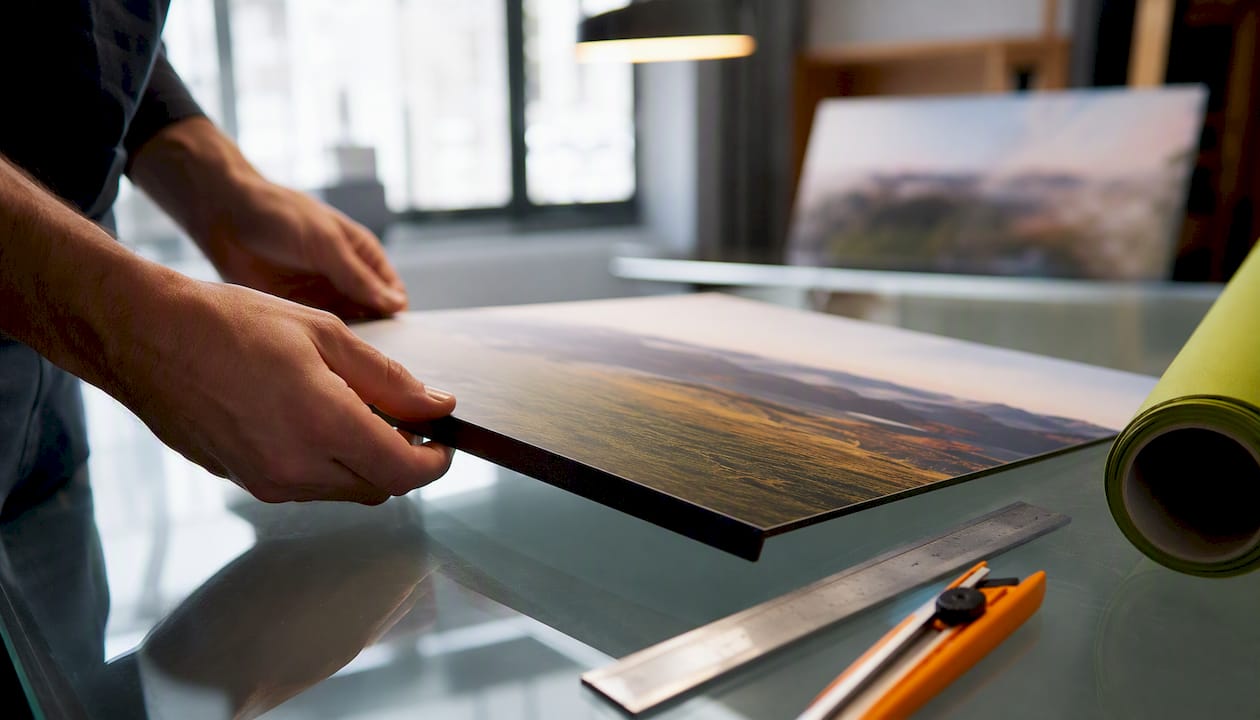
A mounted photo print is a photograph or art image permanently adhered to a rigid backing board, such as foamcore, Gatorboard, or styrene, so the piece stays flat, resists curling, and displays with a clean, gallery-ready edge. Backing thickness typically ranges from 1/16 inch to 3/4 inch, and that range is what separates a lightweight desk piece from a rigid trade show panel. People choose mounted prints because they’re ready to display right out of the box: no frame required, no sagging paper, no corners curling up after a humid week at a booth or in a living room.
If you’ve ever unrolled a photo print and watched it stubbornly curl back into a tube shape, you already understand the problem mounting solves. You’re not buying decoration alone. You’re buying structure.
Key Takeaways
A mounted photo print is a photograph permanently adhered to a rigid backing like foamcore or Gatorboard, and the material you choose determines its rigidity, cost, and archival safety.
Table of Contents
- What Exactly Is a Mounted Photo Print?
- How Do Mounted Prints Differ From Matted, Framed, Canvas, and Metal Prints?
- Which Backing Materials Work Best for Mounted Prints?
- How Are Mounted Prints Made, and Can They Be Reversed?
- How Do You Hang and Display a Mounted Print?
- When Should You Choose a Mounted Print Over the Alternatives?
- Why Trade Shows and Event Marketers Rely on Mounted Prints
- When I’d Recommend a Mounted Print (and When I Wouldn’t)
- Ready to Print and Mount Your Next Event Graphic?
- Sources
- FAQ
What Exactly Is a Mounted Photo Print?
A mounted print is built from three layers working together, and understanding each one tells you what you’re actually paying for.
- The print itself. This can be a traditional photographic paper print, a giclée (fine art pigment print), or a standard digital print, depending on the lab and the intended use.
- The adhesive layer. Heat-activated dry-mount tissue, pressure-sensitive adhesive, or occasionally a spray adhesive bonds the image to the backing.
- The rigid backing. Foamcore, Gatorboard, styrene, Dibond, or matboard gives the piece its stiffness and shape.
- Optional edge finishing. Some labs leave a raw foam edge visible, others wrap or seal it for a cleaner look.
Thickness matters more than most first-time buyers realize. A quarter-inch foamcore mount works fine for a framed 8x10 sitting on a shelf, but a four-foot trade show graphic needs something closer to Gatorboard’s added rigidity or even a 3/4-inch Standout panel to avoid warping under its own weight. The thinner the material, the more it flexes; the thicker it gets, the heavier and more expensive it becomes to ship.
How Do Mounted Prints Differ From Matted, Framed, Canvas, and Metal Prints?
This is where most buyers get confused, and it’s worth untangling before you spend money on the wrong format.
Mounting is permanent. Matting is not. A matted print sits behind a cut window mat that provides a border, keeps the paper from touching the glass, and can be swapped out or reframed later without damaging the print. A mounted print, by contrast, is bonded directly to its backing, often edge-to-edge, with no removable buffer at all.
| Format | Best for | Durability / stiffness | Removability / archival safety | Appearance / edge treatment | Cost | Ready-to-hang |
|---|---|---|---|---|---|---|
| Mounted print | Trade shows, retail, décor | High, rigid | Low, generally permanent | Clean, edge-to-edge, no border | Moderate | Yes, often |
| Matted print (loose) | Collectors, resale, portfolios | Low on its own | High, fully removable | Bordered, traditional gallery look | Low | No |
| Framed print | Home décor, gifting | High, glass protected | Moderate, print can be swapped | Formal, glazed | Higher | Yes |
| Canvas print | Home décor, artistic feel | Moderate, can dent | Low, stretched permanently | Textured, no glare | Moderate to high | Yes |
| Metal print | Modern décor, outdoor-adjacent | Very high | Low, permanent | Glossy, vibrant, no frame needed | Higher | Yes |
The decision usually comes down to three questions: how long do you need it to last, will you ever want to change or reframe it, and how much handling will it take? A dry-mounted print that gets bumped around at a weekend market survives far better than a loose matted print in the same bag.
Pick mounted if:
- You need something that goes straight from box to wall or easel with zero assembly.
- The piece will travel to events, booths, or high-traffic retail spaces where flimsy paper won’t hold up.
- You want a clean, borderless, modern look rather than a traditional framed aesthetic.
- You’re not planning to reframe, resell as an “original,” or preserve the piece as a museum-grade archival object.
Which Backing Materials Work Best for Mounted Prints?
The backing material you choose changes everything from weight to price to how long the piece survives outdoors. Here’s how the common options stack up.
| Material | Typical thickness | Best for |
|---|---|---|
| Foamcore | 3/16 inch | Framing, wall art, indoor décor |
| Matboard | 1/16 inch | Lightweight backing, layered mats |
| Gatorboard | 3/16 to 1/2 inch | Trade shows, retail, larger panels |
| Styrene | Thin, flexible sheets | Budget signage, temporary displays |
| Dibond (aluminum composite) | Rigid, heavier | Outdoor signage, high-durability projects |
- Foamcore: Lightweight and inexpensive, but it dents easily and isn’t built for outdoor use or rough handling.
- Gatorboard: Denser and tougher than foamcore, with the rigidity to survive repeated trade show setups without warping.
- Dibond: An aluminum-faced composite panel that resists moisture and temperature swings, making it one of the few mounting substrates suited to semi-outdoor or long-term commercial display.
- Styrene: Cheap and workable for short-run signage, but it flexes more and shows wear faster than Gatorboard or Dibond.
- Matboard: Rarely used as a standalone mount for large prints; it’s better suited to layered mat presentations behind glass.
For fine art reproduction, a foam-mounted print using archival pigment inks on fine art paper backed by 3/16-inch polystyrene foamboard delivers a museum-adjacent look without the weight or cost of aluminum. If the piece is heading outdoors, or anywhere near direct sun or moisture, foamcore and matboard fall short. Dibond and, in some cases, styrene-based systems handle the exposure better.
How Are Mounted Prints Made, and Can They Be Reversed?
Mounting isn’t one process. It’s a family of techniques, and which one a lab uses determines whether your print can ever be separated from its backing again.
- Dry-mounting uses heat-activated adhesive tissue pressed between the print and the backing under controlled heat and pressure. It’s affordable, produces a smooth, bubble-free bond, and is the industry default for most commercial mounted prints.
- Pressure-sensitive adhesive mounting skips the heat step, bonding print to board at room temperature. It’s faster for production runs but can be less forgiving if misaligned.
- Hinge mounts attach the print to a backing using small strips of archival paper tape, typically at the top edge only, leaving the print itself untouched by adhesive.
- Photo corners hold the print in place with small archival sleeves at each corner, so nothing touches the print’s surface at all.
Here’s the part conservators wish more buyers understood before ordering: dry-mounting is effectively permanent. Once that heat-activated tissue bonds, separating the print without damage is nearly impossible. For a trade show graphic or a living room decoration, that’s a non-issue. For a one-of-a-kind vintage photograph, an original fine art print, or anything you might want to reframe, resell, or preserve for decades, permanence is a real risk. Hinge mounts and photo corners exist precisely because conservators recommend removable methods for archival originals, even though they offer less rigidity than a full dry-mount.
Pro Tip: If you’re not sure whether a piece is replaceable, ask your print lab directly whether they offer hinge mounting or photo corners as an archival alternative to dry-mounting. A five-minute phone call can save an irreplaceable print.
How Do You Hang and Display a Mounted Print?
Mounted prints are built to skip the frame shop entirely, but the right hardware depends on which backing you chose.
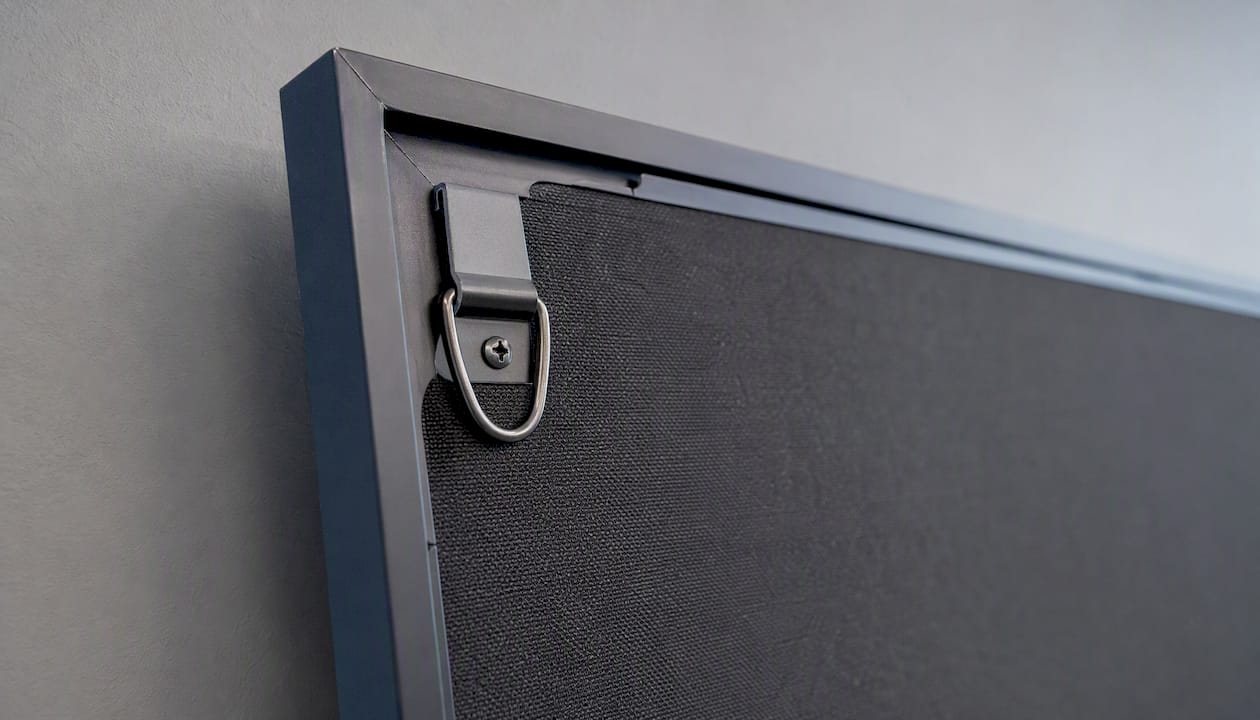
- Sawtooth hangers work well on Gatorboard and foamcore panels under a few pounds. They’re inexpensive and nearly invisible from the front.
- Grooved Standout hardware comes built into some thicker panels, with 3/4-inch Standouts arriving pre-grooved for hanging without any extra hardware purchase.
- Adhesive strips or Command hooks suit small, lightweight foamcore pieces where drilling isn’t practical, though weight limits matter here more than anywhere else on this list.
- Easel backs or A-frame stands turn a mounted print into a freestanding display, ideal for retail counters or event check-in tables.
Framing a mounted print is possible, and often desirable if you want glazing to protect the surface from fingerprints or UV fading. The edge treatment matters here: a raw foam edge looks unfinished inside a shadow-box frame, while a wrapped or beveled edge holds up better without glazing at all. If you’re weighing rigid mounted graphics against a fabric alternative for a booth backdrop, a portable display option built for events might suit large-format needs better than a single oversized mounted panel.
Before hanging anything heavier than a few pounds, confirm your wall anchors are rated for the weight and never rely on adhesive strips alone for panels over roughly 16x20 inches. A dropped Gatorboard sign at a trade show is a bad first impression.
When Should You Choose a Mounted Print Over the Alternatives?
Mounted prints show up constantly in a handful of predictable settings: trade show booths, retail storefronts, gallery walls, portfolios, and home décor where a clean, borderless look is the goal. Foam-mounted prints resist bending and creasing, which is exactly why they hold up in high-traffic environments where a loose paper print would get dog-eared within a day.
The tradeoffs, honestly stated:
- Mounted prints are durable and display-ready, but the mounting is generally irreversible.
- They ship flat, not rolled, which increases packaging size and freight cost compared to a rolled tube, especially for large-format panels.
- Storage takes more space than rolled prints since you can’t compress a rigid panel.
- They cost more upfront than an unmounted print but save you the cost of separate framing hardware.
If you’re ordering a large mounted piece for an event, plan ahead for flat-pack shipping timelines rather than assuming tube-speed delivery. A retail shop swapping window graphics every season, for instance, leans on mounted panels because the finished, professional look works immediately without a frame shop visit, while a collector archiving a rare print should lean toward a removable matted presentation instead.
Why Trade Shows and Event Marketers Rely on Mounted Prints
Exhibitors gravitate toward mounted graphics for a simple reason: lightweight rigidity solves a logistics problem that fabric and paper can’t. A mounted panel leans against a wall, sits on an easel, or hangs from a booth wall in seconds, with none of the sagging or wrinkling you’d fight with an unmounted print in a busy convention hall.
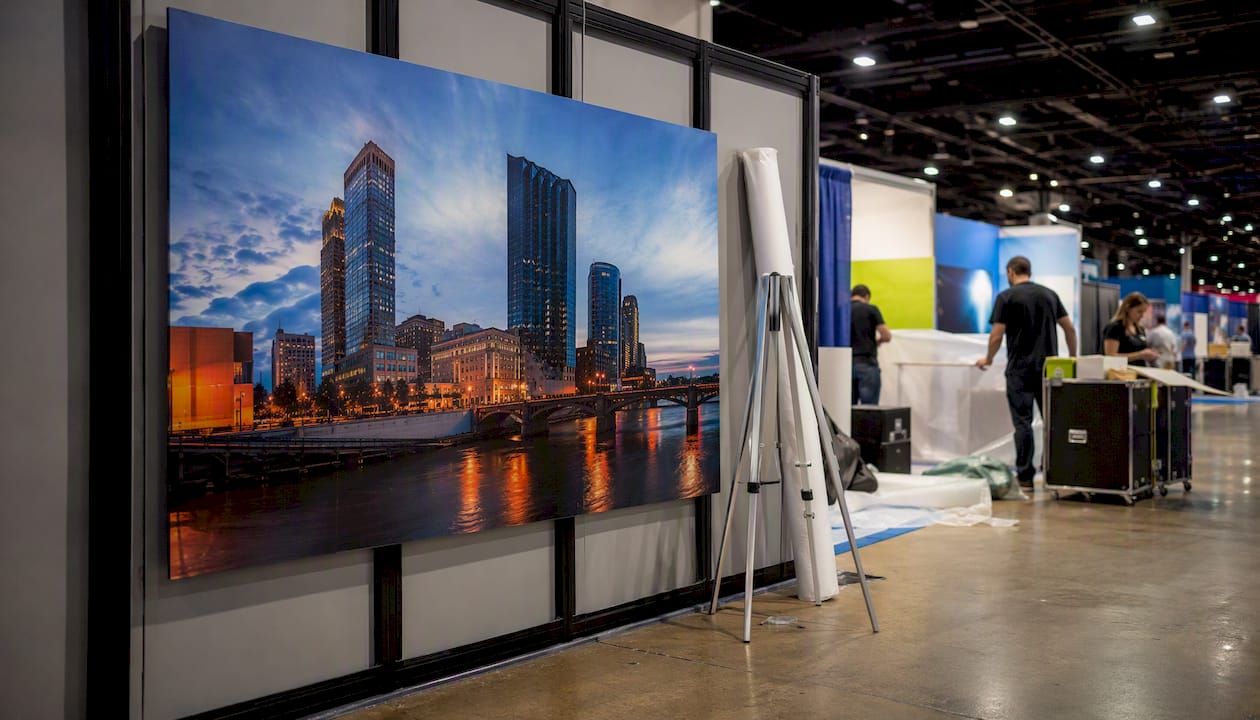
Shipping and handling deserve real planning here. A large mounted panel arrives flat, which means booking freight or oversized parcel shipping ahead of your event date rather than assuming standard ground shipping will cover it. Hardware choice matters too. Grooved Standouts save you from buying separate mounting brackets, while thinner foamcore pieces need careful crate packing to survive a truck ride.
Pro Tip: If your event is more than a few weeks out, order your mounted graphics early and confirm hanging hardware compatibility with your booth’s wall system before the panel ships. Nothing kills setup morning faster than a Standout groove that doesn’t fit your provided hooks.
Arrowhead Sign Company - Signs, Banners and Trade Show Displays works with small businesses navigating exactly this kind of event logistics, shipping most products within two business days and offering direct venue delivery for Arizona-based clients who’d rather skip the freight guesswork entirely.
When I’d Recommend a Mounted Print (and When I Wouldn’t)
If you’re a photographer selling prints at weekend art fairs, mounting is the practical choice almost every time. Buyers want to walk away with something they can prop on a shelf immediately, not a rolled tube they have to frame later, and the added rigidity survives the trip home in a car trunk far better than loose paper. Collectors archiving an original or a limited-edition print are a different story entirely. There, I’d steer toward hinge mounts, photo corners, or a removable matted presentation, because the permanence of dry-mounting is a real cost when the piece might get reframed, appraised, or resold years down the road. The honest rule I keep coming back to is this: mount for display, preserve for posterity, and never let a lab dry-mount something you can’t replace.
Ready to Print and Mount Your Next Event Graphic?
Arrowhead Sign Company - Signs, Banners and Trade Show Displays gets your custom graphics into your hands fast, most products ship within two business days, so you’re not stuck waiting weeks while your booth date creeps closer. Whether you need a rigid mounted panel for a retail window, an outdoor banner frame built to hold up through a full trade show season, a Signicade A-frame sign for walk-up foot traffic, or a full-size 10 ft stretch fabric display for a larger backdrop, you’re choosing from products built specifically for small business exhibitors, not generic print-shop leftovers.
Arizona-based clients get direct delivery straight to their venue, which means one less logistics headache on setup day. Browse the full product lineup and get a quote on your next mounted graphic or display piece before your next event date locks in.
Sources
- What Is a Mounted Print: 2025
- Loose vs mounted prints (Printery press blog)
- 5 Things to Know About Foam-Mounted Fine Art Paper Prints
- Mounting, Matting, and Framing (conservation and techniques)
- FAQ - Mounted Prints (Nations Photo Lab Help Center)
FAQ
What Are the Differences Between Mounted and Framed Prints?
A mounted print is permanently bonded to a rigid backing with no glass, while a framed print sits inside a frame, usually behind glazing, and can be swapped or reframed later without damage.
Do Prints Look Better With or Without a Mount?
Mounted prints have a cleaner, more finished, gallery-ready look right out of the box, while unmounted prints can look flimsy or prone to curling until they’re framed or matted.
How Do You Hang a Mounted Print?
Most mounted prints use sawtooth hangers, grooved Standout hardware, or adhesive strips for smaller pieces, with the right choice depending on the backing material and the print’s weight.
Can You Put a Mounted Print in a Frame?
Yes, a mounted print can go into a frame, though a raw foam edge looks better with a shadow-box style frame while a wrapped or beveled edge can stand alone without glazing.
Which Backing Material Holds Up Best Outdoors?
Dibond, an aluminum composite panel, resists moisture and temperature swings far better than foamcore or matboard, making it the more durable choice for semi-outdoor signage.
Recommended
- Pop Up Tent with Print: Your 2026 Event Branding Guide - Arrowhead Sign Company
- What Is a Hanging Fabric Display? A Trade Show Guide - Arrowhead Sign Company
- How Booth Graphics Get Printed: A Planner’s Guide - Arrowhead Sign Company
- What Does Print Ready Mean? A File Checklist for Exhibitors - Arrowhead Sign Company