

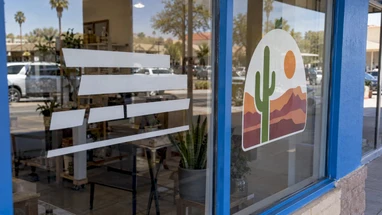
Window Decals vs. Lettering: Which Fits Your Storefront?
Posted by Deeder Dandenhorf on Nov 19th 2026
Window Decals vs. Lettering: Which Fits Your Storefront?

Use cut vinyl lettering when your message is text in one color: your name, hours, phone number or a short phrase. Use a window decal when you need a printed logo, several colors, a photo or artwork. Most storefronts end up using both, with a decal for the brand and lettering for the details that change. Below you will find how each is made, what drives the price, how to apply lettering to glass and how to pick for an event, a booth or a shop window.
If you are ordering for an Arizona event or a storefront on a deadline, we can help you through the choice. Our window lettering and logos service is built around fast turnaround for small businesses.
TL;DR
- Lettering is cut from solid colored vinyl, with no background. It looks like paint on the glass and suits text, hours and simple one-color logos.
- Decals are printed on a vinyl sheet and applied as one piece. They handle full color, gradients, photos and detailed artwork.
- Price depends on the size of the rectangle around your layout and on how much fine detail has to be weeded out, and small jobs carry a minimum charge.
- Placement matters: apply to clean glass, in mild weather, from the inside when you want protection from weather and scratches.
- Best combination: a printed logo decal plus cut lettering for hours and contact details.
Table of Contents
- The core difference in one minute
- Window decals vs. lettering at a glance
- When cut lettering is the better choice
- When a printed decal is the better choice
- Using both together
- What it costs and what drives the price
- How to apply window lettering step by step
- How long each one lasts
- A quick way to decide
- Our take on decals and lettering
- Get your window or event graphics from Arrowhead
- FAQ
- Sources
The core difference in one minute
Both products are vinyl with adhesive on the back. What separates them is how the image is made.
Window lettering is cut. A machine cuts your text or shapes out of a roll of solid colored vinyl. The material around the letters is removed, a process called weeding, and what remains is carried to the glass on a sheet of transfer tape. When the tape is peeled away, only the letters stay on the window. There is no clear border, so the glass shows through everywhere except the letters themselves.
A window decal is printed. The artwork is printed onto a sheet of vinyl, often clear or white, and then cut to a shape. You apply it as a single piece. Because it is printed, it can carry as many colors as your artwork has, including gradients and photos.

That single difference explains almost everything else in this comparison: color, price, how you update the sign and how it looks from the street.
Window decals vs. lettering at a glance
| Cut vinyl lettering | Printed window decal | |
|---|---|---|
| How it is made | Cut from solid colored vinyl, then weeded | Printed on vinyl, then cut to shape |
| Colors | One color per layer of vinyl | Full color, gradients, photos |
| Look on glass | Clean, painted-on look with no background | Image or shape with its own backing area |
| Best for | Business name, hours, phone, web address, door text | Logos with several colors, promotions, seasonal graphics |
| Easy to change | Individual items or lines can be redone | Usually replaced as a whole piece |
| Typical use | Storefront doors and windows, truck doors, offices | Event windows, retail promotions, branded displays |
When cut lettering is the better choice
Choose lettering when the message is mostly words and you want it to look permanent and tidy.
- Hours of operation. Plain letters on a door read quickly and look professional.
- Business name, address numbers and phone number. A single color in high contrast against the glass is easy to read from a car or across a parking lot.
- A one-color logo. If your mark works in white, black or one brand color, cut vinyl reproduces it crisply.
- Text that will change. Because lettering is cut into separate pieces, a line such as a sale percentage or a seasonal hour can be redone without replacing the entire window.
The limit is color. Each layer of cut vinyl is one color, so a multicolor logo means stacking layers or moving to a decal.
Contrast does most of the work here. White or light lettering reads best on dark interiors, while dark lettering works on bright, open glass. Keep the text large enough for the distance your customers see it from, and keep lines short. A window that says three things gets read; a window that says ten gets ignored.
When a printed decal is the better choice
Choose a decal when the image carries the message.
- A full-color logo with several brand colors, shading or fine detail.
- Promotions and seasonal graphics where photos, icons or bold artwork sell the offer.
- Text combined with a logo in a single design that needs to stay aligned exactly as you drew it.
- Event windows and pop-up locations where you want a striking graphic in place quickly.
The type of decal matters too. EufyMake’s guide to window decal types lists standard and outdoor-grade vinyl, static cling, clear decals, frosted vinyl, perforated decals, removable decals and large window wraps. In practice, the choices that matter most to a small business are these:
- Adhesive vinyl for long-term branding.
- Static cling for messages you change often, held to smooth glass without adhesive.
- Removable low-tack vinyl for event or campaign graphics. One manufacturer rates its 3.4-mil removable white vinyl for removal up to one year under normal exposure and gives 40°F as its minimum application temperature.
- Perforated window vinyl for full-window graphics that still let people inside see out.
We cover cling versus adhesive in more depth in our guide on choosing a window cling or decal, and our article on perforated window vinyl explains the full-window option.
Using both together
The strongest storefronts rarely pick one. A printed logo decal on the main window gives you color and recognition. Cut lettering underneath it gives you hours, a phone number and a web address, and you can redo those without touching the logo. The same logic works at events: a printed graphic grabs attention, and a few lines of cut text give the practical details.
If you are thinking about how your window fits into the rest of your brand, visual storytelling for your brand offers ideas for deciding which message belongs in the image and which belongs in plain words.
What it costs and what drives the price
Prices vary by shop, size and material, so treat any figure as a ballpark and get a quote for your exact layout. As one reference point, a November 2026 survey of U.S. shops by Grommet Book puts one-color cut lettering at roughly $8 to $12 per square foot and window lettering at roughly $12 to $18 per square foot, with minimum charges of $35 to $50.
Three things move the price on almost any job:
- Size of the layout. Shops generally price on the rectangle that surrounds your design, not on the area the letters actually cover. A short phrase spread across a wide space costs more than the same words packed tightly.
- Detail. Thin fonts and small letters take longer to weed than big block letters of the same overall size. Simplifying the font is one of the easiest ways to lower the cost.
- Job size. Setup and layout time does not shrink with the sign, which is why small jobs cost more per square foot and why minimums exist. Combining several items into one order helps.
Printed decals follow the same logic, with the added factors of printing, laminate and cutting. A good rule is to ask for the all-in price including layout, material and any outdoor-grade finish, so you can compare quotes fairly.
How to apply window lettering step by step
Lettering arrives on a sheet with the letters held in place by transfer tape. The steps below also work for most small decals. Plan on 20 to 30 minutes for a door and a window.
1. Pick the side of the glass
Inside application protects the vinyl from weather, washing and scratches, and it is the usual choice for long-term storefront lettering. Apply outside only when the glass is tinted or coated on the inside, or when the message must be read from both sides. Check the glass first: window film or coatings on the inside surface can change how the vinyl sticks. Where the vinyl is going determines the vinyl grade you need, so tell your supplier whether the lettering is going on the inside or outside when you order.
2. Check the weather and the surface
Aim for mild, dry conditions. The 40°F minimum application temperature that manufacturers such as the one above state for their removable vinyl is a sensible floor for most adhesive vinyl; confirm the figure for your specific material. Clean the glass with glass cleaner and a lint-free cloth, then wipe the edges with isopropyl alcohol and let it dry. Leftover residue is the most common reason letters lift later.
3. Position the sheet and mark it
Hold the sheet against the glass and check the placement from outside, standing back. Use a level and measure from the frame, not by eye. Run a strip of painter’s tape across the top edge to make a hinge. Step back again before you commit.
4. Use the hinge method
With the tape holding the sheet in place, the hinge method has you lift one half, peel the backing paper away from that half and cut it off. The letters stay stuck to the transfer tape. Then lay that half back down toward the glass.
5. Squeegee from the center out
Press the tape with a squeegee or a credit card, starting at the center of the hinge and working outward in overlapping strokes. Firm, even pressure pushes out air. Repeat with the other half: remove the center tape, peel the remaining backing and squeegee again.
6. Peel the transfer tape slowly
Pull the tape back at a sharp angle, close to the glass, not straight out toward you. If a letter lifts with the tape, lay the tape back down, press the letter again and continue. Small bubbles can usually be pushed to the edge with the squeegee or pricked with a pin. Give the adhesive a day or so before washing the glass, and never use a razor or abrasive pad on the vinyl later.
Where it goes wrong: crooked placement, trapped dust under the letters and peeling the tape too fast account for most redo jobs. Large multi-line layouts and tall windows are hard to do alone. Ordering from a local shop that is set up for storefront work takes much of that risk away, and our window lettering and logos page is the place to start for Arizona businesses.

How long each one lasts
Outdoor-grade vinyl is made to hold up to sun and weather, and inside-glass placement extends its life. Low-quality vinyl is the usual reason a sign cracks or peels early, so the material grade matters as much as the type. Removable and cling products are made for shorter campaigns. For a longer look at lifespan, read our guide on how long vinyl signage lasts.
If you will remove the graphic later, say so when you order. Removable options exist for exactly that purpose, and our article on removable window decals explains how to match removal specifications to your event.
A quick way to decide
Ask these four questions about your window.
- Is it mostly words? Choose lettering.
- Does it need more than one color, a photo or detailed art? Choose a decal.
- Will the message change often or end after an event? Choose static cling or removable vinyl, or cut lettering you can redo in parts.
- Do you need to see out? Choose perforated window vinyl.
For event planners and exhibitors, add a fifth question: when do you need it? Most of our products ship within two business days, so a short timeline does not have to limit the choice. Our guide to choosing promotional signage for an event walks through the wider signage decisions around your booth or venue.
Our take on decals and lettering
We talk to small business owners who are trying to look professional on a deadline, and the same pattern comes up: they start with one big graphic and later realize the practical details, like hours and a phone number, need to be readable and easy to update.
Our advice is to treat the two products as a pair. Use a decal for what makes your brand memorable, and use lettering for what your customers need to know. Keep the lettering simple, keep contrast high and keep the number of lines low.
We built our business around quick turnaround, with most products shipping within two business days, and around local service in Arizona, including delivery to your venue. For an event, that means your window or booth graphics can be ready when you are, without a long wait.
Dan
Get your window or event graphics from Arrowhead
We make custom signage and trade show displays for small businesses, event planners and exhibitors, and our window lettering and logos service covers storefronts and vehicles. Most products ship within two business days, and in Arizona we can deliver directly to your venue. Whether you need lettering for a door, a logo for a window or matching banners, stands and tents for your booth, you can browse everything on our trade show products and displays page or start from our home page.
If your event also needs a banner, our printed banners page lists a standard banner layout for $35 and Next Day Air shipping for $10, so you can match your window graphics to what stands at your booth.
FAQ
Is vinyl lettering the same as a window decal?
No. Lettering is cut from solid colored vinyl and has no background, so only the letters or shapes appear on the glass. A decal is printed on a sheet of vinyl and applied as one piece, which allows full color and photos. Many storefronts use both.
How much does window lettering cost?
It depends on the size of the layout, the font and the number of colors. A November 2026 survey of U.S. shops found about $12 to $18 per square foot for window lettering, with minimums of $35 to $50. Ask for a quote on your exact design.
How long do window clings stay on?
A static cling is held to glass without adhesive, so it can stay up as long as the glass is clean and you want it there, and it can be reused when kept clean. Removable adhesive vinyl is a better fit when you need it to hold through a longer campaign. One removable vinyl is rated for removal up to one year under normal exposure.
What kind of stickers can I put on glass windows?
Standard and outdoor-grade vinyl, static clings, clear decals, frosted vinyl, perforated decals, removable decals and larger window wraps all work on glass, according to EufyMake’s decal guide. Pick the type by how long the message should stay and whether you need to see through it.
Can I apply window lettering myself?
Yes. Clean the glass, mark and level the sheet, hinge it with tape, squeegee from the center out and peel the transfer tape slowly at a sharp angle. For wide windows or multi-line layouts, an installer with the right tools saves time and avoids redoing the job.
Sources
- Types of Window Decals: A Quick Guide, eufymake US
- LexJet Simple Low Tack White Vinyl, 54 in x 150 ft
- How to Price Vinyl Lettering and Decals, Grommet Book
- How to Apply Vinyl on Glass: Window Decals, So Fontsy
- Visual storytelling tips: boost your brand’s impact