

Event Buyers: Match 3M Removal Specs and Get Decals in Two Days
Posted by Deeder Dandenhorf on Sep 28th 2026
Event Buyers: Match 3M Removal Specs and Get Decals in Two Days

For most storefront promotions and trade show booths, order window film specified as “ultra removable” or “removable with heat,” with a stated removal window such as 30 or 90 days, written right on the order. Confirm surface prep first: a quick water-bead test tells you whether an old film is already on the glass, and knowing that decides your removal technique. Many custom orders ship within two business days, which gives you room to fix a spec before your event date arrives.
TL;DR:
- The removal window for custom posters depends on the adhesive class, with most options rated for 30 to 90 days, and surface prep affecting removal ease.
- Proper installation requires cleaning and measuring carefully, and removal techniques vary based on peel angle and whether heat is used, to prevent damage or residue.
- Verify local sign codes and landlord approvals before ordering, especially ensuring graphics do not obstruct safety signage or exceed permitted coverage.
- Fast shipping options, like most Arrowhead products dispatched within two business days, are crucial for meeting tight event deadlines and avoiding last-minute errors.
- Confirm the intended removal date explicitly in your order to ensure you get the correct adhesive class and avoid overly long or short usage periods.
Table of Contents
- What removable window decals are for and when to use them
- How to choose film, adhesive class, and technical specs before ordering
- Install and remove: step by step to avoid damage and residue
- Compliance, placement, and landlord checks before you order
- Why fast turnaround and installation support matter for event buyers
- Get your window graphics ordered and ready to install
- Sources
- FAQ
What removable window decals are for and when to use them
In this guide, removable window decals mean custom, printed vinyl graphics and lettering applied to commercial glass: storefront windows, trade show booth panels, and event displays meant to come down cleanly after a set run. That is different from static-cling home decor stickers, and the material choices below assume a business use case with a real removal date.
You reach for removable film any time a message has a shelf life. A few common scenarios:
- Seasonal sales or promotions that need to disappear after a set date without leaving a shadow on the glass.
- Trade show booth branding that has to survive a three-day event, then peel off for reuse of the booth panel.
- Temporary privacy or frosting effects for a pop-up shop, renovation, or event that only needs coverage for weeks, not years.
- One-way perforated graphics that let staff see out while showing a printed message to the street.
Design priorities follow the use case. A storefront promo wants visibility and a clean removal after 60 or 90 days. A booth graphic wants a print that survives repeated handling over a single event weekend. Privacy film wants full coverage without blocking emergency sightlines. If the message needs to stay up for a year or longer, permanent vinyl is usually the better buy since it is built for durability, not easy removal.
How to choose film, adhesive class, and technical specs before ordering
3M groups window film adhesives into four removal categories: ultra removable, removable with heat, removable with heat and/or chemicals, and not removable. The label “removable” by itself tells you almost nothing. What matters is which of those four categories your film falls into, because that decision drives how hard removal will be months from now.
Work through these steps before you finalize an order:
- Identify how long the graphic needs to stay up, then request a film rated for that exact removal window rather than a generic “temporary” label.
- Check the substrate: interior glass, exterior glass, or a coated or tinted pane all behave differently under adhesive, so state the surface type on your order.
- Run a water-bead test on the glass. Beading water means an existing film is likely present, and you need to know that before layering new graphics on top, per 3M’s application guidance.
- Choose perforated film for one-way viewing where staff need to see outside, clear film for a minimal-visual-impact look, or opaque film for full-coverage branding or privacy.
- Confirm print and finish details: laminate and ink type both affect how brittle the film gets under sun exposure, which changes how it removes later.
The Sign Research Foundation treats film type, cast versus calendared versus perforated, as a decision tied to the application rather than an interchangeable commodity, and mismatched choices show up as installation and durability problems down the line.
Pro Tip: Write your intended removal date directly on the purchase order, not just in an email thread. That single line determines which adhesive class you actually receive.
Custom orders with proofing typically take longer than quick-ship stock sizes, so weigh your timeline against how specific your design needs to be before you commit to a longer production path.
Install and remove: step by step to avoid damage and residue
Getting a decal on straight matters less than getting it off clean. Follow this sequence:
- Prep the surface: strip any existing film or adhesive residue, then clean the glass with isopropyl alcohol or the cleaner the manufacturer recommends for that film.
- Measure twice and leave a small edge margin around the decal so the squeegee has room to work without lifting the border.
- Apply with a felt squeegee, working from center outward, and avoid trapping the edge under a window gasket or frame where it can tear on removal.
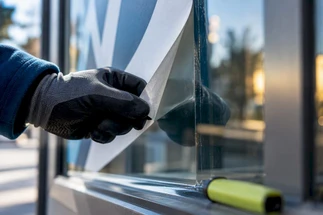
- Before full removal, test a corner first to see how the adhesive responds, then pull at the angle appropriate to the film class.
- Use heat carefully when the film calls for it. 3M’s product bulletins note that many ultra-removable films come off best at a high peel angle, while some perforated films need a lower angle, and warm adhesive with a heat gun or hair dryer rather than a torch.
- Call a professional installer if the film has been up past its stated removal window or if the glass is tinted, coated, or otherwise sensitive to heat and solvents.
Peel angle and heat are frequently the deciding factors in a clean removal, according to 3M’s removal bulletin, which is why the technique matters as much as the product you bought.
For leftover residue on glass, a detergent and water soak is the standard low-risk method, and citrus-based removers or manufacturer remover systems handle stubborn spots. Wear gloves and work in a ventilated space when using chemical removers, and always test any solvent on a small hidden area first. If you install a full campaign of graphics at once, test your removal method on one panel before the event ends rather than discovering a problem across every window at once. For truck or vehicle lettering, a similar clay bar aftercare approach can lift residual adhesive without damaging the surface underneath.

Compliance, placement, and landlord checks before you order
A few permission checks can save you from redoing the whole project. Local sign codes often exempt interior window signs up to a set percentage of window area, but that percentage varies by jurisdiction, so confirm it locally rather than assuming a national rule, per the model sign code. Never let a graphic obscure required exit signage, accessible entry paths, or emergency visibility, since that is a safety issue as much as a design one.
Before you finalize artwork:
- Measure the exact window dimensions and photograph both sides of the glass to document current condition.
- Get landlord or venue sign-off in writing on allowed coverage area, removal expectations, and any approved installer requirement.
- Confirm removal timing and any warranty terms with your supplier so both sides agree on when the graphic comes down.
- Check whether the venue restricts adhesive types, since some trade show halls limit vinyl to specific removable classes.
Why fast turnaround and installation support matter for event buyers
Event timelines rarely leave room for a second attempt. Ordering from a supplier that ships fast, most Arrowhead products go out within two business days, means a spec mistake gets caught and corrected instead of discovered on install day. That margin matters more than picking the fanciest specialty film when your event date is fixed. When time is genuinely tight, a quick-ship option beats a premium custom film you cannot get in hand before the show opens. Prioritize proofing accuracy, the correct removal class, and installer support over chasing a marginally better material, especially on a compressed timeline.
— Dan
Get your window graphics ordered and ready to install
Once you know your removal window and film class, ordering is the easy part. Custom window lettering and graphics are available with fast fulfillment on most items, including options for direct delivery to venues locally and nationwide shipping.
If your booth or storefront campaign needs more than window graphics, a few related products round out the display:
- The 10 ft stretch fabric display works as a backdrop when your window graphics are part of a larger booth setup.
- The Signicade Deluxe A-Frame Sidewalk Sign pairs well with storefront window promotions to catch foot traffic outside.
- The Outdoor Banner Frame, the Banner Bar, gives you an outdoor placement option near entrances when window space runs out.
Request a proof, specify your removal class and window on the order, and choose a quick-ship option if your event date is close. You can start with Printed Banners, where a standard banner layout runs $35 and Next Day Air is available for $10 when you need the order in hand fast.
Sources
Verify your film choice and local rules with primary sources:
- Windows & Glass Applications - Graphics & Signage | 3M United States
- Vinyl film properties — Sign Research Foundation
FAQ
What does “removable” actually mean on a window decal?
“Removable” is not one standard. 3M splits adhesives into four categories: ultra removable, removable with heat, removable with heat and/or chemicals, and not removable. Always ask your supplier which category your film falls into and confirm the intended removal window before you order.
How long can a removable window decal stay up?
The removal window depends on the adhesive class and how much sun and heat the glass gets, so it should be specified at order time rather than assumed. Manufacturer bulletins recommend matching the film to a stated timeframe, such as 30 or 90 days, to avoid adhesive bonding harder than expected.
Will removing a window decal damage the glass or leave residue?
Clean removal depends on peel angle, heat, and how promptly you remove the film within its rated window, according to 3M’s surface preparation guidance. Leftover adhesive typically responds to a detergent and water soak or a manufacturer remover system rather than scraping, which risks scratching glass or damaging tint.
Do I need a permit for temporary window graphics on my storefront?
Many jurisdictions exempt interior window signs up to a set percentage of window area, but that limit varies locally, so check your municipal sign code before installing, per the model sign code. Also confirm with your landlord or venue in writing, since lease terms sometimes add restrictions beyond the local code.
How fast can I get custom removable window decals for an event?
Turnaround depends on the supplier and whether you choose a stock quick-ship size or a fully custom proof. Arrowhead Sign Company ships most products within two business days, with Next Day Air available for $10 through Printed Banners when your event date is close.