

Branded Signage for Sponsored Events: 2026 Guide
Posted by Deeder Dandenhorf on Jun 17th 2026
Branded Signage for Sponsored Events: 2026 Guide
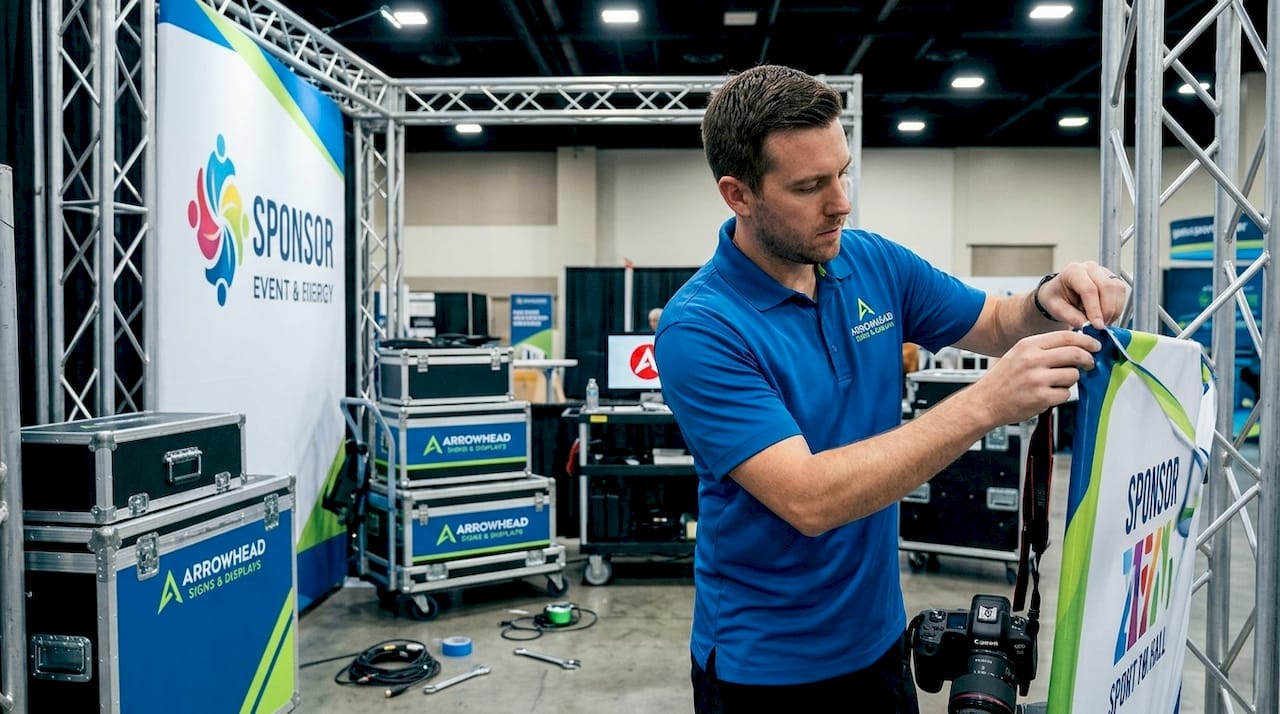
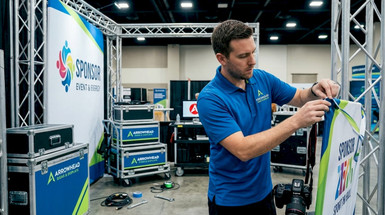
Branded signage for sponsored events is the strategic use of custom visual displays designed to maximize sponsor recognition, guide attendee behavior, and create measurable brand impressions across physical and digital spaces. Event sponsorship signage serves three distinct functions: directional, informational, and experiential. Each function drives a different kind of engagement, and the most effective event programs use all three in combination. Whether you are organizing a regional trade show or a national conference, the quality and placement of your sponsored event displays directly determines how much value sponsors receive from their investment.
What types of branded signage are most effective for sponsored events?
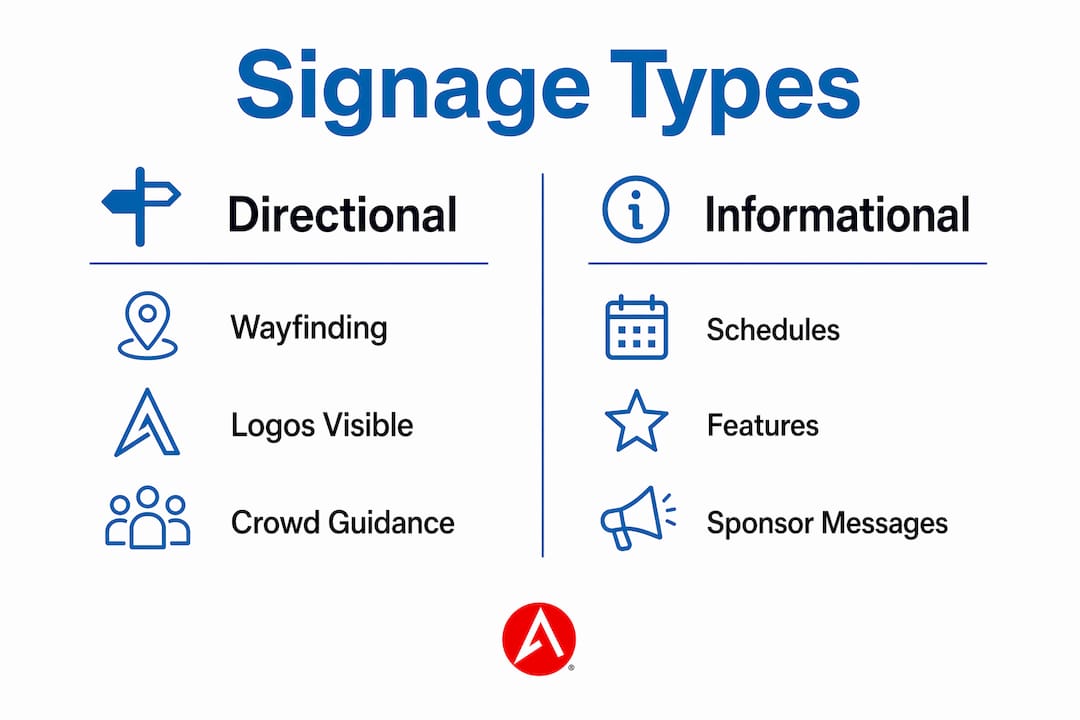
Sponsor signage at trade shows and sponsored events serves directional, informational, and experiential functions to maximize exposure during attendee navigation and engagement. Understanding each category helps you allocate budget and space more precisely.
Directional signage guides attendees through the venue while placing sponsor logos at every decision point. A wayfinding sign at a hallway junction does double duty: it solves a navigation problem and delivers a brand impression at the exact moment an attendee is paying attention. Strategic navigation signage is one of the most underutilized branding opportunities in event marketing, because it builds positive brand association by solving a real attendee problem.
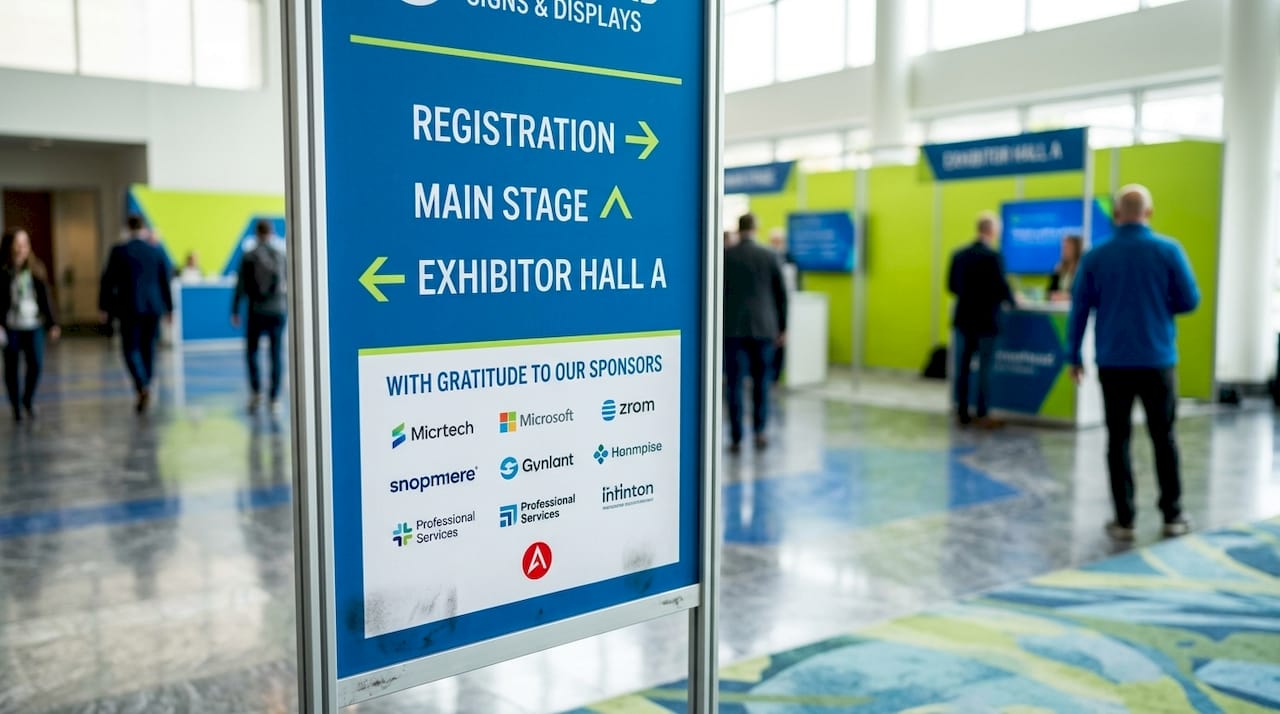
Informational signage communicates sponsor value propositions, product features, and event schedules. This category includes pull-up banners, tabletop displays, and printed panels positioned within the booth footprint. The messaging hierarchy matters here. Your primary claim should be the largest text element, with supporting details scaled down proportionally.
Experiential signage is where branded event graphics generate the longest reach. Photo backdrops and step-and-repeat walls turn attendees into brand ambassadors. Position sponsor logos 5 to 6 feet from the ground, use non-reflective fabric, and include social handles or hashtags so every photo shared online carries the sponsor’s identity. This means a single well-designed backdrop can generate hundreds of organic brand impressions long after the event ends.
Beyond format, vertical presence is non-negotiable in crowded venues. Inline booths rely on vertical back-walls; island booths benefit from hanging signs that are visible from across the floor. Crowd blocking at floor level limits visibility, so designing for overhead sightlines ensures consistent sponsor presence throughout the event day.
- Directional signage: wayfinding panels, floor graphics, hanging arrows at entry points
- Informational signage: retractable banners, tension fabric displays, tabletop stands
- Experiential signage: step-and-repeat backdrops, photo walls, branded tents
- Overhead signage: hanging signs, ceiling banners, suspended frames for island booths
- Digital integration: QR codes, hashtag panels, social media handle callouts
Pro Tip: Use matte fabric tension displays instead of glossy vinyl for backdrops. Matte finishes photograph cleanly under event lighting and eliminate the glare that washes out logos in photos shared on social media.
What venue requirements and compliance issues must you consider?
Venue compliance is the most overlooked phase of event sponsorship signage planning, and skipping it creates expensive last-minute problems. Every major convention center and conference venue has its own set of rules governing what you can hang, how high it can go, and who is authorized to install it.
Here is a practical sequence for managing venue requirements:
- Request the exhibitor services manual early. Most venues publish this document 6 to 12 months before the event. It contains ceiling height limits, rigging restrictions, and the contact information for the official general contractor.
- Submit structural drawings for hanging signs. Large trade show venues require exhibitors requesting hanging signs to submit structural drawings for approval. The 2026 ALA Annual Conference, for example, requires booth size and structure height to be submitted for review before fabrication begins.
- Confirm booth configuration permissions. Inline booths typically cannot use hanging signs at all. Island booths above a certain square footage unlock overhead rigging rights. Know your configuration before you design.
- Coordinate with the official contractor. Most venues require that rigging and installation be performed by their designated contractor, not your own crew. Budget for this labor cost from the start.
- Build in a compliance review window. Approval workflows for hanging signs can take two to four weeks. Treating height and installation as an afterthought causes fabrication delays and, in some cases, forces you to leave signage at home.
Sponsorship exclusivity adds another layer of complexity. Exclusive sponsorship agreements may require the removal or covering of competitor signage during events. At the 2026 FIFA World Cup, non-FIFA sponsor logos at AT&T Stadium were covered to enforce clean-site policies. This is not an edge case. Major sporting events, music festivals, and corporate conferences increasingly enforce exclusivity windows that affect permanent venue signage.
The practical solution is a dual-layer signage plan. Design your primary display for normal event conditions, then prepare a secondary layer of compliant graphics that can be applied quickly if exclusivity rules require covering or replacing existing elements. This approach protects your sponsor’s visibility without requiring a full redesign under pressure.
How to design branded signage that stands out and aligns with sponsor goals
Effective design for sponsored event displays starts with a single principle: consistent visual language and messaging hierarchy enhance brand recall more reliably than creative novelty. Attendees process signage in seconds. Your design must communicate the sponsor’s core identity before a viewer consciously decides to read it.
The comparison below shows how material and format choices affect performance across key criteria:
| Signage format | Visibility in crowds | Photography performance | Setup speed | Best use case |
|---|---|---|---|---|
| Retractable banner stand | Moderate | Good with matte print | Under 5 minutes | Booth perimeter, registration areas |
| Tension fabric display | High | Excellent, wrinkle-resistant | 15 to 30 minutes | Back walls, large format branding |
| Hanging sign (overhead) | Very high | Good from distance | Requires rigging crew | Island booths, main hall presence |
| Step-and-repeat backdrop | High | Excellent for photos | 20 to 40 minutes | Photo opportunities, press areas |
| Custom printed tent | Very high outdoors | Good in natural light | 30 to 60 minutes | Outdoor festivals, entry points |
Color and contrast choices directly affect readability under event lighting. High-contrast palettes, such as dark backgrounds with light text, outperform low-contrast combinations in both ambient and directional lighting conditions. Avoid metallic finishes on large panels because they create glare under overhead fluorescents.
Social media integration belongs in the design brief from day one. Signage must be designed for both physical attendees and camera lenses to maximize brand recall across physical and digital spaces. Include the sponsor’s Instagram handle, a campaign hashtag, or a QR code that links to a landing page. These elements cost nothing to add at the design stage and generate measurable digital impressions after the event.
ADA compliance is a professional obligation, not an optional upgrade. Text on informational panels should meet minimum size and contrast standards. Directional signage should be mounted at heights accessible to attendees using wheelchairs. Venues that enforce ADA standards will flag non-compliant installations during setup, which creates delays you cannot afford.
Pro Tip: When designing for a pop-up display, keep the sponsor’s primary logo and tagline within the top 40% of the display. Crowds, tables, and equipment frequently obscure the lower half of floor-level signage.
What are the best practices for installation and maintenance of branded signage?
Execution quality determines whether your design investment translates into actual sponsor visibility. The best-designed custom event banners fail when installation is rushed, poorly coordinated, or timed incorrectly.
- Start the signage timeline at least 8 weeks out. This window accommodates approval workflows, fabrication, shipping, and contingency time for revisions. Signage planning must start early to accommodate approvals and fabrication. Treating installation as a final-week task is the single most common cause of signage failures at sponsored events.
- Conduct a site walk before installation day. Visit the venue or review detailed floor plans to identify sightline obstructions, lighting positions, and rigging points. What looks clear on a floor plan may be blocked by structural columns or competing displays in reality.
- Schedule installation during off-peak hours. Most venues allow exhibitor access during designated move-in windows. Installing signage before the hall fills with competing booths gives your team unobstructed access and reduces the risk of damage.
- Assign a dedicated signage monitor during the event. Retractable banners tip over. Fabric displays shift. Outdoor signage faces wind and weather. Designate one person to walk the signage footprint at regular intervals and address any issues before they affect sponsor visibility.
- Document everything with photos before and after. Pre-installation photos confirm placement and condition. Post-event photos provide proof of performance for sponsor reporting and serve as a reference for future events.
- Evaluate signage performance after the event closes. Review which placements generated the most foot traffic, which formats held up best, and whether any sightlines were missed. This debrief directly improves your next event’s signage plan.
For events with outdoor components, promotional backdrop displays and custom tents require additional anchoring and weather-resistant materials. Wind ratings and stake requirements vary by venue and local regulations, so confirm these details with the venue coordinator before fabrication.
Key takeaways
Branded signage for sponsored events delivers maximum sponsor value when design, compliance, and installation are treated as a single integrated plan rather than three separate tasks.
| Point | Details |
|---|---|
| Use all three signage functions | Combine directional, informational, and experiential formats to cover every attendee touchpoint. |
| Start compliance early | Submit structural drawings and approval requests at least 8 weeks before the event to avoid fabrication delays. |
| Design for cameras, not just crowds | Use matte finishes, position logos at 5 to 6 feet, and include social handles to generate digital impressions. |
| Plan for exclusivity rules | Build a dual-layer signage plan so you can adapt quickly if clean-site policies require covering existing graphics. |
| Assign a signage monitor on-site | One dedicated person walking the signage footprint during the event prevents visibility failures from going unaddressed. |
Why signage is the most undervalued asset in your sponsorship program
I have worked with event organizers who spend months negotiating sponsorship packages and then treat signage as a line item to cut when budgets tighten. That is a mistake I see repeated constantly, and it costs sponsors real money.
The most impactful shift I have seen in sponsored event branding is treating signage as a storytelling tool rather than a logo placement exercise. A step-and-repeat backdrop is not just a photo opportunity. It is a controlled brand environment where every image shared on social media carries the sponsor’s identity into feeds and networks the event itself never reaches. That is earned media with a one-time production cost.
The compliance piece is where I see the most avoidable damage. Organizers who discover venue rigging restrictions two weeks before an event are forced to downgrade from hanging signs to floor-level displays, which lose visibility in crowds almost immediately. The fix is not complicated. It is simply starting the approval conversation earlier than feels necessary.
One more thing worth saying directly: brand signage consistency across multiple locations or event dates requires operational discipline, not just good design files. The organizations that maintain consistent sponsor branding across a full event season are the ones that have standardized their approval workflows, material specs, and installation checklists. That infrastructure is what separates a one-time success from a repeatable program.
— Dan
Get your sponsored event signage ready fast
Arrowhead Sign Company - Signs, Banners and Trade Show Displays offers custom retractable banners, pop-up signs, tension fabric displays, and custom printed tents built specifically for trade shows and sponsored events. Most products ship within two business days, which means tight event deadlines do not have to compromise your sponsor’s visibility. The team at Arrowhead Sign Company also provides direct delivery to venues across Arizona, removing one more logistical variable from your event plan. If you are ready to see what the right signage can do for your next sponsored event, explore the full range of trade show display options and find the format that fits your booth configuration and sponsor goals.
FAQ
What is branded signage for sponsored events?
Branded signage for sponsored events refers to custom visual displays, including banners, backdrops, and hanging signs, designed to maximize sponsor recognition and attendee engagement at trade shows, conferences, and live events.
How early should you start planning event sponsorship signage?
Start at least 8 weeks before the event. Large venues require structural drawings and approval workflows for hanging signs, and fabrication timelines add additional lead time beyond the approval process.
What signage format works best in crowded trade show halls?
Overhead hanging signs and tall tension fabric back-walls provide the most reliable visibility in crowded halls, because floor-level signage is frequently blocked by attendees and competing displays.
How do exclusivity agreements affect your signage plan?
Exclusive sponsorship deals can require covering or removing non-sponsor logos during the event window. Building a dual-layer signage plan in advance lets you adapt quickly without a full redesign.
What design elements make event signage photograph well?
Matte fabric finishes, high-contrast color palettes, and logos positioned 5 to 6 feet from the ground all improve how signage appears in photos shared on social media, extending sponsor reach beyond the physical event.