

Table Cover Sizes: A Quick Reference and Ordering Checklist
Posted by Deeder Dandenhorf on Aug 27th 2026
Table Cover Sizes: A Quick Reference and Ordering Checklist
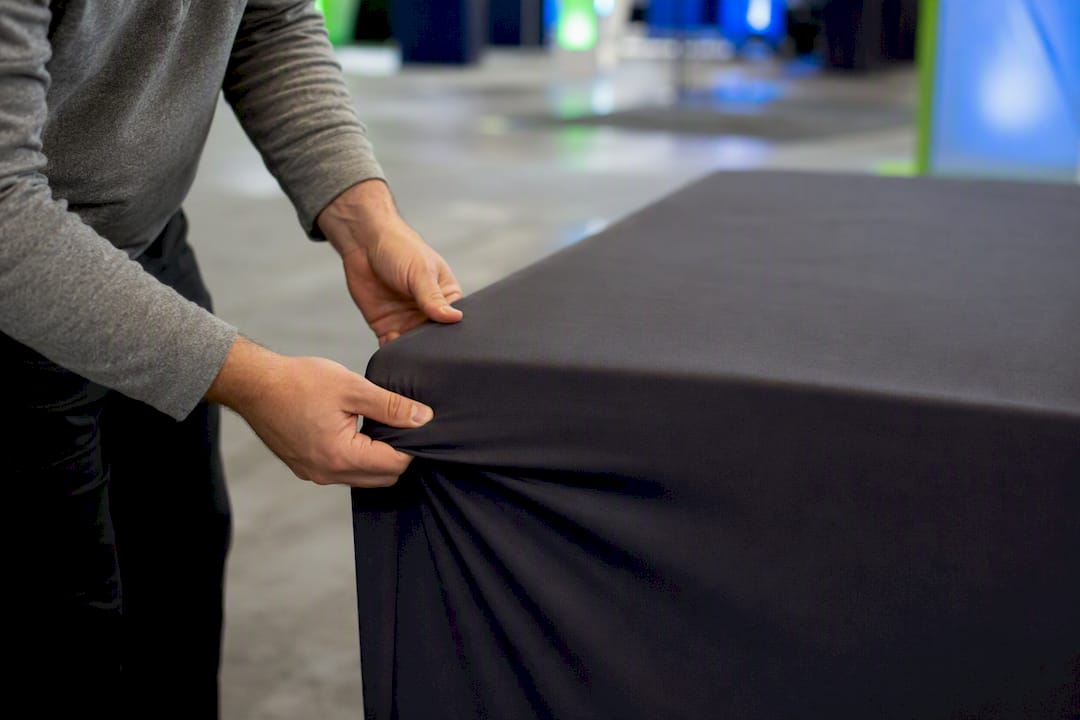
Most trade-show tables need one of three finished cover sizes: a 4-foot cover for 48-inch tables, a 6-foot cover for 72-inch tables, or an 8-foot cover for 96-inch tables, with counter-height and cocktail tables needing their own shorter or taller versions. Before you order anything, measure your table’s length, width, and height (the “drop”) yourself, then pick a fit style, throw, fitted, or stretch, based on whether you need to hide storage underneath or want a tailored, boxed look.
TL;DR:
- Accurate measurement of table length, width, and height is crucial to ensure a proper fit and avoid gaps or damage during the event.
- Standard table sizes emphasize 6-foot and 8-foot tables, but European and custom tables often require specific measurements for a correct fit.
- Throw, fitted, and stretch covers serve different needs, with throws offering flexibility and storage concealment, while fitted and stretch covers provide a professional look with precise sizing.
- Fabric choice impacts durability and appearance, especially after repeated use and transportation, with polyester and stretch blends being popular options.
- Custom sizing options are available for non-standard tables and configurations, requiring exact measurements and professional print files to prevent fit issues.
Table of Contents
- Standard Trade-Show Table Sizes at a Glance
- How Do You Measure a Table for a Cover?
- Throw, Fitted, or Stretch: Which Fit Style Fits Your Booth?
- Which Materials Hold Up Best at Trade Shows?
- What Should You Send When Ordering a Custom Table Cover?
- Do UK and European Table Sizes Match US Standards?
- Can You Get a Table Cover Made to a Custom Size?
- What Sizing Mistakes Do Exhibitors Make Most Often?
- How Do You Keep a Table Cover Fitting Well Over Time?
- Why This Sizing Guide Reflects Real Trade-Show Conditions
- How Arrowhead Sign Company Gets Your Booth Cover-Ready Fast
- Sources
- FAQ
Standard Trade-Show Table Sizes at a Glance
Trade-show tables come in a handful of standard footprints, and knowing them saves you from ordering a cover that puddles on the floor or rides up like a tarp stretched over a boat. Most convention centers and hotel venues rent tables built to the same handful of specs, but “standard” still has room for surprises. A 6-foot table typically measures 72 inches long, 30 inches wide, and 29 inches tall, and an 8-foot table runs 96 inches long at the same 30-inch width and 29-inch height, according to the sizing standards used across the custom table cover industry. Those two numbers, 72 and 96 inches, are the backbone of nearly every table cover size chart you’ll find.
Here’s how the common tabletop sizes translate into finished cover dimensions and fit style:
| Table Size | Tabletop Dimensions (L x W x H) | Common Finished Cover Size | Best Fit Style |
|---|---|---|---|
| 4 ft | 48" x 24" x 29" | 48" x 24" x 29" throw or fitted | Throw or fitted |
| 6 ft | 72" x 30" x 29" | 72" x 30" x 29" throw, fitted, or stretch | Any style |
| 8 ft | 96" x 30" x 29" | 96" x 30" x 29" throw, fitted, or stretch | Fitted or stretch for a tailored look |
| Counter height | Varies, often 42"-45" tall | Custom height, matched to venue | Fitted or stretch |
The height figure matters as much as length. Standard folding tables sit at 29 inches, but counter-height and cocktail tables run taller, and a cover sized for a standard table will look shrunken or oddly cropped on one of those. Most promotional table covers are built around 4, 6, and 8-foot folding tables specifically, so if your venue supplies something unusual, confirming actual dimensions before you place an order is the one step that prevents almost every fit complaint we hear about.
How Do You Measure a Table for a Cover?
Getting an accurate measurement takes about five minutes and a tape measure, but skipping it is the single most common reason a cover doesn’t fit right. Work through these steps before you finalize any order:
- Measure the length. Run your tape along the longest side of the tabletop, edge to edge, and round to the nearest half inch.
- Measure the width or depth. Measure front to back across the shorter side, again edge to edge, not including any overhang or lip.
- Measure the height. Stand your tape at the floor and measure straight up to the tabletop surface. This is your “drop” if you want a floor-length cover.
- Decide your drop length. Floor-length drops hide everything underneath; partial drops (mid-thigh height) show table legs but use less fabric; front-only covers skip the sides and back entirely.
- Account for booth placement. A table against a back wall usually only needs front and side coverage, while a table sitting in the open, surrounded by traffic on all sides, calls for full coverage on every side.
- Check the edges and legs. Note whether the table has rounded or squared corners, where the legs and support braces sit, and whether you’re joining two tables end to end, since that changes your total length.
Throw, Fitted, or Stretch: Which Fit Style Fits Your Booth?
The three main fit styles solve different problems, and the right pick usually comes down to what you’re hiding underneath the table and how polished you need the booth to look.
- Throw (draped) covers hang loose over all sides and are the most forgiving option. They’re easy to use across slightly different table sizes, they hide boxes, bags, and extra inventory underneath, and they work well for registration desks or multi-event use where the exact table isn’t guaranteed. The tradeoff is a softer, less structured look.
- Fitted covers are sewn to box-like corners and require your exact table dimensions to look right. They give a sharp, professional silhouette that suits corporate booths where clean lines and logo alignment matter more than storage access.
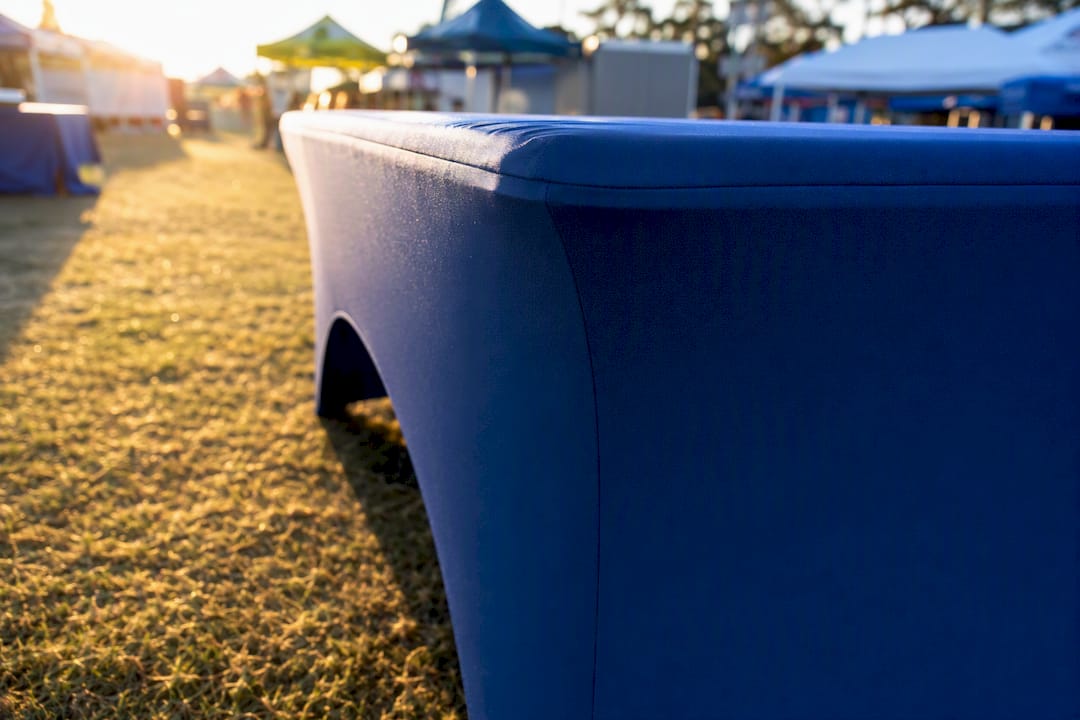
- Stretch (contour) covers pull tight over a form, resist wrinkling, and hold their shape in wind or high foot traffic, making them a strong choice for outdoor activations. They demand precise sizing and careful artwork alignment since the fabric stretches slightly during installation.
Storage need is the deciding factor for most exhibitors: if you’re stashing extra brochures or a cooler under the table, a throw solves that instantly, while fitted and stretch covers assume you’ve planned storage elsewhere. Transport also plays a role. Throws pack down small but may need steaming on arrival, while fitted and stretch covers travel with less wrinkling but take up more room folded.
Pro Tip: If you exhibit at multiple venues with tables that vary slightly in size, a slightly oversized throw (say, an 8-foot cover used on a 6-foot table) is more forgiving than a fitted or stretch cover, which has almost no margin for error once it’s cut and sewn.
Which Materials Hold Up Best at Trade Shows?
Fabric choice affects how your booth looks after four hours of setup, foot traffic, and HVAC vents blowing across your table. Standard polyester is the workhorse of the industry: affordable, durable, and easy to print on, but it tends to wrinkle in transit and often needs a quick steam before doors open. Heavier options like 600D polyester resist abrasion better and hold up to repeated setup and teardown without looking worn.
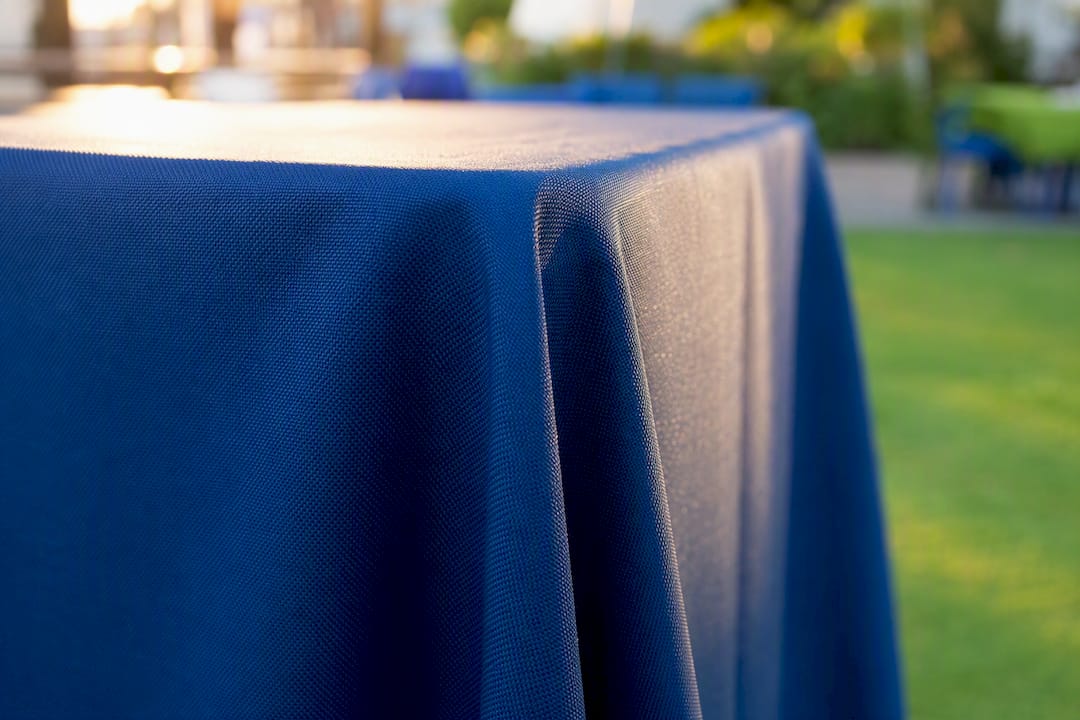
Stretch and spandex blends are the better call for outdoor events or anywhere wind is a factor, since stretch polyester is wrinkle-resistant and stays put even when a breeze catches it, while a classic polyester throw is more likely to shift or need re-steaming mid-event.
A few care habits protect your investment:
- Roll covers instead of folding them tightly to reduce deep creases.
- Store covers in a garment bag or box away from direct sunlight to prevent fading.
- Avoid stacking printed covers face-to-face while damp, which can transfer dye between panels.
- Steam classic polyester before each event rather than ironing directly, since direct heat can distort printed graphics.
What Should You Send When Ordering a Custom Table Cover?
Getting your artwork print-ready the first time saves you a reprint and a missed deadline. Work through this checklist before you submit anything:
- Submit exact measurements. Provide your table’s length, width, and height, plus your chosen drop style, so the print template matches your actual table.
- Request a template or dieline. A cover-specific template shows you exactly where seams, corners, and fold lines fall.
- Build in bleed and a safe area. Keep critical logos and text at least 2 to 3 inches from any edge or seam, since fitted and stretch covers shift slightly during installation.
- Send vector or high-resolution files. Vector files (AI, EPS, PDF) scale cleanly at any size; if you’re using a raster file, send a high-resolution TIFF or PNG, not a web-sized JPEG.
- Confirm your color mode. Specify CMYK values or Pantone matches for brand colors, since RGB files can shift noticeably once printed.
- Approve a digital proof. Never skip this step, especially on full-wrap or stretch covers where a small placement error becomes obvious once the fabric is under tension.
- Ask about turnaround. If you’re ordering close to your event date, rapid fulfillment can be the difference between a finished booth and a bare table.
Do UK and European Table Sizes Match US Standards?
International exhibitors run into a genuine sizing mismatch, and it catches a lot of first-time overseas exhibitors off guard. UK and European trade-show tables are typically specified in metric measurements, and the most common sizes, roughly 1.8 meters and 2.4 meters long, correspond loosely but not exactly to US 6-foot and 8-foot tables. The width often runs narrower too, closer to 68 to 75 centimeters instead of the US standard 30 inches (about 76 centimeters).
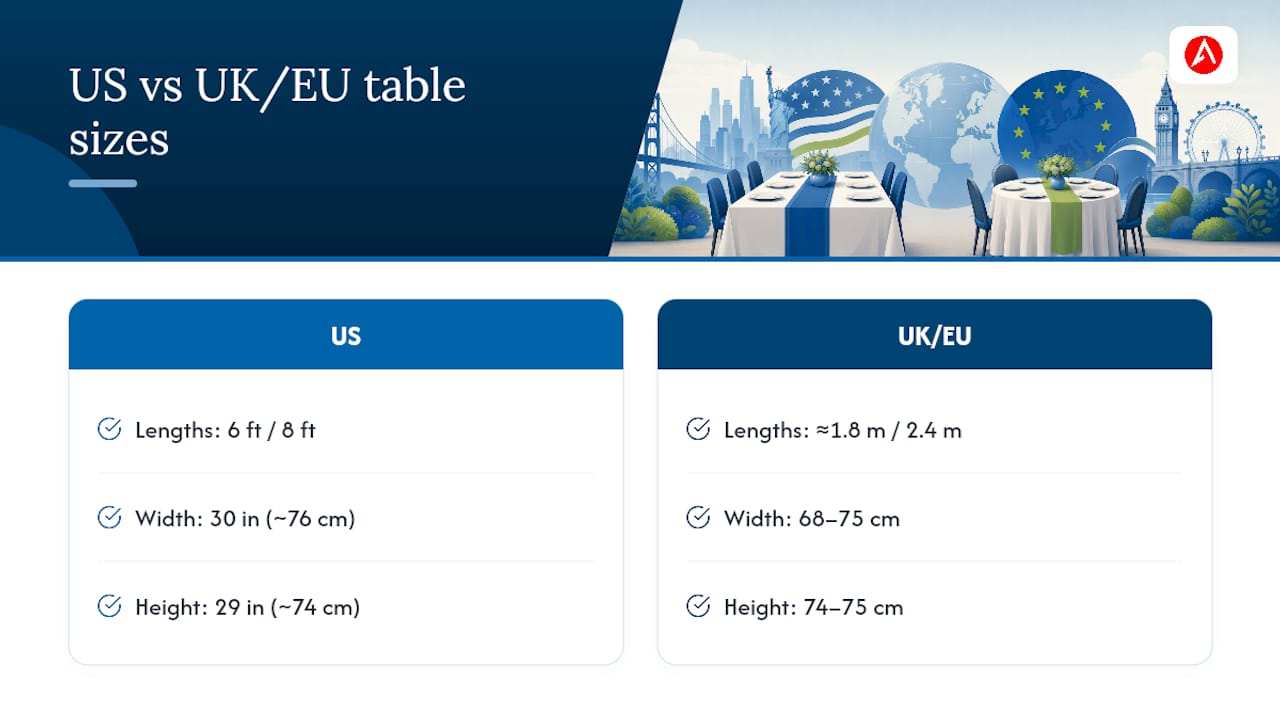
That small width difference matters more than it sounds. A US-sized 8-foot cover made for a 96-inch by 30-inch table can look loose or uneven on a European table that’s slightly narrower or a few centimeters shorter. Height standards vary as well; many European venue tables sit closer to 74 to 75 centimeters (about 29 to 29.5 inches), which happens to align closely with the US 29-inch standard, but it’s still worth confirming rather than assuming.
If you’re exhibiting internationally or working with a venue outside the US, request the table specifications directly from the show organizer before ordering, and give those exact centimeter or inch measurements to whoever prints your cover. A cover cut for a US-standard 8-foot table will not automatically translate to a European “8-foot equivalent” table, and the two-to-three-centimeter differences that seem minor on paper become visible gaps or overhangs once the cover is installed.
Can You Get a Table Cover Made to a Custom Size?
Standard 4, 6, and 8-foot covers handle most bookings, but plenty of real-world tables don’t match those numbers exactly. Folding tables from certain manufacturers run slightly shorter or narrower than the “standard” dimensions, counter-height tables vary widely between venues, and some exhibitors use two tables pushed together to form an L-shape or an extended run that no off-the-shelf cover fits.
Custom sizing solves that gap by building the cover to your table’s exact length, width, and height rather than the nearest standard size. This matters most for fitted and stretch styles, where even a two-inch mismatch shows up as a visible pucker or a gap at the corner. Throw-style covers have more built-in tolerance, but a custom cut still produces a cleaner drop and avoids the excess pooling you get from stretching a generic size over an odd-shaped table.
Custom tailoring also covers less common needs: L-shaped table configurations, cocktail and bar-height tables, ADA-compliant lower tables, and multi-panel covers for joined tables where a seam needs to land in a specific spot rather than wherever a standard template puts it. If your booth uses anything other than a single standard folding table, ask whoever is printing your cover whether they offer true custom sizing rather than a “one-size-fits-most” stretch option, since the difference shows up the moment the cover is installed under show lighting.
What Sizing Mistakes Do Exhibitors Make Most Often?
The most common mistake is ordering based on the table’s marketed size rather than its actual measured dimensions. A table sold as “6 foot” can vary by an inch or two between manufacturers, and that small gap is enough to leave a fitted cover gapping at the corners or straining at the seams.
A second frequent error is ignoring height. Buyers measure length and width carefully, then guess at the drop, and end up with a cover that either drags on the floor or stops well above it, exposing storage bins they meant to hide. Always measure straight up from the floor to the tabletop surface rather than eyeballing it.
Booth placement causes a third mistake: ordering a front-only or three-sided cover for a table that ends up positioned in an open, high-traffic aisle where all four sides are visible. Confirm your booth layout with the show organizer before deciding on coverage, not after your cover arrives.
Finally, exhibitors sometimes order a fitted or stretch cover without accounting for joined tables. Two 6-foot tables pushed together don’t behave like a single 12-foot table when it comes to seams and structure, and a cover designed for one continuous table will bunch or gap at the join. Flagging that detail when you order avoids a last-minute scramble.
How Do You Keep a Table Cover Fitting Well Over Time?
A well-made cover should hold its shape through dozens of events if you handle it correctly between shows. Wash according to the care label rather than defaulting to hot water, since heat can shrink polyester blends slightly and turn a once-perfect fitted cover snug in the wrong way. Air dry or use low heat, since high-heat drying is the single most common cause of shrinkage complaints.
Store covers rolled, not folded, whenever storage space allows. Folding creates permanent crease lines, especially in stretch fabrics, and repeated folding along the same lines eventually weakens the fabric at those points. If folding is unavoidable, vary the fold lines each time you pack the cover away.
Reapply steam heat carefully rather than pressing an iron directly onto printed graphics, which can distort ink or cause discoloration over repeated exposure. For stretch covers specifically, avoid overstretching during installation; forcing a cover onto a form that’s even slightly larger than intended puts strain on the seams and shortens the cover’s useful life. A cover that’s handled consistently across events should maintain its fit for years, not just a season or two.
Why This Sizing Guide Reflects Real Trade-Show Conditions
Dan, who covers signage and display topics for Arrowhead Sign Company - Signs, Banners and Trade Show Displays, built this guide around the sizing questions that come up most often from exhibitors placing real orders, not hypothetical scenarios. Arrowhead Sign Company - Signs, Banners and Trade Show Displays ships most products within two business days, which means sizing mistakes caught early can usually still be corrected before a show date. The company’s product range, including three-sided table covers built for tables positioned against a wall, reflects the same booth-placement logic covered above.
Customers who’ve ordered through the company consistently point to fast turnaround and responsive service as reasons they reorder for future events, which matters most when a booth confirmation comes in later than planned and there’s little room for a shipping delay.
— Dan
How Arrowhead Sign Company Gets Your Booth Cover-Ready Fast
Arrowhead Sign Company - Signs, Banners and Trade Show Displays skips the guesswork that comes with generic online cover shops. Because most orders ship within two business days, you can measure your table today and have a correctly sized, custom-printed cover in hand before your next show, whether you need a fitted style for a polished corporate look or a stretch cover built for an outdoor activation.
Beyond table covers, Arrowhead Sign Company - Signs, Banners and Trade Show Displays carries the pieces that round out a complete booth setup. Pair your cover with the 10 ft stretch fabric display for a matching modern backdrop, add the Outdoor Banner Frame from The Banner Bar for outdoor events that need durable, wind-ready hardware, or place a Signicade Deluxe A-Frame Sidewalk Sign near the entrance to pull foot traffic toward your table. For readers still finalizing their overall booth layout, this 3-sided table cover guide walks through coverage decisions in more depth.
Have your measurements ready? Request a proof or reach out to the sales team through Arrowheadsigncompany to get your custom table cover sized, printed, and shipped in time for your next event.
Sources
- Custom Table Covers: The Complete Guide To Fitted, Stretch & Throw-Style Designs | Canvas ETC
- Trade show table covers material types, sizes & care — Visigraph
- Trade Show Table Covers Guide: Sizes, Materials & Printing Tips — PromotionChoice
FAQ
What Is the Standard Size for an 8-Foot Table Cover?
A standard 8-foot table cover is sized for a 96-inch long, 30-inch wide, 29-inch tall tabletop, matching the most common 8-foot trade-show table dimensions.
What’s the Difference Between a 6ft and 8ft Tablecloth?
A 6-foot cover fits a 72-inch table, while an 8-foot cover fits a 96-inch table; both share the same 30-inch width and 29-inch height on standard folding tables.
How Do I Measure My Table Before Ordering a Cover?
Measure the length along the longest edge, the width front to back, and the height from the floor to the tabletop surface, then choose your drop length based on those numbers.
Should I Choose a Throw, Fitted, or Stretch Table Cover?
Choose a throw if you need to hide storage underneath, a fitted cover for a sharp corporate look, or a stretch cover for outdoor events and high-traffic booths.
Can Arrowhead Sign Company Make a Custom-Sized Table Cover?
Yes, Arrowhead Sign Company - Signs, Banners and Trade Show Displays produces custom-sized table covers for non-standard tables, joined tables, and counter-height setups, with most orders shipping within two business days.
Recommended
- 3-Sided Table Covers: A Trade Show Buyer’s Guide - Arrowhead Sign Company
- Press Conference Backdrop: Size and Order Guide for Events - Arrowhead Sign Company
- How Exhibitors Choose Banner Heights: Quick Sizing Guide - Arrowhead Sign Company
- Quick Turnaround Banner Printing Guide for Events - Arrowhead Sign Company