


Types of Event Directional Signage: A Planner's Guide
Posted by Deeder Dandenhorf on Jul 15th 2026
Types of Event Directional Signage: A Planner’s Guide

Event directional signage is defined as any sign system that guides attendees through a venue, from arrival to exit, without confusion or delay. The industry term for this practice is wayfinding, and it covers four functional categories: directional, informational, identification, and regulatory signs. 83% of modern event organizers use digital signage for real-time updates and branding consistency. That number reflects how seriously professionals now treat navigation as part of the attendee experience. Whether you are planning a trade show, corporate expo, or outdoor festival, understanding the types of event directional signage available gives you a real advantage in creating smooth, confident attendee flow. Arrowhead Sign Company - Signs, Banners and Trade Show Displays offers a full range of customizable wayfinding products built for exactly these situations.
1. What are the main types of event directional signage?
Directional signage guides attendees to key locations such as registration desks, breakout rooms, and exits, reducing congestion and delays. That function makes it the backbone of any event navigation system. The five most common physical and digital forms are:
- Printed arrow signs and directional panels. These are the workhorses of event wayfinding. Bold arrows on foam board, coroplast, or PVC panels mount to walls, stands, or stanchions. They are affordable, fast to produce, and easy to reposition.
- Digital screens and dynamic displays. Digital screens provide easy-to-change content but depend on power and content management systems. Ideal placements include lobbies and session transition areas where schedules shift throughout the day.
- Hanging banners and overhead signs. Suspended from ceiling rigging or truss systems, these signs offer visibility from far away in large convention halls. They work best in venues with high ceilings and open floor plans.
- Floor decals and vinyl graphics. Floor decals direct foot traffic naturally because attendees look down when navigating crowds. They wear out in heavy traffic, so durable laminated vinyl is the right material for multi-day events.
- ADA-compliant wayfinding signs. These signs meet federal accessibility standards and serve attendees with visual or mobility impairments. They are not optional at public events.
Pro Tip: Print a small version of your venue map directly on each directional panel. Attendees who pick up a sign can orient themselves instantly without hunting for a separate map station.
2. How to choose the right signage type based on event size
Event size and venue layout determine which wayfinding signs work best. A small corporate meeting in a single hotel ballroom needs very different signage than a 500-booth trade show floor.
- Small to medium events (under 500 attendees). Printed arrow signs and A-frame sidewalk signs handle most navigation needs. They are fast to set up, easy to move, and cost-effective for single-day events.
- Large expos and trade shows. Hanging banners and digital screens become necessary when attendee volume creates visual noise at ground level. Overhead signs cut through the crowd because they are visible from 50 feet away.
- Outdoor events. Weather-resistant materials like aluminum composite panels or UV-printed vinyl banners on sturdy frames hold up against wind and sun. Indoor-only materials like foam board fail quickly outside.
- Multi-day conferences. Digital screens pay off here because session schedules change daily. Updating a screen takes seconds; reprinting a panel takes hours.
- Venues with complex layouts. Multi-level convention centers or sprawling outdoor grounds require layered signage: arrival signs at entrances, floor directories at elevator banks, and booth-level graphics at decision points.
The role of signage in event flow is directly tied to how well the sign type matches the venue. Choosing the wrong format creates bottlenecks even when the content is correct.
3. How ADA compliance shapes directional signage design

ADA-compliant wayfinding signage requires tactile characters and Braille for room identification signs, while directional signs must meet visual accessibility standards for character height and contrast. These are not the same requirement, and confusing them leads to compliance gaps.
Key ADA design rules for event signage include:
- Tactile text and Braille are required on permanent room identification signs, not on temporary directional arrows. Knowing this distinction saves budget.
- Character height and contrast. Letters must be sized for the viewing distance. High-contrast color combinations, such as black text on white or white text on dark backgrounds, meet the standard.
- Non-glare finishes. Glossy surfaces create reflections that make signs unreadable for people with low vision. Matte laminate is the correct finish for ADA signs.
- Floor markings and vinyl wall graphics serve as complementary accessibility features, guiding attendees who use mobility aids along clear, unobstructed paths.
- Mounting height. Permanent signs must be mounted with the centerline at 60 inches above the floor. Temporary event signs follow the same guideline as best practice.
Communication barriers from conventional signage can exclude attendees with visual impairments. Building accessibility into your signage plan from the start avoids last-minute fixes and protects your event from liability.
Pro Tip: Walk your venue layout with a colleague who covers their eyes for 10 seconds at each decision point. If they cannot quickly orient themselves when they open their eyes, your signage needs more contrast or a lower mounting position.
4. Comparing directional signage types: features and limitations
Each signage format has a specific strength and a specific weakness. Matching the format to the situation is the core skill in event wayfinding design.
| Signage Type | Visibility | Cost | Installation | Adaptability | Best For |
|---|---|---|---|---|---|
| Printed arrow panels | Medium | Low | Simple | Low | Small events, single-day use |
| Hanging banners | High | Medium | Requires rigging | Low | Large halls, trade shows |
| Floor decals | Low to medium | Low | Very simple | Low | Crowd flow, short events |
| Digital screens | High | High | Requires power | Very high | Multi-day, schedule-heavy events |
| A-frame sidewalk signs | Medium | Low | Instant | High | Entrances, outdoor use |
| Vinyl wall graphics | Medium | Medium | Moderate | Low | Permanent or semi-permanent venues |
Hanging banners offer high visibility but require ceiling rigging, while floor decals direct movement naturally though they wear out in heavy traffic. Digital screens solve the adaptability problem but add cost and a dependency on power infrastructure. For most trade shows and expos, the right answer is a combination of two or three formats rather than a single solution. Printed panels handle the detail work; hanging banners handle the long-distance navigation; and A-frames handle the entrance and outdoor cues.
For outdoor events specifically, outdoor signage best practices recommend wind-rated frames and UV-stable inks as non-negotiable requirements. A banner that collapses or fades by noon on day one creates exactly the confusion you are trying to prevent.
5. Best practices for integrating directional signage into a wayfinding system
Effective event wayfinding combines high-level maps, mid-level directories, and low-level graphics with layered signage types to reduce attendee hesitation and improve flow. Placement at decision points like entrances, intersections, and registration areas is critical. That layered approach is what separates a professional event from one where attendees constantly stop to ask for directions.
- Establish a consistent design language. Consistent branding and visual hierarchy improve readability and reduce attendee confusion. Use the same font, color palette, and arrow style across every sign type in your system.
- Place signs at every decision point. A decision point is any location where an attendee must choose a direction: venue entrance, lobby intersection, elevator bank, stairwell, and session room corridor.
- Layer your signage types. Start with arrival signs at parking and drop-off zones. Add lobby directories for the full venue overview. Then use booth-level graphics and floor decals to guide the final 50 feet to a destination.
- Use color-coding for zones or tracks. Assign a color to each section of your event, such as blue for registration, green for sessions, and orange for exhibitors. Repeat that color on every sign in that zone.
- Keep messaging short. Three words or fewer per directional sign is the standard. “Registration This Way” works. A full sentence does not.
- Test before the event opens. Walk the venue as a first-time attendee. Start at the parking lot entrance and navigate to three different destinations. Every point where you hesitate is a gap in your signage system.
Understanding how event signage is installed before your setup day prevents last-minute surprises with rigging, adhesives, or mounting hardware.
Key takeaways
The most effective event wayfinding system layers printed panels, hanging banners, floor decals, and ADA-compliant signs at every decision point in the venue.
| Point | Details |
|---|---|
| Four signage categories | Every event needs directional, informational, identification, and regulatory signs working together. |
| Match format to venue size | Small events use printed panels; large trade shows need hanging banners and digital screens. |
| ADA compliance is required | Tactile characters, high contrast, and non-glare finishes are mandatory for accessible events. |
| Layer signage types | Combine arrival signs, lobby directories, and booth-level graphics for complete attendee coverage. |
| Test before doors open | Walk the venue as an attendee to find every gap in your signage system before guests arrive. |
What I have learned from watching signage fail at real events
The most common mistake I see event organizers make is treating directional signage as an afterthought. They spend months on programming, catering, and booth design, then order signs two days before the event. The result is a mismatched collection of fonts and sizes that confuses more than it guides.
The second mistake is placing signs only where the organizer knows the answer, not where the attendee asks the question. A sign pointing to registration belongs at the parking lot exit, not just inside the lobby. By the time an attendee is inside, they have already been confused for 90 seconds.
I have also watched organizers skip the walk-test entirely. They trust the floor plan instead of their own feet. Walking the venue as a first-time visitor reveals gaps that no spreadsheet will catch. One missed turn at a stairwell can send 200 people in the wrong direction for an entire morning.
The best wayfinding systems I have seen share one quality: they feel invisible. Attendees move through the space without stopping to think about navigation. That outcome requires deliberate planning, consistent design, and the right mix of sign types for the venue. It is not complicated, but it does require attention before the event, not during it.
— Dan
Signage solutions for your next event from Arrowhead Sign Company
Planning the right mix of directional signs is only half the work. Getting them produced, delivered, and ready on time is the other half.
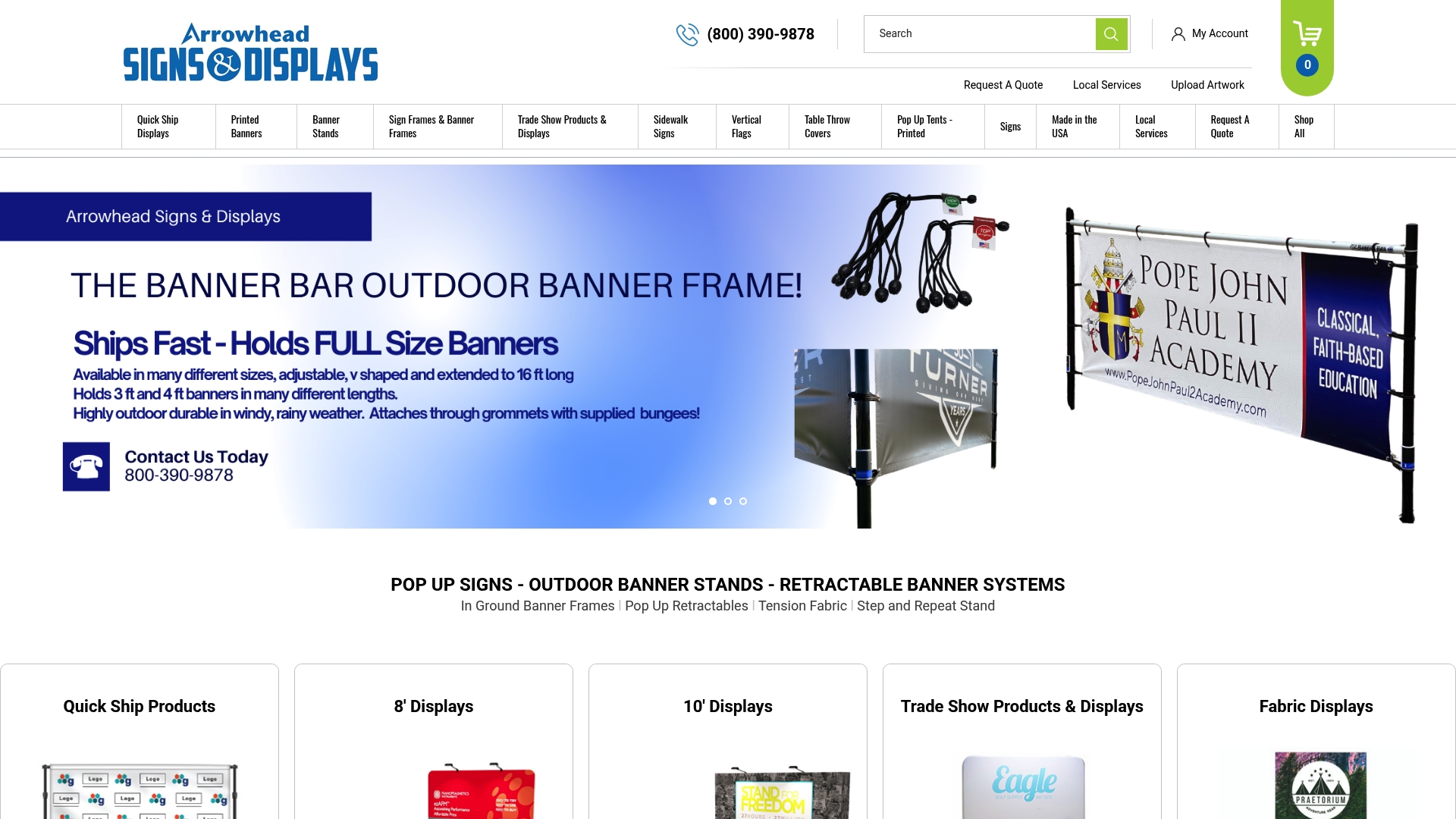
Arrowhead Sign Company - Signs, Banners and Trade Show Displays offers a full range of event signage products built for trade shows, expos, and corporate events. From portable A-frame sidewalk signs for entrance cues to adjustable outdoor banner frames for high-visibility directional displays, every product ships within two business days. Arizona-based clients also receive direct venue delivery. Browse the full catalog of custom event signage solutions and get your wayfinding system ready before your next event opens its doors.
FAQ
What is event directional signage?
Event directional signage is any sign that guides attendees to specific locations within a venue, such as registration, session rooms, restrooms, or exits. It is one of four core event signage categories, alongside informational, identification, and regulatory signs.
What types of wayfinding signs work best at trade shows?
Hanging banners and printed directional panels work best at trade shows because they handle both long-distance and close-range navigation. Digital screens add value for multi-day events where schedules change frequently.
Are directional signs required to be ADA-compliant?
Directional signs must meet visual accessibility standards for character height and contrast under ADA guidelines, though tactile Braille is required only on permanent room identification signs. Non-glare finishes and high-contrast color combinations are best practice for all event directional signs.
How many directional signs does an event need?
Every decision point in the venue requires at least one directional sign. A decision point is any location where an attendee must choose a direction, including entrances, lobby intersections, elevator banks, and corridor junctions.
How far in advance should event signage be ordered?
Ordering signage at least one to two weeks before the event date allows time for production, shipping, and a walk-test of the venue layout. Arrowhead Sign Company - Signs, Banners and Trade Show Displays ships most products within two business days for organizers working on tighter timelines.
Recommended
- The Role of Signage in Event Flow: A Planner’s Guide - Arrowhead Sign Company
- How Event Signage Is Installed: A Practical Guide - Arrowhead Sign Company
- How the Custom Sign Ordering Process Works for Events - Arrowhead Sign Company
- Outdoor Event Signage Best Practices for 2026 - Arrowhead Sign Company