


How the Custom Sign Ordering Process Works for Events
Posted by Deeder Dandenhorf on Jul 8th 2026
How the Custom Sign Ordering Process Works for Events

The custom sign ordering process is a defined sequence of steps that takes your signage from concept to finished product ready for trade shows, expos, and events. Understanding each phase prevents costly delays, rush fees, and last-minute surprises on the show floor. Industry standards recommend starting 8–10 weeks before your event date, with artwork approved no later than four weeks out. Arrowhead Sign Company - Signs, Banners and Trade Show Displays works with small business owners and event planners every day to move through this process efficiently, often shipping finished products within two business days.
What are the key steps in the custom sign ordering process?
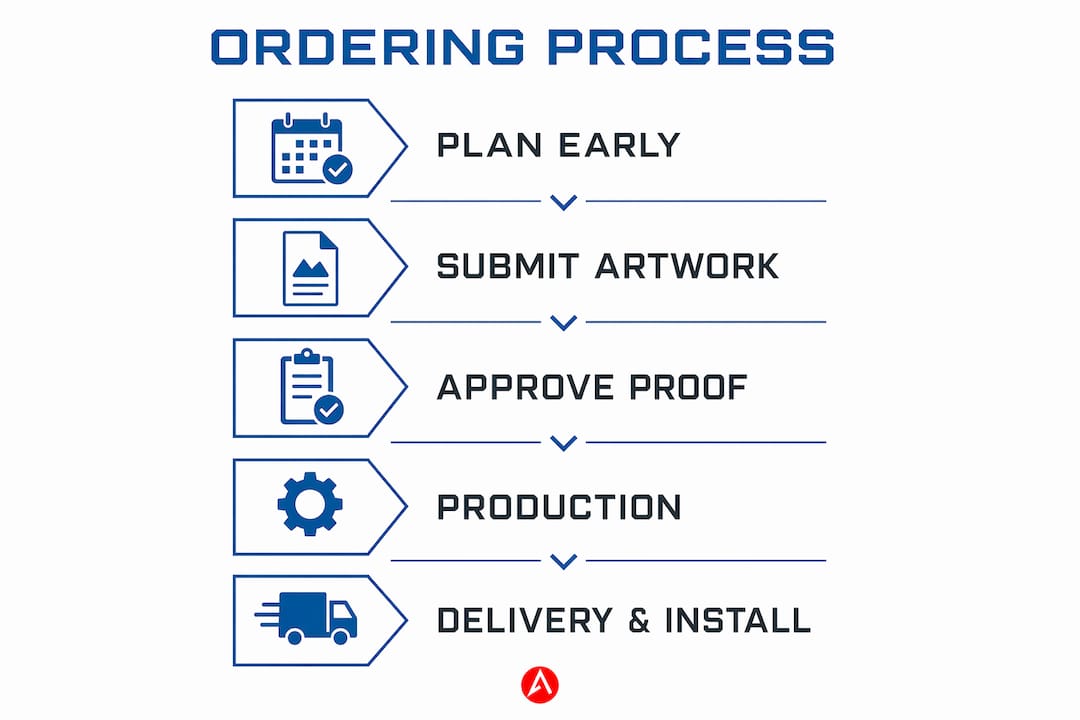
The custom sign ordering process follows five distinct phases. Each one builds on the last, and skipping any step creates problems downstream.
-
Needs assessment. Define what you need before contacting any supplier. Identify the number of signs, their purpose (wayfinding, branding, product promotion), and where they will be placed. A retractable banner stand at a booth entrance serves a different function than a large backdrop behind a presenter. Knowing your goals shapes every decision that follows.
-
Design and artwork creation. This phase covers either uploading your existing artwork or working with a designer to create it. Suppliers require files in specific formats, typically vector-based files like AI or EPS, or high-resolution PDFs at 300 DPI or higher. Color specifications matter here too. Print colors use the CMYK color model, not the RGB model used on screens. Submitting RGB files often produces colors that look noticeably different in print.
-
Proof review and approval. Once artwork is submitted, the supplier generates a digital proof. Digital proofs simulate the finished product accurately and give you the chance to catch errors before production begins. Review every element carefully: spelling, logo placement, color accuracy, and bleed margins. Approving a proof triggers production, so treat this step seriously. Errors caught after approval can require reprinting at full cost.
-
Production scheduling. After approval, your order enters the production queue. Standard lead times vary by product complexity. Simple vinyl banners may print in one to two days. Multi-piece fabric displays or custom pop-up structures take longer. Arrowhead Sign Company - Signs, Banners and Trade Show Displays ships most standard products within two business days of proof approval, which gives planners a reliable benchmark for scheduling.
-
Delivery and coordination. The final step aligns your shipment with your event setup window. Staged delivery and careful packaging keep all components together and reduce onsite delays. Confirm your delivery address, contact person, and any venue receiving restrictions before the order ships.
Pro Tip: Request your digital proof within 24 hours of submitting artwork. The faster you approve it, the more buffer time you have before your event.
How do timelines and scheduling impact custom sign ordering?

Timing is the single biggest variable in the custom sign ordering guide. Get it right and you have options. Get it wrong and you pay for it.
The recommended starting point for any custom signage order is 8–10 weeks before your event. That window gives you time to refine your design, request revisions, and still hit standard production timelines without pressure. Artwork approval should happen no later than four weeks before the event date. Missing that deadline pushes your order into rush territory.
Rush orders carry a significant price premium. Rush production typically costs 50–100% more than standard rates, and that figure does not include expedited shipping fees on top. A $400 banner order can become an $800 order overnight when rush fees apply. That premium also does not guarantee the same quality. Complex, multi-piece installations often cannot be expedited without compromising quality, meaning rush production is only realistic for simpler items like single-panel banners or basic A-frame signs.
Late changes compound the problem. Revising artwork after a proof is approved restarts the clock. Even a minor logo adjustment can add one to two days to your timeline. If you are within three weeks of your event, that delay may be unrecoverable without paying rush fees.
Key scheduling checkpoints to track:
-
8–10 weeks out: Confirm signage needs, quantities, and placement locations
-
6–7 weeks out: Submit final artwork for proof generation
-
4–5 weeks out: Approve proof and confirm production start
-
2–3 weeks out: Confirm shipping address and delivery window
-
1 week out: Verify all components have shipped and track delivery
Planning for installation time is also part of the timeline. Venue setup windows are fixed. If your signs arrive the morning of the event, you may not have time to inspect, assemble, and position everything correctly. Build in at least one full day between delivery and your setup deadline.
What factors should you consider when selecting sign materials?
Material selection directly affects how your signage performs, how long it lasts, and what it costs. The right choice depends on where the sign will be used and for how long.
Indoor vs. outdoor use
Indoor signs tolerate lighter materials because they face no weather exposure. Fabric displays, foam board, and vinyl banners work well in controlled environments. Outdoor signs need materials that resist UV fading, moisture, and wind load. Durable, fire-rated materials are required for indoor public venues, and many outdoor venues have their own material standards. Check venue requirements before finalizing your material choice.
Finishing options and their impact
Laminates and coatings extend the life of printed graphics and affect visual quality. A gloss laminate intensifies color saturation and works well for product photography. A matte laminate reduces glare under bright event lighting, which makes it better for text-heavy signs. Anti-scratch coatings protect high-touch surfaces like countertop displays. Finishing options like laminates impact both durability and visual quality, so they are worth discussing with your supplier before production begins.
| Material type | Best use | Key consideration |
|---|---|---|
| Stretch fabric | Indoor backdrops, pop-up displays | Wrinkle-resistant, vibrant color output |
| Vinyl banner | Indoor and outdoor banners | Durable, cost-effective, wide format |
| Foam board | Indoor tabletop and wall signs | Lightweight, not weather-resistant |
| Corrugated plastic | Outdoor directional signs | Affordable, moderate durability |
| Rigid aluminum | Long-term outdoor signage | High durability, higher cost |
Pro Tip: Ask your supplier for a material sample before approving large orders. Seeing and touching the substrate in person prevents surprises when the finished signs arrive.
Material choice also affects lead time. Specialty substrates or custom-cut shapes require additional processing steps. If your timeline is tight, stick to standard materials that your supplier stocks and prints regularly. For outdoor event signage, reviewing best practices for 2026 helps you match material specs to current venue and weather conditions.
What venue and installation considerations must be integrated in the sign ordering process?
Venue rules shape your signage decisions more than most planners expect. Ignoring them creates problems that no amount of great printing can fix.
Many trade show venues and convention centers require external contractors to submit documentation before they can work onsite. Venue rules often require certificates of insurance and labor approval forms by specific deadlines. Missing those deadlines can result in denied access or last-minute labor costs that far exceed the original installation budget.
Key venue and installation factors to address early:
-
EAC (Exhibitor Appointed Contractor) forms: Submit these to the venue well in advance. Most venues have a cutoff date, often two to three weeks before the event.
-
Union labor rules: Some convention centers require union labor for installation tasks above a certain height or weight. Know this before you plan your display structure.
-
Permits for outdoor signage: Temporary outdoor signs may require local permits depending on size and placement. Confirm this with the venue coordinator.
-
Packaging and component labeling: Staged delivery and proper packaging keep all components together and match the installation sequence. Label every box clearly with booth number, component name, and assembly order.
-
Onsite inspection: Professional installation includes inspecting graphics upon arrival, preparing surfaces, applying elements in a planned sequence, and completing a final punch-list before the show opens.
Working with a supplier that understands installation logistics reduces coordination errors. Arrowhead Sign Company - Signs, Banners and Trade Show Displays offers direct delivery to venues in Arizona, which simplifies the receiving and inspection process for local clients. For a detailed look at what professional installation involves, the event signage installation guide covers the full sequence from arrival to final placement.
Key Takeaways
The custom sign ordering process succeeds when you start early, approve artwork on time, match materials to your venue, and coordinate delivery with your installation window.
| Point | Details |
|---|---|
| Start 8–10 weeks out | Early planning gives you time for revisions and avoids rush fees. |
| Approve artwork by week four | Proof approval triggers production; delays here push costs up significantly. |
| Match materials to environment | Indoor and outdoor venues require different substrates, finishes, and fire ratings. |
| Submit venue paperwork early | EAC forms and insurance certificates have hard deadlines that affect site access. |
| Coordinate delivery with setup | Confirm shipping details and build in at least one day before your setup window closes. |
What I’ve learned from watching planners get this wrong
The most common mistake I see is treating signage as a last-minute task. Planners spend months on booth layout, product demos, and staff training, then order signs two weeks before the show. That decision forces rush fees, limits material options, and removes any room for error on the proof. The signs that arrive are often fine, but they could have been great with three more weeks.
The second mistake is underestimating venue compliance. I have seen exhibitors show up with a full display system only to learn that their installer did not submit the required EAC paperwork. The venue would not allow the contractor onsite. The exhibitor spent the first morning of the show scrambling to find union labor at premium rates. That situation is entirely avoidable with a simple checklist and a two-week head start on paperwork.
Working with a single trusted supplier simplifies the whole process. Single-source suppliers manage design, materials, printing, and delivery together, which reduces the coordination gaps that cause errors. When one vendor owns the full process, there is no finger-pointing between a designer and a printer when colors come out wrong.
For small businesses managing tight budgets, the math is simple. Paying standard rates for well-planned signage costs far less than paying rush premiums for the same product. Start earlier than you think you need to. The process rewards preparation every time.
— Dan
Signage solutions from Arrowhead Sign Company - Signs, Banners and Trade Show Displays
Arrowhead Sign Company - Signs, Banners and Trade Show Displays carries a full range of products built for trade show and event use, from retractable banner stands and outdoor banner frames to custom printed tents and pop-up displays. Every product is designed to meet the demands of real event environments, not just look good in a catalog photo.
For exhibitors who need a high-impact booth presence, the 10 ft stretch fabric display delivers vibrant, wrinkle-free graphics that set up in minutes. Most orders ship within two business days, and Arizona clients receive direct venue delivery. Whether you are planning your first trade show or your fiftieth, Arrowhead Sign Company - Signs, Banners and Trade Show Displays has the products and experience to get your signage done right and on time.
FAQ
How early should I start the custom sign ordering process?
Start at least 8–10 weeks before your event. That window allows time for design revisions, proof approval, standard production, and shipping without rush fees.
What happens if I miss the artwork approval deadline?
Missing the four-week artwork approval deadline typically triggers rush production fees of 50–100% above standard rates, plus expedited shipping costs. Complex displays may not be eligible for rush production at all.
What file format should I submit for custom sign artwork?
Submit vector files (AI or EPS) or high-resolution PDFs at 300 DPI minimum. Use CMYK color mode, not RGB, to get accurate print colors.
Do I need to submit paperwork to the venue before my signs are installed?
Most trade show venues require EAC forms and certificates of insurance from external installers before granting site access. Missing these deadlines can result in denied access or forced use of on-site union labor at premium rates.
Can I order signs for a trade show if I only have two weeks until the event?
Two weeks is possible for simpler products like vinyl banners or A-frame signs, but expect to pay rush premiums. Multi-piece displays and fabric structures typically cannot be produced and shipped in that window without quality trade-offs.
Recommended
-
How Event Signage Is Installed: A Practical Guide - Arrowhead Sign Company
-
The Role of Signage in Event Flow: A Planner’s Guide - Arrowhead Sign Company
-
Quick Turnaround Banner Printing Guide for Events - Arrowhead Sign Company
-
Branded Signage for Sponsored Events: 2026 Guide - Arrowhead Sign Company