


Versioning Promotional Materials Across Regional Markets
Posted by Deeder Dandenhorf on Aug 4th 2026
Versioning Promotional Materials Across Regional Markets

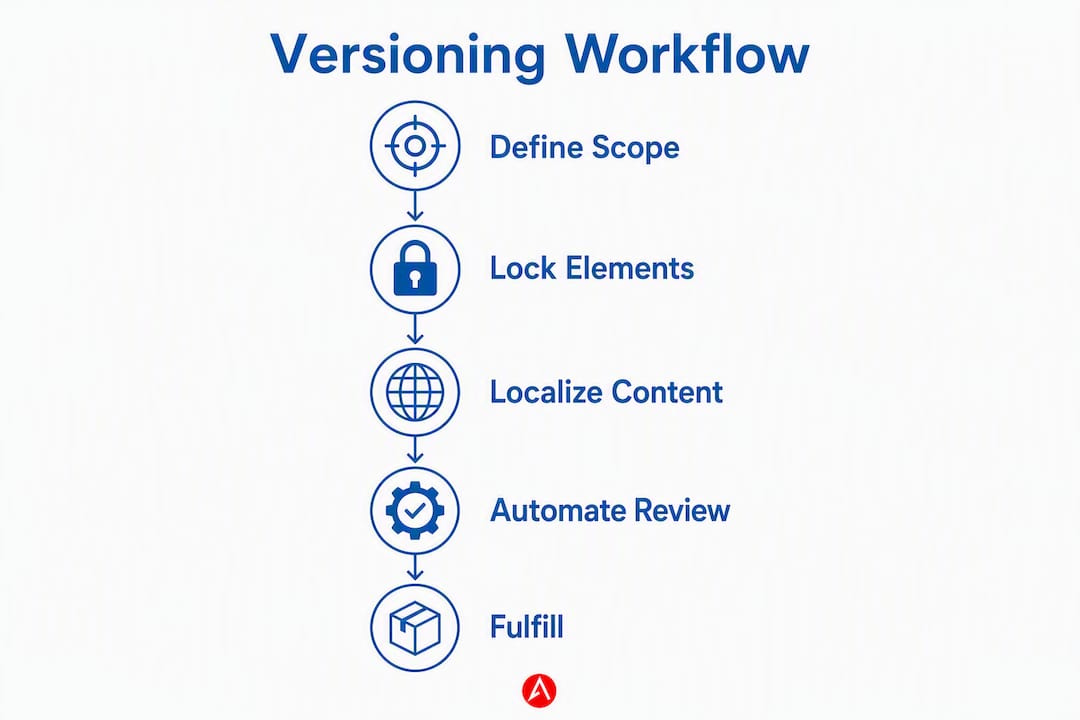
The most effective approach to versioning promotional materials across regional markets is a template-first model: lock your brand elements, define scoped editable fields for each market, and route changes through a risk-based review that automates low-risk updates while reserving manual sign-off for anything that touches claims, imagery, or compliance copy. That combination gives you speed without sacrificing brand safety.
Your three-action starter checklist:
- Create a per-market spec row listing language, legal disclosures, offer text, and channel specs before any creative work begins.
- Lock logo treatment, core typography, and primary color palettes in your master template so regional teams can only touch approved fields.
- Enable mandatory compliance fields in your web-to-print or DAM platform so no version can be submitted without required market-specific legal copy.
Table of Contents
- What versioning promotional materials actually means
- Why regional versioning drives real business outcomes
- Which versioning model fits your campaign?
- What to lock and what to leave flexible in your creative
- How to build a governance workflow that doesn’t slow you down
- Which platforms support versioning at scale?
- How to reduce cost and lead time for regional print and signage
- Your per-market brief template
- How to test and measure whether local variants actually work
- Common mistakes and compliance traps to avoid
- How Arrowhead Sign Company supports rapid regional versioning
- Key Takeaways
- When to centralize and when to hand off control
- Fast, fulfillment-ready signage for every regional campaign
- Selected sources and further reading
What versioning promotional materials actually means
In marketing operations, “versioning” refers to the systematic production of local variants from a single master asset. You change specific elements (language, imagery, pricing, legal supers, or packaging details) while keeping everything else identical. The industry term for this at scale is multi-market versioning, and it sits between two extremes: a single global asset used everywhere, and fully bespoke creative built from scratch for every market.
The practical difference matters for how you budget and staff:
- Multi-market versioning: One master plus controlled deviations. Regional teams swap approved fields. Fast, cost-efficient, brand-safe.
- Full per-market localization: Entirely new creative per market. High relevance, high cost, slow to produce.
Most North American marketing teams operate somewhere in the middle. A retail chain might run a national campaign with regional price swaps on in-store posters. A trade show exhibitor might use one backwall design with venue-specific imagery and booth numbers swapped per city. A regional franchise might run the same outdoor banner frame with a localized offer and phone number per location.
Why regional versioning drives real business outcomes

Local relevance converts. When a promotional asset reflects the right price, the right offer, and the right visual context for a specific market, it performs better than a generic national version. Decentralized ordering and manual approval bottlenecks are among the most common reasons localized marketing fails at scale, producing inconsistent branding and excess inventory.
KPIs worth tracking across your versioned campaigns:
- Time-to-market: Days from brief submission to in-market asset delivery.
- Per-version cost: Setup fees plus print unit cost plus fulfillment, divided by total versions.
- Local CTR and conversion lift: Compare localized variants against the national master in the same period.
- Error and recall rate: Number of assets pulled back due to non-compliant content.
- Exception rate: How many versions required manual review outside the automated workflow.
Pro Tip: Track both speed (days to fulfillment) and risk (number of exceptions requiring manual review) together. A fast workflow that generates frequent compliance exceptions is not actually efficient. Both metrics belong on the same dashboard.
Which versioning model fits your campaign?
The right model depends on campaign complexity, regulatory variability, and how much local autonomy your markets need. Here are the four primary models and when each one makes sense:
-
Centralized (global master only): One asset, no regional variants. Works for brand campaigns with no pricing, no local offers, and no regulatory differences. Fastest to produce, zero version management overhead.
-
Regional (per-region variants): Separate masters per region (e.g., Southwest, Midwest, Northeast). Appropriate when regions have distinct pricing tiers, different regulatory requirements, or meaningfully different audiences. Manageable at two to six regions; complexity grows quickly beyond that.
-
Per-store or per-SKU: Individual variants at the branch or product level. Used by large franchise networks, retailers with location-specific promotions, or exhibitors with unique booth configurations per venue. Requires web-to-print or a DAM with strong variant mapping to stay manageable.
-
Hybrid (locked master + local editable fields): The recommended default for most marketing teams. A locked master preserves brand integrity; scoped editable fields let local teams update copy, pricing, imagery from an approved library, and contact details. Web-to-print portals are built for exactly this model, combining locked templates, controlled personalization, and order tracking in one platform.
Decision criteria at a glance:
| Scenario | Recommended model |
|---|---|
| National brand campaign, no local offers | Centralized |
| 2–6 distinct regional markets | Regional |
| — | Per-store via web-to-print |
| Franchise or multi-location network | Hybrid |
| Time-critical event with local details | Hybrid with automated routing |
What to lock and what to leave flexible in your creative
Locked templates reduce review volume because they make the right choice the easiest choice for regional teams. When brand constraints are built into the template itself, outputs are on-brand by construction rather than by inspection. That shifts your governance effort from policing to enabling.
Lock these elements in every master:
- Logo treatment, size, and clear space
- Core color palette (hex/Pantone values enforced in template)
- Primary typeface and type hierarchy
- Key layout grid and safe zones
- Any claim that has been legally reviewed and approved
Leave these fields editable (within approved parameters):
- Local copy and translated headlines
- Pricing and offer text
- Local imagery selected from an approved asset library
- Contact details, booth numbers, and venue-specific information
- Regulatory supers and legal disclosures (mandatory, market-specific)
Design your masters with clean plates and face-swap-friendly framing so talent swaps and on-screen text changes can be executed without re-rendering the entire asset. Failing to plan for swaps at the shoot stage is one of the most common reasons multi-market projects go over budget.
| Do | Don’t |
|---|---|
| Leave negative space for translated supers | Embed legal copy in rasterized background photos |
| Use a modular grid with a dedicated offer plate | Lock pricing into the hero image layer |
| Frame talent with room to crop or swap | Shoot talent in a way that requires full background replacement |
| Build a separate text layer for each market field | Merge all text into a single flattened layer |
| Provide clean plates (background without talent) | Deliver only a composited final with no separable layers |
Pro Tip: Check your print specifications before finalizing your master layout. Banner and signage sizes vary by channel, and a master built to the wrong dimensions forces costly resizing across every regional version.
How to build a governance workflow that doesn’t slow you down
Risk-based review is the operational core of any versioning program. The goal is to automate everything that doesn’t require human judgment and route only genuine exceptions to a reviewer.
Calibrating review by actual risk means: automate template-compliant text changes, and reserve manual review for image swaps, new claims, or non-approved creative directions.
Risk-based routing matrix:
- Automated approval: Templated text swap within approved fields, price update from approved list, contact detail change, regulatory super from pre-approved library.
- Expedited human review (24-hour SLA): New offer claim not in the approved library, imagery swap using a pre-cleared asset.
- Full legal/brand review (48–72-hour SLA): New talent, unapproved claim, new product category, or any change that touches a legally reviewed statement.
Treat the versioning brief as a formal deliverable, not a casual email. A signed-off table with one row per market, listing explicit fields, makes parallel versioning predictable and auditable. Required brief fields per market row: language, talent direction, packaging notes, regulatory supers, offer text, channel specs, and delivery deadline.
Checklist: does this change need formal sign-off?
- Does it introduce a new claim or modify an existing approved claim? → Yes, full review.
- Does it use talent or imagery not in the approved library? → Yes, expedited review.
- Is it a text swap within a locked template field? → No, automated.
- Does it involve a market with distinct regulatory requirements (e.g., Quebec French, California Prop 65)? → Yes, compliance check.
A quarterly or semiannual operational audit surfaces where guidelines are impractical for local teams and prevents drift. Review actual usage versus guidelines, find workarounds regions rely on, and update your documentation accordingly.
Pro Tip: Partner with a marketing automation agency to set up automated routing rules in your DAM or web-to-print platform. The upfront configuration investment typically pays back within the first major multi-market campaign.
Which platforms support versioning at scale?
The right tech stack depends on your channel mix and the number of markets you manage. These are the core platform types and the capabilities that matter most:
Core platform types:
- DAM (Digital Asset Management): Central library for approved masters, clean plates, and regional variants. Look for rights and expiry tracking, automated notifications when assets need refresh, and variant mapping.
- PIM (Product Information Management): Manages product-level data (pricing, SKUs, specs) that feeds into versioned promotional assets. Critical for retail and e-commerce versioning.
- Web-to-print / brand portal: Gives local managers access to locked templates, controlled personalization, and order and fulfillment tracking. Reduces outdated inventory and unauthorized customizations.
- Versioning modules: Standalone or integrated tools that manage the variant production pipeline, approval routing, and audit trail.
- Production automation: AI-assisted tools that surface affected derivatives after a master update, monitor rights expiry, and generate initial copy variants for human refinement.
Capabilities checklist for vendor evaluation:
- Locked template fields with granular permission controls
- Per-market mandatory fields (cannot submit without completing them)
- Rights and expiry tracking with automated alerts
- Asset variant mapping (which regional versions derive from which master)
- Full audit trail and approval history
- Scalability across the number of markets and SKUs you manage
- Integration between DAM (digital) and web-to-print (physical) for unified ordering
When evaluating platforms, ask vendors specifically: Can regional teams be restricted to approved fields only? Does the system log every change with a timestamp and user ID? Can it trigger a review workflow automatically when a high-risk field is edited?
Effective systems integrate DAM for digital assets and web-to-print for physical items, with search, tagging, permission controls, and fulfillment integration in one workflow.
How to reduce cost and lead time for regional print and signage
Production efficiency for regional signage comes down to four levers: template file readiness, supplier consolidation, on-demand versus bulk printing, and local fulfillment options.

A typical signage order timeline for a multi-market campaign includes stages such as master setup, market customization, proofing, print production, and fulfillment, each requiring a few business days to complete.
On-demand printing through a web-to-print portal eliminates the warehousing cost of pre-printed regional inventory. You only print what you need, when you need it, at the spec the market requires. For trade show exhibitors, this is particularly valuable: each event has unique venue dimensions, booth configurations, and local contact details that make bulk pre-printing wasteful.
Cost considerations worth modeling before you commit to a production approach:
- Per-version setup fees (template customization, prepress)
- Per-unit print cost (varies significantly by material, size, and quantity)
- Shipping and handling to each location or venue
- Warehousing costs for pre-printed inventory versus on-demand waste reduction
Pro Tip: For event-driven regional campaigns, prepare your display materials at least two weeks before the event date. That buffer gives you time to proof regional variants, catch errors, and still meet a two-business-day fulfillment window without paying rush fees.
Your per-market brief template
A brief is only useful if it forces teams to supply exactly the data the production pipeline needs. Here are the required fields for each market row:
Per-market brief fields:
- Market code and region name
- Primary language and any secondary language requirements
- Legal disclosures and regulatory supers (mandatory for that market)
- Offer text and pricing (with currency and expiration date)
- Approved local imagery selections (asset IDs from the DAM library)
- Talent direction (approved talent IDs, usage rights confirmation)
- Channel specs (print size, digital dimensions, OOH format)
- Delivery deadline and fulfillment address or venue
Required attachments checklist:
- Approved master file (latest version with clean plates)
- Packaging assets and product SKU plates if applicable
- Rights clearances for any talent or third-party imagery
- Specification sheets for print sizes and materials
- Translation context document (tone, register, any terms to avoid)
Do/don’t for brief quality:
- Do provide translation context and tone guidance, not just a word-for-word swap request.
- Do include the offer expiration date in the brief so the production team can set asset expiry in the DAM.
- Don’t request “the same ad in every market” without completing per-market fields. Vague briefs force markets to improvise, which is where brand and compliance failures originate.
- Don’t submit a brief without confirmed rights clearances for any imagery or talent you’re requesting.
Structured file names with version, date, and purpose help teams identify current assets quickly and avoid using outdated files. Build your naming convention into the brief template itself.
How to test and measure whether local variants actually work
Testing localized variants requires a different setup than standard A/B testing because market differences can confound results. Here’s how to structure it:
Testing methods by channel:
- Digital (paid social, display, email): Run A/B or multivariate tests with the localized variant against the national master in the same market window. Control for audience segment and spend level.
- In-store and OOH: Use holdout markets. Run the localized version in selected locations and the master in comparable control locations. Measure foot traffic, conversion, and average transaction value.
- Regional offer splits: Test different offer versions across comparable markets (similar demographics, similar store footprints) to isolate the effect of the localized offer versus the creative.
Metrics to track per variant:
- Local CTR versus national master CTR in the same period
- Conversion rate and incremental lift versus the control
- Cost per conversion for the localized versus master version
- Time-to-publish (days from brief submission to live asset)
- Version error rate (assets requiring correction or recall)
Practical testing checklist:
- Confirm sample size is sufficient before reading results. Small markets with low traffic need longer test windows.
- Run tests for at least two to four weeks to account for day-of-week and promotional cycle effects.
- When cross-market differences appear, distinguish between creative effects (the variant itself) and cultural effects (audience behavior differences that exist regardless of creative).
- Document test results in your DAM or campaign management system so future versioning decisions are informed by evidence, not assumption.
Common mistakes and compliance traps to avoid
Most versioning failures are operational, not creative. They happen when the process breaks down, not when the design is wrong.
Common operational pitfalls:
- Missing clean plates: If your master doesn’t include a background-only layer, every talent swap requires a full reshoot or expensive compositing work.
- Unclear naming and versioning: Without structured file names, teams pull outdated assets under deadline pressure. A single naming convention, enforced in the DAM, prevents this.
- Insufficient rights for AI-assisted swaps: If talent agreements don’t explicitly permit AI modifications or digital alterations, you need contractual addenda before those assets enter an automated versioning pipeline.
- Vague briefs: When markets receive incomplete briefs, they improvise. That improvisation is where unauthorized claims, off-brand imagery, and compliance failures originate.
Regulatory guardrails for North American markets:
- Require mandatory compliance fields in every market template. A version cannot be submitted without them.
- Include offer expiration dates in every time-limited promotion and set corresponding asset expiry dates in your DAM.
- Maintain a full audit trail for every claim approval. If a claim is challenged, you need to show who approved it, when, and against which brief.
- For Quebec, French-language requirements under the Charter of the French Language apply to commercial signage and promotional materials. Build a Quebec-specific template variant with French as the primary language field.
- For California, Prop 65 warnings apply to certain product categories. If your campaign covers California locations, include a mandatory Prop 65 field in the California market template.
Pro Tip: Automations that monitor rights expiry and surface at-risk derivatives reduce compliance incidents significantly. Set up expiry alerts at 60 days and 30 days before rights lapse so you have time to renew or swap assets before they go out of market.
How Arrowhead Sign Company supports rapid regional versioning
Here’s what a practical versioning workflow looks like for physical signage, using a trade show backwall as the example.
A marketing team running a national trade show circuit locks the brand elements in their backwall template: logo position, color field, and primary headline. Local fields are scoped to venue imagery (selected from an approved DAM library), booth number, regional contact details, and any show-specific sponsor logos. Each event location submits a brief row with those fields completed. The template generates a print-ready file. Production runs on demand.
With Arrowhead Sign Company - Signs, Banners and Trade Show Displays, most products ship within two business days, and direct venue delivery is available for Arizona events. That fulfillment speed changes the math on regional versioning for physical signage. You don’t need to pre-print and warehouse regional inventory. You brief, customize, and order per event, per market, per deadline.
Products built for rapid regional execution:
- 10 ft stretch fabric display: A fulfillment-ready trade show backwall ideal for template-driven swaps of local imagery, sponsor logos, and event-specific details. The fabric format accepts full-bleed graphics and ships ready to assemble.
- Signicade Deluxe A-Frame Sidewalk Sign: A durable a-frame for regional storefront promotions with quick-change graphics. Swap the printed insert per location to update pricing, offers, or contact details without replacing the hardware.
- Outdoor Banner Frame - The Banner Bar: An adjustable outdoor frame in 6 ft and 8 ft configurations. Regional teams can order a new printed banner per campaign cycle and reuse the frame, reducing per-version hardware cost.
For portable display options across multiple event formats, Arrowhead Sign Company - Signs, Banners and Trade Show Displays also carries retractable banners, pop-up displays, and printed table covers that fit the same template-first workflow.
Key Takeaways
A template-first versioning model with locked brand elements, scoped local fields, and risk-based review delivers the best balance of speed, brand safety, and compliance across regional markets.
| Point | Details |
|---|---|
| Start with a locked template | Lock logo, color, and typography; scope editable fields to copy, pricing, imagery, and compliance supers. |
| Brief as a formal deliverable | One row per market with language, offer text, rights confirmation, channel specs, and delivery deadline. |
| Route by risk, not habit | Automate template-compliant changes; reserve manual review for new claims, image swaps, or unapproved talent. |
| Measure speed and error rate | Track speed and error rate together to assess operational health. |
| Arrowhead Sign Company for fast fulfillment | Ships most signage within two business days, with venue delivery in Arizona and nationwide shipping for event-driven regional campaigns. |
When to centralize and when to hand off control
The conventional advice on versioning tends to land in one of two camps: centralize everything for brand safety, or decentralize everything for local relevance. Both are wrong as absolutes.
Centralize the elements that carry legal, reputational, or brand equity risk. Decentralize the elements that drive local relevance and conversion. The line between those two categories is not fixed. It shifts based on campaign type, market maturity, and regulatory exposure.
A practical threshold: when a market introduces regulatory requirements that differ from the national standard (Quebec French, California Prop 65, state-specific financial disclosures), it needs its own template variant, not just a field swap. When a campaign is time-critical and the market has a strong track record of brief compliance, automate the approval and trust the template constraints. When a market is new to the versioning workflow or has a history of off-brief submissions, add an expedited human review step until the process is established.
The rule of thumb worth keeping: police the template, not the team. If your template is built correctly, regional teams cannot deviate on the elements that matter. That frees your governance effort for the genuinely ambiguous cases, which is where human judgment actually adds value. Working with a local agency partner can help you calibrate that line for markets where you lack in-house regional expertise.
Fast, fulfillment-ready signage for every regional campaign
When your versioning workflow is built and your templates are locked, production speed becomes the last variable. Arrowhead Sign Company - Signs, Banners and Trade Show Displays offers rapid shipping of custom signage with direct venue delivery in Arizona and nationwide shipping for events across the country. That turnaround means you can brief a regional version, customize the template, and have print-ready signage at the venue without pre-printing weeks in advance.
Whether you need a 10 ft stretch fabric display for a trade show backwall, a Signicade Deluxe A-Frame for a regional storefront promotion, or an Outdoor Banner Frame - The Banner Bar for an outdoor event, Arrowhead Sign Company - Signs, Banners and Trade Show Displays has the product range and the fulfillment speed to support your regional campaign calendar. Contact the team at arrowheadsigncompany.com to discuss template setup, custom sizing, and express production for upcoming event deadlines.
Selected sources and further reading
- How DAM Helps Marketing Teams Localize Assets Globally | Orange Logic — Covers template locking, risk-based review, and automation for asset refresh and rights monitoring in multi-market DAM workflows.
- What Is Multi-Market Versioning? | Myth Labs — Defines multi-market versioning, covers brief structure, clean plate design, and production planning for local variants.
- Marketing Asset Management for Multi-Location Businesses | Propago — Comprehensive guide to web-to-print portals, MAM systems, and integrated DAM and fulfillment for franchise and multi-location networks.
- Localize Your Marketing Without Losing Brand Control | Baesman — Explains common failure modes in decentralized localization and how centralized portals with controlled personalization address them.
- 05 Best Practices for Managing Assets in Global Marketing Teams | Ethos — Covers naming conventions, living documentation, and operational audit cycles for global marketing asset management.
- Managing Promotional Content Across Geographies | Vodori — Outlines the global-to-local content model, including how corporate content is disseminated and localized by regional teams.
- The Multi-Location Headache: 5 Ways Web-to-Print Cures Brand Chaos | Vpress — Practical breakdown of how web-to-print platforms solve print procurement, brand consistency, and cost control for multi-site organizations.
Recommended
- Proofing Custom Promotional Signage: A Small Business Guide - Arrowhead Sign Company
- Portable Display Options for Marketing Events: 2026 Guide - Arrowhead Sign Company
- How Exhibitors Prepare Display Materials: Small Team Guide - Arrowhead Sign Company
- Visual Marketing Display Best Practices: 2026 Guide - Arrowhead Sign Company