


Standard Banner Sizes: A 2026 Guide for Marketers
Posted by Deeder Dandenhorf on Jun 28th 2026
Standard Banner Sizes: A 2026 Guide for Marketers

A standard banner size is a set of predetermined dimensions widely accepted in advertising to ensure compatibility, visibility, and cost-effectiveness across platforms and print media. Knowing what is a standard banner size saves you from costly reprints, rejected digital ads, and displays that look wrong at your event. The Interactive Advertising Bureau (IAB) governs digital banner standards, while print production norms are shaped by equipment roll widths and stand compatibility. Whether you are running a Google Display Network campaign or setting up a trade show booth, the right dimensions determine whether your message lands or gets ignored.
What are the most common standard banner sizes?
Standard banner sizes fall into two categories: digital and print. Each category has a core set of dimensions that the industry has adopted for practical reasons, not arbitrary ones.
Digital banner dimensions
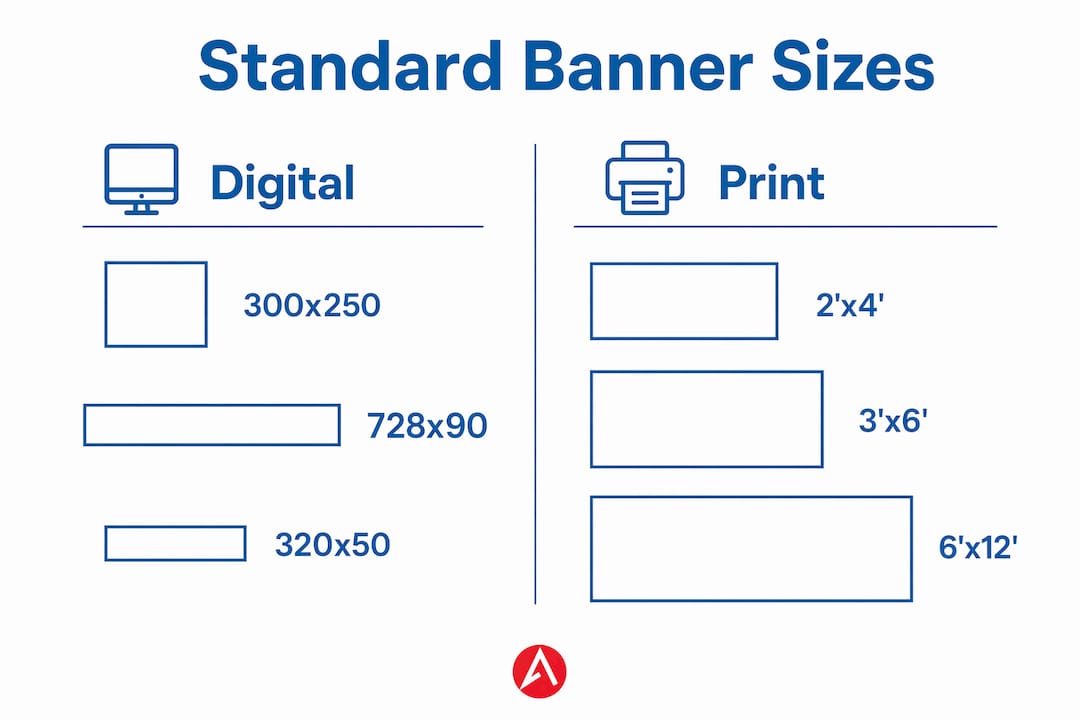
The 300x250 pixel medium rectangle is the most widely used web banner, comprising about 40% of Google Display Network inventory. That dominance reflects how well it fits sidebar placements on both desktop and mobile screens. The 728x90 leaderboard is the classic desktop format, placed at the top of pages for maximum visibility before a user scrolls. The 160x600 wide skyscraper fills vertical sidebar space on content-heavy pages. For mobile, the 320x50 mobile leaderboard is the go-to format because it fits small screens without blocking content.

| Size (pixels) | Name | Best use |
|---|---|---|
| 300x250 | Medium rectangle | Sidebar, in-content, mobile |
| 728x90 | Leaderboard | Top of desktop pages |
| 160x600 | Wide skyscraper | Vertical sidebar placements |
| 320x50 | Mobile leaderboard | Mobile web and apps |
| 300x600 | Half page | High-impact display ads |
Print banner dimensions
Standard print banners like 2’x4’, 3’x6’, and 6’x12’ align with common stand and roll sizes, which keeps production costs low and turnaround times short. A 2’x4’ banner fits most retractable banner stands. A 3’x6’ works well for table displays and indoor event backdrops. A 6’x12’ is the workhorse of outdoor advertising, sized for fence lines, building facades, and large venue entrances. Understanding banner stand types helps you match the right print size to the right hardware from the start.
Pro Tip: Order your print banner in a standard size even if your display space is slightly larger. Centering a standard banner on a wider wall looks intentional. A custom-cut banner that is slightly off from a standard size costs more and takes longer to produce.
Why do standard banner sizes matter for campaign success?
Sticking to recognized dimensions is not just a preference. It is a technical requirement that directly affects whether your ad runs and how it performs.
IAB-regulated ad networks require standard banner sizes to prevent upload rejections and visual deformation. When you submit a non-standard size, the ad system either rejects it outright or stretches it to fit, which distorts your logo and message. Non-standard sizes also reduce ad reach because fewer publishers support them, meaning your campaign appears on fewer websites. These are not edge cases. They are routine problems that cost real budget.
Print production follows the same logic. Non-standard print banner sizes increase production costs because they generate more material waste and require custom equipment setups. Standard sizes reduce trimming issues and fit directly onto pre-configured printing equipment, which speeds up production and lowers cost per unit.
The business case for standard dimensions comes down to three points:
- Ad network compatibility. Standard IAB sizes run on every major network without modification.
- Visual integrity. Correct dimensions prevent cropping and distortion that damage brand credibility.
- Production efficiency. Standard print sizes reduce waste, lower costs, and support faster turnaround.
“Strict adherence to IAB standard banner sizes ensures greater ad inventory availability and compatibility on major ad networks.” — The Brief AI, 2026
Pro Tip: Before submitting any digital banner, verify the pixel dimensions against the IAB standard list. A five-minute check prevents a rejected campaign launch.
How to choose the right banner size for your goals
Banner size selection should be driven by campaign goals rather than creative preferences. The size that looks best in your design software is not always the size that performs best in the real world.
Follow this decision process when selecting your dimensions:
-
Define your placement first. A trade show booth calls for a 2’x4’ or 3’x6’ retractable banner. An outdoor festival needs a 6’x12’ vinyl banner on a frame. A digital campaign targeting desktop users starts with the 728x90 leaderboard and 300x250 medium rectangle.
-
Match size to viewing distance. Larger formats work for outdoor spaces where viewers stand 10 or more feet away. Smaller formats work indoors where viewers are within arm’s reach of your display.
-
Build a core size set for multi-platform campaigns. Using 300x250, 728x90, and 320x50 together covers desktop, sidebar, and mobile placements in one campaign. That combination maximizes reach without multiplying design work.
-
Factor in portability for events. A 2’x4’ retractable banner fits in a carry bag and sets up in under two minutes. A 6’x12’ banner requires hardware, tie-downs, and a vehicle. Choose the size your team can actually manage on-site. Reviewing retractable banner design practices before you finalize dimensions saves you from a size that looks great on paper but fails at setup.
-
Set a budget ceiling before ordering. Larger print banners cost more per unit and more to ship. Standard sizes keep costs predictable because suppliers stock the materials and hardware for them.
Pro Tip: For trade shows, order one 3’x6’ banner for your table display and one 2’x4’ retractable for your booth entrance. That two-banner combination covers most event footprints without overspending.
Common pitfalls and design tips for standard banner sizes
Knowing the right dimensions is only half the job. How you fill that space determines whether your banner actually works.
Designers frequently neglect mobile safe zones, causing text and calls-to-action to be cropped on smaller screens. Placing critical content centrally avoids this problem. The rule is to keep key text and calls-to-action within the center 70–80% of the banner area. Anything near the edges risks being cut off by a browser frame, a banner stand hardware clip, or a screen bezel.
Watch for these common mistakes:
- Overcrowding the layout. A banner is not a brochure. Limit yourself to one headline, one supporting line, and one call-to-action.
- Low-contrast color choices. Dark text on a dark background fails at a distance. Use high-contrast combinations that read clearly from 10 feet away.
- Ignoring file size limits for digital ads. Digital banner files should stay below 200 KB with text and CTAs inside safe zones. Oversized files load slowly and get penalized by ad networks.
- Skipping hardware compatibility checks. A banner printed at 33 inches wide will not fit a stand designed for 24-inch media. Always confirm stand width before finalizing print dimensions. The guide on assembling retractable banner stands covers the compatibility details worth checking before you print.
- Using low-resolution artwork. Print banners require 100–150 DPI at full size. Artwork pulled from a website at 72 DPI will print blurry.
Pro Tip: Connect two 2’x4’ retractable banners side by side to create a 4’x4’ display wall at no extra hardware cost. This is a proven technique for small booths that need a larger visual presence. Arrowhead Sign Company - Signs, Banners and Trade Show Displays covers this approach in detail for large exhibit displays.
Key takeaways
Standard banner sizes are the foundation of any effective advertising campaign, whether digital or print, because they determine compatibility, cost, and visual impact.
| Point | Details |
|---|---|
| Core digital sizes | Use 300x250, 728x90, and 320x50 together to cover desktop, sidebar, and mobile placements. |
| Core print sizes | The 2’x4’, 3’x6’, and 6’x12’ formats align with standard stands and production equipment. |
| IAB compliance | Non-standard digital sizes cause ad rejection or visual distortion on major networks. |
| Safe zone rule | Keep all key text and CTAs within the center 70–80% of any banner to prevent cropping. |
| Size drives strategy | Choose dimensions based on placement and campaign goals, not design preference. |
My take on banner sizing in 2026
Working with marketing teams and event planners over many years, I have seen the same mistake repeat itself: someone falls in love with a custom size because it looks unique in a mockup, then discovers it costs twice as much to print, takes longer to produce, and does not fit any of the stands at the venue.
The IAB standards for digital and the production norms for print exist because they work at scale. They are not creative limitations. They are the framework inside which great design happens. The best banners I have seen at trade shows are not the ones with unusual dimensions. They are the ones with sharp contrast, a single clear message, and hardware that actually holds them upright all day.
For 2026 campaigns, the practical advice is this: lock in your sizes early, build your creative within those dimensions, and spend your energy on the message rather than the format. Digital campaigns are moving toward responsive ad units that adapt to placements automatically, but the underlying standard sizes still anchor the system. Print is not changing. A 3’x6’ banner will fit the same stands in 2030 that it fits today.
The one area worth watching is the 300x600 half-page digital unit. It is gaining traction on premium publisher sites because it commands more visual attention than the medium rectangle. If your budget allows, test it alongside your standard 300x250 placements and measure the difference in engagement.
— Dan
Ready to print in the right size?
Arrowhead Sign Company - Signs, Banners and Trade Show Displays carries a full range of display solutions built around the standard sizes covered in this guide.
The 10 ft stretch fabric display is a top choice for trade show booths that need a large, professional backdrop without custom fabrication costs. For outdoor events, the adjustable outdoor banner frame accommodates standard 6-foot and 8-foot print banners with no special tools required. Most products ship within two business days, and the Arizona team delivers directly to venues for local clients. If you need guidance on which size fits your next event, the team at Arrowhead Sign Company - Signs, Banners and Trade Show Displays is ready to help you get it right the first time.
FAQ
What is the most common standard banner size for digital ads?
The 300x250 medium rectangle is the most widely used digital banner, making up about 40% of Google Display Network inventory. It works across desktop and mobile placements, making it the safest starting point for any display campaign.
What are standard print banner sizes for events?
The most common print banner dimensions are 2’x4’, 3’x6’, and 6’x12’. These sizes align with standard banner stands and printing equipment, which keeps production costs low and turnaround times short.
Why do ad networks reject non-standard banner sizes?
IAB-regulated ad networks require specific dimensions to maintain visual integrity across publisher sites. Non-standard sizes either get rejected at upload or display with distortion, which damages brand appearance and wastes ad spend.
How many banner sizes should I use in one digital campaign?
Use three core sizes: 300x250, 728x90, and 320x50. That combination covers desktop, sidebar, and mobile placements and maximizes reach without requiring a large number of separate design files.
What is a safe zone in banner design?
A safe zone is the center 70–80% of a banner where key text and calls-to-action are guaranteed to display without cropping. Placing critical content outside this zone risks it being cut off by browser frames, screen bezels, or hardware clips on physical stands.
Recommended
- How Outdoor Event Banners Are Made: a 2026 Guide - Arrowhead Sign Company
- Custom Banner Application Examples for Events in 2026 - Arrowhead Sign Company
- What Is a Banner Stand? Types, Uses, and Benefits - Arrowhead Sign Company
- Quick Turnaround Banner Printing Guide for Events - Arrowhead Sign Company