

What Is a Double Sided Banner? Your Complete Guide
Posted by Deeder Dandenhorf on Jul 4th 2026
What Is a Double Sided Banner? Your Complete Guide
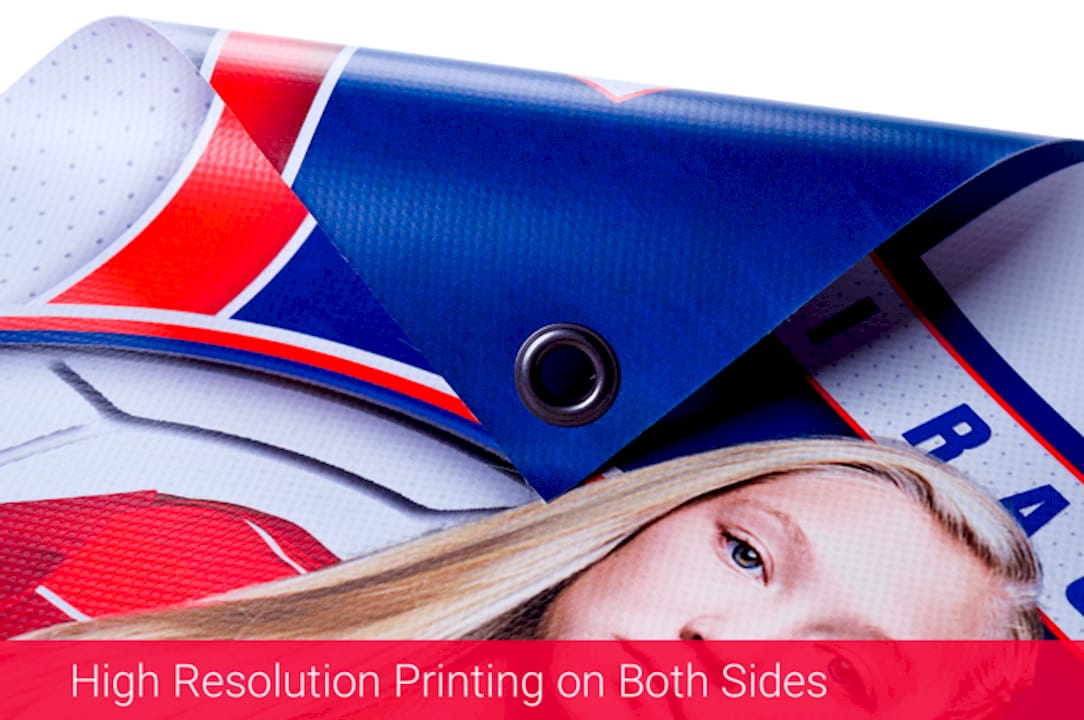
A double sided banner is a display graphic printed on both sides of a single panel, giving your brand full visibility to viewers approaching from any direction. Unlike a standard single-sided banner, this format uses a specialized blockout layer construction to prevent graphics from bleeding through to the opposite face. The industry term you will also see is “double-sided banner printing,” and it is the recognized standard for island booths, retail aisles, and outdoor events where foot traffic is unpredictable. Arrowhead Sign Company - Signs, Banners and Trade Show Displays produces these displays using materials and construction methods built for real-world marketing environments.
What is a double sided banner and how is it constructed?
A double sided banner achieves its dual-print capability through a sandwich construction that most buyers never see but always benefit from. The core of this construction is a blockout layer placed between two printed faces. Without it, graphics show through to the opposite side, especially in backlit environments, and the visual impact of both faces degrades immediately.
The outer layers are printed independently, then bonded to the opaque center core. This process demands precise registration so both sides align correctly when the banner is hung or framed. The result is a display that looks sharp and intentional from every angle.

Materials used in double sided banner printing
Material choice directly affects durability, weight, and clarity. The most common options are:
-
PVC vinyl (650gsm–750gsm): The standard for outdoor double sided banners. Heavier weight resists wind and UV exposure. Best for frames, poles, and outdoor banner bars.
-
Engineered mesh with opaque layers: Mesh construction allows wind to pass through while the internal opaque layer maintains graphic clarity on both faces. Ideal for large outdoor displays where wind load is a concern.
-
Lightweight fabric: Used for indoor hanging banners and ceiling displays. Lower weight makes installation easier but offers less weather resistance.
| Material | Weight | Best Use | Weather Resistance |
|---|---|---|---|
| PVC vinyl | 650–750gsm | Outdoor frames, poles | High |
| Engineered mesh | Varies | Large outdoor displays | Medium-High |
| Lightweight fabric | Low | Indoor ceiling/hanging | Low |
Pro Tip: For outdoor events, always choose 650gsm or heavier PVC. Lighter materials may look fine in the shop but flutter and wrinkle in even moderate wind, which undermines both faces of your display. Read more about outdoor banner materials before you order.
What are the benefits and trade-offs of double sided banners?
The core benefit is straightforward: visibility from multiple directions effectively doubles your impressions without requiring a larger footprint. At a trade show island booth, for example, attendees walking from opposite ends of the aisle both see your brand clearly. That is a significant return on a single display investment.
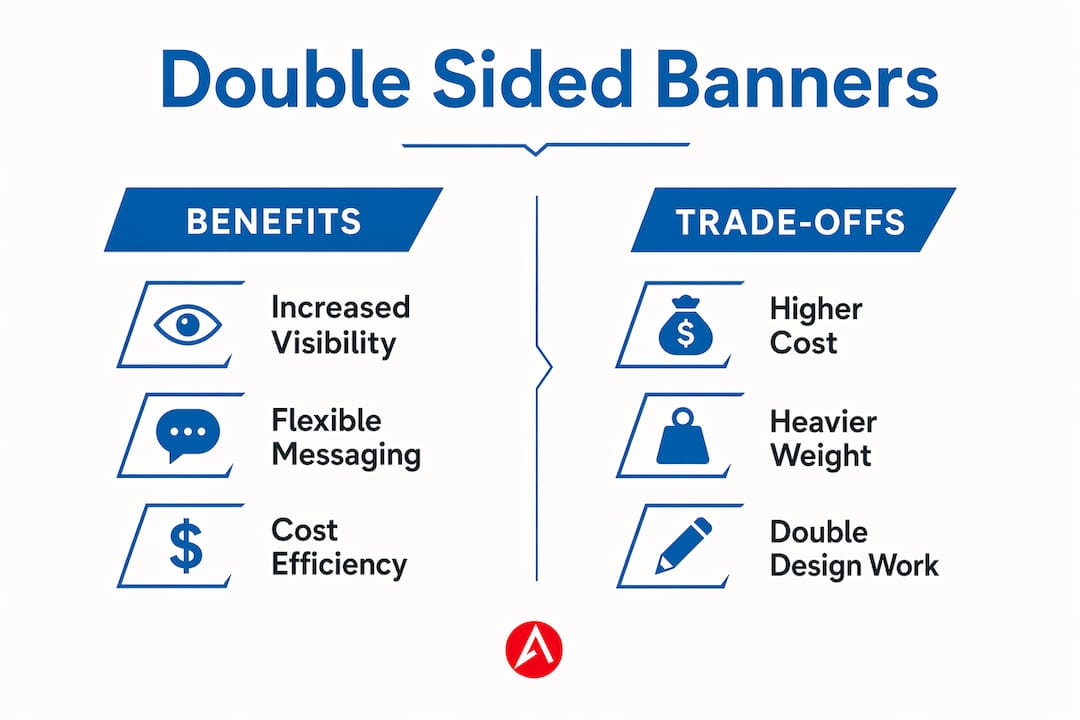
The second major benefit is messaging flexibility. Each face can carry a different design, which means you can promote two products, two offers, or two brand messages without cramming everything onto one panel. Cluttered single-sided designs are a common problem in event marketing, and a two-faced display solves it cleanly.
Cost and practical trade-offs
Double sided banners cost 40–70% more than single-sided equivalents of the same size. That premium reflects the extra material, the blockout layer, and the additional print run required for both faces. For businesses with tight budgets, this is a real consideration.
The displays are also heavier and bulkier than single-sided versions. The extra layers add weight that affects how you pack, transport, and mount the banner. Standard hardware usually handles the load, but you should factor in the added bulk when planning logistics for multi-day events.
Design workload doubles as well. You need two complete, high-impact graphics rather than one. Each face must work independently while also making sense as part of the same brand presentation.
When single-sided banners are the better choice
Single-sided banners are the right call when your display backs against a wall, a corner, or any fixed structure where only one face is ever visible. Paying the double-sided premium in that scenario adds cost with zero added visibility. The decision should always start with your booth layout and the direction of audience flow, not with aesthetics alone.
How and where can you use double sided banners effectively?
The best placements for double sided advertising banners share one characteristic: traffic approaches from at least two directions. Island trade show booths are the clearest example. Attendees walk the aisle from both ends, and a centrally hung or freestanding double sided display captures both streams simultaneously.
Retail aisles work the same way. A banner hung above a product display in a grocery or hardware store gets seen by shoppers walking in either direction. Outdoor festivals and street fairs, where crowd movement is completely unpredictable, are another strong use case. You cannot control which direction people come from, so a display that works from all angles removes that variable entirely.
Strategic placement tips for maximum impact
-
Hang from ceilings or overhead structures at trade shows to maximize sightlines from both ends of the hall. Ceiling-hung banners are visible above booth walls and competing displays.
-
Use in island booth configurations where no wall backs your display. A freestanding frame with a double sided banner becomes a visual anchor for your entire space.
-
Place at entry and exit points of retail spaces or event venues. Visitors see one face on the way in and the other on the way out, reinforcing your message twice in a single visit.
-
Mount in outdoor banner frames at street-level events. Frames like adjustable outdoor banner bars hold the material taut and keep both faces readable even in light wind.
Pro Tip: Plan your two messages before you design either face. Decide whether you want two different products, a before-and-after story, or a bilingual presentation. Locking in the strategy first prevents the common mistake of designing one great face and one afterthought. Check out custom banner application examples for real-world inspiration.
What should you know about designing and setting up double sided banners?
Designing for two faces is not the same as designing one banner twice. Each face needs to function as a standalone graphic with its own visual hierarchy, call to action, and brand identity. A viewer on one side has no idea what is on the other face, so you cannot split a single message across both sides and expect it to work.
Keep these design principles in mind:
-
Treat each face as a complete design. Use a clear headline, supporting visual, and one call to action per face. Do not assume the viewer will walk around to read the rest.
-
Maintain brand consistency across both faces. Use the same color palette, logo placement, and typography so the display reads as one cohesive brand, not two separate banners.
-
Use high-resolution files for both sides. Print quality on 650gsm PVC demands files at 100–150 DPI at full size. Low-resolution files look soft and unprofessional at banner scale.
-
Choose finishes that suit your mounting method. Grommets, pole pockets, and hem stitching each work differently with double-sided material. Review banner finish options before finalizing your order.
-
Avoid dark backgrounds on both faces simultaneously. When both sides use dark colors, the blockout layer works harder and any imperfection in the core becomes more visible at the edges.
Setup demands more attention than a single-sided banner. Proper tensioning is critical to avoid wrinkles, and the heavier material of a double sided display makes this more demanding than with lighter single-sided formats. Uneven tension creates ripples that distort both faces at once. Always tension from opposite corners in sequence, not from one side straight across.
Pro Tip: Bring a second person to installations involving large double sided banners. The extra weight and the need for even tensioning on both axes makes solo setup genuinely difficult, and a rushed install shows in the final display.
Key Takeaways
A double sided banner maximizes marketing exposure by delivering two complete, independent graphics from a single display, making it the right choice when audience traffic approaches from multiple directions.
| Point | Details |
|---|---|
| Core construction | A blockout layer between two printed faces prevents graphic bleed-through and maintains clarity on both sides. |
| Material selection | Choose 650–750gsm PVC for outdoor use; engineered mesh suits large displays where wind load is a factor. |
| Cost premium | Double sided banners cost 40–70% more than single-sided options, so use them only where multiple viewing angles exist. |
| Best placements | Island booths, retail aisles, ceiling hangs, and outdoor events with unpredictable foot traffic deliver the strongest return. |
| Design discipline | Each face needs a complete, independent graphic with its own headline, visual, and call to action. |
Why placement matters more than the banner itself
I have seen businesses invest in beautiful double sided banners and then mount them against a back wall where only one face was ever visible. The banner was excellent. The placement decision wasted half the investment.
The real value of a double sided display is not in the printing. It is in the strategic decision to put it somewhere that earns both faces. That decision starts with a floor plan and an honest look at where your audience actually walks. At a trade show, I always ask clients to sketch the traffic flow before we discuss display formats. Nine times out of ten, that conversation changes what they order.
The cost premium is real, and it is justified only when placement delivers on the format’s promise. A well-placed double sided banner in an island booth configuration outperforms two single-sided banners in the same space. A poorly placed one is just an expensive single-sided banner with extra weight.
Design coordination is the other piece most buyers underestimate. Two faces means two creative briefs, two rounds of revisions, and two sets of files to manage. Build that into your timeline. The businesses that get the most from double sided signage are the ones that treat both faces with equal creative attention from day one.
— Dan
Custom double sided banners from Arrowhead Sign Company
Arrowhead Sign Company - Signs, Banners and Trade Show Displays offers a full range of display solutions built for businesses that need real impact at events and in retail environments.
From outdoor banner frames that hold double sided material taut in any weather, to stretch fabric displays designed for trade show island configurations, every product ships within two business days. Arizona businesses also get direct venue delivery, so your display arrives ready to install. The team at Arrowhead Sign Company - Signs, Banners and Trade Show Displays works with you on sizing, finishes, and hardware to make sure both faces of your banner perform exactly as planned.
FAQ
What is a double sided banner?
A double sided banner is a display graphic printed on both faces of a single panel using a blockout layer between the two prints to prevent show-through. It delivers full visibility to viewers approaching from opposite directions.
How much more do double sided banners cost?
Double sided banners cost 40–70% more than single-sided banners of the same size, reflecting the additional material, blockout core, and dual print production.
What material is best for outdoor double sided banners?
Heavy-duty PVC at 650–750gsm is the standard for outdoor double sided banners. Engineered mesh with an internal opaque layer is the better choice for large displays where wind resistance matters.
When should I use a single-sided banner instead?
Use a single-sided banner when your display backs against a wall or corner where only one face is visible. Double sided banners add value only when viewers approach from multiple directions.
Can I put different designs on each side of a double sided banner?
Yes. Each face is printed independently, so you can use completely different graphics, messages, or product promotions on each side without any bleed-through between them.