

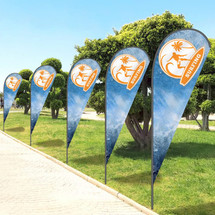
What Is a Promotional Flag Banner? A Business Guide
Posted by Deeder Dandenhorf on Jun 7th 2026
What Is a Promotional Flag Banner? A Business Guide
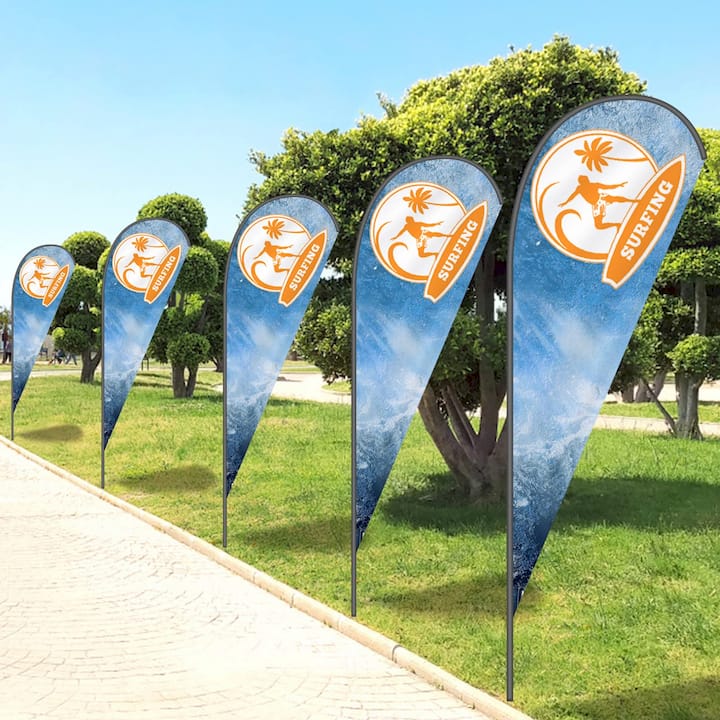
A promotional flag banner is defined as a lightweight, vertically oriented advertising display mounted on a flexible pole, used indoors and outdoors to promote brands, events, and sales. Known in the industry as “feather flags,” “teardrop flags,” or simply “promotional flags,” these displays range from 4 to 15 feet tall depending on the application. Businesses from retail storefronts to trade show exhibitors rely on them because they combine motion, color, and portability in a single, reusable format. Whether you are directing foot traffic at a festival or announcing a grand opening, a promotional flag banner delivers visibility that static signs cannot match.
What is a promotional flag banner and how does it work?
A promotional flag banner is a fabric advertising panel attached to a flexible fiberglass or aluminum pole, designed to move naturally in the wind or stand upright indoors with a weighted base. The motion is the point. Unlike a flat wall sign, a flag in motion catches peripheral vision, which makes it effective even when a viewer is not actively looking for signage. Resources like Gettysburg Flag Works, Bannerfi, and Display Wizard all document this as the core advantage of the format over static alternatives.
The pole system is what separates promotional flags from traditional banners. Most flags use a curved or straight pole that threads through a sleeve sewn into the fabric, keeping the printed face visible at all times. Feather flags use pole flexibility to prevent breakage in wind while keeping the graphic open and readable. The base options, including cross bases, water-fillable bases, and ground stakes, allow the same flag to move between an indoor trade show and an outdoor parking lot without purchasing new hardware.
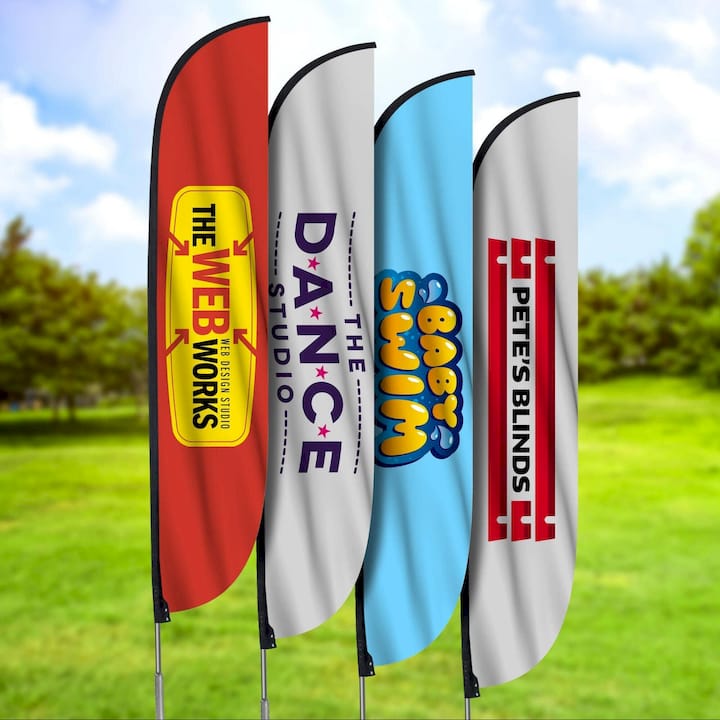
Promotional flags are also distinct from hero banners or permanent signage. Promotional banners focus on temporary, campaign-specific offers designed to drive immediate action, which is why they are built for fast setup, takedown, and reuse. A business can carry six flags in a single bag, set them up in under ten minutes, and pack them out the same day.
What types of promotional flag banners are available?
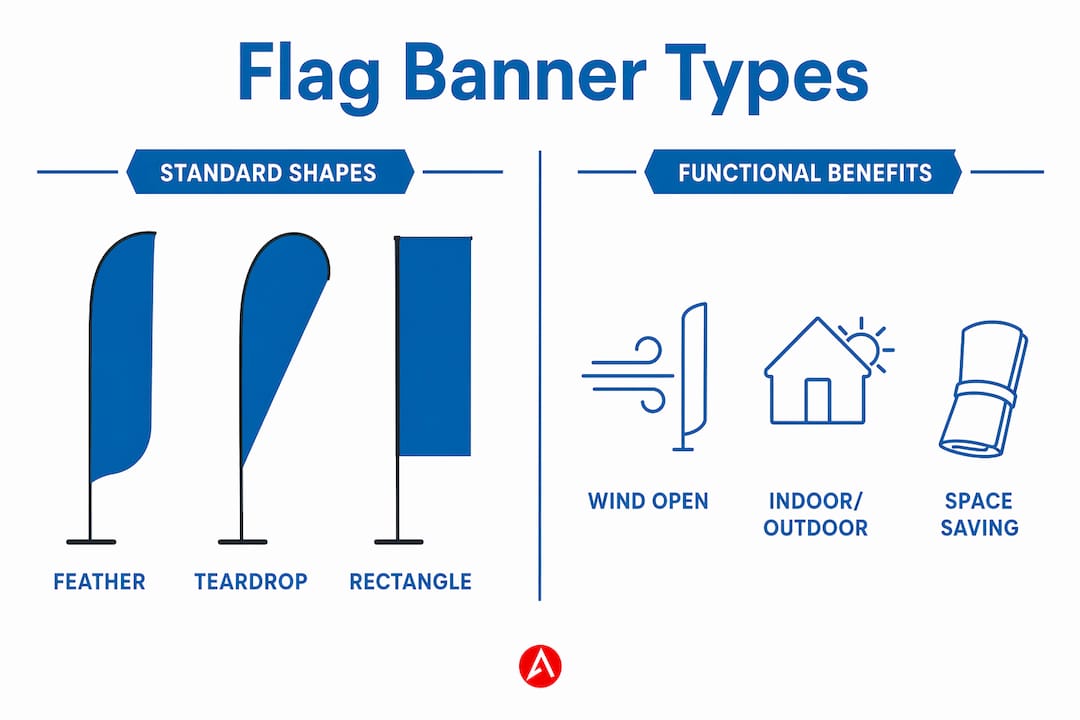
Four main shapes dominate the market, and each serves a different visual and functional purpose.
| Flag type | Shape | Best use case | Visual impact |
|---|---|---|---|
| Feather flag | Curved, tapered top | Storefronts, festivals, roadside | High motion, large print area |
| Teardrop flag | Rounded teardrop | Trade shows, indoor events | Stays taut, minimal flutter |
| Rectangular flag | Straight edges | Sponsor branding, formal events | Maximum print area |
| Bow/angled flag | Angled top edge | Retail, grand openings | Strong visual angle, eye-catching |
Size selection matters as much as shape. Here is how the height ranges break down by application:
-
4 to 6 feet: Indoor trade show booths, tabletop displays, retail counters
-
7 to 9 feet: Standard outdoor storefronts, vendor booths, event entrances
-
10 to 12 feet: Parking lots, festival perimeters, sports event sidelines
-
13 to 15 feet: Roadside advertising, high-traffic intersections, large venue exteriors
Feather flags are the most widely used format because their curved shape keeps the fabric open even in low wind, giving the printed graphic consistent visibility. Teardrop flags are the preferred choice for indoor events because the shape holds tension without relying on airflow. Rectangular flags offer the largest flat print area, which makes them the go-to for sponsor logos that need precise reproduction. Bow flags split the difference, offering a strong visual silhouette with a moderate print area.
Pro Tip: If you are working a trade show with a ceiling height limit, measure the venue before ordering. An 8-foot flag is the standard safe choice for most convention centers, while outdoor events can accommodate 10 to 12 feet without issue.
What are the best design practices for flag banners?
Strong flag banner design follows one rule above all others: less is more. A flag is read from a distance, often by someone in motion, so every design decision must prioritize instant readability over completeness.
A professional flag design uses 3 to 4 colors at most, with a clear hierarchy between the primary message and supporting details. Your brand name or event title belongs at the top in the largest font. A secondary line, such as a website URL or hashtag, sits below in a noticeably smaller size. Tertiary details like dates or addresses should appear only if space allows without crowding the layout.
Font choice is equally critical. Bold, sans-serif typefaces like Impact, Bebas Neue, or Montserrat Bold read clearly from 20 feet away. Script fonts and thin weights disappear at distance. High-contrast color combinations, such as white text on a dark background or black text on a bright yellow field, outperform low-contrast schemes in outdoor light conditions. For detailed guidance on applying these principles across banner formats, the retractable banner design guide from Arrowhead Sign Company covers color palette and layout decisions that translate directly to flag design.
Avoid the temptation to include every piece of information your business offers. A flag that tries to communicate ten things communicates nothing. Pick one primary message, support it with one secondary detail, and let the design breathe.
Pro Tip: Print a proof at full scale before your event if possible. A design that looks balanced on a laptop screen can feel crowded on a 10-foot flag. Most professional print vendors offer digital proofs, and reviewing them at actual size prevents costly reprints.
How are promotional flag banners used for events, retail, and outdoor advertising?
Promotional flags work across a wide range of settings, and the deployment strategy changes depending on the environment. Here is a practical breakdown of how to use them effectively:
-
Trade show booths: Place one flag at each front corner of your booth to frame the space and draw attention from the aisle. A 7 to 8-foot flag is the standard height for most convention center floors. Use teardrop or feather flags here because they stay visible without relying on airflow from HVAC systems.
-
Storefront and retail: Position flags at the sidewalk entrance and at the street corner nearest your location. Multiple flags amplify visual impact far more than a single flag, so a row of three flags along a storefront creates a stronger signal than one flag placed at the door.
-
Festivals and outdoor events: Use flags to define your vendor area perimeter and to guide attendees from parking areas to your booth. Spacing flags 10 to 15 feet apart along pathways creates a professional, guided experience. Bunching them too close creates visual noise that works against you.
-
Grand openings and sales events: A row of tall feather flags along the street edge of your property signals an event in progress to passing drivers. At 15 feet, these flags are visible from a significant distance, which makes them effective for roadside advertising without requiring a permit in most municipalities.
-
Sports events and sponsorships: Rectangular flags work best for sponsor branding at sports venues because the flat surface reproduces logos accurately. Place them along the field perimeter or at entry gates where dwell time is highest.
For outdoor placements, base selection determines stability. Quality bases including cross, water-fillable, and ground stake options keep flags upright in wind and on uneven surfaces. A flag that tips over or collapses mid-event undermines the brand impression you are trying to create. For a deeper look at how outdoor placement decisions affect performance, the guide on outdoor event banner placement covers surface types, wind exposure, and anchoring strategies.
How do custom flag banner options compare to other promotional signage?
Custom promotional flags stand apart from other signage formats in three specific ways: mobility, motion, and cost per use. Flag banners outperform static signs by capturing attention through movement and vibrant color, which is something a retractable banner or pop-up display cannot replicate.
Here is how promotional flag banners compare directly to other common signage formats:
| Signage type | Mobility | Visibility at distance | Setup time | Reusability |
|---|---|---|---|---|
| Promotional flag banner | Very high | Excellent (motion) | Under 5 minutes | High |
| Retractable banner stand | High | Moderate (static) | Under 3 minutes | High |
| Pop-up display | Moderate | Good (large format) | 10 to 20 minutes | Moderate |
| Foam board/standing sign | Low | Limited | Immediate | Low |
Custom flag banners are printed with your logo, brand colors, and messaging directly onto the fabric using dye-sublimation printing, which produces vivid, fade-resistant color. The fabric is typically polyester, which is lightweight, weather-resistant, and machine washable. Reusable poles and bases increase cost-effectiveness over time because you only replace the fabric when your messaging changes, not the entire hardware system.
The key advantages of custom flag banners over other formats include:
-
Visibility: Height and motion make them readable from distances where retractable banners are invisible
-
Portability: A complete flag kit including pole, base, and fabric fits in a carry bag
-
Scalability: You can deploy one flag or twenty with the same hardware investment per unit
-
Versatility: The same flag works at an indoor trade show on Friday and an outdoor festival on Saturday
For businesses deciding between flag banners and other signage types, the indoor vs. outdoor sign options guide provides a practical framework for matching signage to environment.
Key takeaways
Promotional flag banners are the most mobile, motion-driven advertising format available to small businesses, and their effectiveness depends on choosing the right shape, size, design, and placement for each specific venue.
| Point | Details |
|---|---|
| Definition and function | A promotional flag banner is a vertically oriented fabric display on a flexible pole used for brand promotion and wayfinding. |
| Shape selection matters | Feather flags suit outdoor motion; teardrop flags hold tension indoors; rectangular flags maximize logo reproduction. |
| Design simplicity wins | Limit designs to 3 to 4 colors with a clear message hierarchy to maximize readability from a distance. |
| Spacing drives impact | Space flags 10 to 15 feet apart along pathways for a professional appearance; avoid clustering. |
| Cost-effectiveness over time | Reusable poles and bases mean you only replace fabric when messaging changes, lowering long-term cost. |
What I have learned from watching flags work (and fail) at events
After seeing hundreds of event setups, the single most common mistake is over-ordering large flags for small spaces. A business rents a 10x10 trade show booth and brings four 10-foot feather flags, and the result is a cluttered, overwhelming display that pushes attendees away rather than drawing them in. Two well-placed 7-foot flags at the front corners of that same booth would do more for visibility and brand impression than four oversized ones.
The second pattern I notice consistently is poor base investment. Businesses spend money on beautiful custom-printed fabric and then buy the cheapest cross base available. The flag tips over twice during the event, the fabric drags on the ground, and the brand impression suffers. Quality bases are not glamorous, but they are the difference between a flag that works all day and one that becomes a liability.
Design simplicity is the third area where I see the most room for improvement. The instinct is to put everything on the flag: the business name, the tagline, the website, the phone number, the social media handles, and the current promotion. A flag is not a brochure. It is a signal. The best flags I have seen at events carry one word or one logo at a size that reads from 30 feet away. That is the entire job of the flag, and it does that job exceptionally well when you let it.
Spacing flags along a pathway to create a guided experience is genuinely underused. Most businesses cluster their flags at one point. Spreading them out turns your signage into a directional system that moves people toward your booth or storefront, which is a far more powerful use of the same hardware.
— Dan
Get custom promotional flag banners from Arrowhead Sign Company
Arrowhead Sign Company - Signs, Banners and Trade Show Displays offers custom-printed promotional flags and banner stands built for businesses that need professional results fast. Most orders ship within two business days, and the team provides direct delivery to venues across Arizona for clients who need flags on-site without the logistics headache.
From custom pop-up signs and outdoor banner stands to full trade show display packages, Arrowhead Sign Company handles the design, printing, and fulfillment so you can focus on your event. Whether you need a single feather flag for a storefront or a full set of branded flags for a festival booth, the team is ready to help you create signage that performs. Reach out today to discuss your custom flag banner options and get your order moving.
FAQ
What is a promotional flag banner used for?
A promotional flag banner is used for brand promotion, event visibility, directional wayfinding, and sales announcements at locations including trade shows, storefronts, festivals, and sports events. The motion of the flag in wind or airflow attracts attention that static signs cannot generate.
How tall should a promotional flag banner be?
Flag banner height depends on the venue. Heights of 7 to 9 feet work for standard outdoor storefronts and trade show booths, while 13 to 15-foot flags are suited for roadside advertising and large outdoor venues where visibility from a distance is the priority.
What is the difference between a feather flag and a teardrop flag?
A feather flag has a curved, tapered shape that stays open in wind and is best for outdoor use, while a teardrop flag has a rounded shape that holds tension without airflow, making it the preferred choice for indoor events and trade shows.
How many colors should a flag banner design use?
A professional flag banner design uses 3 to 4 colors at most, with high-contrast combinations to maximize readability from a distance. More colors add visual complexity that reduces legibility when the flag is viewed from 20 feet or more.
How far apart should promotional flags be spaced?
Spacing flags 10 to 15 feet apart along pathways creates a professional, guided appearance. Placing them too close together creates visual clutter that reduces the impact of each individual flag and makes the display feel disorganized.
Recommended
-
What Is a Promotional Standing Sign for Marketing - Arrowhead Sign Company
-
What Is a Pull Up Banner? Your Complete Event Guide - Arrowhead Sign Company
-
What Is a Banner Stand? Types, Uses, and Benefits - Arrowhead Sign Company
-
How Outdoor Event Banners Are Made: a 2026 Guide - Arrowhead Sign Company