

What Is an Outdoor Trade Show Sign? A Practical Guide
Posted by Deeder Dandenhorf on Jun 11th 2026
What Is an Outdoor Trade Show Sign? A Practical Guide
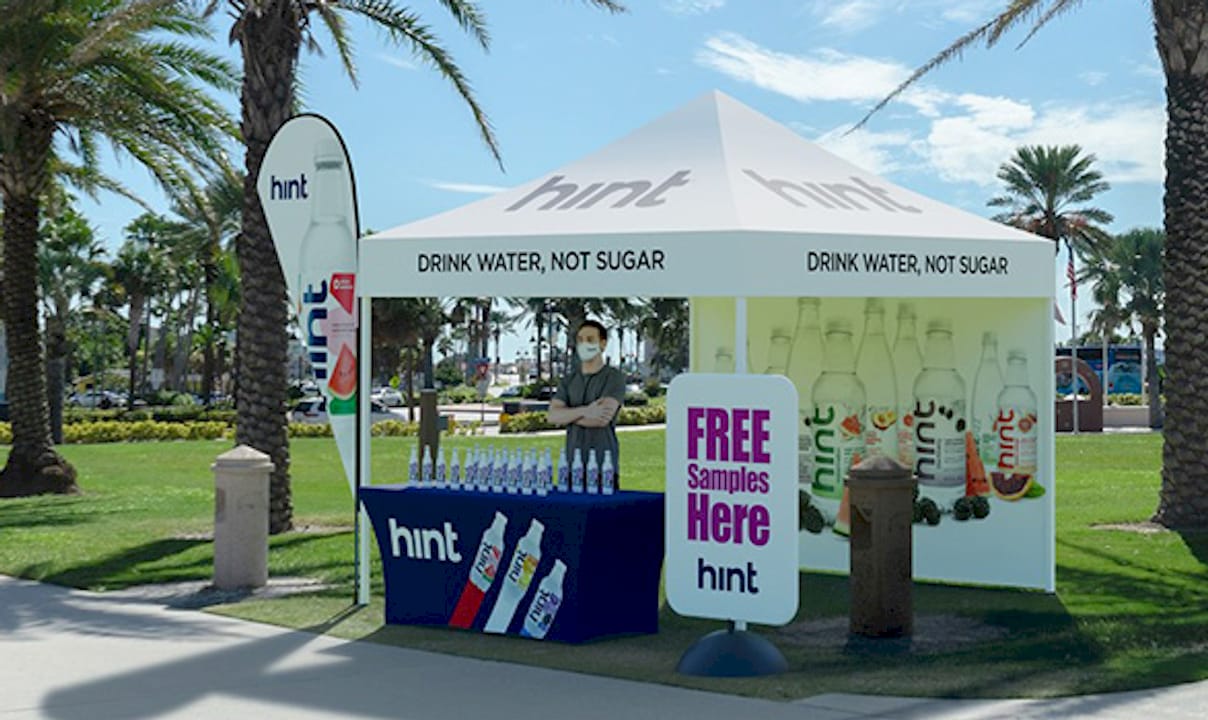
An outdoor trade show sign is a weather-resistant, branded display built specifically for open-air exhibition settings, designed to attract attendees and communicate your message despite wind, sun, rain, and uneven terrain. Unlike standard promotional materials, these signs must perform under real environmental pressure while still stopping foot traffic at a glance. Common formats include feather flags, vinyl banners, A-frame signs, and custom printed canopy tents. Each format serves a distinct role in your booth setup, from long-distance visibility to close-up product messaging. Understanding your options before your next event means the difference between a booth that gets noticed and one that gets passed.
What is an outdoor trade show sign and why does it matter?
An outdoor trade show sign is a branded display feature made for open-air exhibition settings that must withstand weather and visibility challenges while attracting attendees. The industry term for this category is “outdoor event signage,” and it covers every printed or structured display element placed outside a controlled indoor environment at a trade show, expo, or festival. These signs do more than identify your booth. They guide attendees through crowded event grounds, reinforce your brand identity from a distance, and communicate your core offer before a single conversation happens.
The stakes are high at outdoor events because you are competing with natural light, ambient noise, and dozens of other exhibitors. A sign that works perfectly indoors can become invisible outside when sunlight washes out low-contrast colors or wind topples an unsecured banner stand. Outdoor event signage is purpose-built to solve these problems, using UV-resistant inks, reinforced grommets, weighted bases, and flexible poles that absorb wind rather than resist it. Getting this right from the start protects your investment and your brand reputation at every event you attend.
What types of outdoor trade show signs are commonly used?
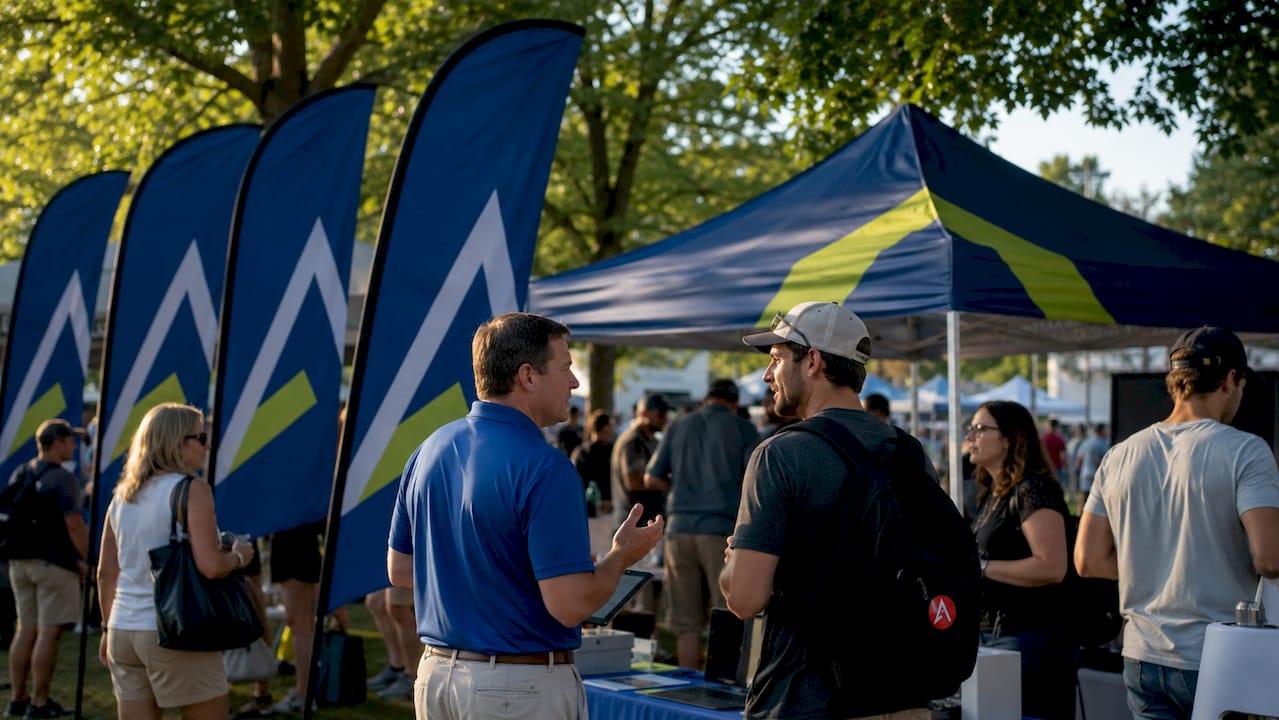
Common outdoor trade show signs include banners and banner stands, feather flags, A-frames, and canopy tent graphics, each serving a specific role in your overall booth setup. Knowing which type fits which purpose helps you build a display that works at every distance, from across the parking lot to right in front of your table.
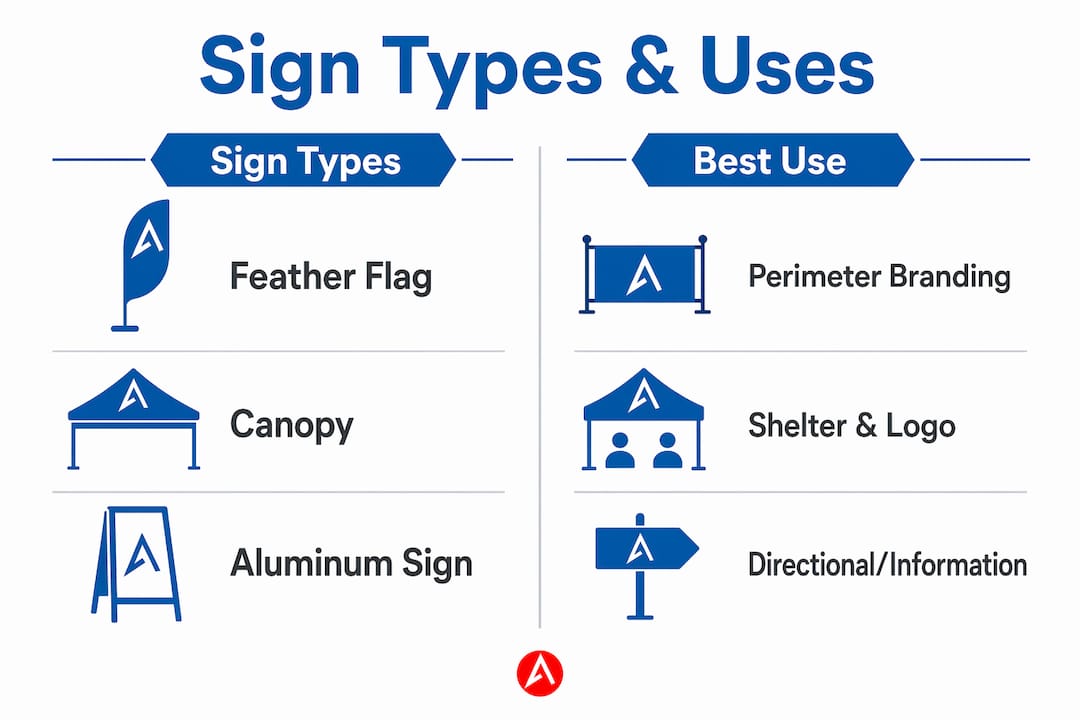
Here is a breakdown of the most widely used formats:
-
Feather flags stand 8 to 15 feet tall and use flexible fiberglass poles that bend with the wind rather than snapping. They are ideal for perimeter marking and long-distance visibility, and they can be anchored with ground spikes on grass or weighted cross bases on pavement.
-
Vinyl banners and banner stands are the workhorses of trade show display options. They carry detailed messaging, product images, and pricing information at eye level, making them effective for close-up engagement at your booth.
-
A-frame signs direct foot traffic to entrances, restrooms, or event schedules. They are portable, double-sided, and easy to reposition throughout the day.
-
Canopy tents with branded graphics anchor your entire booth area visually. Pop-up tents with printed canopies provide shelter for staff and products while serving as the most recognizable branding element on the event floor.
| Sign type | Best use | Visibility range | Key advantage |
|---|---|---|---|
| Feather flag | Perimeter branding, walkway guides | 50 to 100 feet | Movement draws attention naturally |
| Vinyl banner | Booth backdrop, product messaging | 10 to 30 feet | High detail, cost-effective |
| A-frame | Wayfinding, promotions | 5 to 15 feet | Double-sided, repositionable |
| Canopy tent | Full booth coverage, shelter | 50 to 150 feet | Largest branding surface available |
Pro Tip: Combine at least two sign types at every outdoor booth. Use a feather flag or canopy for long-distance visibility and a banner stand for close-up messaging. This layered approach covers both the “find us” and “understand us” stages of the attendee journey.
What materials and design features make outdoor signs effective?
The best materials for outdoor signs are vinyl, mesh vinyl, and aluminum, chosen specifically because they resist the conditions that destroy standard print materials. Mesh vinyl is perforated to reduce wind load, preserving both visibility and structural stability in exposed locations. Solid vinyl delivers sharper image quality and is better suited for sheltered or low-wind environments. Aluminum frames resist rust and keep signs rigid without adding significant weight.
Beyond material selection, design choices determine whether your sign actually gets read. Effective outdoor signage uses high-contrast colors, large sans-serif fonts with 4 to 6 inch headlines, and minimal text to maximize readability at typical attendee walking speeds. People pass signs at roughly 3 to 5 mph and from greater distances outdoors than indoors. That means you have roughly two seconds to land your message. Every word on the sign must earn its place.
Key design and material features to prioritize:
-
UV-resistant inks prevent fading after repeated outdoor use, protecting your investment across multiple events
-
Weighted bases and ground anchors keep signs stable on both hard surfaces and grass without requiring tools
-
High-contrast color combinations such as dark text on a light background or white text on a saturated color field maintain readability in direct sunlight
-
Minimal copy with one clear headline and one supporting line performs better than a sign crowded with bullet points and fine print
-
Reinforced hems and grommets on banners prevent tearing at attachment points, which is where most outdoor banner failures begin
Pro Tip: Test your sign design at arm’s length in bright light before ordering. If you cannot read the headline instantly, your attendees will not read it at all. Simplicity is not a compromise. It is the strategy.
How do outdoor trade show signs differ from indoor signage?
Outdoor and indoor trade show signs solve fundamentally different problems, and using the wrong type in the wrong environment costs you visibility and money. Here are the key contrasts every event organizer needs to understand:
-
Environmental exposure. Indoor signs operate in controlled conditions with stable lighting, no wind, and no precipitation. Outdoor signs face UV radiation, rain, wind gusts, and temperature swings within a single event day. Standard indoor signs often lack weighted bases, flexible frames, and UV-treated graphics, which means they may not hold up or require significant additional support when placed outside.
-
Material durability. Indoor signs are commonly printed on foam board, fabric, or lightweight paper-based substrates. Outdoor signs require vinyl, mesh vinyl, or aluminum-backed materials that resist moisture and UV degradation. The durability difference is not cosmetic. An indoor foam board sign left in direct sun for four hours will warp, fade, and lose structural integrity.
-
Viewing distance and font size. Indoor booth visitors are typically within 10 feet of your display. Outdoor attendees may be 50 to 100 feet away when they first spot your booth. This requires significantly larger type, simpler layouts, and bolder color contrasts than indoor signage standards call for.
-
Anchoring and stability. Indoor signs rest on flat, level floors with no wind load to manage. Outdoor setups require ground spikes, sandbag weights, or cross-base anchors depending on the surface. Failing to account for this is the most common setup mistake at outdoor events.
-
Replacement frequency. Outdoor signs wear faster due to environmental exposure. Budget for replacement every two to three seasons of regular use, and store signs in protective cases between events to extend their lifespan.
Some indoor signs can work outdoors with modifications. Placing a retractable banner stand under a canopy tent, for example, shields it from direct sun and wind while still delivering close-up messaging. The indoor vs. outdoor distinction is not always absolute, but the default assumption should always be to use purpose-built outdoor materials for any exposed position.
What are the benefits and best practices for outdoor trade show signs?
The core benefit of outdoor event signage is visibility at scale. A well-placed feather flag or branded canopy tent can draw attendees from across an event venue before they have read a single word of your messaging. Combining signage types such as banners, feather flags, and pop-up tents creates a branded zone that balances visibility from a distance with detail up close, which increases both foot traffic and attendee engagement.
Practical best practices for getting the most from your outdoor signage investment:
-
Place your tallest signs at the perimeter of your booth space so they are visible above crowd level and from multiple approach angles
-
Use consistent brand colors and fonts across all sign types to create a unified visual identity that attendees recognize from any direction
-
Secure every sign before the event opens, not during. Wind conditions can change quickly, and a fallen sign creates a safety hazard and a poor first impression
-
Transport signs in padded carry bags or hard cases to prevent scratches, creases, and frame damage between events
-
Inspect graphics and hardware after each event and replace worn components before the next show rather than discovering problems on setup day
Feather flags and banners are designed to be set up and dismantled quickly by a single person, with lightweight aluminum frames and fiberglass poles contributing to portability. This matters for event organizers managing multiple booth setups or working with small teams. The faster your setup, the more time you spend engaging with attendees rather than wrestling with hardware.
Key takeaways
Outdoor trade show signs are purpose-built marketing tools that combine weather-resistant materials, bold design, and stable hardware to deliver brand visibility and attendee engagement at open-air events.
| Point | Details |
|---|---|
| Definition and purpose | Outdoor trade show signs are weather-resistant branded displays built for open-air exhibition settings. |
| Best sign types | Feather flags, vinyl banners, A-frames, and canopy tents each serve distinct visibility and messaging roles. |
| Material selection | Vinyl, mesh vinyl, and aluminum frames resist UV, wind, and moisture better than standard indoor materials. |
| Design principles | Use large sans-serif fonts, high-contrast colors, and minimal text to capture attention within two seconds. |
| Indoor vs. outdoor | Outdoor signs require weighted bases, UV-treated graphics, and flexible frames that indoor signs typically lack. |
Why I think most exhibitors underinvest in outdoor signage
Most exhibitors I have worked with spend the bulk of their display budget on table covers and printed brochures, then grab a single vinyl banner as an afterthought. That approach consistently underperforms, and the reason is straightforward. At an outdoor event, your sign is your first salesperson. It works before you do, from the moment attendees enter the venue.
The exhibitors who consistently draw the largest crowds use layered signage setups. They have a tall feather flag or branded canopy visible from 50 feet out, a banner stand with specific product messaging at the booth entrance, and an A-frame on the walkway directing traffic toward them. Each sign handles a different stage of the attendee journey, and together they create a branded zone that feels intentional and professional.
The other mistake I see regularly is overloading signs with text. A sign that tries to explain your entire product line is a sign that nobody reads. The most effective outdoor displays I have seen carry a logo, a single bold headline, and one supporting line at most. That is it. The conversation happens in person. The sign just needs to get people to stop walking.
If you are planning your next outdoor event, start with your signage budget, not your giveaway budget. A well-designed feather flag and a quality canopy tent will do more for your foot traffic than any branded pen or tote bag. You can explore the full range of trade show sign options to see what fits your booth size and event type before you commit.
— Dan
Get custom outdoor trade show signs from Arrowhead Sign Company
Arrowhead Sign Company - Signs, Banners and Trade Show Displays builds custom outdoor trade show displays designed to perform in real event conditions, not just look good in a product photo. Their lineup includes outdoor banner stands, retractable banner stands, pop-up signs, and custom printed canopy tents, all made with weather-resistant materials and built for fast setup by a single person.
Most products ship within two business days, and the team offers direct delivery to venues across Arizona for local clients. Whether you need a single feather flag or a complete branded booth package, Arrowhead Sign Company provides professional design support and high-quality printing to make your next outdoor event stand out from the first attendee to the last.
FAQ
What is an outdoor trade show sign?
An outdoor trade show sign is a weather-resistant branded display used at open-air exhibitions to attract attendees, communicate your offer, and guide foot traffic. Common formats include feather flags, vinyl banners, A-frame signs, and canopy tents with printed graphics.
What materials are best for outdoor trade show signs?
Vinyl and mesh vinyl are the top choices for outdoor signage because they resist UV fading, moisture, and wind. Mesh vinyl is perforated to reduce wind load, making it the better option for exposed or windy locations.
How do outdoor trade show signs differ from indoor signs?
Outdoor signs require UV-resistant inks, weighted bases, and flexible frames to handle weather and wind, while indoor signs are built for stable, controlled environments. Using an indoor sign outdoors without modification risks fading, warping, and structural failure.
How many signs do I need for an outdoor trade show booth?
Most exhibitors benefit from at least two sign types: one tall display like a feather flag for long-distance visibility and one banner stand for close-up messaging at the booth. Adding an A-frame on the walkway further increases foot traffic.
How should I design an outdoor trade show sign for maximum impact?
Use a large sans-serif font with a 4 to 6 inch headline, high-contrast colors, and no more than two lines of text. Outdoor signs must deliver their message in roughly two seconds to attendees passing at walking speed from a distance.