


Why Lightweight Displays Reduce Shipping Costs
Posted by Deeder Dandenhorf on Aug 7th 2026
Why Lightweight Displays Reduce Shipping Costs

Lightweight displays reduce shipping costs because carriers bill the higher of actual weight or dimensional (DIM) weight — and most trade show displays are bulky enough that DIM weight controls the invoice. Switching from rigid panel systems to fabric or SEG graphics, using modular knockdown frames, and right-sizing your carry cases can cut billed weight by a meaningful margin on every shipment. Industry examples show that reducing DIM weight by 15% across 3,000 shipments averaging $18 each saves roughly $8,100 per year. Your fastest wins:
- Choose fabric or SEG graphics over rigid PVC or acrylic panels wherever your display allows.
- Right-size carry cases and shipping boxes so packed dimensions are as tight as possible.
- Specify modular or knockdown frames that collapse flat or roll into a tube.
- Consider local rental or fulfillment for shows more than 500 miles away.
- Check your carrier’s DIM divisor (FedEx/UPS commonly use 139; USPS retail uses 166) before assuming savings — the divisor changes your billed weight significantly.
Table of Contents
- How do different strategies compare for cutting display shipping costs?
- How do carriers actually calculate what you owe?
- Which materials and design choices cut the most weight?
- Two worked examples that show the actual math
- What should you ask your display vendor before you order?
- Key Takeaways
- The case for rethinking what “lightweight” actually means
- Arrowhead Sign Company makes lightweight shipping practical
- Useful sources and further reading
How do different strategies compare for cutting display shipping costs?
Not every approach delivers the same savings, and the right choice depends on how often you ship, how far, and how fragile your display components are.
| Strategy | Typical Impact | Best For | Key Trade-Off |
|---|---|---|---|
| Fabric/SEG graphics (rollable) | High — reduces DIM and actual weight | Frequent shippers, multi-event tours | Requires careful handling; wrinkles if packed wet |
| Modular/knockdown aluminum frames | High — collapses flat, cuts case volume | Any exhibitor shipping more than 3x/year | Slightly longer setup time onsite |
| Right-size packaging | High — eliminates DIM penalty from airspace | All shippers; immediate win | Requires new cases or custom inserts |
| Local rental or fulfillment | Very high for distant shows | Shows 500+ miles away, infrequent exhibitors | Less control over display quality |
| Advance warehousing near show | Medium-high — reduces last-mile LTL cost | Multi-day events, large booth footprints | Requires lead time and warehouse coordination |
| Poly mailers / soft bags for nonfragile items | Medium — eliminates rigid box DIM entirely | Fabric banners, printed table covers | No protection for hard components |
Fabric and right-sizing both attack DIM weight on parcel shipments. Local rental and advance warehousing reduce per-event freight density costs on LTL and pallet moves. For a portable display program covering multiple cities, combining two or three of these strategies delivers the largest cumulative savings.
How do carriers actually calculate what you owe?
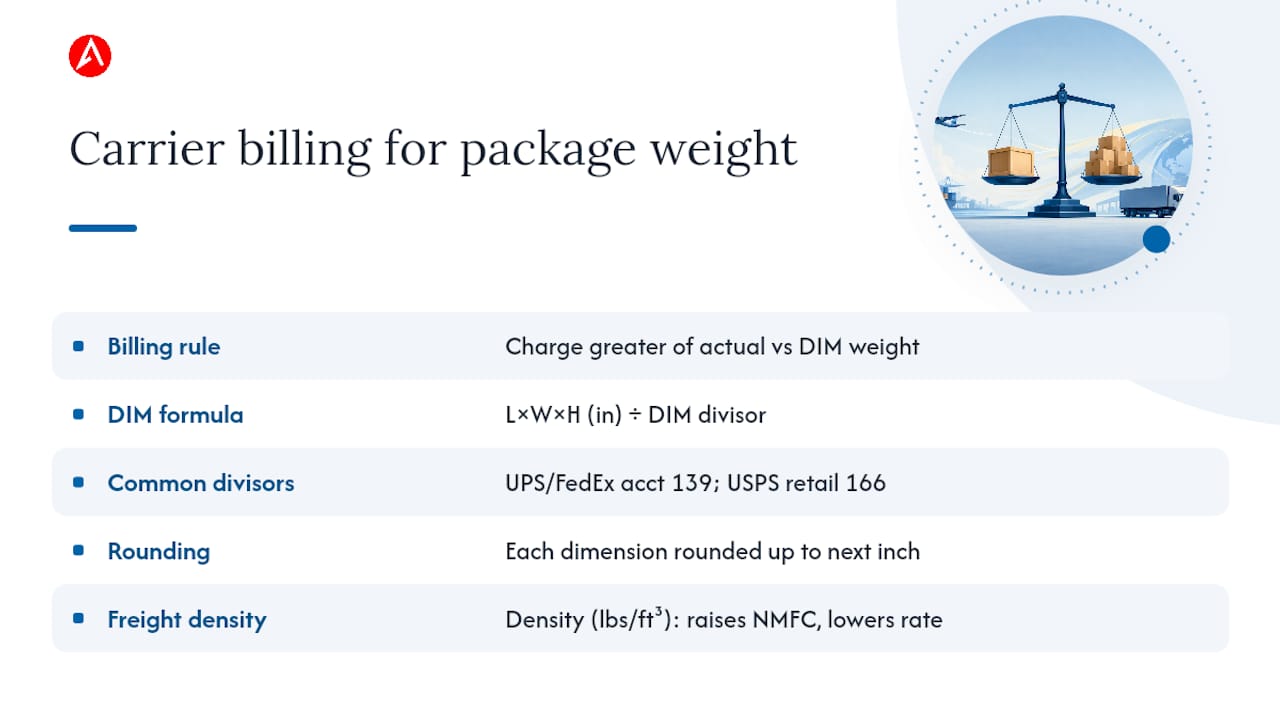
Every major North American carrier — FedEx, UPS, and USPS — compares your package’s actual weight against its dimensional weight and charges whichever is greater. Dimensional weight pricing was adopted broadly because carriers were losing revenue on lightweight but bulky shipments that consumed truck and aircraft space disproportionate to their mass.
The formula is straightforward:
DIM weight (lbs) = (Length × Width × Height in inches) ÷ DIM divisor
Carrier divisors differ: UPS and FedEx commonly apply 139 for account-rate shipments, while USPS retail can use 166. A lower divisor produces a higher DIM weight from the same box, so your carrier choice and account type both affect your bill.
Quick numerical example:
A carry case with certain dimensions has a volume measured in thousands of cubic inches. Depending on the carrier’s DIM divisor, the dimensional weight can be notably higher than the actual weight, leading to higher shipping charges. Reducing the case dimensions decreases the volume and thus the dimensional weight, potentially lowering billed weight closer to actual weight.
For pallet and LTL freight, carriers use freight density (lbs per cubic foot) to assign a freight class under the National Motor Freight Classification (NMFC) system. Lightweight but bulky rigid crates often land in a high freight class (low density = higher rate per hundredweight). Rollable or flat-packed displays increase pallet cube utilization and push density upward, which can drop your freight class and rate. The CSCMP State of Logistics Report consistently identifies packaging efficiency and pallet optimization as primary levers for reducing total distribution cost.
Pro Tip: Measure your packed cases after packing, not before. Carriers round each dimension up to the nearest whole inch, so a case that measures 14.2" bills as 15". Shaving one inch off two dimensions can drop your DIM weight by more than you’d expect.
Which materials and design choices cut the most weight?

The biggest shipping wins come from material selection and structural design, not from packing tricks alone. Here’s how common display materials compare:
| Material | Approx. Weight per sq. ft. | Flat-Pack / Rollable | Key Trade-Off |
|---|---|---|---|
| Stretch fabric / SEG | — | Yes — rolls into a tube | Wrinkles if stored compressed; needs steaming |
| Aluminum extrusion frame | — | Yes — breaks down flat | Assembly learning curve for new users |
| Corrugated display board | — | Yes — flat-ships easily | Less durable; not suited for repeat touring |
| Rigid PVC / Sintra | — | No — ships in crates | Durable and vibrant; high DIM weight |
| Acrylic / plexiglass | — | No — fragile; needs foam | Premium look; heavy and fragile to ship |
Modular knockdown frames are the structural counterpart to lightweight graphics. A 10 ft aluminum tube frame collapses into a carry bag or compact case, while an equivalent rigid panel display ships in a crate that can weigh three to four times as much and occupy twice the cubic volume. When you pair a rollable fabric graphic with a knockdown frame, you often convert a freight-class LTL shipment into a standard parcel — a category shift that can cut per-event shipping cost substantially.
Before you order, request these specs from any vendor:
- Packed dimensions (L × W × H) for every case or bag
- Packed weight per case
- Number of cases in a full kit
- Packing method (rolled, folded, or flat-stacked)
- Whether the display is flat-packable for return shipping
Durability is the real trade-off. Fabric displays require careful handling at the venue — a wet or dirty environment can damage graphics that a rigid panel would shrug off. For outdoor events, review indoor vs. outdoor sign options to match material choice to environment before committing to a lightweight format that may not hold up.
Two worked examples that show the actual math
These examples use publicly documented carrier logic. Plug in your own dimensions and rates to verify savings for your specific program.
Example 1: Parcel shipment of a fabric banner display
| Input | Rigid panel carry case | Fabric banner carry bag |
|---|---|---|
| Packed dimensions | 52" × 16" × 10" | 48" × 8" × 8" |
| Volume (cubic inches) | 8,100 | — |
| Actual weight | — | 14 lbs |
Assumptions: UPS/FedEx account divisor 139; sample ground rate of ~$0.87/lb at this weight band. Your contract rate will differ.
Example 2: Pallet/LTL shipment — rigid crates vs. rollable displays
- Rigid crate setup: Four 52" × 16" × 10" crates on a pallet occupy roughly 18 cubic feet. Total weight: 112 lbs. Density: ~6.2 lbs/cu. ft. → NMFC freight class 125 (higher rate).
- Rollable display setup: Four fabric carry bags on the same pallet occupy roughly 8 cubic feet. Total weight: 56 lbs. Density: ~7.0 lbs/cu. ft. → NMFC freight class 100 or lower (lower rate per hundredweight).
- The density improvement drops freight class, and the lower actual weight reduces the hundredweight charge simultaneously — a double saving on the same pallet.
| Rigid crates | Rollable displays | |
|---|---|---|
| Pallet cubic feet | ~18 | ~8 |
| Total weight | 112 lbs | 56 lbs |
| Freight density | ~6.2 lbs/cu. ft. | ~7.0 lbs/cu. ft. |
| Approx. freight class | 125 | 100 |
| Relative rate impact | Higher | Lower |
Assumptions: standard 48" × 40" pallet; NMFC density-based class assignment; actual rates vary by carrier and lane.
What should you ask your display vendor before you order?
Bring this checklist to every vendor conversation. The answers determine your real shipping cost before you commit to a purchase.
- What are the packed dimensions (L × W × H) for each case or bag in the kit?
- What is the packed weight per case?
- How many cases does a complete display ship in?
- Is the display flat-packable or rollable for return shipping?
- What packing method do you use — rolled graphics, folded, or rigid crated?
- Can you provide photos of the packed display or a sample packing spec sheet?
- Do you offer local fulfillment or direct venue delivery (relevant for Arizona-based events)?
- What is your return packaging policy if the display is damaged in transit?
- What are your standard fulfillment lead times, and can you ship within two business days for rush orders?
- Do you offer lightweight product lines specifically designed for low DIM weight?
Always compare vendor quotes using total landed cost: product price plus packaging plus outbound shipping plus drayage plus return shipping. A display that costs $50 less upfront but ships in an oversized crate can cost $120 more per event over a six-show season. For a practical trade show display checklist that covers setup and logistics together, review the full guide before your next event.
Pro Tip: Ask your vendor for a “packing test report” or a photo of the actual packed unit before your order ships. Vendor-listed packed dimensions are sometimes measured before foam inserts are added — the real packed case can be an inch or two larger in each dimension, which changes your DIM weight calculation.
Key Takeaways
Lightweight displays reduce shipping costs most reliably when DIM weight controls carrier billing, which it does for most trade show display shipments.
| Point | Details |
|---|---|
| DIM weight drives most display shipping bills | Carriers bill the higher of actual vs. DIM weight; bulky displays almost always trigger DIM billing. |
| Fabric and rollable formats cut billed weight | Switching from rigid panels to fabric/SEG graphics can reduce billed weight substantially on a sample parcel shipment. |
| Right-sizing packaging multiplies savings | Cutting inches from all three packed dimensions reduces volume multiplicatively, not linearly. |
| Operational tactics compound per-item savings | Advance warehousing, consolidation, and early booking reduce total freight spend beyond what lighter materials alone achieve. |
| Arrowhead Sign Company offers lightweight options | Products like the 10 ft stretch fabric display, Signicade A-Frame, and Outdoor Banner Frame ship compactly with two-business-day fulfillment. |
The case for rethinking what “lightweight” actually means
The conventional framing around lightweight displays focuses almost entirely on the display itself — its frame material, its graphic substrate, its carry case. That framing misses half the opportunity.
The real savings in a multi-event program come from system decisions: how you pack, how you route, how far in advance you book, and whether you ship at all or rent locally. A fabric display packed carelessly in an oversized box with loose fill can cost more to ship than a rigid panel display packed precisely in a custom-fit case. The material choice matters, but the packing discipline matters just as much.
What most buyers underestimate is the compounding effect of zone distance on DIM savings. A 10 lb reduction in billed weight saves modestly on a regional Zone 2 shipment. On a Zone 7 or Zone 8 cross-country move, that same 10 lb reduction can save three to four times as much per shipment. If your event calendar includes national shows, the ROI on investing in lightweight, compact display systems is substantially higher than it looks when you only model local freight.
The other overlooked factor is return shipping. Most exhibitors calculate outbound freight carefully and ignore the return leg. DIM applies both ways. A display that saves $30 outbound but ships back in a sloppy repack can erase that saving entirely. Build return packing discipline into your process from day one.
Arrowhead Sign Company makes lightweight shipping practical
If you’ve run the DIM math and you’re ready to order displays that actually ship efficiently, Arrowhead Sign Company - Signs, Banners and Trade Show Displays offers a product line built for exactly this. The 10 ft stretch fabric display rolls into a compact carry bag, ships as a standard parcel rather than freight, and sets up without tools. The Signicade Deluxe A-Frame Sidewalk Sign ships flat and light, making it one of the most cost-effective display options for local events and retail locations. The Outdoor Banner Frame - The Banner Bar packs into a slim carry bag and works for both 6 ft and 8 ft banner configurations.
Most products ship within two business days, and for Arizona-based events, direct venue delivery is available. Before you order, contact Arrowhead Sign Company - Signs, Banners and Trade Show Displays to request packed dimensions, packed weight specs, and a shipping quote for your specific display configuration. That one conversation can confirm your DIM savings before you commit.
Useful sources and further reading
These references support the claims and calculations in this article and are worth bookmarking for your own shipping audits:
- What Is DIM Weight? Dimensional Weight Formula, Divisors, and How to Reduce It | PackCalc Resources
- What Is Dimensional Weight? How Carriers Calculate DIM Weight — FreightFigures
- What Is DIM Weight? Complete DIM Weight Guide for E-commerce | Attribute Blog
- Dimensional weight — Wikipedia
- Shelf-Ready Packaging Design Guide For Retail Brands And B2B Packaging Buyers — Long-Win Display
- Retail-Ready Packaging (SRP) Helps Get Product On Store Shelves — PopDisplay
- State of Logistics Report — CSCMP
- Trade Show Display Types Explained for Marketers - Arrowhead Sign Company
Recommended
- DisplayShopUSA.com Alternatives for Small Business Exhibitors - Arrowhead Sign Company
- How Exhibitors Prepare Display Materials: Small Team Guide - Arrowhead Sign Company
- Trade Show Display Types Explained for Marketers - Arrowhead Sign Company
- Budget Trade Show Materials List for Small Businesses - Arrowhead Sign Company