

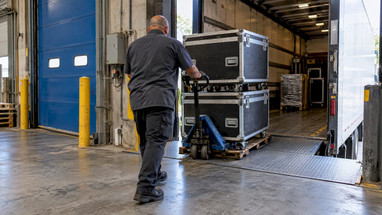
Phoenix Trade Show Delivery: How to Get Your Booth There On Time
Posted by Deeder Dandenhorf on Nov 11th 2026
Phoenix Trade Show Delivery: How to Get Your Booth There On Time

Trade show delivery in Phoenix comes down to three decisions: where your freight goes (advance warehouse or straight to the show), when it has to arrive, and who handles it once it reaches the venue. Get those three right and your booth is standing when the doors open. Get them wrong and you pay late fees or set up with an empty space.
This guide walks through how delivery to the Phoenix Convention Center and other Valley venues works, what to check in your exhibitor manual, how much time to allow, what drives cost, and how to shorten the whole process when your banners and displays are still on order.
TL;DR
- Phoenix Convention Center deliveries run through a marshaling yard check-in, and shipments need a certified weight ticket and Bill of Lading.
- Use the advance warehouse for long-distance, large or complex booths. Direct-to-show suits small, simple shipments with a flexible setup team.
- Plan for freight to reach a warehouse at least two weeks before move-in, and ideally seven to ten business days ahead if graphics need a check.
- Small banner-and-pop-up booths often cost $200 to $600 round trip, but drayage (floor handling) is billed separately by weight.
- Most of our products ship within two business days, and we deliver directly to venues in Arizona.
Table of Contents
- What trade show delivery actually includes
- How delivery to the Phoenix Convention Center works
- Advance warehouse or direct-to-show?
- What to check in your exhibitor manual
- How much time to allow
- What trade show delivery costs
- Preventing damage and delays
- Skip the freight: local delivery in Arizona
- Perspective: why local production shortens your delivery plan
- Get your displays ready for your next Phoenix show
- FAQ
- Sources
What trade show delivery actually includes
Trade show shipping is more than sending a box. It is the logistics behind moving your booth, goods and equipment to and from the show, with exact timing and venue rules that ordinary freight never faces.
The process has three parts, as GES describes it:
- Inbound shipping: getting freight to the venue or an advance warehouse.
- Material handling (drayage): unloading and moving freight from the warehouse or dock to your booth space.
- Outbound shipping: sending everything away after the show.
The piece that surprises first-time exhibitors is drayage. In the U.S., the official service provider is typically the only company authorized to move materials on the show floor, and handling is a chargeable service. That is why your delivery plan starts with the exhibitor manual, not with a carrier quote.
How delivery to the Phoenix Convention Center works
The Phoenix Convention Center loading dock is at 100 N 3rd St, but trucks do not simply pull up to it. For shows serviced by GES, every delivery carrier must check in at the Marshaling Yard at 1102 E Tonto St, Phoenix, AZ 85034 before going to the convention center. Inbound shipments are weighed there, must carry a certified weight certificate and a Bill of Lading, and drivers receive a number and are dispatched to a dock as space opens.
A few practical points follow from that:
- Timing matters. At one show, trucks signing in after 2:00 PM may be charged the overtime rate, and carriers arriving off schedule may be redirected off site until space frees up.
- Requirements vary by show. Marshaling rules differ from event to event, so read your own manual rather than assuming last year’s procedure.
- Paperwork is part of the job. Bills of Lading and Material Handling Agreements are standard, and any error can lead to costly delays or incorrect fees.
Other Valley venues, such as resorts and stadiums, have their own receiving rules. Call the venue’s event services team before you book a driver.
Advance warehouse or direct-to-show?
This is the biggest delivery choice you will make.
Advance warehouse means your materials arrive at a designated warehouse before the show, typically run by the show’s official contractor. It makes sense if you are shipping from far away, your booth is large or complex, or you want a buffer against weather and transit delays.
Direct-to-show sends freight straight to the venue during a set window. It can work if your shipment is small or straightforward, you are shipping from nearby, your setup team is flexible, and you can confidently hit the assigned window.
| Factor | Advance warehouse | Direct-to-show |
|---|---|---|
| Best for | Large, complex or long-distance shipments | Small, simple, nearby shipments |
| Timing risk | Low: freight is waiting before move-in | Higher: you must hit a narrow window |
| Marshaling yard | Handled between warehouse and show | Required for venue delivery |
| Late arrival | Surcharge after the posted deadline | Possible redirect or overtime charges |
If your whole booth is a couple of banner stands, a table cover and a pop-up display, many exhibitors skip freight altogether and bring it in a vehicle or send it by parcel. That is where a local Arizona supplier changes the math, which we cover below.
What to check in your exhibitor manual
Every Phoenix show publishes a service kit or exhibitor manual. The details differ, but the same items show up again and again. Recent Phoenix manuals, such as the Medtrade exhibitor services manual, list:
- The advance warehouse address and receiving hours. Medtrade’s warehouse is at 4301 W Mohave St, Phoenix, AZ 85043, with weekday receiving hours.
- An opening date and a deadline. Freight that arrives after the deadline incurs a surcharge.
- What the warehouse refuses. Uncrated freight, COD shipments, hazardous materials and refrigerated freight are not accepted, and single pieces have weight limits.
- Labeling. Drivers should have the show name, exhibitor name and booth number, and certified weight tickets must accompany all shipments.
The exact dates and limits change every year and with every show, so treat the current manual as the only authority. Put the warehouse deadline and the direct-to-show window on your calendar the day you register.
GES also warns that exhibitors should confirm details with the official provider to avoid surcharges for late-to-warehouse, mixed shipment, uncrated and off-target fees.
How much time to allow
There is no single rule, but the guidance from logistics providers is consistent:
- Arizona-based Brick Dynamics recommends freight reach its local warehouse seven to ten business days before move-in, leaving time for receiving, condition checks and graphics replacement if something is wrong.
- Advance warehouse shipping can typically start up to 30 days before the event, and at least two weeks before move-in is recommended. Without an advance warehouse, you can ship to the venue about a week before move-in day.
Work backward from your move-in date. Subtract transit time, add your production time, then add a buffer. If a new banner or display is part of the plan, production is the step most likely to squeeze the schedule.
A sample timeline for a small booth
- Four weeks out: read the exhibitor manual and note the warehouse deadline and move-in time.
- Three weeks out: finalize artwork and place your graphics order.
- Two weeks out: have everything packed, labeled and shipped to the warehouse, or confirmed for local delivery.
- Move-in day: confirm your delivery window and have a team member at the booth.
- After the show: arrange return paperwork before you leave the floor.
What trade show delivery costs
Cost is where plans fall apart, so separate the pieces.
Drayage. This is billed by weight, usually per hundredweight (CWT), and most shows enforce a minimum charge per shipment. One provider says standard drayage tends to run $60 to $160 per 100 pounds in the U.S., and another puts typical round-trip rates at $60 to $180 per CWT. GES lists its own drayage as billed per 100 lbs with a 300 lb minimum. Your show’s rate card is the number that counts.

Freight. For a small booth of banner stands and pop-up displays in hard cases, shipping typically costs $200 to $600 round trip by parcel or small LTL. A mid-size modular booth with three to five crates usually runs more.
Timing penalties. Late arrival fees and rush shipping add up quickly. Shipping all freight together avoids separate delivery charges, and last-minute expedited shipping can be expensive. Our guide to combining loads and cutting drayage fees goes deeper on this.
The cheapest shipment is usually the lightest one. Lightweight fabric and banner displays that pack into a single wheeled case keep your billable weight low.
Preventing damage and delays
Exhibit materials are often high-value, custom-built or sensitive, and need specialized packing rather than the handling standard cargo gets. A few habits help:
- Use a proper case. A travel case protects banner stands and fabric graphics through handling. We carry trade show display travel cases for banner stands and displays.
- Store graphics carefully between shows. Fabric creases and edges curl when packed badly. See our notes on trade show graphics storage.
- Label every piece. Show name, exhibitor name, booth number and piece count (1 of 3, 2 of 3) on every box.
- Choose experienced help for freight. A generic carrier may lack trade show expertise, so look for a provider with show experience and clear communication.
- Document the arrival. Photograph your crates when they are packed and again when they arrive. If you want to see what a strong booth record looks like, this piece on trade show booth photography shows how to capture a booth well, and the same images help with damage claims.
Skip the freight: local delivery in Arizona
For small and mid-size exhibitors, the simplest delivery plan is to avoid long-haul freight entirely. If your displays are produced in Arizona, they can arrive from across the Valley instead of across the country, with no cross-country transit risk to build into your schedule.
That is the reason many Phoenix exhibitors order from a local supplier. At Arrowhead Sign Company, most of our products ship within two business days. In Arizona we also offer direct delivery to your venue, and we ship nationwide when your event is elsewhere. Before you rely on any venue delivery, confirm with your show’s service desk how outside deliveries are received, since show rules govern what can come through the dock.
A few ways exhibitors use this:
- Last-minute banners. A forgotten logo or a changed booth number is not a crisis when production is fast. Our printed banners page lists a $35 standard banner layout and a $10 Next Day Air option.
- Grab-and-go booths. Quick Ship banner stands and Quick Ship Displays are built for tight timelines.
- Bigger statements. EZ Tube tension fabric displays and printed pop up tents cover bigger spaces and outdoor events.
Still choosing what to bring? Our guides to the best trade show displays in Phoenix and displays across Arizona cover sizes, formats and how to match them to a booth space.
Perspective: why local production shortens your delivery plan
Most delivery stress we see starts with a display that was ordered too late or shipped from too far away. The exhibitor then has to choose between a rush fee and an empty booth.
We built our process around the opposite. Most products ship within two business days, and in Arizona we can deliver directly to your venue. That removes one leg of the journey you would otherwise have to manage: the cross-country trip and the warehouse deadline that comes with it.
Our advice for small businesses: pick a display that packs into one case, order graphics early enough to catch a typo, and keep the plan simple. You will spend less on handling, and your team will spend its energy on the people walking the aisle instead of on a freight tracking page.
Dan
Get your displays ready for your next Phoenix show
If you are planning an upcoming event, start with the display and let the delivery plan follow. Browse our trade show products and displays to find banner stands, tension fabric displays, pop-ups and table covers that fit one case and one schedule.
Need a sign or banner for the booth itself? Our custom signs and banner stands pages show the options, and you can explore the full range from Arrowhead Sign Company.
FAQ
What is trade show shipping?
It is the process of moving your booth displays, equipment and promotional materials to an event venue and back. It involves exact timing, special handling and coordination with show decorators and venue rules. The main stages are inbound shipping, drayage and outbound shipping.
How early should freight arrive in Phoenix?
Follow your show’s advance warehouse deadline first, because late arrivals trigger surcharges. As a general guide, two weeks before move-in is recommended, and one Arizona logistics provider suggests seven to ten business days to leave time for condition checks.
Do I need to check in at a marshaling yard?
For shows at the Phoenix Convention Center serviced by GES, yes. Carriers check in at 1102 E Tonto St and are weighed and dispatched to a dock. Requirements vary by show, so confirm the process in your own exhibitor manual.
Can Arrowhead deliver to my Phoenix venue?
Yes. We offer direct delivery to venues in Arizona, and most products ship within two business days. Confirm your venue’s and show’s receiving rules first, then contact us with your event details so we can plan the delivery around your move-in time.
Sources
- How Trade Show Shipping Works
- Trade Show Logistics Guide for Shipping, Freight & Handling (GES)
- Phoenix Convention Center shipping (NEX EXPO)
- Marshaling Yard, Expresso by GES
- Expresso by GES welcome page
- What Is Trade Show Shipping? (Tradeshow Shipping)
- Advance Warehouse vs Direct-to-Show Shipping
- Medtrade 2026 Exhibitor Services Manual
- NASGW Expo exhibitor kit
- Trade Show Logistics in Arizona (Brick Dynamics)
- Your Ultimate Guide to Trade Show Shipping (Team Phoenix Logistics)
- Trade Show Shipping Tips for 2026 (Phoenix Logistics)
- Trade Show Shipping & Exhibition Logistics Solutions (DTS)
- Trade Show Shipping Costs: Freight, Drayage & Budget (Freightzy)
- Trade Show Shipping Services (BGI Worldwide Logistics)
- Trade Show Booth Photography (Dock Street Blog)