


Why Signage Deadlines Affect Events: A Planner's Guide
Posted by Deeder Dandenhorf on Jul 25th 2026
Why Signage Deadlines Affect Events: A Planner’s Guide

Why signage deadlines are crucial for event success
Signage deadlines are not administrative formalities. They are the structural backbone of a well-executed event, and missing them sets off a chain reaction that touches budget, brand perception, and day-of logistics. The core reason why signage deadlines affect events so directly is simple: production, quality control, approvals, and installation all require time that cannot be compressed without consequence.
Here is what depends on those deadlines:
- Production quality: Standard production timelines span four to six weeks for design approval, material procurement, and quality control. Compress that window and material choices narrow fast.
- Compliance and approvals: Venue safety regulations, branding standards, and accessibility requirements need review time built in before anything goes to print.
- Real-world testing: Signage must be evaluated under actual event lighting and spatial conditions, not just on a screen.
- Installation coordination: Loading dock access, crew scheduling, and venue permissions require confirmed timelines weeks in advance.
- Budget protection: Rush fees typically add 50–100% above standard pricing, plus expedited shipping costs.
Every one of these factors depends on the same thing: starting early enough to do the work properly.
Table of Contents
- What happens when you order signage too late
- How deadlines support quality control and regulatory compliance
- Best practices for managing signage deadlines in event planning
- Arrowhead Sign Company as a trusted partner for event signage
- Your next step toward on-time, on-brand event signage
- Key Takeaways
What happens when you order signage too late
Late signage ordering is one of the most consistent and preventable mistakes in event planning. Experts observe that signage is frequently ordered in the final two weeks before an event, when the brief is rushed and the result is a generic display that does little for brand perception.
The consequences stack up quickly:
- Cost spikes: Rush production fees can double your baseline signage budget before expedited shipping is even factored in.
- Material compromises: Complex or specialty materials simply cannot be produced under compressed timelines. You end up with whatever is available, not what your brand needs.
- Design shortcuts: Rushed briefs produce generic output. There is no time for iteration or refinement.
- Installation conflicts: Venue access, loading dock scheduling, and installer coordination require confirmed plans weeks ahead. Late orders push these into the event build window, creating real-time chaos.
- Compliance failures: Errors in spelling, dimensions, or regulatory language discovered during installation mean on-site reprints, delays, and added expense.
The brand impact is harder to quantify but just as real. At any live event, signage is often the first physical interaction an attendee has with your brand. A rushed, generic sign communicates exactly that.
Pro Tip: Lock your signage brief at the same time you confirm your venue. If your venue is booked, your signage clock should already be running.
How deadlines support quality control and regulatory compliance
Meeting your signage production lead time is not just about getting products delivered on time. It creates the buffer needed to catch problems before they become expensive ones.
Signage ordered four to six weeks out allows for a structured review process that compressed timelines make impossible. That includes internal stakeholder sign-offs, vendor proofing rounds, and physical testing of materials under conditions that approximate the event environment. Skipping that testing phase is where last-minute corrections and poor visibility problems originate.
Critical checkpoints that deadlines protect:
- Design approval: All stakeholders review and sign off on artwork, spelling, dimensions, and branding before production begins.
- Material selection: Adequate lead time allows you to specify the right substrate for outdoor versus indoor use, lighting conditions, and installation method.
- Venue compliance review: Safety signage, emergency exit markers, and accessibility requirements must meet venue and local regulations.
- Visibility testing: Evaluate legibility at realistic viewing distances and under the lighting conditions your event will actually use.
- Placement confirmation: Formal sign-off on placement prevents installation crews from waiting on-site for stakeholder decisions that should have been made days earlier.
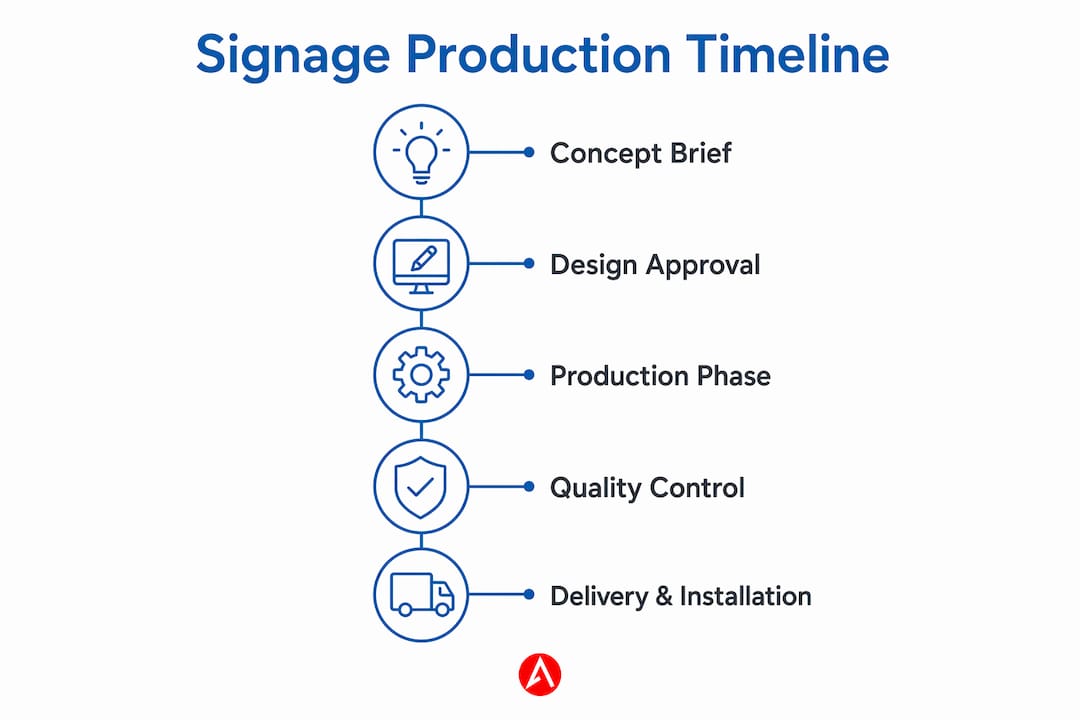
A typical production timeline moves through four phases: concept and brief, design and approval, production and quality check, and delivery and installation. Each phase needs its own time allocation. Collapsing them into one another is where errors enter the process. For guidance on proofing your artwork before it goes to print, Arrowhead Sign Company’s proofing guide for custom signage walks through exactly what to check.
Best practices for managing signage deadlines in event planning
Effective signage timeline management starts well before most event organizers think to address it. The importance of signage timelines becomes clear only after a deadline is missed, which is precisely the wrong time to learn the lesson.
These practices keep your production on track:
- Start at the event design phase: Signage requirements should be mapped during initial event planning, not after the program is finalized. Knowing your venue layout, session structure, and sponsor commitments early shapes your signage scope.
- Establish vendor communication protocols: Agree on response windows, revision rounds, and escalation contacts with your signage vendor before production begins. Ambiguity in communication is a leading cause of delays.
- Build an approval workflow: Identify every stakeholder who needs to review artwork and confirm their availability before the approval window opens. A stakeholder who is traveling during your proofing window can hold up an entire production run.
- Coordinate installation logistics early: Site surveys, venue permissions, and installer scheduling need to be confirmed well before your event build date. Treat signage installation as an operational component, not an afterthought.
- Add contingency time: Build at least one week of buffer into your signage timeline for unforeseen revisions, shipping delays, or vendor issues. Events rarely go exactly to plan, and your timeline should reflect that.
For a deeper look at how signage fits into the broader event flow, the event signage flow guide from Arrowhead Sign Company covers placement strategy and timing in practical detail. Creative event production teams at U LA LA also offer useful perspective on recommended timelines for signage in high-production event environments.
Pro Tip: Add your signage deadlines directly into your master event timeline, not a separate document. When signage milestones sit alongside venue, catering, and AV deadlines, they get the same attention.
Arrowhead Sign Company as a trusted partner for event signage
When the importance of signage timelines is clear, the next question is who you trust to deliver. Arrowhead Sign Company - Signs, Banners and Trade Show Displays is built around the operational reality of event planning: most products ship within two business days, and for Arizona-based events, direct venue delivery is available.
Their product range covers the signage types event organizers rely on most:
- Outdoor Banner Frame (The Banner Bar): An adjustable 6 ft and 8 ft frame designed for temporary outdoor installations. The adjustable design accommodates different banner sizes without requiring custom hardware.
- Signicade Deluxe A-Frame Sidewalk Sign: A durable, portable A-frame with two prints included, suited for directional signage, entry points, and high-traffic areas where visibility matters most.
- 10 ft stretch fabric display: A straight stretch fabric display that delivers a polished, professional backdrop for trade show booths, stage areas, and branded environments.
Fast turnaround reduces the risk that a delayed decision becomes a missed deadline. And because expert-coordinated signage delivery reduces the risk of installation delays in complex event environments, working with a vendor who understands event logistics matters as much as the product itself.
That kind of reliability is not incidental. It is the direct result of a fulfillment process designed around the reality that event deadlines are fixed.
Your next step toward on-time, on-brand event signage
Tight event schedules leave little room for signage surprises. Arrowhead Sign Company - Signs, Banners and Trade Show Displays ships most products within two business days, which means even organizers working with compressed timelines have a reliable path to professional signage without the rush-fee penalty that last-minute ordering typically triggers.
Whether you need an outdoor banner frame for a festival entrance, a fabric display for your trade show booth, or A-frame signs to guide attendees through a venue, the product range covers the formats event organizers actually use. Arizona-based clients benefit from direct venue delivery, cutting one more logistical variable out of your build-day schedule. Browse the full range at Arrowhead Sign Company and get your order in before your next deadline, not after it.
Key Takeaways
Meeting signage deadlines protects event budgets, brand quality, and installation logistics by giving every production phase the time it genuinely requires.
| Point | Details |
|---|---|
| Order four to six weeks out | Standard production timelines span four to six weeks for design approval, material procurement, and quality control. |
| Rush fees can add 50–100% above standard pricing, before expedited shipping costs are added. | |
| Test before the event | Signage evaluated under real event lighting and conditions catches visibility problems before they become on-site corrections. |
| Treat installation as an operation | Site surveys, venue permissions, and crew scheduling must be confirmed weeks before the event build date. |
| Arrowhead Sign Company - Signs, Banners and Trade Show Displays | Ships most products within two business days, with direct venue delivery available for Arizona events. |
Recommended
- The Role of Signage in Event Flow: A Planner’s Guide - Arrowhead Sign Company
- How the Custom Sign Ordering Process Works for Events - Arrowhead Sign Company
- Types of Event Directional Signage: A Planner’s Guide - Arrowhead Sign Company
- Branded Signage for Sponsored Events: 2026 Guide - Arrowhead Sign Company