

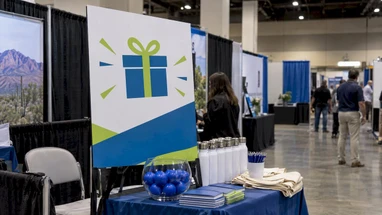
Booth Signage for Giveaways: What to Say and Where to Put It
Posted by Deeder Dandenhorf on Nov 20th 2026
Booth Signage for Giveaways: What to Say and Where to Put It

Good booth signage for a giveaway does three jobs in a few seconds: it shows what people can win, tells them the one thing to do, and gives them a reason to come back. Put a tall banner at the aisle edge for the prize, a short tabletop sign for the action, and keep every word to what a passerby can read while walking. If you are exhibiting in Arizona or on a tight deadline, we print and ship most products within two business days and can deliver straight to your venue.
Below you will find the sign formats that suit a giveaway, wording that gets entries, sizes and placement, and a timeline for ordering so your signs arrive before the show does.
TL;DR
- Lead with the prize and one action. Three seconds of reading time is all a passerby gives you, so one idea per sign.
- Use three layers: a tall banner or backdrop to be seen from the aisle, a counter or tabletop sign for the entry action, and a small sign for the drawing time.
- Letters need to be big: about 1 inch of letter height for every 3 feet of viewing distance.
- Order custom graphics 3 to 4 weeks before the show at the latest, and check venue rules before ordering anything that hangs or stands extra tall.
- Tie the giveaway to a next step, such as a scan, a sign-up or a booked demo, so entries become leads.
Table of Contents
- Why a giveaway needs its own signage
- The three-layer sign plan
- Layer one: be seen from the aisle
- Layer two: tell them what to do
- Layer three: make the entry count
- Sign formats that suit giveaways
- How big should the type be?
- A worked example: a 10 x 10 booth with a prize drawing
- Materials: portable, durable, affordable
- When to order
- Our perspective
- Build your giveaway signs with Arrowhead
- FAQ
- Sources
Why a giveaway needs its own signage
A giveaway is a promise, and a promise only works if people can see it. Visitors walk a trade show floor deciding in moments which booths deserve a stop. If your prize table is covered by a general company banner with a logo and a tagline, the giveaway is invisible from the aisle, and the only people who find it are those already standing in your booth.
There is also a practical reason to treat giveaway signs separately from your main branding. Your back wall tells people who you are. Your giveaway sign tells them why to stop right now. These are different messages with different reading distances, and mixing them produces a crowded sign that does neither well.
If you want a broader view of the main booth graphics before you plan the giveaway layer, our guide to designing eye-catching booth signage covers the foundations.
The three-layer sign plan
Think of a booth as read in three passes. Visitors first see it from across the aisle, then at the booth edge, then in conversation. Map D’s signage guide describes the same three passes, and it maps neatly onto a giveaway.
| Layer | Reading distance | What it says | Best format |
|---|---|---|---|
| 1. Attract | Across the aisle | Prize and one short line | Tall retractable banner, back wall graphic, tension fabric display |
| 2. Invite | At the booth edge | The action: spin, scan, sign up, drop a card | Counter graphic, table throw, tabletop sign, sidewalk or A-frame sign |
| 3. Convert | In conversation | Rules, drawing time, QR code to the next step | Small product sign, handout, QR sign |
Layer one earns the glance, layer two earns the step toward the booth, and layer three turns an entry into a lead. Skip any layer and the giveaway leaks people.
Layer one: be seen from the aisle
Height is the cheapest advantage you have. People in a crowd see over shoulders at about eye level or above, and a sign at table height disappears behind them.
Exhibitor Online’s graphics guide puts mid-range graphics, read from roughly 10 to 50 feet away, at or just above eye level, about 5 to 8 feet off the floor. That is where your prize and headline belong. Short-range graphics, read from 1 to 10 feet, sit at eye level between 5 and 6 feet.
Good formats for this layer:
- Retractable banner stands. They set up in a minute, stand tall and travel in a carrying case. A pair at the front corners of the booth frames your entrance.
- Tension fabric displays. A larger back wall gives you room for a big prize image and a headline above head height.
- Printed pop up tents. For outdoor expos, farmers markets and festivals, a branded canopy can carry the prize message overhead.
Tall signage should also be checked against the venue. Hanging signs usually need show approval and rigging, and some halls limit the height of anything freestanding. The Small Business Expo advises checking the venue’s rigging rules before you order a hanging sign or an extra-tall retractable banner. Your exhibitor manual lists the limits, so read it before you pick a size. Our notes on how exhibitors choose banner heights and pop up display sizes help you match the display to the space.
Layer two: tell them what to do
Once someone slows down, the sign must answer three questions without a word from you: what can I win, what do I do, and when will I know.
A useful template is incentive, action, hashtag or next step. At A Photo Booths recommends that sort of sign for social giveaways and notes that a short call to action such as “Tag to Win!” works better than a long list of rules. The same logic applies to a prize drawing at a trade show.
Sample giveaway wording
- Win a $250 gift card. Scan to enter. Drawing at 2 pm.
- Free sample kit. Drop your card in the bowl.
- Spin to win. Every spin gets a prize.
- Win a pair of tickets. Book a 10-minute demo to enter.
Notice what each line leaves out: no paragraph of terms, no second offer, no three different ways to enter. Choose one primary action. Competing instructions slow people down, and a slow decision usually becomes no decision.
Give people a reason to return
Timed drawings turn a single glance into a second conversation. Gather Shot’s booth guide suggests hourly prize drawings with a line like “Come back at 2pm for the main giveaway.” A small sign with the next drawing time is easy to update by hand and gives your team a natural opening when people return.
Keep the rules short but real
If your giveaway is a sweepstakes with a meaningful prize, rules can apply. US promotion law generally asks whether a promotion combines prize, chance and consideration, and Brandmovers’ legal overview explains that federal and state rules differ by promotion type. Put “no purchase necessary” on a sweepstakes where it applies, keep a short rules sheet at the booth, and check your state’s rules or ask an attorney before running a large prize drawing.
Layer three: make the entry count
A giveaway that collects only names is half finished. The most useful giveaway signs link the entry to a next action. A QR code on the counter sign can take people to a sign-up page, a booking calendar or a short offer, and you see which signs bring people in.
Two practical points on QR codes: give people a reason to scan, since “scan to enter the drawing” is a reason and “scan here” is not, and test the code before the show on the printed size, not only on screen. Our guide to booth QR codes that become trackable leads walks through how to set that up so each scan is attributable.
The call to action itself is a skill worth refining. This guide to compelling CTAs covers the principles of wording a clear next step, and they carry over from web pages to signs.
One more point from event marketers: the sign opens the door, but your team has to be ready to walk through it. Everyone staffing the booth should be able to explain the giveaway the same way in one sentence. If a visitor asks “how do I win?” and gets three different answers, the sign has done its job and the booth has not.

Sign formats that suit giveaways
Not every sign type earns its place in a giveaway setup. Here is how the common ones compare.
| Format | Job in a giveaway | Where it goes |
|---|---|---|
| Retractable banner | Names the prize from the aisle | Front corners or beside the table |
| Tension fabric display | Large prize graphic and headline | Back wall or side wall |
| Printed table throw | Puts the offer on the surface where people enter | Front of the prize table |
| Tabletop or counter sign | The action and the drawing time | Beside the entry bowl or scanner |
| Sidewalk or A-frame sign | Pulls traffic from a nearby walkway at outdoor or lobby events | At the edge of your space |
| Vinyl banner | Large, low-cost message for fairs and outdoor spaces | Across the front or on a fence |
| Flags | Motion and color that mark the spot at outdoor events | Beside your tent |
If you need a starting point for the full set, signs every small business needs for trade shows and 7 display ideas to attract visitors go deeper on combinations.
How big should the type be?

This is where most giveaway signs fail. A sign that looks fine on your computer screen can be unreadable from the aisle.
Exhibitor Online gives two rules worth keeping: keep headlines to six words or fewer, and allow about 1 inch of letter height for every 3 feet of viewing distance. Here is what that means in practice.
| Viewing distance | Minimum letter height |
|---|---|
| 6 feet (counter sign) | 2 inches |
| 15 feet (booth edge) | 5 inches |
| 30 feet (aisle) | 10 inches |
The Small Business Expo suggests keeping text large and short enough to read from 30 feet away. If your prize line cannot be set 10 inches tall on your banner without wrapping to four lines, shorten the line, not the letters.
A few more design habits:
- Contrast first. Dark letters on a light background or the reverse. Avoid thin script fonts and pale colors on photos.
- One hero. One prize image or one number, not a collage.
- Clear center. Leave the middle of the sign uncluttered so the main message reads from the aisle.
- Resolution. Send artwork at print size or as vector files so large letters stay sharp.
For the reasoning behind long-, mid- and short-range sizing, sign size, fonts, layout and placement is a useful companion when you plan the lettering.
A worked example: a 10 x 10 booth with a prize drawing
Say you run a local landscaping company at a home and garden expo, and you will draw one winner of a $250 service credit every hour.
- Aisle layer. Two retractable banners at the front corners. Left banner: your logo and company name. Right banner: “Win a $250 landscaping credit” in large letters, with a photo of a finished patio.
- Table layer. A printed table throw with your logo, plus a tabletop sign reading “Scan to enter. Drawing every hour on the hour.”
- Follow-up layer. A small sign by the entry bowl: “Next drawing: 2 pm.” You change the time by hand each hour.
- Lead layer. The QR code leads to a short form that asks for name, email and the type of project, so the follow-up call after the show starts with context.
The visitor sees the prize from the aisle, understands the action from the table, and returns at the posted time. That is three signs doing three clear jobs, with no one reading a paragraph.
Materials: portable, durable, affordable
Match the material to where you will use the sign.
- Indoor shows, frequent travel: retractable banners and fabric displays pack down small and fit in a carrying case, which suits exhibitors who load their own car.
- Outdoor events: vinyl banners, printed tents, flags and frames are built for outdoor display, and sidewalk signs give you a swappable message at the entrance.
- Reusable giveaway messages: If your prize changes by event, put the permanent brand on the large display and use smaller, lower-cost signs for the prize line so you do not reprint the whole wall.
That last point saves money. Keep the expensive, permanent graphics evergreen, and make the giveaway sign the part you can replace. A standard banner layout is $35 when you order a printed banner, which makes a dedicated prize banner an inexpensive add-on to your main display.
When to order
The Small Business Expo recommends planning booth design and giveaways 6 to 8 weeks out, with custom graphics ordered no later than 3 to 4 weeks before the show. Work backward from your show date:
| Timing | Task |
|---|---|
| 6 to 8 weeks out | Choose the prize and the entry method, read the exhibitor manual for size limits |
| 4 to 5 weeks out | Write the wording, confirm the sizes, gather logo files |
| 3 to 4 weeks out | Place the order for custom graphics |
| 1 week out | Test the QR code on the printed proof, pack the signs, set up the bowl, markers and rules sheet |
Plans change, and sometimes a prize is confirmed late. Most of our products ship within two business days, and Next Day Air is available for a $10 fee on printed banners, so a late decision does not have to mean a missing sign. In Arizona, we can deliver directly to your venue.
Our perspective
Most giveaway signs we see fail for the same reason: they try to say everything. The business wants to name the company, list the services, announce the prize, explain the rules and promote the website, all on one banner.
Our advice is to split the work. A tall banner carries the prize. A table sign carries the action. A small sign carries the time. Each one is easy to read, and together they tell the whole story.
We built our product range around that way of working. Retractable banners, banner stands, fabric displays, printed table covers and tents fit together, so you can build the three layers from one place, and most orders ship within two business days. For small businesses working to a show date, that speed matters as much as the design.
If you are unsure which sizes suit your booth, start with the space you have and the venue limits, then pick the signs. It is a simpler path than starting from a pile of ideas.
Dan
Build your giveaway signs with Arrowhead
If your show is coming up, start with the banner that names your prize. Our printed banners come with a standard banner layout for $35, and banner stands put that message at eye level. For a full booth, browse trade show products and displays, or choose quick ship displays when your timeline is short. Most products ship within two business days, and we deliver direct to venues in Arizona.
Add a printed table throw for the entry table and a sidewalk sign for outdoor spaces, and your giveaway has every layer it needs. Our brand visibility checklist for exhibitors is a good last pass before you pack.
FAQ
How much text should a giveaway sign have?
Aim for one idea that can be read in about three seconds. A headline of six words or fewer, such as “Win a $250 gift card,” plus one line for the action, is enough. Put rules and details on a small sheet or a page behind a QR code.
Where should I put the giveaway sign?
Put the prize message at or just above eye level, roughly 5 to 8 feet off the floor, so it reads over the crowd from the aisle. Put the entry instructions on the table or counter at the point where people act. Keep short-range signs between 5 and 6 feet if they are mounted on a wall or stand.
Should I print a new banner for every show?
Not necessarily. Keep your brand graphics permanent and print the prize line on a separate, smaller banner or sign. That lets you change the offer for each event without reprinting your main display.
Do I need to include rules on the sign?
A short call to action goes on the sign, and the full rules go on a separate sheet at the booth. For sweepstakes, include “no purchase necessary” where the rules require it, and check your state’s requirements or speak with an attorney before running a high-value drawing.
How late can I order signs for a show?
A safe target is 3 to 4 weeks before the show for custom graphics. If you are past that, ask about our quick ship options. Most of our products ship within two business days, and Next Day Air is available for $10 on printed banners.
Sources
- A Rookie’s Guide to Graphics, Exhibitor Online
- 17 Trade Show Booth Ideas For Real Engagement, The Small Business Expo
- Trade Show Booth Ideas for 2026, Gather Shot
- Turn Guests into Your Free Marketing Team via Tag-to-Win, At A Photo Booths
- The Complete Legal Guide For Running Sweepstakes, Contests, and More, Brandmovers
- Trade Show Signage: Banners and Hanging Signs, Map D