

Event Signage Budget: How to Plan and Spend It in 2026
Posted by Deeder Dandenhorf on Nov 25th 2026
Event Signage Budget: How to Plan and Spend It in 2026
A good event signage budget starts with the attendee, not the sign catalog. List the places where people have to make a decision, fund those signs first, then spend what remains on branding that you can reuse at the next event. Add the costs that surprise first-time buyers: layout, shipping, setup, storage and rush fees. Order inside normal production time, and you keep most of the budget for the signs that matter.
This guide is for small business owners, exhibitors, festival and craft fair organizers, church event teams and marketers who need signs that look professional without a blank check. At Arrowhead Sign Company we ship most products within two business days, so a late order does not have to become an expensive one. The best budget, though, is the one you make before the deadline.
TL;DR
- Budget by function: wayfinding and safety first, operational messages second, branding and sponsor recognition third.
- Count signs from your site map, one for every decision point, instead of guessing from attendance.
- Plan for the hidden lines: layout, freight, setup, storage, permits and rush charges.
- Choose reusable hardware (stands, frames, tension fabric) and swap only the printed graphic from event to event.
- Outdoor and temporary signs can need a permit, so check your city before you print.
Table of Contents
- Start with what attendees need, not what looks good
- How many signs do you actually need?
- Where the money goes: a line-item budget
- The costs that surprise first-time buyers
- Make every sign work more than once
- Match the sign to the event
- Check the rules before you print outdoor signs
- A timeline that protects the budget
- Our view on signage budgets
- Build your signage order with us
- FAQ
- Sources
Start with what attendees need, not what looks good
Event signage means every visual display that gives information, gives directions, reinforces your brand or shapes the attendee experience. Event glossaries include directional signs, room identifiers, banners, sponsor boards and informational posters in that definition. For a small event that can be as simple as a booth banner, a sidewalk sign and a table cover.
The mistake that blows budgets is buying by excitement: a big hero backdrop, then nothing left for the arrow that tells people where parking is. Reverse it. Walk through your event as a guest, from the street to the exit, and write down every moment a person might hesitate. Those moments get funded first.
A simple priority ladder works for almost any event:
- Safety and access. Entrances, restrooms, first aid, accessible routes, no-entry areas.
- Wayfinding. Parking, registration, vendor rows, stages, session rooms.
- Operations. Hours, schedules, rules, pricing and payment information.
- Brand and sponsors. Backdrops, booth graphics, sponsor recognition, photo areas.
If you must cut something, cut from the bottom of the list, and cut the size before you cut the sign.
How many signs do you actually need?
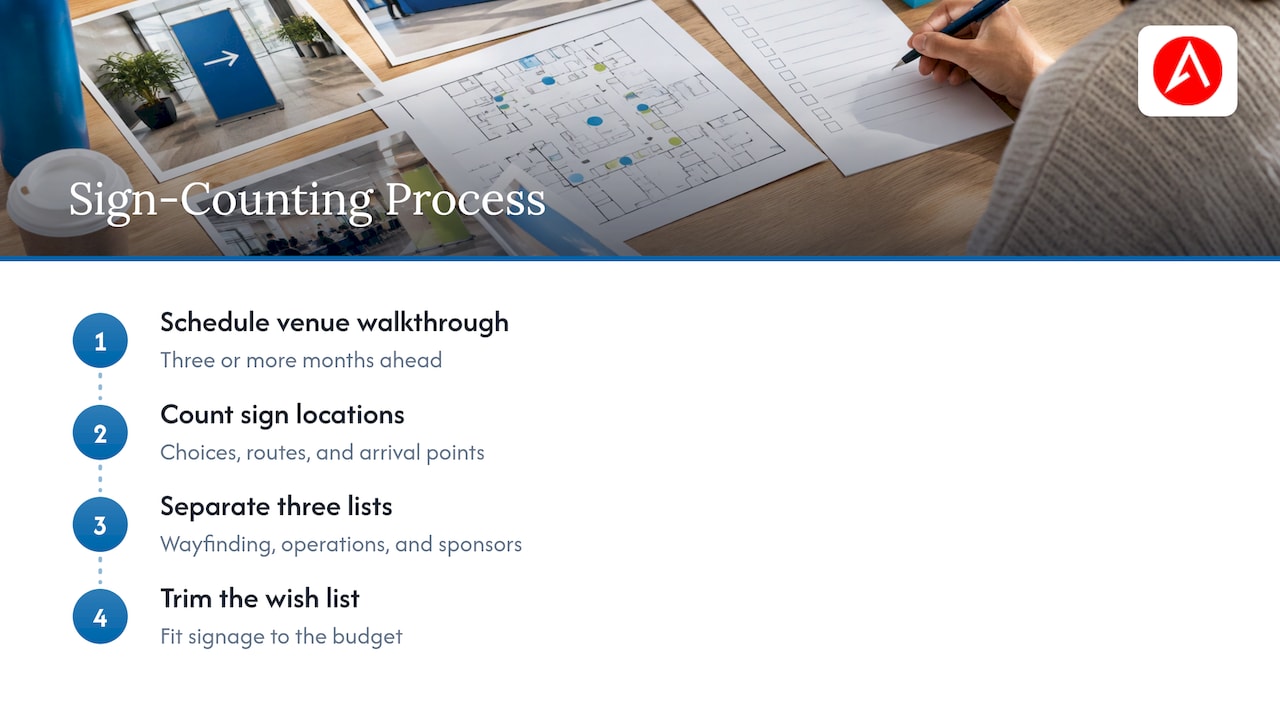
There is no reliable rule such as “one sign per 50 guests.” The number comes from your layout. Count three things on your site map: every place an attendee has to choose a direction, every route that reaches that place from a different side, and every destination that needs a sign confirming people have arrived. Keep three separate lists, one for wayfinding, one for operations and one for sponsors, so you can see what each costs.
Do this early. The Meeting Professionals International (MPI) report Signs for the Times recommends a venue walkthrough three or more months ahead to find directional sign areas, rigging points and, for outdoor signs such as street banners, permit requirements and deadlines. It then suggests turning the findings into a wish list that you trim to fit the budget. That wish list is your budget document.
For a craft fair or festival, the count is usually driven by the entrance, the vendor map and the edges where cars and pedestrians meet. For a church event, it is often the parking lot, the welcome table and the door to each room. For a trade show, it is your booth: a backwall or display, one or two banners, a table cover and a sign that states your offer in a few words.
If juggling the checklist, vendors and deadlines is the hard part, a timeline for running an open house like a campaign shows how organizers work backward from the event date, which is the same habit that keeps signage orders on schedule.
Where the money goes: a line-item budget
Prices vary with size, material, quantity and turnaround, so build the budget from quotes rather than from a generic average. Here is the structure we suggest, with the questions that set each line.
| Budget line | What drives the price | Smart way to save |
|---|---|---|
| Layout and design | Number of different layouts, whether you supply print-ready art | Reuse one brand system across every sign |
| Printed banners | Size, material, hems and grommets, quantity | Order matching sizes so layouts can be reused |
| Hardware: stands, frames, tents | Portability, outdoor use, wind rating | Buy hardware once, swap graphics |
| Trade show displays | Display type, graphic size, case or bag | Choose a display that fits more than one booth size |
| Sidewalk and directional signs | Number of faces, weather exposure | Use changeable inserts instead of new signs |
| Shipping and delivery | Weight, speed, destination, venue delivery | Ship early, to one address |
| Setup and takedown | Ladders, labor, installation time | Choose signs one person can assemble |
| Permits and fees | City, sign size, duration | Check rules before ordering |
| Storage and disposal | Where reusable items live between events | Plan it before the event |
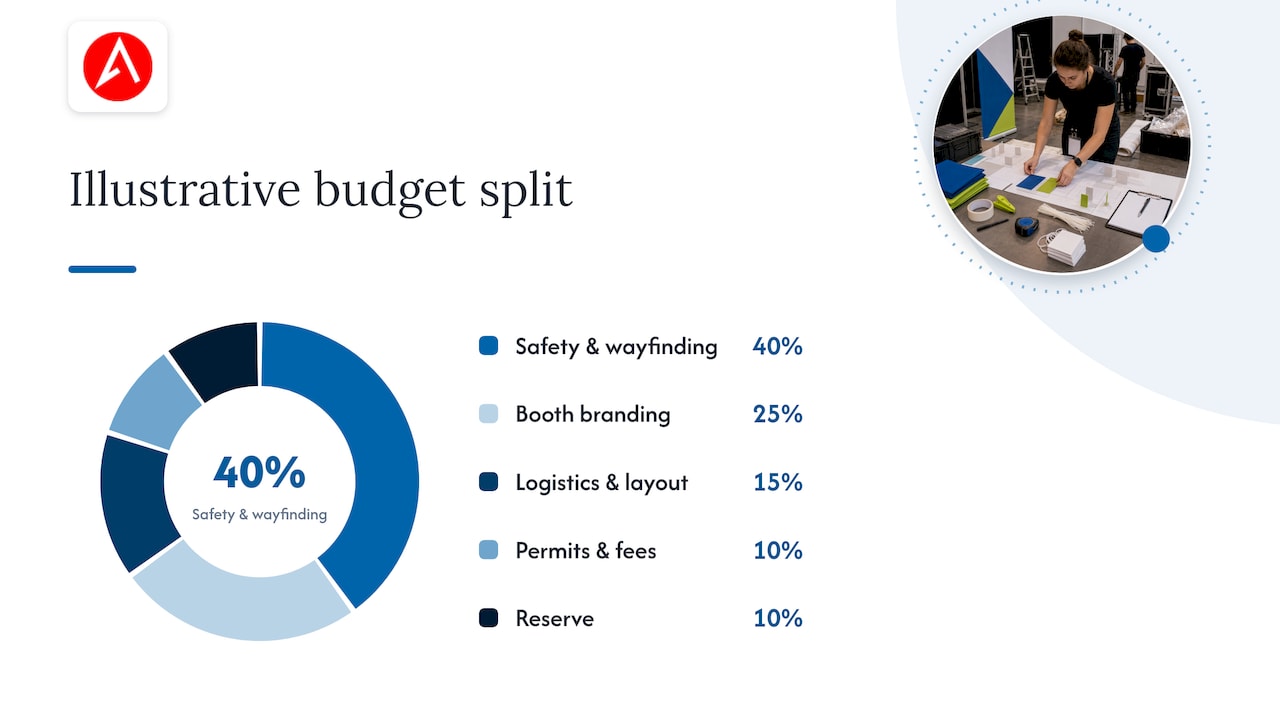
A small worked illustration, for planning only: imagine a one-day outdoor fair with a signage pot of $1,000. You might set aside roughly 40% for safety and wayfinding signs, 25% for the booth or entrance branding, 15% for shipping, setup and layout, 10% for permits or fees, and keep 10% as a reserve. Those percentages are a starting frame, not a market price. Replace them with real quotes as soon as you have them.
On our site, a standard banner layout is $35 one-off, and Next Day Air is $10 on the printed banners page. Knowing those two lines up front makes the banner part of your budget easy to total.
The costs that surprise first-time buyers
The price of the sign is rarely the price of having the sign. These are the lines people miss.
Design and layout
Every distinct item needs its own layout: backwall, banners, table cover, flags, sidewalk sign. If they are designed separately they often disagree on colors, logo placement and wording. Start with one logo lockup, one or two brand colors and one headline, and then adapt it to each size. That keeps design time down and makes the whole booth look intentional.
Shipping and delivery
Freight is the line most often left off. Large rolled graphics are light, but stands, frames and tents are not. Decide early where everything is going: your office, the venue or your hotel. We offer direct venue delivery in Arizona and nationwide shipping, and most products ship within two business days, so you can work back from your setup day with a clear window. Shipping to a venue also means someone has to receive the boxes, so confirm the venue’s receiving hours and any storage fee.
Setup and takedown
Signs that need ladders, drills or two people cost labor. Signs that a single person can assemble in minutes do not. For outdoor events, also think about weights, stakes or ballast for wind. Our guide on how event signage is installed walks through the practical side so you can budget the time as well as the product.
Rush production
The most avoidable cost in signage is urgency. When you leave the order to the last week, you either pay for faster service or settle for fewer choices. Our article on why signage deadlines affect events explains how late approvals ripple through production and delivery. Set an internal artwork deadline at least a week before you need the boxes in hand.
Storage and disposal
MPI’s report reminds planners that what goes up must come down, and recommends planning for storage, donation, recycling or disposal before the event. If a sign has a second life, budget a bin or a closet for it. If it does not, know where it will go.
Make every sign work more than once
Reuse is the strongest lever in any signage budget, and you control it at the design stage.
Buy hardware once, change the message. A banner stand, a tension fabric frame or a pop-up tent frame can carry a new graphic next year. The frame is the part you pay for once. Our banner stands and EZ Tube tension fabric displays are built around that idea: portable hardware that sets up for the next show.
Design evergreen graphics. Leave the date, year and price off anything you want to use again. Put “Spring Craft Fair” on a changeable insert, not on the banner itself. Logos, a tagline and your website are the evergreen core.
Keep wayfinding generic. Arrows, “Parking,” “Registration” and “Restrooms” work at every event you ever run. Print them once on durable material.
Match sizes. If your banners share a size, they can swap places between indoor and outdoor use, or between two booths.
Think about materials. MeetGreen’s sustainability director, Shawna McKinley, advised in the MPI report that you invest in durable signage reused year to year, with planned storage, and choose recyclable substrates such as cardboard or wood fiberboard for single-use pieces. Use that split: durable for the signs you will keep, paper-based for the signs with an expiration date.
Match the sign to the event
Trade shows and expos. Your budget is your booth. A display with a large graphic, a banner stand for a secondary message and a printed table cover give you a complete look in a standard space. Our guide to the signs every small business needs for trade shows lists the essentials, and the Quick Ship Displays line is built for tight timelines.
Festivals and craft fairs. Outdoor durability matters more than finish. Vinyl banners, a banner frame and a printed pop-up tent give you a recognizable spot in a crowd. Our outdoor event signage best practices covers wind and placement.
Church and community events. Wayfinding, a welcome banner and a sidewalk sign for the street usually cover it. Keep the date off the hardware so the same frame serves your next three events.
Seasonal and holiday events. Treat the seasonal graphic as the disposable part and the stand as the permanent part.
Sponsored events. Sponsor recognition has to be on the budget from the start because sponsors expect their logos to be correct. See our branded signage for sponsored events guide for how to plan it.
Check the rules before you print outdoor signs
Temporary and outdoor signs can need permits, and the cost differs by city. A few examples show the range:
- New York City. The city’s 2026 event permitting guide makes it illegal to display a placard, flag, banner or sign in a city park without a Parks Department permit.
- San Antonio. The city’s sign permit information bulletin IB 191 lists a $50 inspection fee and a $50 plan review fee, with additional charges by area and height for freestanding signs.
- Florida special oversight district. The district’s event planning guide requires engineered plans signed and sealed by a Florida-licensed engineer for outdoor structures and temporary units exposed to wind loading.
Fire rules matter too. Tents, canopies and decorative materials may need proof of flame resistance in some cities. Call your city’s permit office or fire marshal, and ask the venue for its signage rules, before you order. A permit line belongs in the budget even if it turns out to be zero.
A timeline that protects the budget
- Three or more months out: walk the venue, map decision points and draft the wish list.
- Eight to ten weeks out: confirm permits, sponsor requirements and quantities.
- Four to six weeks out: finalize layouts and approve proofs.
- Two to three weeks out: order, with shipping to the right address.
- One week out: receive, unpack and check every item against your list.
- After the event: pack, label and store the reusable pieces.
Our signage in event flow guide helps with step one, and the one on choosing promotional signage helps with step two.
Our view on signage budgets
Most budget trouble we see starts with a rush, not with a price. A banner that is approved a week early costs less in stress and in choices than the same banner ordered at the last minute.
Our advice is simple. Put your money into a few signs that work hard: a strong display or banner stand, a clear sidewalk or directional sign and a table cover that ties it together. Choose hardware that you can use again, and change only the graphic. That is why we built our range around banners, stands, tension fabric displays and printed tents that set up quickly and travel well.
Speed matters, too. Most of our products ship within two business days, and in Arizona we can deliver directly to the venue. That gives you room to proof your artwork properly instead of rushing it.
Dan
Build your signage order with us
If your list is ready, start with the pieces that carry the most weight. Our printed banners come with a $35 standard banner layout and an optional $10 Next Day Air, and our Trade Show Products & Displays range covers retractable banners, tension fabric displays and pop-up options for a complete booth. For outdoor events, see our printed pop-up tents and banner frames.
We ship nationwide, with most products leaving within two business days, so you can plan a full signage set around your event date.
FAQ
What is a realistic signage budget for a small event?
There is no single figure, because the number of decision points, sign sizes and shipping distance drive the total. Count the signs you need from your site map, get line-item quotes and add shipping, setup, permits and a reserve. A 10% reserve for corrections and late changes is a sensible planning buffer.
What should I buy first if money is tight?
Buy the signs that keep people safe and moving: entrances, parking, registration and restrooms. Then fund one strong branded piece, such as a banner stand or display, that you can use at future events. Sponsor and decorative signs come last.
How do I lower signage costs without lowering quality?
Reuse hardware, design evergreen graphics and order inside normal production time. Keep dates and prices on changeable inserts and use matching sizes. Combine your orders into one shipment to cut freight.
Do I need a permit for temporary event signs?
Often, yes, especially for outdoor signs, signs on public property or large freestanding signs. Rules differ by city, so check with your local permit office before you print. Budget for any fees and allow time for approval.
What counts as event signage?
It covers any display that informs, directs, brands or recognizes sponsors at an event. Common examples are banners, banner stands, sidewalk signs, directional signs, table covers, backdrops, flags and room signs.
Sources
- What Is Event Signage? Event Glossary
- Signs for the Times, MPI
- Comprehensive Event Permitting Guide for the City of New York, 2026
- IB 191 Sign Permit Application, City of San Antonio
- Special Event and Convention Planning Guide, 2026
- Run Public Open Houses Like a Campaign: Timeline for Organizers