


Why Your Exhibit Planning Timeline Matters
Posted by Deeder Dandenhorf on Aug 11th 2026
Why Your Exhibit Planning Timeline Matters

Start planning a major trade show 9–12 months out, a medium-complexity exhibit 6–8 months out, and standard custom signage at least 4–6 weeks before your show date. For last-minute needs, fast-turnaround options like rental displays and expedited print orders can ship in as few as 1–5 business days. Understanding why exhibit planning timeline matters isn’t just reassuring. It’s the difference between a polished booth that generates leads and a scrambled setup that costs twice as much and delivers half the impact.
Three actions to take right now:
- Pull your exhibitor manual and note every hard deadline: space confirmation, graphics submission, electrical, rigging, and drayage cutoffs.
- Lock your booth space. Premium corner locations near entrances can draw significantly more foot traffic than mid-aisle spots, and those spaces go fast.
- Start your display artwork and submit it for proofing with your vendor. Production cannot begin until art is approved, and that approval window eats into your lead time every day it sits open.
GES recommends starting major show planning 9–12 months out, setting a comprehensive budget, and aligning sales goals before any display orders are placed. Expo Pass recommends starting at least 12 weeks before the event and building a contingency buffer of roughly 10–15% into your budget for rush fees and unexpected shipping costs.
Pro Tip: Set a calendar reminder the moment you register for a show. The clock starts then, not when you feel ready.
Key Takeaways
A structured exhibit planning timeline is the single most effective way to avoid rush fees, missed show deadlines, and last-minute display compromises.
| Point | Details |
|---|---|
| Start early for major shows | Begin planning 9–12 months out for large shows; 12 weeks minimum for any exhibit. |
| Budget a contingency | Reserve 10–15% of your exhibit budget for rush fees and unexpected shipping costs. |
| Approve artwork fast | Production starts only after art approval; each revision round adds 1–2 days to your lead time. |
| Track organizer deadlines | Drayage, rigging, and electrical cutoffs are hard stops with real financial penalties for missing them. |
| Arrowhead for tight timelines | Arrowhead Sign Company - Signs, Banners and Trade Show Displays ships most products within two business days, with direct Arizona delivery available. |
Table of Contents
- What does a trade show planning timeline look like?
- Which show-organizer deadlines should you track?
- How long does it take to produce custom displays and signage?
- How does your timeline directly affect your exhibit budget?
- Who needs to approve what, and when?
- How do you protect your timeline when things go wrong?
- When should you rent, expedite, or go custom?
- What the timeline actually teaches you about your show strategy
- Your timeline is tight — here’s how Arrowhead delivers
- Sources
What does a trade show planning timeline look like?
The importance of exhibit planning becomes concrete when you map each deliverable to a specific time window. Here’s how the phases break down:
| Planning Window | Key Tasks |
|---|---|
| 9–12 months out | Register for the show, lock booth space, set budget, align sales goals, begin custom booth fabrication RFPs |
| 6–8 months out | Finalize booth design, confirm display types, order large-format fabric backdrops and SEG frames |
| 3–8 weeks out | Order retractable banners, table covers, printed collateral, promotional products; submit artwork for proofing |
| 1–5 business days | Expedited banner prints, rental displays, last-minute replacements via fast-ship vendors |
Critical hard-deadline items that must be tracked separately:
- Space reservation: Often closes 6–12 months before the show. Missing it means losing your preferred location.
- Rigging and electrical: Advance deadlines from the show organizer, typically 4–8 weeks out. Late requests incur premium labor rates or may be denied entirely.
- Drayage (material handling): The advance warehouse window usually closes 1–2 weeks before move-in. Shipments arriving after the cutoff go to a more expensive direct-to-show rate.
- Graphics submission: Some shows require digital files weeks before move-in for approval.
Trade Show Labs’ 90/60/30-day framework maps this well: at 90 days, set goals and book your booth; at 60 days, finalize designs and order promotional items; at 30 days, pack and prepare to ship.
Pro Tip: Build your internal deadlines two weeks ahead of every vendor or show-organizer deadline. That buffer absorbs approval delays without pushing you into rush territory.
Which show-organizer deadlines should you track?
The exhibitor manual is your show’s rulebook. It contains floor plans, service order forms, and hard cutoff dates for every operational service. Missing one doesn’t just cause inconvenience. It can mean your signs can’t be hung, your electrical isn’t connected on move-in day, or your freight sits in a holding area at a premium rate.
Key terms to know:
- Drayage: The material handling fee charged by the show’s official contractor to move freight from the loading dock to your booth. The advance warehouse deadline controls whether you pay the standard rate or a higher direct-delivery rate.
- Rigging: Any overhead hanging sign or banner requires advance approval and a certified rigger. Miss the deadline and the sign stays on the floor.
- Lead retrieval: Badge-scanning equipment must be reserved in advance. Last-minute rentals are often unavailable or cost more.
- Advance warehouse: A pre-show storage facility where freight can be delivered before move-in. Shipments must arrive within a specific window, typically 1–2 weeks before the show opens.
Checklist for reviewing your exhibitor manual:
- Identify the show’s general service contractor (GSC) and download the full manual.
- Flag every deadline with a date and assign an owner on your team.
- Note which services require advance payment or deposits.
- Confirm move-in and move-out hours and whether early access is available.
Barrett Exhibition advises using a detailed exhibitor checklist, training staff before move-in, and checking venue rules carefully. Clear objectives lead to better design decisions and fewer on-site problems.
How long does it take to produce custom displays and signage?
Production lead times vary by product type and complexity. The exhibit timeline significance here is direct: every day you delay artwork approval is a day subtracted from production, not added to it.
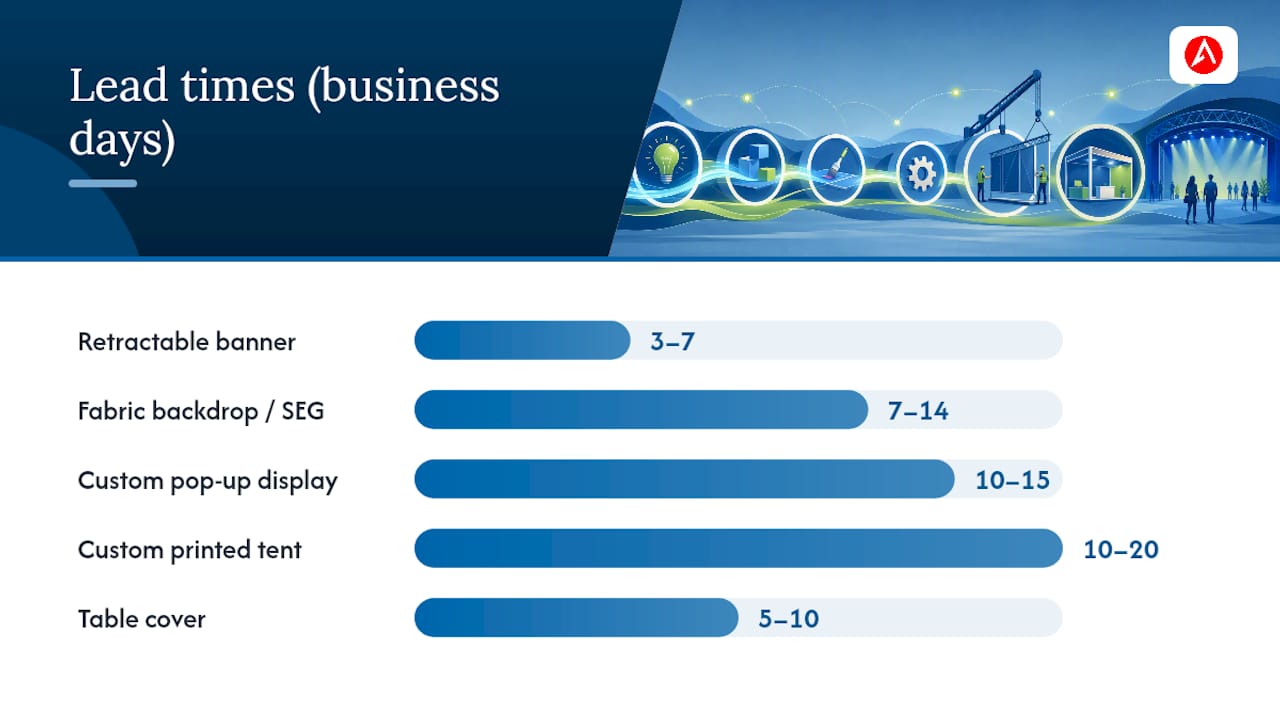
Typical lead times for common items:
- Retractable banners: 3–7 business days after art approval
- Fabric backdrops and SEG frames: 7–14 business days
- Custom pop-up displays: 10–15 business days
- Custom printed tents: 10–20 business days
- Table covers: 5–10 business days
- Proof turnaround: 1–2 business days per revision round
| Item | Art-Approved Lead Time | Late-Approval Impact |
|---|---|---|
| Retractable banner | 3–7 business days | Rush fee; possible missed ship date |
| Fabric backdrop/SEG | 7–14 business days | Expedited production adds cost |
| Custom tent | 10–20 business days | May not arrive in time without air freight |
| Table cover | 5–10 business days | Rush print available at premium |
“Art approved” and “order confirmed” are two different milestones. Your order is not in production until both are complete. Submitting artwork that requires multiple revision rounds can push your production start by a week or more. Finalizing artwork 4–6 weeks before your event for most print items is a reliable target. Confirm delivery timelines at least two weeks before your shipping window closes.
Trade Show Labs also recommends a simple readability check: headlines should be readable from ten feet, with high-contrast text and a minimum of approximately 24-point type for show-floor legibility. Catching this in the proof stage costs nothing. Reprinting after delivery costs real money.
Pro Tip: Submit print-ready files in the vendor’s required format (PDF/X-1a or PDF/X-4 are common) with bleeds and crop marks set. Clean files skip the revision round entirely.
How does your timeline directly affect your exhibit budget?
Late decisions compound costs fast. Expedited production, rush shipping, and premium labor rates can each add meaningfully to your original budget line. Expo Pass recommends a contingency buffer of roughly 10–15% to absorb these last-minute costs without derailing the overall spend.
Common cost drivers tied to timeline:
- Expedited production: Rush fees typically apply when lead time is compressed below standard.
- Air freight vs. ground shipping: A banner that ships ground for a modest cost can cost several times more via overnight air.
- Premium booth locations: Corner and entrance-adjacent spaces fill early. Corner booths and high-traffic locations can pull 30–50% more foot traffic than mid-aisle spots, so missing the early registration window has a direct ROI impact.
- Last-minute labor: On-site setup labor booked at the show is priced at a premium compared to pre-scheduled rates.
For the rent-vs.-buy decision, timeline is often the deciding factor. If you have fewer than three weeks, a rental display or a fast-ship modular unit is usually the smarter financial choice than a custom build you can’t receive in time.
Pro Tip: Track your total exhibit spend in a single spreadsheet that includes production, shipping, drayage, labor, and contingency. Seeing the full number early prevents budget shock at the show.
Who needs to approve what, and when?
A well-run exhibit plan has clear ownership at every stage. Internal delays are the most common reason vendor deadlines get missed, and they’re entirely preventable.
Typical roles and sign-off windows:
- Show lead (marketing manager or event coordinator): Owns the exhibitor manual, space reservation, and all show-organizer deadlines. Must act within the 9–12 month window for major shows.
- Creative approver (brand manager or designer): Signs off on all artwork before vendor submission. Must approve proofs within 24–48 hours of receipt to protect production schedules.
- Finance sign-off (controller or CFO): Approves the exhibit budget and any rush-fee overages. Should be looped in at the 6–8 month mark, not the week before the show.
- Logistics coordinator: Manages shipping, drayage, and advance warehouse bookings. Owns all freight deadlines from 8 weeks out.
- Onsite lead: Confirms move-in/move-out schedules, staff assignments, and setup checklists. Briefed at the 30-day mark.
Compact approvals checklist:
- Space reservation confirmed (9–12 months out)
- Budget approved and contingency line added (6–8 months out)
- Display design finalized and submitted for proof (6–8 weeks out)
- Artwork approved and order placed (4–6 weeks out)
- Drayage and advance warehouse booked (4–6 weeks out)
- Shipping labels and freight documents prepared (2 weeks out)
- Staff briefed and lead-retrieval equipment reserved (1–2 weeks out)
Convert this list into a shared project management tool like Asana, Trello, or a simple Google Sheet with due dates and assigned owners. Every item should have one person responsible, not a team.
Pro Tip: Use your trade show display checklist as the master document and link it to your calendar invites so deadline owners get automatic reminders.
How do you protect your timeline when things go wrong?
Delays happen. Freight gets held. Vendors miss production windows. A file gets corrupted in transit. The exhibitors who handle these situations well aren’t lucky. They planned for them.
Common delay causes and practical buffers:
- Fabrication delays: Add 3–5 business days to any custom build estimate. Complex structures with custom graphics are the most vulnerable.
- Shipping delays: Ground freight across the country can take 5–7 business days. Build that into your ship date, not your arrival date.
- Venue access issues: Move-in schedules are often staggered by booth size or location. Confirm your specific window early.
- Artwork revision loops: Each round adds 1–2 days. Submit clean, spec-compliant files the first time.
Mitigation tactics worth keeping on your list:
- Identify a local print shop near the venue for emergency reprints.
- Keep a modular rental option in mind for any show where your custom build is at risk.
- Ship to the advance warehouse rather than direct-to-show whenever possible. It gives you a buffer if freight is delayed.
- Request tracking numbers and delivery confirmations from every vendor.
Pro Tip: Ask your vendor for an explicit delivery window in writing, not just a ship date. “Ships by Friday” and “arrives by Friday” are very different commitments.
When should you rent, expedite, or go custom?
Not every show warrants a full custom build, and not every timeline allows for one. Knowing when to shift strategies is part of how to plan an exhibit that actually works within your constraints.
Scenarios where fast-tracking or renting makes sense:
- You have fewer than three weeks until the show.
- This is a single-use or test event with an uncertain ROI.
- Your budget is under pressure and a rental covers the visual need at lower cost.
- Your custom display is delayed and you need a backup.
Scenarios where a custom build is the right call:
- You exhibit at three or more shows per year and the per-show cost of rentals exceeds the amortized cost of ownership.
- Brand consistency across multiple markets is a priority.
- Your booth requires specific dimensions, messaging, or interactive elements a rental can’t provide.
Decision checklist:
- How many days until move-in?
- What is the budget delta between renting and buying?
- How much does brand impact matter at this specific show?
- Is a fast-ship modular option available that meets your visual standard?
For exhibitors in Arizona or shipping nationwide, Arrowhead Sign Company - Signs, Banners and Trade Show Displays ships many products within two business days, making fast-ship modular displays a practical contingency for tight timelines.
What the timeline actually teaches you about your show strategy
Most exhibitors treat the planning timeline as a logistics checklist. That’s useful, but it undersells what the timeline actually reveals. When you map out every deadline from space reservation to drayage cutoff to proof approval, you’re not just scheduling tasks. You’re exposing every assumption your team has made about how long things take.
The exhibitors who consistently outperform their booth size aren’t the ones with the biggest budgets. Barrett Exhibition’s research confirms that careful planning often has a greater impact on results than last-minute upgrades or a larger stand. A small exhibitor with a clean, well-placed 10-foot display and a trained staff will outperform a larger booth that arrived in chaos.
Two rules I’d apply to every show:
Do lock your booth space the moment registration opens. The floor plan fills from the outside in, and the best locations are gone within days of opening.
Don’t assume a late graphic proof is recoverable. Every hour an approval sits unsigned is an hour of production time you can’t get back. The proof approval is not an administrative step. It is the production start trigger.
Keep a local print shop near your venue on speed dial. Not because you’ll need it every time, but because the one time you do, you’ll be grateful you planned for it.
Your timeline is tight — here’s how Arrowhead delivers
When your show is weeks away and your display order hasn’t been placed yet, the benefits of a planning timeline are most visible in what you’ve lost: time. Arrowhead Sign Company - Signs, Banners and Trade Show Displays is built for exactly this situation. Most products ship within two business days, and Arizona-based exhibitors get direct venue delivery, cutting the freight variable out entirely.
Three products worth knowing when your lead time is short:
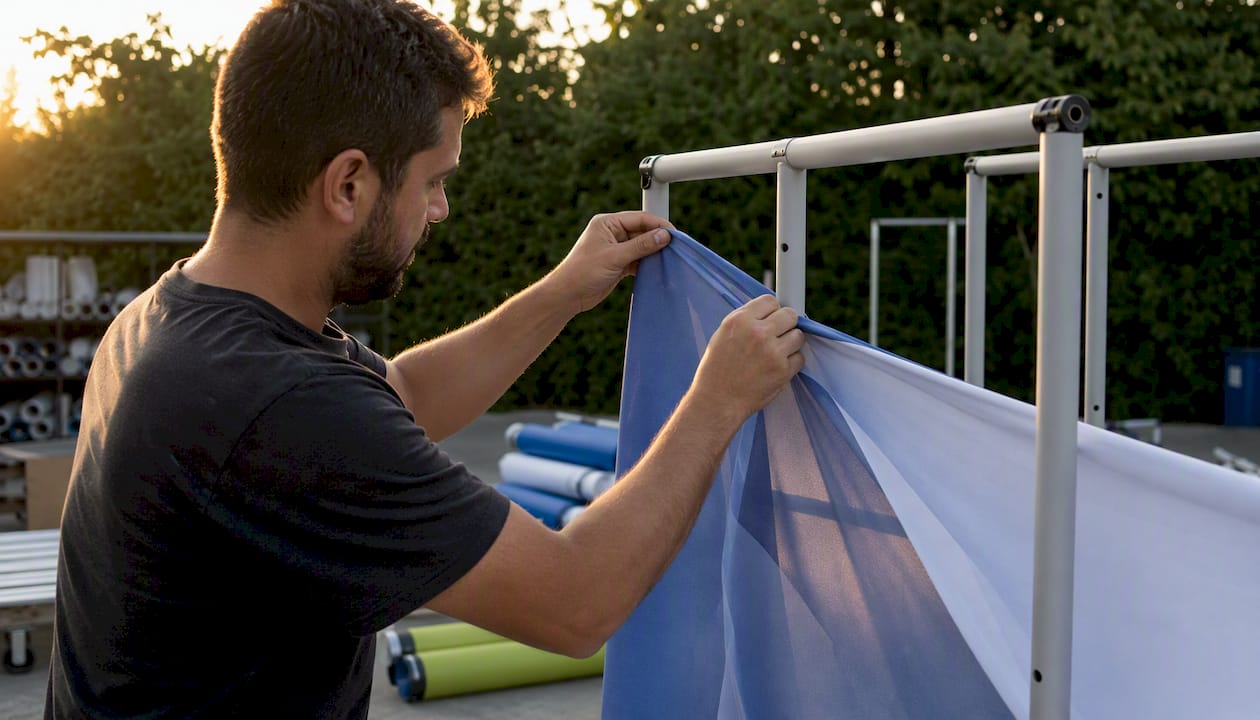
The 10 ft stretch fabric display is a strong choice for mid-to-large booths. Fabric graphics are fast to produce, lightweight to ship, and easy to set up without tools. If you need a professional backdrop in under two weeks, this is the format to order first.
The Signicade Deluxe A-Frame Sidewalk Sign works well for exterior or drive-up visibility. It’s portable, comes with two prints included, and can be placed outside your venue entrance to pull foot traffic before attendees even enter the hall.
The Outdoor Banner Frame (The Banner Bar) adjusts between 6 ft and 8 ft and installs in minutes. It’s a reliable fast-deploy solution when you need outdoor presence without a complex setup.
Visit Arrowhead Sign Company - Signs, Banners and Trade Show Displays to request a rush quote or confirm your show’s delivery window before your next deadline hits.
Sources
Every show is different, and the exhibitor manual for your specific event is always the primary authority. These sources give you the planning frameworks and production benchmarks to work from before that manual arrives.
- Maximize Your Trade Show Success: The Ultimate Exhibitor Checklist (2024)
- Trade Show Checklist: 90/60/30-Day Plan — Trade Show Labs
- The Ultimate Trade Show Checklist: 50 Items for Flawless Execution — Expo Pass
- Trade Show Checklist: Complete Guide for Exhibitors | Barrett Exhibition
Recommended
- Why Early Setup Benefits Exhibitors: A Practical Guide - Arrowhead Sign Company
- How Exhibitors Prepare Display Materials: Small Team Guide - Arrowhead Sign Company
- Why Signage Deadlines Affect Events: A Planner’s Guide - Arrowhead Sign Company
- 2026 Trade Show Trend Display Ideas That Win Attention - Arrowhead Sign Company