

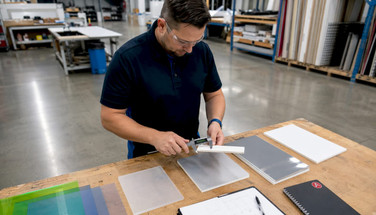
Rigid Sign Substrates: A Practical Buyer's Guide
Posted by Deeder Dandenhorf on Aug 2nd 2026
Rigid Sign Substrates: A Practical Buyer’s Guide
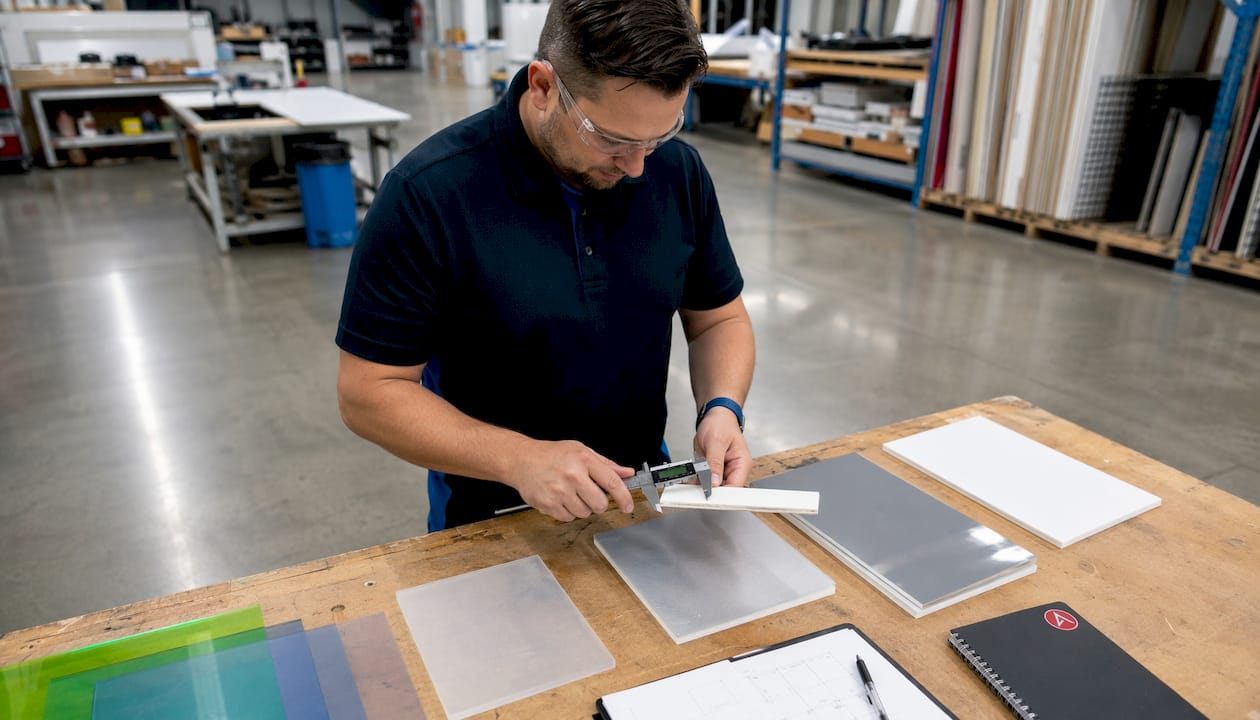
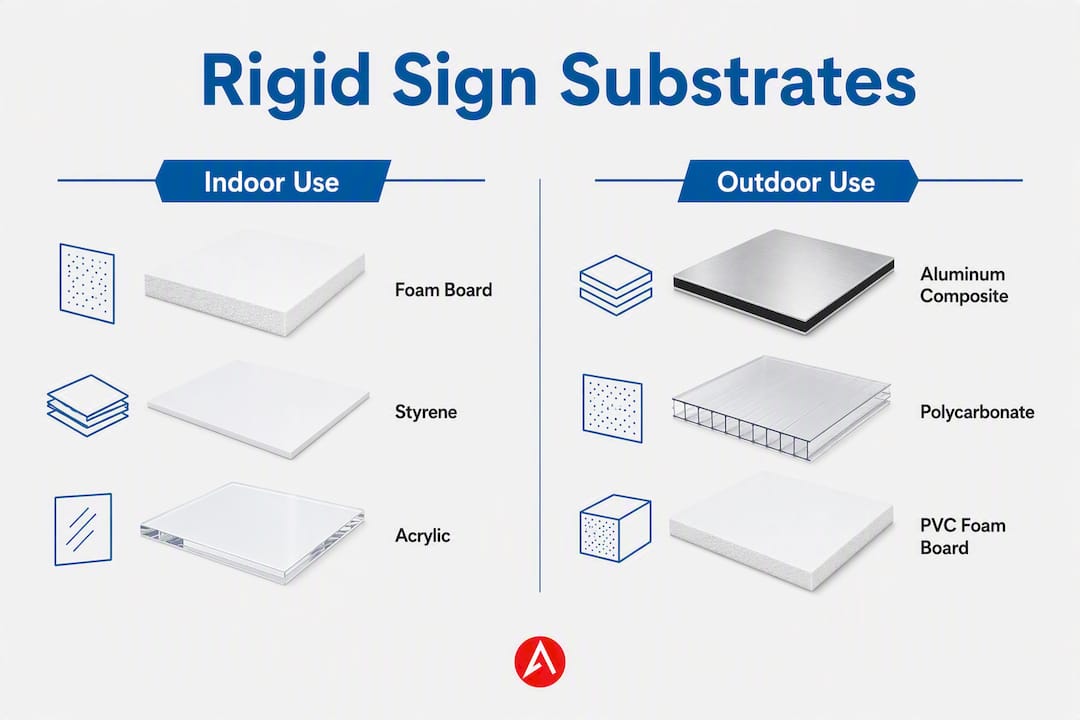
A rigid sign substrate is a flat, inflexible panel used as the durable base for printed signage. Unlike vinyl or fabric, it holds its shape under its own weight, which makes it the right choice whenever a sign needs to stand, mount, or display without a frame doing all the structural work. Four materials cover the vast majority of commercial signage needs in North America, and each occupies a specific lane:
- PVC foam board (Sintra): Lightweight, easy to cut, and budget-friendly. Best for indoor retail displays, trade show panels, and short-run outdoor signs.
- Acrylic: Glass-like clarity with a premium finish. Best for backlit displays, lobby signage, and high-end interior applications.
- Polycarbonate: Extremely tough and impact-resistant. Best for panels in high-traffic or vandalism-prone locations.
- Aluminum Composite Material (ACM): Two aluminum skins over a polyethylene core. Best for long-term building-mounted exterior signs and wayfinding.
- Corrugated plastic (Coroplast): Lightweight and inexpensive polypropylene. Best for yard signs, election signage, and any short-term outdoor job.
- Foam board (paper-faced): Economical polystyrene core with paper facing. Best for indoor posters, POP displays, and presentation boards.
- Styrene: Thin, rigid plastic sheeting. Best for lightweight indoor signage, shelf talkers, and point-of-purchase displays.
No single material wins every job. The right pick depends on where the sign lives, how long it needs to last, and how it gets mounted.
Table of Contents
- What is a rigid sign substrate, and how do you choose the right one?
- Substrate-by-substrate breakdown: which material fits your project?
- At-a-glance comparison of common rigid substrates
- Mounting, hardware, and installation: what you need to know per substrate
- Indoor vs. outdoor: a practical decision guide
- Pro tips and common failure modes from working signmakers
- Key Takeaways
- What a fabricator actually needs from you
- Arrowhead Sign Company has your rigid signage covered
- Useful sources and technical references
What is a rigid sign substrate, and how do you choose the right one?
Match the substrate’s service life and mechanical properties to the sign’s environment and campaign window. That single rule prevents most material mistakes before they happen.
Ask yourself four questions before you spec any job:
Where will it be installed? Indoor environments are forgiving. Outdoor exposure introduces UV radiation, moisture, temperature swings, and wind load. A material that looks great in a lobby for five years can warp, fade, or delaminate in six months on a south-facing exterior wall.
How long must it last? A two-week in-store promotion has completely different durability requirements than a ten-year building identification sign. Choosing the wrong substrate often comes from prioritizing upfront cost over service life, which raises total cost through replacements and callbacks. A quick mapping: two-week indoor promo → foam board or styrene; six-month outdoor campaign → PVC foam board; ten-year building ID → ACM.
How will it be mounted, and what impact risk exists? A sign screwed to a brick facade needs a substrate that won’t crack at the fastener holes. A panel near a loading dock needs impact resistance. Mounting method also determines weight limits, which rules out heavier materials for suspended or ceiling-hung applications.
What finish and print process are required? Some substrates accept UV-cured inks directly. Others need a primer or adhesion promoter, particularly for solvent printing. Gloss, matte, and textured surfaces all behave differently under direct print versus applied vinyl.
Substrate-by-substrate breakdown: which material fits your project?
PVC foam board (Sintra)
PVC foam board is closed-cell, accepts UV-cured inks well with proper surface preparation, and is the everyday board for many sign shops. It cuts like wood with a table saw or router, scores cleanly with a utility knife, and accepts screws, standoffs, and adhesive-backed vinyl without special tooling. Common thicknesses run from 3mm to 19mm. Relative cost is low.
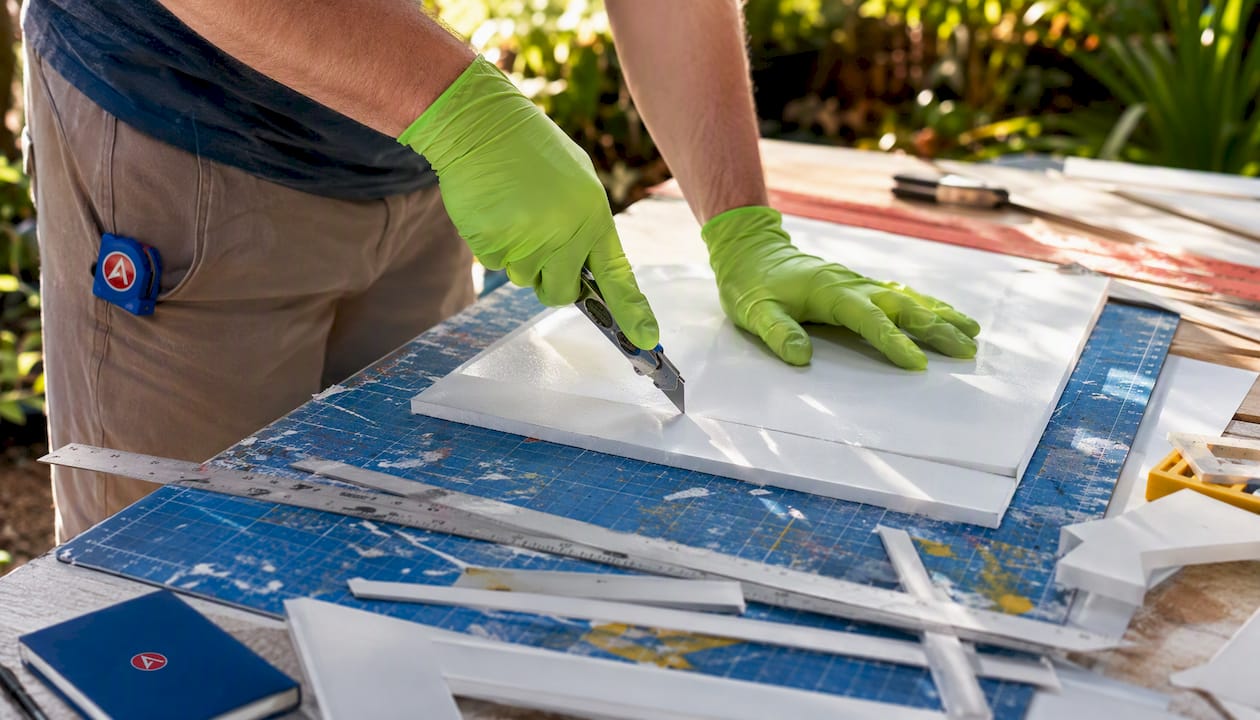
Pros: Lightweight, easy to fabricate, prints clean, widely available, cost-effective. Cons: Not suited for long-term outdoor exposure without UV-protective overlaminate; can warp under continuous heat if constrained at the edges. Allow an expansion gap on long edges for any outdoor or warm-environment installation.
Typical lifespan: 1–3 years outdoors (with overlaminate); 5+ years indoors.
Acrylic
Acrylic offers glass-like clarity and a premium finish that no other rigid substrate matches at the same price point. Common thicknesses are 1/8", 3/16", and 1/4". It is ideal for photo mounting, illuminated displays, and lobby signs where appearance is the priority.
Pros: Excellent optical clarity, high-end aesthetic, good UV resistance in cast grades, compatible with direct print and applied vinyl. Cons: Heavier and more brittle than polycarbonate; cracks under impact; edges chip if not properly finished. Flame-polish or sand edges after cutting.
Typical lifespan: 5–10 years indoors; outdoor use requires UV-stabilized grades.
Polycarbonate
Polycarbonate is roughly 200 times stronger than glass at a comparable gauge, making it the right call for panels that may take hits. Bus shelters, ATM surrounds, and menu boards in high-traffic areas are classic applications. It is more expensive than acrylic and has slightly lower optical clarity, but the impact resistance trade-off is worth it when breakage is a real risk.

Pros: Exceptional impact resistance, flexible enough to bend without cracking, good UV resistance in coated grades. Cons: Scratches more easily than acrylic; higher cost; solvent inks can craze the surface without proper adhesion promoter.
Typical lifespan: 5–10 years with UV-coated grades.
Aluminum Composite Material (ACM)
ACM is the benchmark for signs that mount to buildings and need long-term outdoor durability and flatness. Its aluminum skins bonded to a polyethylene core resist weathering, stay flat on large-format panels, and hold fasteners cleanly. Standard gauge for building-mounted wayfinding is 3mm. ACM routes, cuts, and bends with standard woodworking tools.
Pros: Dimensionally stable, excellent weathering resistance, flat over large spans, accepts direct print and applied vinyl, long service life. Cons: Heavier than PVC foam board; higher upfront cost; requires proper edge sealing to prevent moisture ingress at cut edges.
Typical lifespan: 10–20+ years outdoors.
Corrugated plastic (Coroplast)
Corrugated polypropylene is inexpensive, cuts with a utility knife, and is the go-to for short service-life jobs. Standard gauge for yard signs is 4mm. It is the lightest rigid substrate on this list and installs with wire stakes, zip ties, or simple adhesive.
Pros: Very low cost, lightweight, easy to cut and install, widely recyclable. Cons: Flutes can trap moisture and delaminate in prolonged outdoor exposure; not suitable for premium print finishes; limited lifespan.
Typical lifespan: 3–12 months outdoors.
Foam board (paper-faced)
Paper-based rigid board performs well for indoor poster mounting but will fail in moist or high-handling environments. It is recyclable and economical, which makes it a smart choice for event signage, POP displays, and presentation boards that won’t be reused.
Pros: Lightweight, low cost, recyclable, easy to cut and mount. Cons: Not moisture-resistant; paper facing tears under repeated handling; unsuitable for outdoor use.
Typical lifespan: Days to months indoors; single-use for most applications.
Styrene
Styrene is a thin, rigid plastic sheeting used for lightweight indoor signage, shelf talkers, and point-of-purchase displays. It prints well with UV and screen processes, cuts cleanly, and costs less than PVC foam board at thin gauges. It is not an outdoor material and has limited impact resistance, but for short-run retail graphics it is hard to beat on price.
Pros: Low cost, good printability, lightweight, easy to die-cut. Cons: Brittle at thinner gauges; not UV-stable; not suitable for outdoor or high-handling applications.
Typical lifespan: Weeks to months indoors.
| Material | Common Thickness | Typical Lifespan | Common Applications |
|---|---|---|---|
| PVC foam board | 3mm–19mm | 1–3 yrs outdoor / 5+ yrs indoor | Retail displays, trade show panels, interior signs |
| Acrylic | 1/8"–1/4" | 5–10 yrs indoor | Backlit displays, lobby signs, photo mounting |
| Polycarbonate | 1/8"–1/2" | 5–10 yrs (UV-coated) | High-traffic panels, bus shelters, menu boards |
| ACM | 3mm–4mm | 10–20+ yrs outdoor | Building ID, wayfinding, exterior fascia signs |
| Corrugated plastic | 4mm–6mm | 3–12 months outdoor | Yard signs, election signs, temporary displays |
| Foam board | 3/16"–1/2" | Days–months indoor | POP displays, event signage, presentations |
| Styrene | — | Weeks–months indoor | Shelf talkers, retail POP, lightweight indoor signs |
At-a-glance comparison of common rigid substrates
| Material | Best for | Outdoor UV & moisture | Durability / impact | Print quality | Weight / rigidity | Ease of fabrication | Relative cost | Mounting methods | Typical lifespan |
|---|---|---|---|---|---|---|---|---|---|
| PVC foam board | Indoor/short outdoor retail | Moderate (needs overlaminate) | Medium | Excellent | Light / medium | Very easy | Low | Screws, standoffs, adhesive | 1–3 yrs outdoor; 5+ indoor |
| Acrylic | Premium interior, backlit | Good (cast grades) | Low (brittle) | Excellent / high gloss | Medium / rigid | Moderate (chip risk) | Medium–high | Standoffs, adhesive, routed channels | 5–10 yrs indoor |
| Polycarbonate | High-impact panels | Good (coated grades) | Very high | Good | Medium / flexible | Moderate | High | Screws, standoffs, framing | 5–10 yrs |
| ACM | Long-term exterior | Excellent | High | Excellent | Medium / very flat | Easy | Medium–high | Screws, channel frames, standoffs | 10–20+ yrs |
| Corrugated plastic | Short-term outdoor | Low–moderate | Low | Good | Very light / moderate | Very easy | Very low | Wire stakes, zip ties, adhesive | 3–12 months |
| Foam board | Indoor POP, events | Poor | Low | Good | Very light / moderate | Very easy | Very low | Adhesive, pins, easel backs | Days–months |
| Styrene | Retail POP, shelf talkers | Poor | Low | Good | Very light / low | Easy | Low | Adhesive, clips, die-cut mounting | Weeks–months |
Mounting, hardware, and installation: what you need to know per substrate
Getting the substrate right is only half the job. Even premium substrates can fail if adhesives, standoffs, or edge sealing do not account for thermal expansion or wind loading. Here is how to mount each material correctly.
- PVC foam board: Use screws with large-diameter washers to prevent pull-through, or aluminum standoffs for a finished look. For long panels, leave a 1/8" expansion gap at each constrained edge. Avoid rigid perimeter framing that prevents thermal movement, which causes bowing.
- Acrylic: Standoffs are the standard choice. Pre-drill with a sharp bit and use a slightly oversized hole to allow minor thermal movement. Never over-torque fasteners. For wall-flush mounting, use VHB tape (3M 4950 or equivalent) on clean, primed surfaces.
- Polycarbonate: Screw mounting with oversized holes is required to allow expansion. Polycarbonate expands more than acrylic, so the gap allowance matters more. Channel framing works well for large panels.
- ACM: Screws, standoffs, and channel frame systems all work. For facade-mounted signs, a routed aluminum channel frame is the most professional finish and prevents moisture ingress at edges. Seal all cut edges with aluminum tape or edge trim to block moisture from reaching the polyethylene core.
- Corrugated plastic: Wire H-stakes for yard signs; zip ties for fence mounting; double-sided tape for flat surface applications. Keep fasteners away from the flute ends where the material is weakest.
- Foam board: Adhesive mounting with repositionable or permanent spray adhesive, T-pins for temporary display, or easel backs for freestanding. Not suitable for any permanent or outdoor mount.
- Styrene: Adhesive, clips, or die-cut tabs. Lightweight enough that VHB tape holds it reliably on smooth interior surfaces.
Pro Tip: For any outdoor sign over 24 inches on the long edge, calculate wind load before specifying fastener count and spacing. A sign that looks secure in calm conditions can become a projectile in a 40 mph gust if it is only held by two screws at the corners.
For event signage installations specifically, proper hardware selection is as important as the substrate itself, particularly for freestanding or suspended displays in high-traffic venues.
Indoor vs. outdoor: a practical decision guide
The single most useful frame for substrate selection is campaign window length, not upfront price.
Short window (days to a few months): Foam board, styrene, and corrugated plastic all perform well indoors. For short outdoor runs, corrugated plastic is the default. Cost per impression is low because you are not paying for durability you will not use.
Mid window (1–5 years): PVC foam board with UV overlaminate handles most indoor and semi-sheltered outdoor applications in this range. For fully exposed outdoor signs in this window, step up to ACM. Weather-resistant sign materials pay for themselves quickly when you factor in reprint and reinstallation costs.
Long window (5–20+ years): ACM is the clear choice for exterior building signs, wayfinding systems, and any application where replacement is expensive or disruptive. Polycarbonate fits this window for impact-exposed panels. Acrylic in cast grades works for long-term interior applications.
Outdoor suitability checklist:
- UV resistance confirmed for the substrate grade you are ordering (not all PVC foam board is UV-stabilized)
- Moisture tolerance verified (sealed edges on ACM; no paper-faced boards)
- Thermal expansion accounted for in mounting design
- Hardware specified for wind load at the installation site
- Finish and ink system confirmed as outdoor-rated
Maintenance expectations shift with material. ACM and polycarbonate clean easily with mild soap and water and rarely need refinishing within their service life. PVC foam board may need overlaminate replacement after two to three years outdoors. Corrugated plastic is typically replaced rather than maintained.
On sustainability: corrugated polypropylene and paper-faced foam board are both recyclable in many North American municipal programs. ACM recycling requires separation of the aluminum skins from the polyethylene core, which some metal recyclers handle. Acrylic and polycarbonate are less commonly recycled at the municipal level but can be returned to specialty plastics recyclers.
Pro tips and common failure modes from working signmakers
The most expensive substrate mistakes are also the most preventable. Here is what experienced fabricators check before and during every job.
- Order a finish sample before a production run. Surface finish varies between manufacturers even within the same material category. A sample confirms color, gloss level, and print adhesion before you commit to a full run.
- Confirm the print process matches the substrate. Some print processes require surface prep or primers, particularly solvent printing on PVC, which can need adhesion promoters. Always verify with your print provider before ordering substrate.
- Seal cut edges on ACM. Unsealed cut edges on ACM allow moisture to wick into the polyethylene core, causing delamination over time. Aluminum edge tape or PVC edge trim costs almost nothing and extends service life significantly.
- Allow expansion gaps for long-edge constrained PVC foam board. Thermal expansion behavior varies by substrate: ACM is dimensionally stable, but PVC foam board can warp under continuous heat if constrained. Leave at least 1/8" at each fixed edge for panels longer than 48 inches.
- Specify gauge in your order, not just material name. “PVC foam board” without a thickness spec can result in 3mm when you needed 6mm. Always state the gauge.
- Include artwork bleed and wrap dimensions. For mounted or routed signs, artwork should extend at least 1/8" beyond the cut line. For wrapped edges, confirm the wrap depth with your fabricator before sending files.
- Check fire classification for indoor public spaces. Some venues and building codes require Class A or Class 1 fire-rated substrates for interior signage. Confirm the rating before specifying material for a lobby, convention center, or retail build-out.
Pro Tip: When proofing artwork for rigid substrates, review your proof at the actual output size, not on screen. Color shifts and resolution issues that are invisible at 10% view become obvious at full scale.
Fabricator ordering checklist:
- Intended service life and environment (indoor/outdoor, UV exposure, moisture)
- Mounting method and hardware (standoffs, screws, stakes, adhesive)
- Substrate material, grade, and gauge
- Print process (UV, latex, solvent, screen)
- Edge finish (raw, routed, flame-polished, edge-taped)
- Artwork file format, bleed, and color profile
- Shipping and handling requirements (corner protection, flat packing)
Key Takeaways
Rigid sign substrates are a service-life decision first and a cost decision second: matching material properties to environment and campaign window consistently delivers lower total cost than choosing the cheapest option upfront.
| Point | Details |
|---|---|
| Match service life to material | Short campaigns use corrugated plastic or foam board; long outdoor runs need ACM for durability and flatness. |
| Account for thermal expansion | PVC foam board requires expansion gaps on long constrained edges; ACM is dimensionally stable and does not. |
| Mounting and hardware matter as much as material | Unsealed ACM edges, under-torqued standoffs, and missing wind-load calculations cause failures even on premium substrates. |
| Confirm print process compatibility | Solvent inks on PVC may need adhesion promoters; always verify substrate finish and print method before a production run. |
| Arrowhead Sign Company | Offers custom rigid signage, trade show displays, and rapid fulfillment with samples and quotes available on request. |
What a fabricator actually needs from you
When a job arrives at the shop, the first thing a fabricator checks is whether the file and the job spec tell the same story. Mismatches between artwork dimensions and specified substrate size, or between a requested finish and the print process on the order, are the two most common sources of delays.
Tell your fabricator:
- The intended life of the sign and where it will be installed (indoor lobby, exterior facade, trade show booth, outdoor event)
- The mounting method you have planned, including hardware type and surface material
- Exposure conditions (direct sun, rain, high humidity, temperature extremes)
- Finishing preferences (gloss, matte, edge treatment, grommets, standoff holes)
- Whether the sign will be reprinted on the same substrate or replaced entirely at end of life
The more specific you are upfront, the faster the quote and the fewer rounds of revision before production. For promotional standing signs and trade show displays in particular, substrate choice affects not just durability but how the finished piece ships, sets up, and stores between events.
Arrowhead Sign Company has your rigid signage covered
Arrowhead Sign Company - Signs, Banners and Trade Show Displays takes the guesswork out of substrate selection by pairing fast production with real expertise. For those planning impactful brand campaigns, boosting brand visibility in Australia with promotional materials offers valuable guidance on strategic use of signage and promotional products. Most orders ship within two business days, and the team handles everything from custom rigid panels and trade show displays to outdoor signs and promotional materials. Arizona customers get direct venue delivery, and nationwide shipping means the same speed and quality reaches you wherever your next event or installation is.
If you are ready to put the right material to work, the Signicade Deluxe A-Frame sidewalk sign is a practical starting point: a durable, double-sided A-frame that ships with two prints included and works equally well for retail storefronts, trade show floors, and outdoor events. Request a sample, upload your artwork, or get a quote directly at arrowheadsigncompany.com.
Useful sources and technical references
These primary sources provide technical specifications, fabrication notes, and material datasheets for the substrates covered in this guide:
- Laird Plastics: Choosing the Right Rigid Substrates — Broad overview of rigid substrate types with material descriptions and application guidance; useful for confirming material definitions and use-case fit.
- Farco Plastics: Sign Substrates Guide — Detailed breakdown of PVC foam board, acrylic, polycarbonate, and ACM with pros, cons, and application notes for North American sign shops.
- Vanderbilt Printing Services: Choosing the Right Sign Material — Practical guidance on acrylic and foam board selection for institutional and commercial signage.
- Yupseni: PVC Foam Board vs Acrylic vs ACM vs Corrugated Plastic — Side-by-side material comparison with notes on cost, lifespan, and common failure modes.
- Sign Trade Supplies: Sign Substrates Complete Guide — UK-market fabrication reference covering mounting, edge sealing, thermal expansion, and hardware selection (note: UK market; verify local codes for North American installations).
- ASTM D4329 — Standard practice for fluorescent UV exposure of plastics; the relevant test standard for confirming UV stability ratings on acrylic, polycarbonate, and PVC substrates.
- Spandex: Understanding Different Types of Sign Substrates — North America–focused overview of substrate categories with print compatibility notes.
Recommended
- How Event Signage Is Installed: A Practical Guide - Arrowhead Sign Company
- Proofing Custom Promotional Signage: A Small Business Guide - Arrowhead Sign Company
- Indoor vs Outdoor Sign Options: A Practical Guide - Arrowhead Sign Company
- Selecting Finishes for Custom Printed Banners: A Pro Guide - Arrowhead Sign Company