

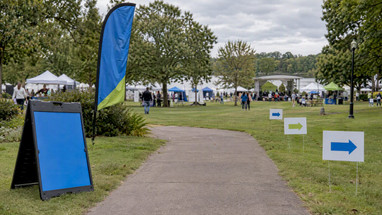
Best Outdoor Event Signs: 7 Options Compared
Posted by Deeder Dandenhorf on Oct 29th 2026
Best Outdoor Event Signs: 7 Options Compared

The best outdoor event signs are the ones that match the job: A-frame sidewalk signs for entrances and walk-up traffic, outdoor banners on frames for distance visibility, flags for drawing the eye from the street, and printed tents for owning a booth. Most events need two or three of these working together, not one hero sign. Below, we compare seven options on visibility, durability, setup and fit, so you can pick the right mix before you order.
TL;DR
- Match the sign to the job: wayfinding, booth identification and promotion each call for a different format.
- For anything outdoors, material matters as much as design. Corrugated plastic is a short-term choice, while aluminum lasts for years.
- A-frames, banner frames and printed tents cover most small-business needs and set up without tools or a crew.
- Order proofs early and build in shipping time. Most Arrowhead products ship within two business days, and Next Day Air is available for $10.
Table of Contents
- How to choose: start with what the sign must do
- Seven outdoor event sign options compared
- What about other providers?
- Materials and weather: what to compare before you order
- Design choices that make signs read from farther away
- Our perspective: build a kit, not a single sign
- Ready to order? Here is how we can help
- A simple timeline for ordering event signs
- FAQ
- Sources
How to choose: start with what the sign must do
Before comparing products, decide which of three jobs a sign has. Many buyers skip this and end up with a beautiful banner in the wrong place.
Wayfinding. Guests need to know where to park, where to enter and where the restrooms are. The U.S. Forest Service’s design guidance says signs should be limited to what is needed, clear, visible, and positioned where users have time to act. That is as true in a fairground parking lot as on a trail. If your event must be accessible, the Department of Justice’s small-town guide notes that signs should direct people to accessible parking, entrances and toilet rooms. Plan those signs first.
Identification. Visitors need to find your booth, your tent or your entrance from a distance. Size, contrast and height matter most here.
Promotion. These signs carry an offer, a QR code or a brand message to people who are already nearby. They work best with one clear line and one action.
If you want a deeper planning walk-through, our guide to the role of signage in event flow and our overview of types of event directional signage cover the wayfinding side in detail.
Seven outdoor event sign options compared
| Sign type | Best for | Strength | Limitation | Setup |
|---|---|---|---|---|
| A-frame sidewalk sign | Entrances, walk-up promotions | Swappable graphics, easy to move | Small viewing distance | One person, no tools |
| Outdoor banner on a frame | Booth or event identification | Large message, readable from a distance | Needs a stable footing in wind | One or two people |
| Vinyl banner | Fences, stages, tent walls | Low cost per square foot, many sizes | Hung banners need secure tie-downs | Minutes with ties or grommets |
| Custom flags | Street-side visibility | Movement catches the eye | Small message area | Pole and base |
| Printed pop-up tent | Vendor booths, sponsor areas | Shade, branding and a work space in one | Needs weights and more space | Two people |
| Yard and corrugated signs | Directions, parking, short events | Cheap and light | Short outdoor life | Stakes |
| Tension fabric and retractable displays | Covered or semi-covered areas | Crisp graphics, quick setup | Best kept out of rain and heavy wind | One person |
1. A-frame sidewalk signs
The A-frame is the workhorse of small events. It stands on its own, folds flat and takes replaceable graphic inserts, so one frame can serve a spring festival and a fall open house. It is the right choice at an entrance, on a path, or beside a tent where people are walking slowly enough to read.
The tradeoff is scale. An A-frame is read at a few yards, not across a parking lot. Use it for a headline and one line of support, not a paragraph. We carry sidewalk signs, including the Signicade Deluxe A-Frame, which comes with two prints included.
2. Outdoor banners on a banner frame
When you need a sign that people can read from the street or the far end of a field, a large banner on a freestanding frame is hard to beat. It gives you a big canvas without needing a wall or fence to hang from. Our Outdoor Banner Frame, the Banner Bar, adjusts between 6 ft and 8 ft, so one frame can fit different banner sizes from event to event.
Wind is the thing to plan for. A big flat surface acts like a sail, so use the base weights the frame is designed for, and bring extras. If the forecast is rough, move the banner under a tent wall or take it down.
3. Printed vinyl banners
Vinyl banners are the most flexible product in outdoor signage. Hang one on a fence line, across a stage front, along a tent wall or on a barricade. Because they are made to your exact dimensions, they suit odd spaces that off-the-shelf signs do not.
Our printed banners page lets you order custom sizes. A standard banner layout is $35, and Next Day Air shipping is an additional $10. Most products ship within two business days, so a banner ordered early in the week can usually be in your hands before a weekend event. For tight timelines, still allow time for proof approval, because a rush with a typo costs more than a day of patience.
4. Custom flags
Flags give you motion, and motion draws the eye on a busy road or a crowded lot. They suit the edge of an event: a driveway entrance, a corner, or the front of a booth row. Their weakness is the amount of message they can hold. Think logo, one color field and maybe three words. Treat a flag as an arrow that says “here,” and put the details on a banner or A-frame nearby. Our custom flags are listed on our main site.
5. Printed pop-up tents
For vendors, sponsors and farmers-market-style events, a printed tent does the most work per dollar of effort. It identifies your space from a distance, provides shade, and gives you valls and a valance to carry branding. People remember the tent more often than any sign beside it.
For anyone who sets up outdoors regularly, a printed pop-up tent becomes the anchor for everything else: a banner on one wall, an A-frame at the front, a table cover inside. Weight the legs every time, even on calm days, because gusts arrive without warning.
6. Yard signs and corrugated plastic signs
Corrugated plastic yard signs are the budget answer for parking, directions and short one-time events. They are light and stake into the ground in seconds. But they are not built to last. The U.S. Government Publishing Office’s materials guide lists corrugated signs at an average of 3 to 6 months outdoors, compared with 5 or more years for aluminum. If you will reuse a sign across a season or several years, aluminum is the better value even though it costs more up front. The same guide lists common poster sizes of 18×24, 22×28, 24×36 and 36×48 inches, a useful checklist when you order.
For a deeper look, see our post on how to choose outdoor sign materials that last. Our custom signs page covers rigid options.

7. Tension fabric and retractable displays
These are really indoor and covered-area products, and they earn a place in an outdoor guide because so many outdoor events include a tent, a pavilion or a covered entry. Tension fabric graphics look sharp and set up quickly. We offer EZ Tube Tension Fabric Displays, Quick Ship Displays and banner stands. Keep them out of rain and strong wind, and use them under cover.
What about other providers?
You will find plenty of sign shops, and many of them are good. Regional companies such as Custom Signs Today in Marietta, Georgia, and Signs Today in Honolulu list banners, flags, canopies, A-frames, window lettering and yard signs, and New York City Signs & Awnings covers awnings, sidewalk barriers and permanent signage for its metro area. If you are in those markets and need installation or permanent signs, a local shop is a reasonable place to start.
The difference for event buyers is usually speed, ease of ordering and whether the shop can deliver to your venue. We ship nationwide, and in Arizona we can deliver directly to your venue, which removes one of the biggest sources of event-day stress.
Materials and weather: what to compare before you order
Outdoor signs fail for predictable reasons. A short checklist helps:
- Expected life. One weekend, one season or several years? Match the material to that answer, using the corrugated versus aluminum figures above as a guide.
- Wind. Large flat signs need weights, vented designs or a plan to take them down. Flags and banners on frames are the most exposed.
- Sun. Strong sun fades colors over time. For a recurring display, choose durable printing and keep graphics out of direct sun when stored.
- Rain. Tension fabric and paper-based products belong under cover. Vinyl, aluminum and plastic handle wet weather better.
- Size. Pick a size for the viewing distance, not for the space you happen to have. Our guide to outdoor event signage best practices goes further on this.
Design choices that make signs read from farther away
Customization is where an ordinary sign becomes a branded one, and it is also where many signs fail. A few rules hold up across formats:
- One message per sign. A headline, a logo and one action. If you need more, add a second sign.
- High contrast. Dark on light or light on dark, with no busy photo behind the text.
- Large type. If you cannot read it from several steps back on your screen, nobody will read it outside.
- Consistent branding. Use the same colors and logo across every sign so the event feels like one environment. For more on building a message that sticks, see these visual storytelling tips.
- A way to continue. A QR code or short URL lets a passer-by act without stopping.
If you are a sponsor or exhibitor at a larger event, our guide to branded signage for sponsored events explains how to coordinate with organizers.
Our perspective: build a kit, not a single sign
We talk with small business owners, event planners and exhibitors every week, and the same pattern shows up. People ask for “a sign” when they need a system. A good outdoor setup has a far sign that gets noticed, a near sign that explains, and a branded space that holds the conversation.

Our recommendation for most small businesses is a printed tent or banner frame as the anchor, an A-frame as the near sign, and a flag for the street. Choose reusable frames and swap the graphics, so a new event means a new print, not a new setup. That is also why we focus on fast turnaround: most products ship within two business days, so a date change or a last-minute booth assignment does not wreck your plan.
The other lesson is to order earlier than you think you need to. Proof approval, shipping and a test setup take time, and the test setup is where you find the missing weight or the too-small logo.
— Dan
Ready to order? Here is how we can help
If you are planning an event, we can put together the whole kit in one order: banners, frames, A-frames, flags, printed tents and table covers, all customized with your branding. Most products ship within two business days, Next Day Air is available, and in Arizona we can deliver straight to your venue.
Start with printed banners for the quickest win, or browse our full range of trade show products and displays. If you are not sure which mix fits your event, our guide on choosing the right promotional signage walks through the decision.
A simple timeline for ordering event signs
- Four weeks out: decide which jobs you need signs for and confirm venue rules on sign size and placement with the organizer.
- Three weeks out: finalize artwork and approve the proof. Check spelling, phone numbers and URLs twice.
- Two weeks out: place the order. Standard shipping leaves room for a reprint if something is wrong.
- One week out: do a test setup at home or in the office, with weights, and photograph it.
- Event day: arrive early, set up the far sign first, then the near signs, then walk the route as a guest would.
If you are short on time, rush options exist, but they work best when the artwork is already approved.
FAQ
What is the best outdoor sign for a small event?
For most small events, a printed tent or banner on a frame, plus an A-frame sidewalk sign, covers identification and promotion at a reasonable effort. Add a flag if you need visibility from the street. Choose by the job each sign has to do.
How long do outdoor event signs last?
It depends on the material. The GPO’s materials guide lists corrugated signs at about 3 to 6 months outdoors and aluminum at 5 or more years. For one-off events, corrugated is fine, and for repeated use, a durable frame with replaceable graphics is the better investment.
How far ahead should I order?
Plan for about two to three weeks before the event, so there is time for proof approval and a reprint if needed. Most Arrowhead products ship within two business days, and Next Day Air is available for $10 when time is short.
Do outdoor signs need to be accessible?
If your event must be accessible, signs should direct people to accessible parking, entrances and restrooms, according to the Department of Justice’s guide for small towns. Check with your venue or local officials for the rules that apply to your event.
Can you deliver signs to my event venue?
In Arizona, yes: we offer direct delivery to your venue. Outside Arizona, we ship nationwide.
Sources
- Signage and Banners: A materials and size availability guide (U.S. Government Publishing Office)
- ADA Guide for Small Towns (U.S. Department of Justice)
- Equestrian Design Guidebook for Trails, Trailheads, and Campgrounds (U.S. Forest Service)
- Visual storytelling tips: boost your brand’s impact