
Corporate Event Display Examples That Drive Real Impact
Posted by Deeder Dandenhorf on Jul 27th 2026
Corporate Event Display Examples That Drive Real Impact
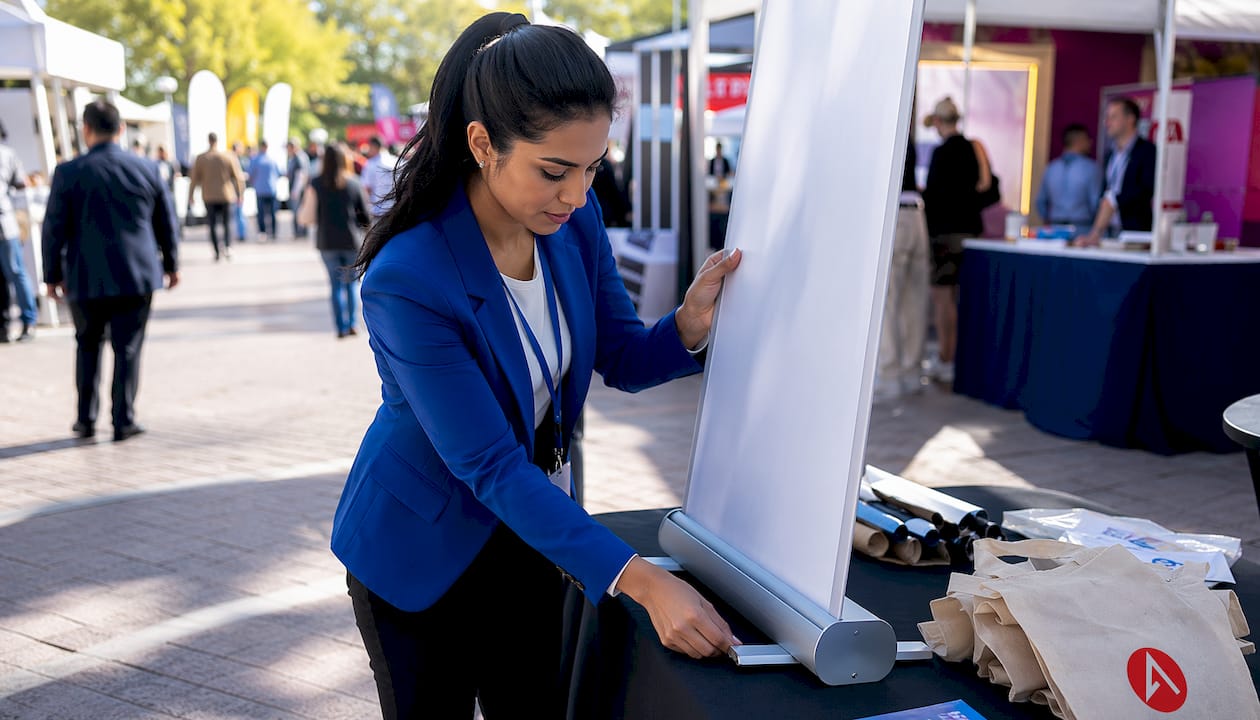
The most effective content marketing examples that actually drive results share one trait: they were chosen for a specific goal, not a catalog photo. For brand visibility at entrances, retractable banner stands and Signicade Deluxe A-Frame Sidewalk Signs work immediately. For photo ops and press walls, a 10 ft stretch fabric display delivers wrinkle-free, camera-ready backdrops. Keynote stages call for LED video walls; high-traffic aisles benefit from interactive kiosks. Outdoor visibility belongs to the Outdoor Banner Frame - The Banner Bar, rated for wind and UV exposure. Standard large-format signage typically ships in 3–5 business days, so plan your timeline before you finalize your design.
- Wayfinding goal: Retractable banners, A-frame sidewalk signs, directional panels
- Brand impact/photo ops: Stretch fabric backwalls, step-and-repeat backdrops
- Keynote/stage: LED video walls, tension fabric stage surrounds
- Engagement/data capture: Interactive kiosks, touchscreen demo stations
- Outdoor presence: Outdoor Banner Frame - The Banner Bar, custom printed tents
- ADA compliance: Plan wayfinding sign heights and clearances per ADA requirements before production
Table of Contents
- 1. What are the best corporate event display examples by type?
- 2. How do you choose the right display for your event?
- 3. Which display technology fits your venue and audience?
- 4. What production timelines and logistics should you plan for?
- 5. How do Arrowhead products solve real event planning problems?
- Key Takeaways
- What suppliers actually see planners get wrong
- Arrowhead Sign Company makes fast fulfillment straightforward
- Useful sources
1. What are the best corporate event display examples by type?
The display types below cover the full range of corporate event scenarios, from a single-booth trade show to a multi-city conference rollout. Each entry includes typical specs, materials, and a primary use case.
| Display Type | Typical Dimensions | Substrate | Budget Band | Primary Use Case |
|---|---|---|---|---|
| Retractable banner stand | 24x36 in – 33x80 in | Vinyl or tension fabric | — | Registration, wayfinding |
| Pop-up fabric backwall | 10x8 ft – 10x10 ft | Dye-sublimation fabric | — | Booth backdrop, photo wall |
| Modular booth kit | 10x20 ft+ | Aluminum + fabric panels | $6,000–$35,000+ | Multi-show brand consistency |
| Custom build / demo station | Varies | Mixed: wood, metal, acrylic | Variable, often high | Machinery demos, flagship launches |
| LED video wall | 10x8 ft – 20x10 ft | Fine-pitch LED panels | Varies by size and rental agreement | Keynote stages, large audiences |
| Interactive kiosk | — | Tempered glass, powder-coat | Prices vary by specification | Entry points, demo aisles |
| 10 ft stretch fabric display | 10x8 ft | Stretch polyester fabric | — | Photo ops, press walls |
| Outdoor Banner Frame (The Banner Bar) | 6 ft – 8 ft adjustable | Aluminum frame + vinyl | — | Outdoor brand visibility |
| Signicade Deluxe A-Frame | 24x36 in inserts | Corrugated plastic inserts | — | Sidewalk wayfinding, entrances |
| Experiential / projection-mapped | Venue-specific | Projection surface | — | Product launches, immersive themes |
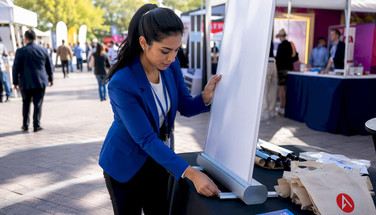
Retractable banner stands remain the workhorse of corporate events. At 33x80 inches, they fit registration desks, breakout room entrances, and aisle ends without requiring tools or freight crates. Vinyl prints are cost-effective; tension fabric options give a higher-end, wrinkle-free finish that photographs well.
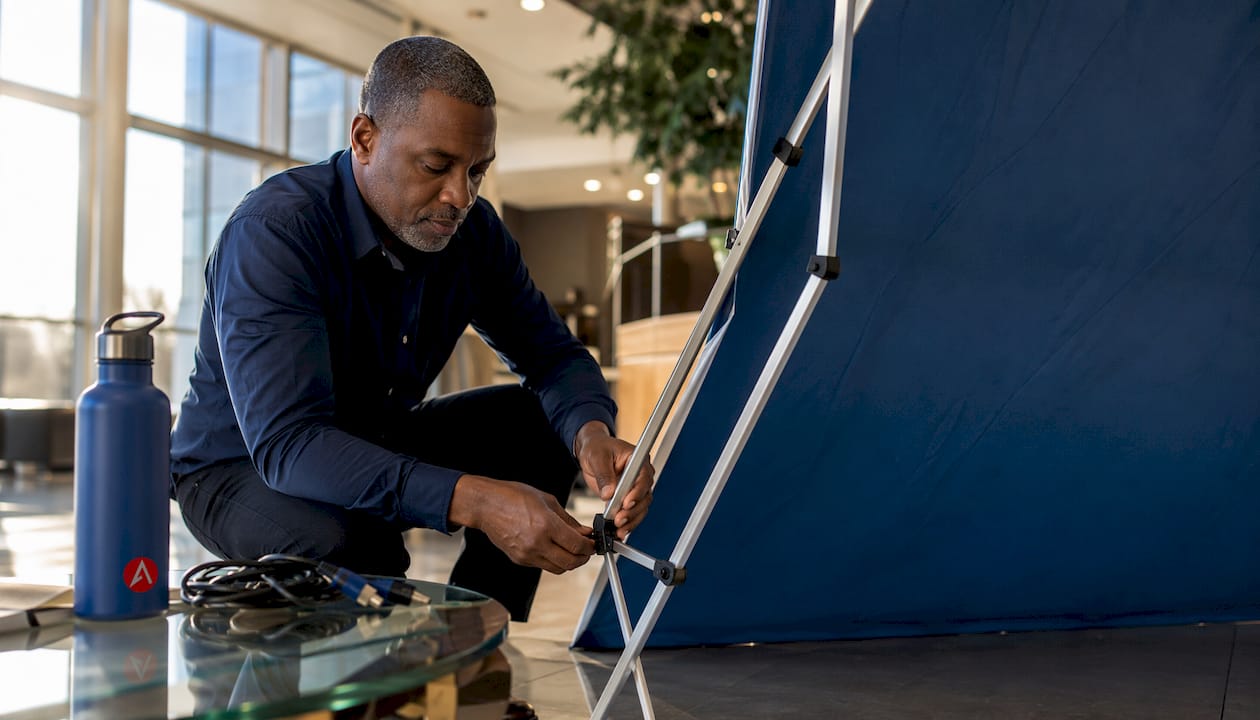
Pop-up fabric backwalls use lightweight aluminum frames with dye-sublimation fabric panels. A 10x10 ft backwall ships in a rolling carry case, sets up in under 20 minutes, and doubles as a photo backdrop. Tension fabric displays are favored for wrinkle-free visuals and easy shipping, with sustainability options including FSC-certified substrates and eco-friendly inks increasingly available.
Modular booth kits reconfigure across 10x20 ft or larger footprints. Trade show display budgets for modular systems typically range from $6,000–$35,000 or more, while portable entry-level kits often start under $1,000. Rental is a smart option when your footprint changes show to show.
Custom builds and demo stations make sense when your product requires physical stability, power routing, or machine mounts. Budget and freight risk both climb sharply here, so factor in labor, crating, and drayage from the start.
LED video walls use fine-pitch panels that keep imagery crisp and legible even at close viewing distances. Fine pixel pitch and brightness make LED the preferred choice for keynote stages and large-audience presentations where ambient light is uncontrolled.
Interactive kiosks drive engagement and data capture when placed at entry points or high-traffic aisles. Plan for power access, a staffing rotation, and a sanitization protocol for any touchscreen surface.
The Outdoor Banner Frame - The Banner Bar is an adjustable 6–8 ft aluminum frame built for outdoor conditions. Wind and UV resistance make it reliable for parking lot entrances, outdoor registration, and festival-style activations. The Signicade Deluxe A-Frame Sidewalk Sign handles sidewalk wayfinding with swappable 24x36 in inserts, so you can update messaging between event days without reprinting the hardware.
Projection-mapped experiential installations transform venue surfaces into immersive brand moments. They require precise calibration and controlled lighting to perform well, making them best suited for product launches in dedicated, low-ambient-light spaces.
Pro Tip: Select your display type based on function first. Portable displays suit simple product stories; modular systems pay off across repeated shows; custom builds are justified only when the demo genuinely requires it.
2. How do you choose the right display for your event?
Start with five questions before you open a product catalog.
- How many shows will this display serve? One event favors rental or a portable kit. Three or more shows per year justifies a modular purchase.
- What is your booth footprint? Confirm the exact dimensions with the venue before specifying any structure.
- Does your demo require touch, screen-only, or physical product interaction? Touch demands kiosks with power; physical demos need custom-built stability.
- What are the venue’s rigging and electrical limits? LED walls and hanging signs require rigging points and dedicated circuits. Get the venue’s AV specs in writing.
- What is your freight and storage capacity? Large custom builds need crating, drayage, and warehouse space between shows.
The decision framework from exhibition experts is straightforward: portable for simple stories, modular for multi-show reuse, custom for complex or high-value demos. Avoid choosing by catalog photo alone.
Common mistakes to avoid:
- Planning projection in a venue with floor-to-ceiling windows or uncontrolled ambient light
- Skipping the CAD drawing step and ordering based on estimated dimensions
- Forgetting on-site power and cable routing until move-in day
- Missing venue permit or rigging approval deadlines
Pre-order checklist:
- Confirmed booth dimensions (CAD or venue floor plan)
- AV brief with power requirements and rigging load limits
- Venue permit and approval status
- Shipping window confirmed with carrier
- Proof approval deadline set before production starts
Pro Tip: Check the trade show display types guide to match your event format to the right exhibit structure before requesting quotes.
3. Which display technology fits your venue and audience?
Choosing the wrong medium wastes budget fast. Technology mismatch between projection and a poorly controlled lighting environment frequently leads to poor visual performance and wasted budget. Here is how each medium stacks up.
LED video walls
- Pros: high brightness, flexible sizing, outdoor-capable with proper IP rating, no ambient-light sensitivity
- Cons: rigging requirements, higher cost, significant power draw
- Best for: keynote stages, large audiences, bright ballrooms
Projection mapping
- Pros: transforms irregular surfaces, creates immersive experiences at scale
- Cons: requires controlled lighting, high calibration time, sensitive to ambient light
- Best for: evening product launches, dedicated dark rooms, venue-theme transformations
Interactive screens and kiosks
- Pros: engagement, data capture, personalized content delivery
- Cons: requires staffing, sanitization, UX planning, and reliable power
- Best for: entry points, demo aisles, registration zones
Display solutions should be customized to the event’s goals and venue constraints. Professional AV partners help avoid the most common mistake: selecting a technology that looks great in a showroom but fails in the actual room.
4. What production timelines and logistics should you plan for?
Standard large-format signage carries a 3–5 business day production lead time. Complex or nationwide rollouts need significantly more runway.
Production-to-install timeline:
- Display selection and brief — 1–3 days
- Design and proof approval — 2–5 days (client-dependent)
- Production — 3–5 business days for standard large-format
- Shipping — 1–5 business days depending on destination and carrier
- On-site install — 2–4 hours for portable/modular; 1–2 days for custom builds
Logistics checklist before you ship:
- Crates labeled with booth number, hall, and contact name
- Freight window confirmed with show decorator
- Local delivery or advance warehouse address confirmed
- Insurance certificate filed with venue
- On-site install crew briefed on sequence
Arrowhead Sign Company - Signs, Banners and Trade Show Displays ships most products within two business days and offers local delivery directly to venues in Arizona, which removes the freight window guesswork for regional clients. Color-matched production across multiple pieces keeps your brand consistent from banner to backdrop.
Pro Tip: Request kitting and pre-sequenced shipments. Receiving one labeled kit per booth station cuts on-site labor time and reduces the chance of a piece going missing in a busy exhibit hall.
5. How do Arrowhead products solve real event planning problems?
These products address specific planning friction points that event marketers face repeatedly.
- 10 ft stretch fabric display: Creates a camera-ready photo wall or branded press backdrop. The stretch polyester fabric ships wrinkle-free, sets up tool-free, and holds color accurately under event lighting.
- Signicade Deluxe A-Frame Sidewalk Sign: Handles entrance wayfinding with swappable inserts. Update messaging between event days without replacing hardware.
- Outdoor Banner Frame - The Banner Bar: Wind-rated aluminum frame for outdoor brand visibility at parking lot entrances, festival activations, and outdoor registration areas. See outdoor signage best practices for mounting and material guidance.
- Retractable banner stands: Low freight risk, tool-free setup, and fast turnaround make these the default choice for registration and wayfinding at nearly every corporate event format.
- Tension fabric backwalls: Dye-sublimation printing delivers consistent color across large surfaces. Lightweight aluminum frames mean a single person can set up a 10x10 ft backwall without a crew.
For sponsored event signage that includes step-and-repeat backdrops or sponsor recognition panels, the same stretch fabric system scales from a single 10 ft display to a full 20 ft press wall without changing the production workflow.
Key Takeaways
The most effective corporate event displays are chosen by goal and venue, not by appearance alone. Match your display type to the event objective, respect production lead times, and budget for freight and labor alongside the display cost itself.
| Point | Details |
|---|---|
| Choose by goal, not catalog photo | Match display type to your primary objective: wayfinding, brand impact, demo, or data capture. |
| Respect production lead times | Standard large-format signage takes 3–5 business days; add buffer for custom builds or multi-city rollouts. |
| Budget beyond the display cost | Freight, drayage, and on-site labor often equal or exceed the display purchase price. |
| Match technology to venue lighting | Use LED for bright rooms and large audiences; reserve projection for controlled, low-ambient-light spaces. |
| Arrowhead Sign Company | Ships most products within two business days, with local delivery to venues in Arizona for regional events. |
What suppliers actually see planners get wrong
The gap between a great-looking event display plan and a smooth install day usually comes down to three things: late proof approvals, wrong file specs, and neglected kitting.
Proof approval is the most common bottleneck. A display that takes three business days to produce can sit in a queue for a week waiting on a client sign-off. Build your proof deadline into the project brief, not as an afterthought. File specs matter just as much. Sending a low-resolution JPEG for a 10x8 ft backwall is a guaranteed reprint. Request the vendor’s spec sheet before your designer starts, not after.
Color drift across multiple vendors is a real problem at multi-piece installs. When your retractable banner, stretch fabric backwall, and outdoor frame are produced by three different suppliers, the brand color that looks consistent on screen rarely matches on the show floor. Centralized production with calibrated color control solves this in one step.
The kitting point is underrated. Pre-labeling every crate and grouping pieces by booth station means your install crew spends time building, not sorting. For Arizona-based events, local delivery from Arrowhead Sign Company - Signs, Banners and Trade Show Displays removes the freight window entirely and gives you same-region flexibility if a piece needs a last-minute reprint.
Arrowhead Sign Company makes fast fulfillment straightforward
When your event timeline is tight, two-day shipping and local Arizona delivery are not just conveniences. They are the difference between a display that arrives ready to install and one that arrives the morning of setup.
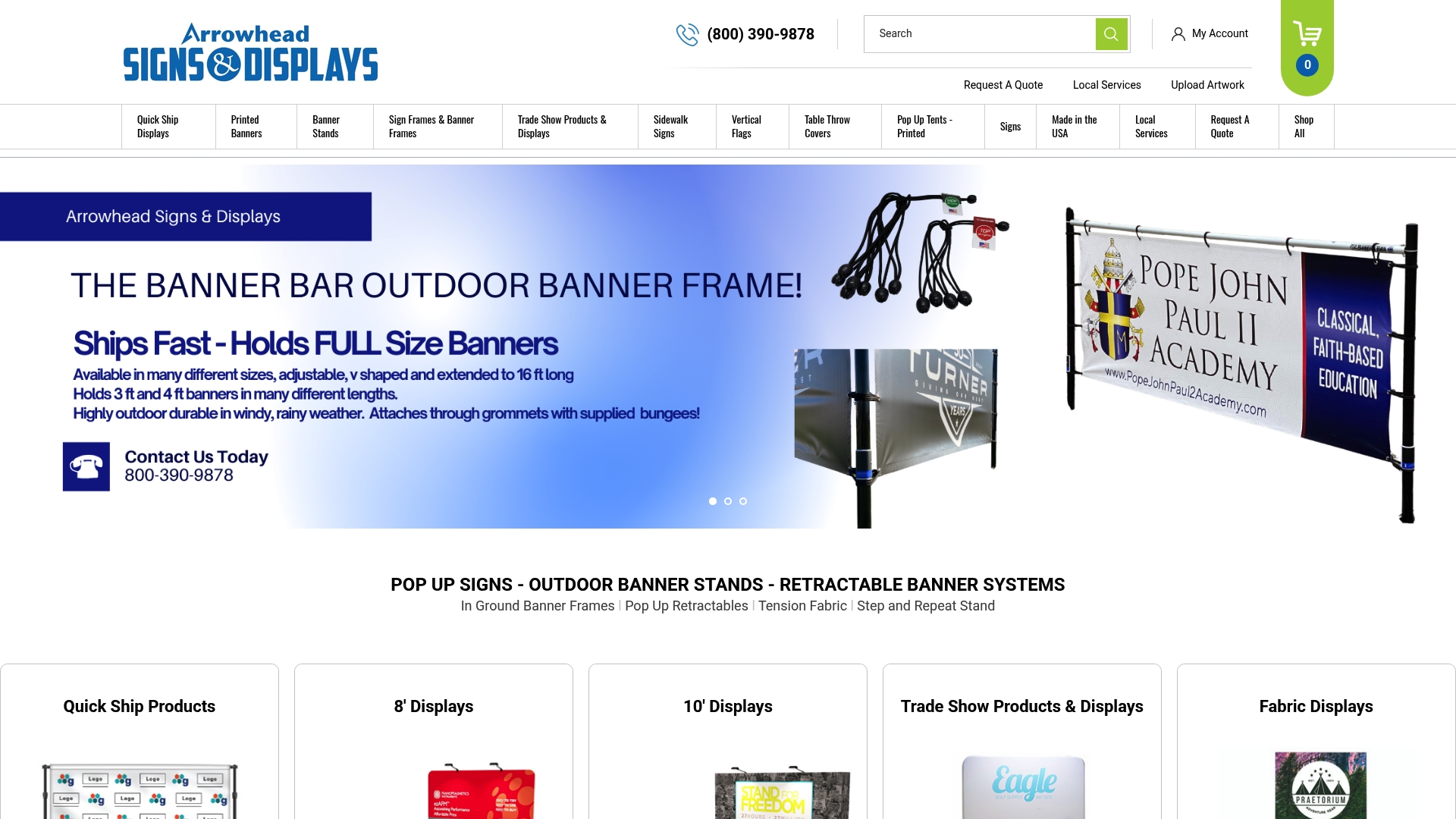
Arrowhead Sign Company - Signs, Banners and Trade Show Displays offers custom printing across retractable banners, stretch fabric displays, outdoor banner frames, and A-frame sidewalk signs, all produced with calibrated color matching and shipped within two business days for most products. Arizona clients get direct venue delivery, cutting freight risk and setup time.
Start with the product that fits your next event goal: the 10 ft stretch fabric display for photo walls and press backdrops, the Signicade Deluxe A-Frame for entrance wayfinding, or the Outdoor Banner Frame for outdoor visibility. Browse the full product range at Arrowhead Sign Company and request your proof today.
Useful sources
- Large Format Signage for Corporate Events: A Strategic Production Guide | Linemark — production lead times, tension fabric specs, and sustainability options
- Top 5 Best Ways To Improve Displays at Corporate Events | EventTechnology — technology selection and kiosk placement guidance
- Trade Show Booth Displays Guide | ExhibitionsVoice — budget ranges and buyer-journey selection framework
- Choosing the Right Visual Medium for Your Event | Go2 Productions — LED vs. projection tradeoffs and projection mapping requirements
- Ask an Event Expert: How Do I Choose the Right Display Solutions? | Encore — venue-specific display selection and professional partner guidance
- Portable Display Options for Marketing Events | Arrowhead Sign Company — portable display formats aligned to marketing goals
Recommended
- Product Signage Examples That Drive Real Engagement - Arrowhead Sign Company
- 2026 Trade Show Trend Display Ideas That Win Attention - Arrowhead Sign Company
- Visual Marketing Display Best Practices: 2026 Guide - Arrowhead Sign Company
- Pop Up Display Comparison Guide for Event Marketers - Arrowhead Sign Company