
Die Cut Signs: Benefits for Events, Booths and Brands
Posted by Deeder Dandenhorf on Nov 22nd 2026
Die Cut Signs: Benefits for Events, Booths and Brands

A die cut sign is cut along the outline of its artwork instead of a rectangle, and that single choice is why it gets noticed: in a room or along a roadside full of squares, the odd shape is the one people look at. The benefits are practical. You get more attention, a sign that carries your brand before anyone reads a word, a message that fits your event theme, and a lightweight piece that is easy to carry and set up. The catch is timing. Shaped signs only help if they arrive before your event, so plan the shape, the material and the delivery date together.
TL;DR
- A die cut sign follows the edge of your logo, mascot, product or symbol, so the sign itself becomes the graphic.
- The main benefits are attention, brand recall, theme fit at events and flexibility in where you place it.
- Material drives weight, rigidity and how long the sign lasts outdoors, so choose it by where and how long the sign will be used.
- Simple, bold outlines with generous margins print and cut cleanly. Thin spindly details break and get lost at a distance.
- Work backward from your event date, and build in time for proofing and shipping.
Table of Contents
- What a die cut sign is
- The benefits of die cut signs
- Are die cut signs more expensive?
- Choosing the material
- How to choose a shape and prepare your artwork
- Where die cut signs work best at trade shows and events
- Common mistakes to avoid
- Our perspective
- Get your booth ready on time
- FAQ
- Sources
What a die cut sign is
A standard sign is a rectangle, square or circle, and your design sits inside it. A die cut sign reverses that. The design decides the shape: a coffee cup, a house, a lightning bolt, a speech bubble, a state outline. There is no background border, so the printed artwork runs right to the edge.
You will also hear the term “contour cut” or “custom cut”. In everyday buying, people use these words for the same result: a sign shaped to its artwork. How the shape is produced (a physical steel die, or a computer-guided blade or router) can affect setup and quantity pricing, but as a buyer, the question that matters is whether the outline suits your design and your use.
Die cut signs come in many formats: yard signs, table-top signs, hanging signs, wall signs, foam-core display pieces and lightweight booth accents. If you are searching for die cut stickers or die cut boxes, those are different products. This article is about signs for your business, booth or event.
The benefits of die cut signs
1. They break the rectangle pattern
Most signs at a trade show, fair or storefront row are rectangles. Your eye learns to skip them. A shaped sign interrupts that pattern, which is the simplest reason to use one. The effect is strongest where visitors scan quickly: expo aisles, festival grounds, a parking lot, a crowded sidewalk.
The benefit is not the novelty itself. It is that the shape earns the half second of attention your message needs. The headline, offer or logo still has to do the rest, so keep the copy short and large.
2. The shape becomes part of your brand
If your logo has a distinctive silhouette, a die cut sign shows it at full strength. Brands built around a mascot, a product or an icon get the most from this: a taco shop with a taco-shaped sign, a roofer with a roofline, a dental office with a tooth. Visitors who see the shape across the room recognize you before they can read you.
Repeat the same shape across your materials and it becomes a habit for your audience. Pair a shaped counter sign with a printed table cover and a matching banner, and your booth reads as one system. For more on how visual identity and distinctive shapes help a business stand out, these visual storytelling tips for your brand are a useful starting point.
3. They fit an event theme or a place
Event planners get a particular benefit here. The Meetings Professionals International report Signs for the Times notes that die-cut signs can be shaped to reinforce an event’s theme or to bring in the local landscape. It also describes meeting professionals increasingly using signs to turn spaces into brand experiences, not just to point people to the right room.
In practice that means a desert-themed gala can use cactus and mesa silhouettes for directional and welcome signs, a sports event can use shaped arrows and balls, and a sponsor can have its mark shaped into a photo-friendly welcome piece. Directional and welcome signs that carry a theme do double duty: they guide people and decorate the space. If you are planning the wayfinding side as well, our guides on types of event directional signage and the role of signage in event flow cover where each sign should go.

4. They give sponsors something worth photographing
A shaped sign is more likely to turn up in a photo than a plain rectangle, because it looks like part of the scene. That matters when attendees post on social media. If you manage sponsors, a shaped logo piece gives them a visible, unique placement. Our guide to branded signage for sponsored events shows how to plan sponsor visibility.
5. Many are light and easy to move
Die cut signs are often made from rigid but lightweight boards and plastics, which keeps shipping, carrying and setup simple. A small team can load a shaped foam-core piece into a car, carry it across a convention hall and stand it on an easel or table without a crew. That suits small business owners who set up their own booth.
6. They work at many sizes
The same idea scales. A tabletop shape sits beside your checkout or sign-up sheet. A larger shape hangs over a booth or stands near a tent entrance. You can pick the scale that fits the space and the viewing distance, then keep the outline consistent.
Are die cut signs more expensive?
This is one of the most common questions, and the honest answer is that it depends on the design. Shaped signs involve an extra cutting step, so a simple rectangle of the same material and size is usually the lower-cost starting point. The difference is driven by a few things:
- Outline complexity. A smooth, bold silhouette is quicker to cut than one with many tight curves, narrow points and interior cutouts.
- Size and material. Larger pieces and thicker or more durable materials cost more to produce.
- Quantity. Setup effort is spread across the run, so unit cost generally falls as quantity rises.
- One side or two. Double-sided printing adds to the price but doubles the exposure.
The way to judge value is to compare against what the sign must do. If a shaped sign draws visitors to a booth you paid hundreds or thousands of dollars to occupy, the shape is a small share of the total. If you only need a plain price list, a standard sign does the job. Start with the job, then pick the shape.
Choosing the material
Material decides how heavy the sign is, how stiff it stays, and how long it lasts outdoors. Here is a plain way to think about it:
| Use | What to look for |
|---|---|
| One-day indoor event or trade show | Lightweight, flat-printing board that is easy to carry |
| Indoor display for weeks or months | A rigid board that stays flat and takes crisp printing |
| Short outdoor campaign | A weather-ready board, with stakes or a stand |
| Long outdoor use | A tougher, UV-resistant material and a protective finish |
Outdoor sun is the biggest factor in Arizona and other sunny states, so match the material to how long the sign will actually stay outside. Our guide to outdoor sign materials and how to choose what lasts walks through the options, and how long vinyl signage lasts helps if your design includes vinyl graphics. For indoor displays, foam-core signboard is a lightweight option that suits events and booths.
How to choose a shape and prepare your artwork
A good shaped sign is decided before the order. Work through these steps.
- Pick one shape that carries your message. Use your logo outline, a product, or a symbol people connect to your offer. If you cannot name the shape in a few words, it is probably too complicated.
- Simplify the outline. Bold curves and clear edges read from a distance. Very thin arms, tiny gaps and fine points are fragile and easy to chip or bend, and they disappear when viewed from across an aisle.
- Keep the text inside the safe area. Leave a comfortable margin between your words and the cut edge so nothing is clipped. Keep the copy to a headline, a short line and a way to reach you.
- Use high-resolution or vector artwork. Logos supplied as vector files print crisply at any size. Low-resolution images look soft once enlarged.
- Check contrast and colors. The sign should read against its background, whether that is a white wall, a green lawn or a dark curtain. A dark outline or a light backing can help a shape stand out.
- Think about how it stands or hangs. A shaped sign needs a stable base: a stake, an easel, a stand, a hanger or a mount. Decide this early, because it affects the shape’s weight balance.
- Proof before it prints. Look at the cut line on the proof, not just the colors. Confirm the size in inches and the orientation.
- Work back from your event date. Allow time for artwork changes, production and shipping, and add a buffer for unexpected edits.
If you are planning a larger event program and want to tie your signs to a goal, this event marketing plan for small teams shows how to connect visuals to what you want attendees to do.
Where die cut signs work best at trade shows and events
- Booth accents. A shaped piece at counter height gives visitors a reason to step in. Pair it with a banner stand or tension fabric display for the main message.
- Entrance and welcome signs. A themed shape sets the tone as soon as guests arrive.
- Directional signs. Arrows and icons in a consistent shape help people find restrooms, check-in, food and sessions.
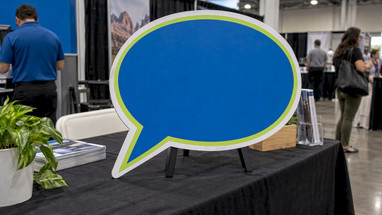
- Photo moments. Large shaped logos and speech bubbles invite pictures at sponsor areas.
- Outdoor festivals and fairs. A shaped sidewalk or yard piece stands apart from the usual rectangles.
- Retail and storefront promotions. Seasonal shapes can announce a sale, then be replaced when the promotion ends.
Keep one principle in mind: the shape gets the glance, but the message gets the visit. Use the shaped sign to attract attention, and use a clear banner, backdrop or display behind it to explain what you offer. For outdoor timing and placement, see our outdoor event signage best practices for 2026.
Common mistakes to avoid
- Choosing a shape that hides the message. If the outline leaves too little space, the text becomes tiny.
- Overcomplicating the edge. Detailed cutouts add cost and fragility.
- Forgetting the stand. A great shape that tips over does not help anyone.
- Using the wrong material outdoors. Pick a material built for the length of your campaign.
- Ordering too late. Even fast production leaves little room for corrections close to an event.
Our perspective
Most of the sign orders we see in the trade show world come down to the same three questions: Will people notice it, will it be ready in time, and will it hold up at the event? A shaped sign answers the first question well. The other two depend on how you plan.
Our approach is built around the second one. Most of our products ship within two business days, and in Arizona we can deliver directly to your venue. When your booth date is fixed, that is what keeps a good idea from turning into a missed opportunity.
Our advice: build the booth as a system. Let a bold shape or a strong custom sign draw people in, and let a banner stand, tension fabric display or printed table cover carry the details. Keep the artwork simple, keep your brand colors consistent, and order early enough to proof.
> Dan
Get your booth ready on time
Fast turnaround is part of how we work for small businesses, event planners and exhibitors. Most of our products ship within two business days, and Arizona customers can have orders delivered directly to the venue. Browse our custom signs to plan your event signage, or see our trade show products and displays for the pieces that carry your main message, including banner stands, EZ Tube tension fabric displays and quick ship displays. On printed banners, a standard banner layout is $35, and Next Day Air is available for $10.
FAQ
What is the difference between a die cut sign and a standard sign?
A standard sign is a regular shape such as a rectangle, with your design printed inside it. A die cut sign is cut along the outline of the design, so the sign’s edge is the edge of the artwork. The result is a shape that looks like your logo, product or theme rather than a block with a picture on it.
Are die cut signs good for trade shows?
Yes, as an attention-getter that supports your main display. Shaped pieces stand out in aisles of rectangles, and they are usually light enough to carry and set up yourself. Use them for booth accents, counter signs and photo moments, and put your core message on a banner stand or fabric display.
Are die cut signs more expensive than regular signs?
Usually a little more, because of the extra cutting step. Price depends mainly on size, material, how complex the outline is and how many you order. A bold, simple outline keeps cost down and reads better from a distance.
What file do I need for a shaped sign?
A vector file of your logo or artwork is best, because it stays sharp at any size and gives a clean outline. If you only have an image file, use the highest resolution you can find, and ask for a proof so you can check the edge and the text margins.
Is a die cut sign the same as a contour cut sign?
In everyday sign buying, the terms are used for the same result: a sign cut to follow the outline of its artwork. The cutting method can differ, but what you receive is a shaped sign.
Sources
- Signs for the Times, Meetings Professionals International
- Visual storytelling tips: boost your brand’s impact
- Online event marketing: a practical plan for creators